








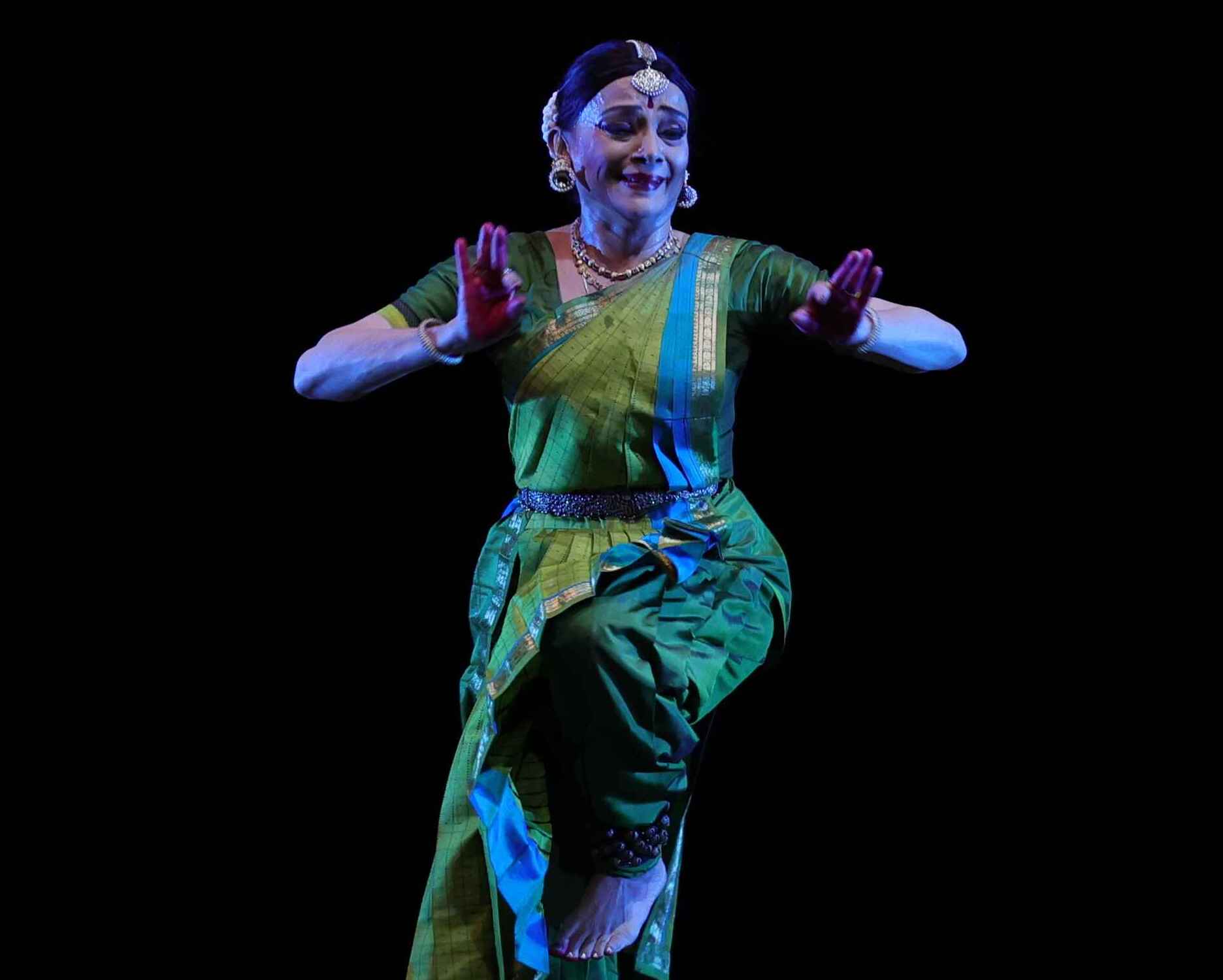
“I wanted to centre the emotions and wisdom of non-human life, using Bharatanatyam as my language of expression,” says Malavika Sarukkai. Photos courtesy of the artist
Bharatanatyam exponent Malavika Sarukkai on her new production ‘Beeja: Earth Seed,’ in which dance becomes seed, stage becomes soil, and the audience is invited into an immersive meditation on our planet in the throes of climate change
On Wednesday (September 10), the stage at Delhi’s Kamani Auditorium will become an unusual site of germination. For 75 minutes, the classical body of Bharatanatyam exponent Malavika Sarukkai will hold and release a seed — a beeja — carrying with it memory, menace, dissonance, and above all, a cry for renewal. ‘Beeja: Earth Seed’, her latest solo production presented by Kalavaahini Trust and HCL Concerts, is a call to attention. “I wanted to centre the emotions and wisdom of non-human life, using Bharatanatyam as my language of expression,” Sarukkai says with a calm urgency. It is both a declaration and an invitation: to reimagine what classical dance can do when it bends its body toward the planet.
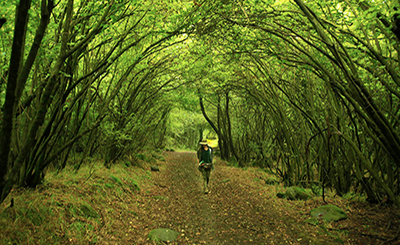
For decades, trees have threaded their way through Sarukkai’s choreography. They have stood tall in her imagination as metaphors and as teachers. “Trees have a generosity and dignity that I greatly admire and they have appeared and reappeared in several of my choreographies over the years,” she says. “They represent wisdom and generosity, a quality we humans can well learn to emulate.” The ecological thread that has worked its way into ‘Beeja: Earth Seed’ began with a moment in the hills. Sarukkai recalls: “Once, in the hills, I read a sign pinned to a magnificent tree. It read, ‘I was once a seed that held its ground.’ This saying rested as a beeja within me, lying dormant to be awakened by a response to life.”
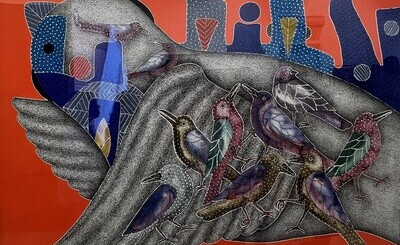
The sign stayed with her, like a poem, eventually finding its way into the dramaturgy of her performance. On stage, Sarukkai doesn’t merely show trees, deer, or swans. She becomes them. The effort is not mimicry but embodiment, a practice honed over decades of inhabiting myth, divinity, and metaphor in Bharatanatyam. “To ‘become’ a tree, swan, deer requires an awareness to permeate the body to become,” she explains. “Over decades of internalization and working on my craft, I have developed a technique of DanceSpeak that embodies the way I dance.”
Her idea of DanceSpeak is striking; it’s a personal vocabulary where Bharatanatyam’s codified gestures open into sensorial presence. The hand no longer just shows a branch; the spine feels its tensile growth, the breath carries its stillness. One of the most interesting aspects of Beeja: Earth Seed is how it marries the weight of a centuries-old form with the urgency of a climate emergency. For some, Bharatanatyam might seem too tightly structured, too historically bound to devotion, to accommodate such contemporary anxieties. Sarukkai resists this assumption with conviction: “Bharatanatyam for me is a language of dance, not only a style,” she says. “This allows for suppleness in thinking and execution as it opens up structures.” The choice of theme, however, brings with it both creative demand and ethical responsibility. “Working on a theme like Beeja: Earth Seed brings with it challenge, creative demand and responsibility. Many elements come together as an organic whole in the production, enhancing and playing off each other,” she adds.
Sarukkai is careful to position her work not as a solitary performance but as a collaboration. The show bears the signature of several creative partners. While script and narration are by Sumantra Ghosal, music has been given by Rajkumar Bharati, sound design and recording by Sai Shravanam and light design by Niranjan Gokhale. “In Beeja: Earth Seed my team and I bring together an extraordinary track of recorded music together with an ambisonics sound design, with two musicians participating in real time on stage,” she notes. The process, she says, was one of dialogue and reciprocity: “Overall my team and I worked with a sense of partnership with each other, of responding to each other as the production evolved. From the initial seed of the concept of beeja, it was important for me and my team to engage with areas of intersection.”
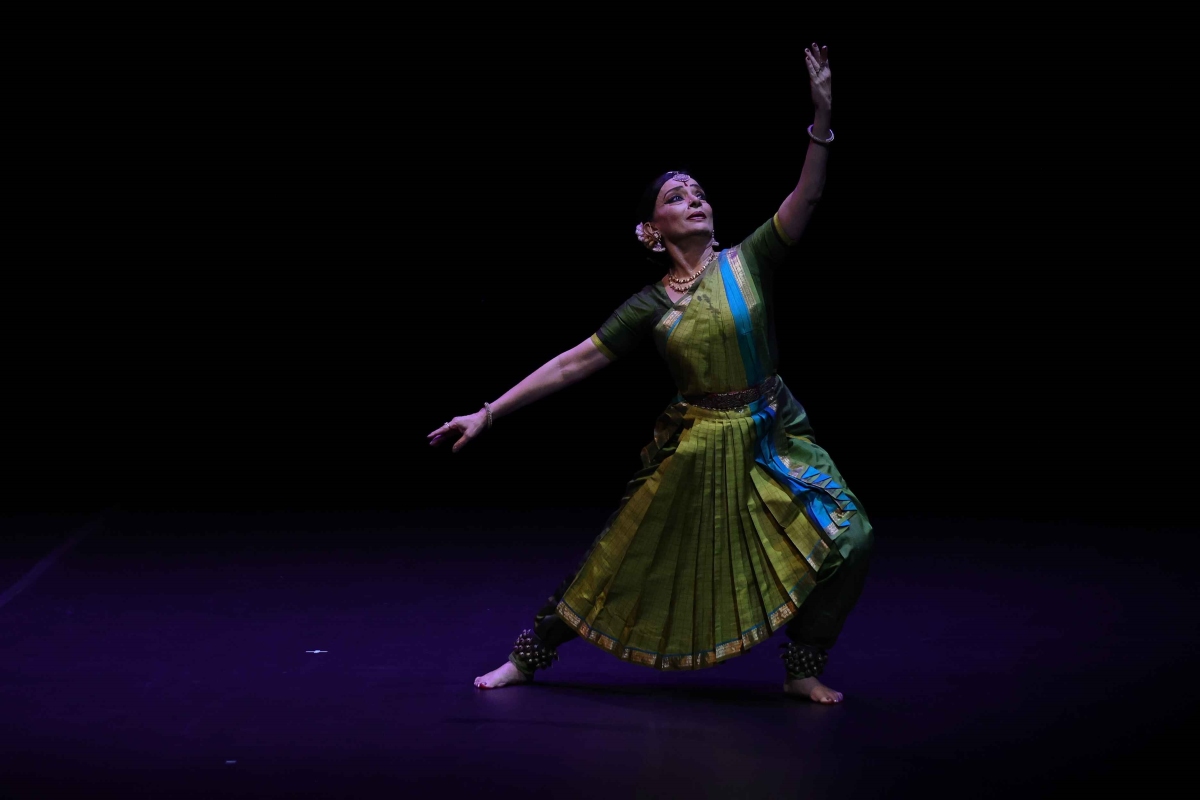
According to Malavika Sarukkai, dance is not performance alone; it is also seed, a gesture toward continuity and hope.
In particular, she recalls the wildfire sequence: “In the more contemporary section of wildfires, my dance is extempo, changing with each moment as I respond to sound design, pulsating rhythms, rising voice cries and dynamised energy on stage. All this makes the theme ‘live in real time’.” For the audience, the promise is immersion. “Viewing Beeja: Earth Seed, the audience will be in for an immersive experience. High production values with creative artistry will bring the story alive. In addition, the production is created with an ambisonics sound design providing a rich audio experience like never before.”
The title itself is expansive. A seed, after all, is not just a speck of possibility but an entire future in miniature. “When I think of Beeja, many associated words arise — prithvi, potential, bindu, nurture, truth, energy, protect, grateful, little, life force,” she reflects. In her formulation, dance is not performance alone; it is also seed, a gesture toward continuity and hope.
Traditional Bharatanatyam often draws on stories of gods, goddesses, and epics retold across generations. For Sarukkai, this repertoire is to be engaged with responsibly. “The retelling of myths is a part of our cultural heritage, our racial memory. I believe it will continue to be a part of the Bharatanatyam repertoire with multiple interpretations,” she says. “However, our responsibility as artists is to bring them alive with storytelling keeping in mind their cultural ethos. But the thirst to be ‘different’ should not warp the myth out of context.”
Her own practice shows that Bharatanatyam remains malleable. “Personally for me, Bharatanatyam is a language of dance I greatly respect and live in wonderment of each day. Hence, my dance interpretations are anchored in the foundation of tradition. But as an artist living in the here and now, my dance language has evolved a technique of DanceSpeak, a language of movement vocabulary that is tethered by tradition but finds the freedom to explore,” she says
This dual anchoring — in tradition and in contemporary urgency — is perhaps what makes Beeja: Earth Seed distinctive. “The collaborators have endeavoured to bring together classicism with its rich heritage in dance interpretation, Bharatanatyam movements, natyadharmi (stylised mode of storytelling), classical music compositions, play of rhythms together with a contemporary sound design requiring a unique range of movement vocabulary, stitched together with poetry and text in English,” she says.
The work, then, is neither pure tradition nor sheer innovation, but something that “traces a wide arc of storytelling in the solo format,” as she puts it. The American naturalist John Muir once wrote, “When a man plants a tree, he plants himself.” Sarukkai, by planting Beeja in the fertile ground of Bharatanatyam, is planting a question: what will we choose to nurture, and what will we allow to perish? Her body, trained in centuries of grammar yet alive to the crises of today, offers presence, a chance to breathe with a tree, to tremble with a deer, to glide with a swan. In that sense, Beeja: Earth Seed is a rehearsal for empathy, for re-seeding our relationship with the Earth itself.
More from Arts
Comments
*Comments will be moderated