








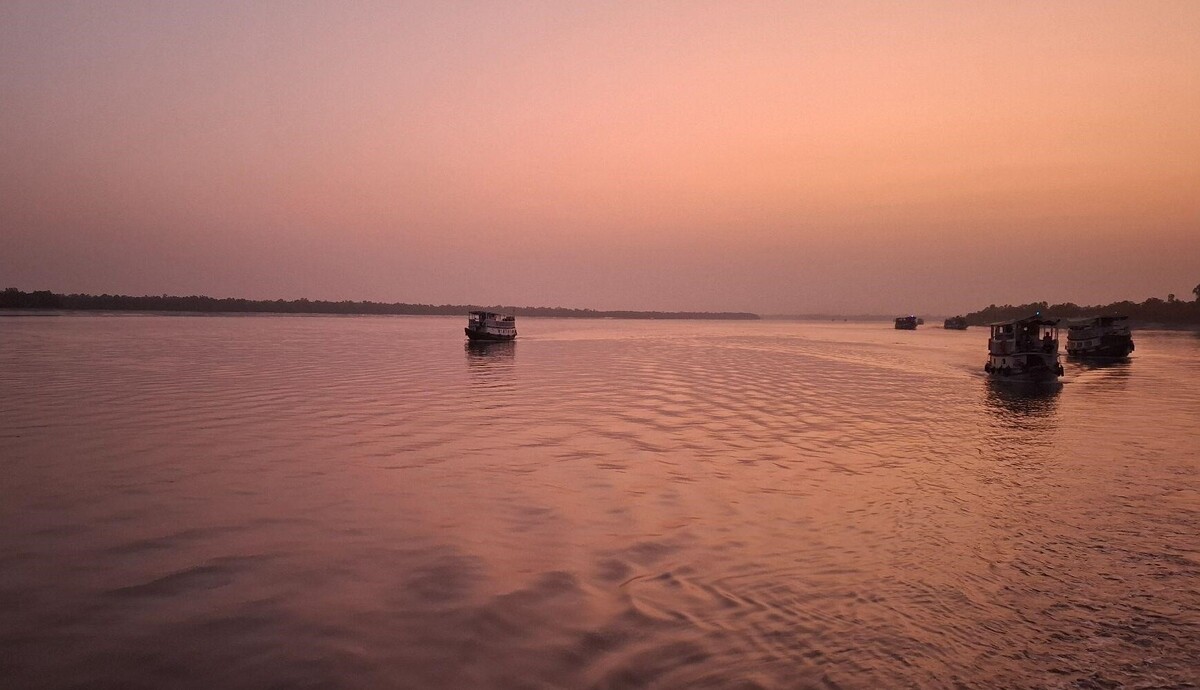

For a lifelong opacarophile who thought she’d seen every hue the sky could offer — from Kanyakumari’s tri-sea shimmer to Darjeeling’s misted dawns — the Sundarbans was a revelation. In the world’s largest mangrove delta, where land dissolves into water and light melts into silence, she discovered that the sunset of a million hues
I have never been one for waking up early to catch a sunrise. When working days are spent rising before dawn just to add a couple of extra hours to an already packed schedule, a sunrise doesn’t hold much appeal. I’ve been guilty of missing famed ones, from Darjeeling’s Tiger Hill to Kanyakumari’s meeting of three seas. However, I’ve learnt to make up for it by chasing sunsets. In all my travels, I’ve never been guilty of missing a good one. I think I’ve been called an opacarophile for good reason. I thought I had seen them all, until I went to the Sundarbans. Nothing had prepared me for the beauty I was about to experience there.
Not visiting the mangrove forests of the Ganga delta after living in Kolkata for decades usually raises a few eyebrows. The Sundarbans has several claims to fame — it is not only the world’s largest mangrove forest and a UNESCO World Heritage Site, but also the home of the Royal Bengal Tiger, India’s national animal. It attracts wildlife enthusiasts eager to catch a glimpse of the elusive big cat. It is equally famous, however, for stories of disappointed tourists who return from the Sundarbans “in vain.” But nothing here is ever in vain — nature overcompensates tired eyes for the tiger’s absence. It’s a pity that there are more people who lament not seeing a tiger than those who praise the raw wilderness of the delta.
Tired of dealing with raised eyebrows, we eventually decided to visit the delta. Winter 2024 was the year we packed our bags for a short weekend trip that began with a bus ride to the ferry point at Garkhali. Beyond this point, there are no roads — the Sundarbans, being a vast network of waterways, can only be reached by boat. It was a promising start. The absence of roads was new to me. Being firmly urban, I couldn’t quite wrap my head around the expanse of water that snaked into narrow ‘alleyways’ and broadened into wide, open ‘highways.’ The greenery on either bank of the river system was of incomparable beauty.
As our boat meandered through the waterways that grew narrower with every twist and turn, we noticed it became progressively quieter as well. By the time we had left the populated islands and their busyness behind, all we could hear were birds and the gentle lapping of water, occasionally broken by the laughter of other passengers on board. Sometimes, we caught sight of a crocodile sunning itself on the muddy banks. On either side of the river stood dense forests bordered with barbed wire — green, but not in the way of mountains and meadows. This was wild, dangerous, and alluring.
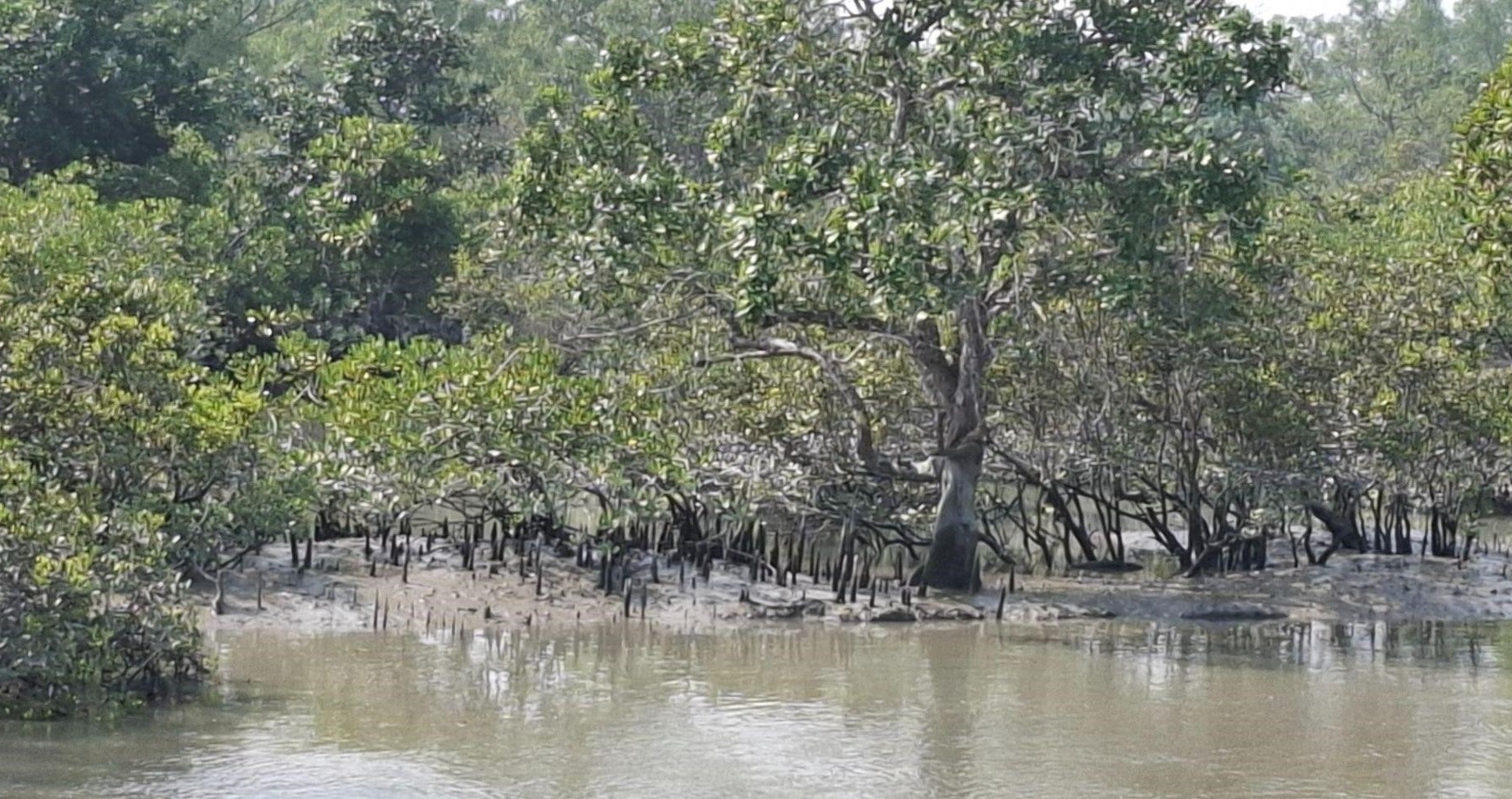
The Forest as seen from the boat at low tide
The forest lacked the curated elegance of pine woods and their crisp, chilly air; instead, it possessed the untamed, luxuriant foliage of tropical wetlands — swampy, humid, and dim. “Is this my journey into my very own heart of darkness?” I remember thinking. I noticed that the vegetation bore a clear line marking the water level at high tide — nature’s own calibration. Here, islands and forests appeared and disappeared as surely as night and day, rising and sinking with the rhythm of the tides.
I was under the spell of the forest, but I didn’t know then that the best was yet to come. The sunset over the Sundarban delta would be a treat to any opacarophile’s eyes. We had sailed all day and finally reached the estuary. The river had widened, and at that point it resembled a sea more than a river. It was time to turn around and head back. Dusk was falling. The sun hung low on the horizon, and the sky was no longer blue. It was slowly transforming into every shade of pink and orange. There was nothing to hinder the view for miles — just a vast expanse of water bordered by green that was gradually deepening into black. The sky wasn’t dressed in these colours alone; they were reflected in the water as well. Wherever the eye turned, beauty surrounded us. It was impossible to look away from that pink, glowing sky.
I clicked photographs as best I could, hoping not to lose the sight or the memory of that spectacular vision. Being an untrained and inexperienced photographer armed only with a mobile phone camera felt like a curse at that moment. I was desperate to preserve the beauty of the sunset. As our boat sped back toward its starting point, the sky grew darker and darker until it was enveloped in the purple hues of night. It felt as though the Painter, unhappy with His masterpiece of dusk, had overturned a bottle of ink across the canvas, erasing in an instant the magical, myriad hues. The water, too, turned dark. Electric lights began to flicker to life one by one in the distance. The uninhabited islands lay in darkness, while the ones with villages sparkled like stars in the night sky. It was finally evening in the Sundarbans.
My eyes had feasted by the time I disembarked at the jetty. By then, the villagers had ended their day and returned home. The only sound was the steady chorus of crickets. The impenetrable wildness of the forest, the tide marks on the vegetation, the fauna, the river — and above all, that sunset — had captivated me. I knew then that I would come back.
There are some places that have a hold on you. They call you back again and again. The reasons may differ for everyone: the mangrove’s nearness to the city, the delicious local fare served on the boats, or the hope of spotting a tiger. But for this opacarophile, the reason will always be that sunset of a million hues.
More from The Byword




Comments
*Comments will be moderated