








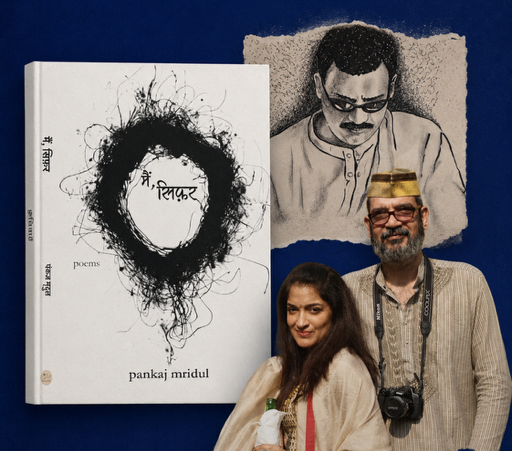
Published by Sandhya Mridul in memory of her brother Pankaj, Main Sifar is a tender but unsentimental collection of poems that speaks of love, God, loneliness and the self with rare directness.
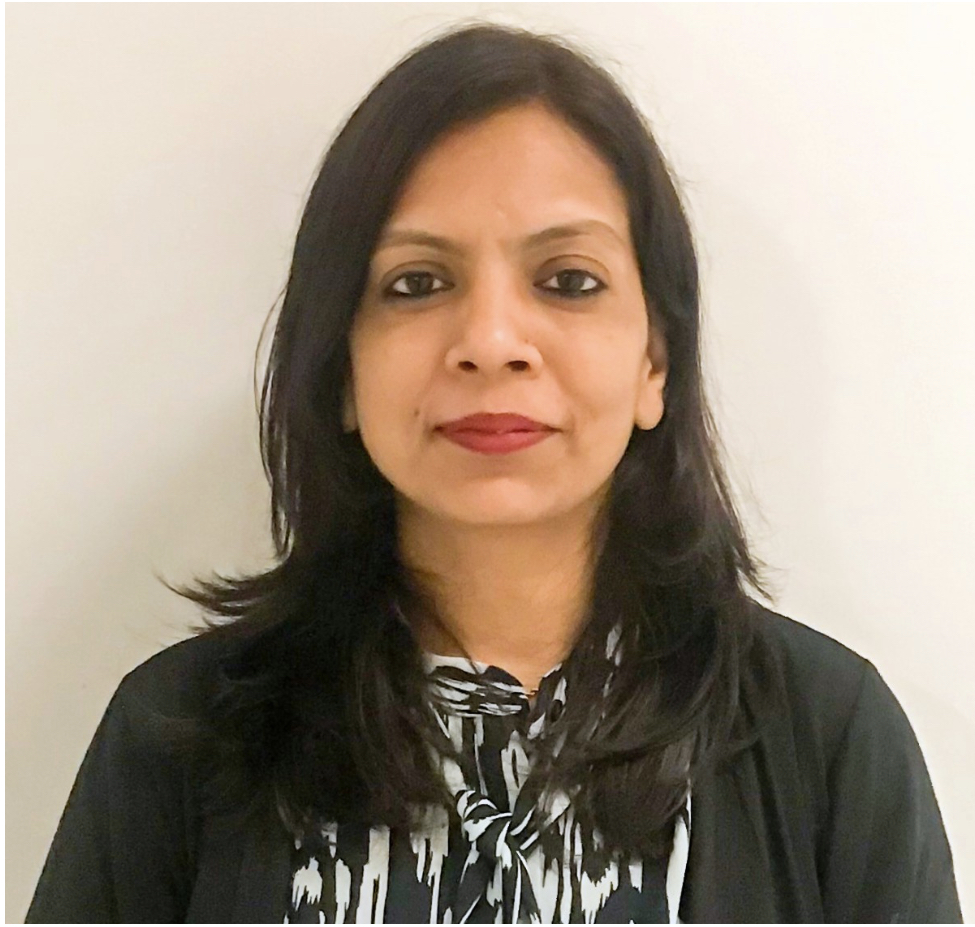
In Main, Sifar, Sandhya Mridul gathers the Hindi and English poems of her late brother Pankaj Mridul, a private, searching voice that turns hurt, doubt and silence into spare, unsettling verse.
Main, Sifar, the late Pankaj Mridul’s bilingual collection of poems in Hindi and English, comes with a difficult question inherent in it: how does one bring a private person into print without making him public in the wrong way? Actor-poet Sandhya Mridul, who has published the book in memory of her brother, answers this in the Foreword with unusual care. “This book is not an explanation of my brother,” she writes. “It is an offering.” The sentence is simple, but it gives the reader the right instruction: to read him.
Main, Sifar is a posthumous gathering of more than 150 poems by a man who wrote across languages and registers, sometimes in English, sometimes in Hindi, sometimes with the emotional residue of Urdu. The book note describes Pankaj as a poet of quiet intensity and rare sensitivity, someone who did not turn away from pain, doubt or solitude. That is an accurate way to enter the work.
Sandhya writes of her brother as “a deeply private man, especially about the inner landscape from which these poems came.” She says she has tried to honour that privacy “at every step of bringing this book into the world.” Most importantly, she adds: “The journey contained here is his not mine to interpret, embellish or speak over.” It is the right editorial stance for such a book. She is close enough to know the man, but careful enough not to replace his voice with her memory of him.
The public Pankaj, as she sketches him, seems to have been vivid, social, funny, able to command affection without making a show of depth. “To most people, he was many things,” she writes. “A formidable worker. A generous colleague. A great boss. A sharp, funny presence in a room.” He loved “his single malt, his food,” and seemed to know “every hidden food stall in every city.” He knew his “world music,” his “facts,” his “people.” He appeared “endlessly curious about life.” But then Sandhya makes the turn that explains why these poems matter: “But this book holds something far less visible. It holds his heart.”
That heart, in the poems, is watchful, bruised, ironic, impatient with false comfort. On the cover or introductory page, Sifar writes: “what can one say about a man / who lies to his diary?” The line is nearly comic until it is not. A diary is supposed to be the place where pretence ends. If a man lies even there, then the self is not merely hidden from others; it is hidden from itself. A few lines later, he writes: “They say, I can talk; but, / who can hear what I do not say?” That question is among the keys to the book. The problem is not the speech per se but what it cannot carry.
In poem after poem, Pankaj writes from that gap between what is said and what remains unsaid. His poems move between melancholy and reflection, but they are rarely loose or indulgent. The speaker often sounds like someone who has been disappointed enough to stop being polite with illusion. In “I Found,” he begins with a bitterly controlled line: “Look how i have been rewarded for my patience.” The next line tells us what that reward is: “The kiss on the lips received, was laced with poison.” Love, instead of being presented as a lyrical shelter, is an event one survives and remembers with suspicion.
The poem continues: “The wine last night did not have potency, friends / My senses - lost in the evening - at dawn i found.” There is an old mehfil echo in these lines (wine, friends, dawn, lost senses) but the feeling is not borrowed. It is the morning after all escapes fail. Even intoxication has not done its work. The mind comes back. So does pain.
The same poem turns towards God with a bluntness that gives it force: “Was it a game, or was it cruelty that He made the world?” The next line is even better: “Of God i shall certainly ask, if Him ever i found.” The syntax may be slightly unusual, but the thought lands. God, if encountered, will not be praised first. He will be questioned.
The title Main, Sifar becomes clearer in the closing movement of this poem. After searching everywhere, the speaker says: “High and low did i look for him, but in the end / It was in the mirror that Sifar i found.” In the Hindi version, the line has a cleaner ache: “Kahan kahan nahin talasha hamne use magar, / Aakhirkar aayine mein hamien sifar mila.” The search for the other ends at the mirror, but the mirror does not return a grand revelation, but “sifar” or zero. The word is not used here as a clever pen name alone. It is an argument about the self. To become zero is to be denuded of pose, claim, vanity, perhaps even defence.
One of the strongest poems in the selection is “Words Of Silence,” where this idea of “sifar” moves beyond self-negation. “the poet am i, and his words, too / the song am i, the tune, too, i am,” he writes. The poem is built on pairings: “the thorn am i, and the flower, too,” “the river am i, its flow, too, i am,” “victory am i, and defeat, too.” This could easily have become grandiose, but it does not, because the poem’s movement is not boastful. It is a way of saying that the self contains its opposites. The speaker is “the dawn” and “the sunset,” “the beginning” and “the end,” “the dark night” and “the light of the world.” The final lines are plain and memorable: “how shall anyone, separate me from me? / every thing am i, and nothing, too, i am.”
That “nothing” is the centre of the book. Pankaj’s poems are not simply sad. They are interested in what remains when ordinary forms of identity fall away. A man can be boss, colleague, brother, wit, drinker, lover of food, keeper of facts, talker in rooms. But what remains when the room is gone? What remains when speech stops performing? These poems suggest an answer without spelling it out: what remains is the unsentimental self, reduced to zero and therefore difficult to falsify.
The Hindi poem “Zaroor Hogi” gives the collection another register. Here Pankaj places himself in relation to Kabir, Bulleh Shah, Rumi, Ghalib, Mir, Faiz and Dard. The gesture could have been inflated; instead, it is modest. “Gar na pahuncha bhi tere muqaam tak Kabeer, / Magar dekhna, us rahguzar par meri khaak zaroor hogi.” Even if he does not reach Kabir’s station, his dust will be on that road. To Bulleh, he says that even if he cannot embrace him, “Teri mazaar gird meri raakh zaroor hogi.” The poem, far from claiming greatness, is eyeing kinship through longing.
The last couplet is especially revealing: “Ghalib-o-Meer-o-Faiz-o-Dard Shajar-e-sukhan hain yeh sab, / Sifar ke naam ki bhi kahin ek shaakh zaroor hogi.” Ghalib, Mir, Faiz and Dard are trees of verse; somewhere there will be a branch in Sifar’s name too. That image works because it asks for little. Sifar is not craving for a monument or a throne, but merely a branch.
Sandhya writes that language was never the main concern with his poetry: “The poem itself chose its language… English, Hindi, sometimes Urdu… effortlessly. His poetry was his language.” The book proves this. The English poems are direct, sometimes raw, sometimes aphoristic. The Hindi poems carry cadence and inheritance. The Urdu-inflected vocabulary gives some lines their ache and polish. The movement between languages does not feel like an experiment. It feels like a man allowing a feeling to choose its own tongue.
As a collection, Main Sifar may not always have the finish of a book planned over years for publication. But that is not its weakness. It has the uneven but living texture of private writing brought into the open with care. Some poems are closer to notes, some to ghazals, some to meditations, some to confession. What binds them is a mind unwilling to accept any easy answers.
More from The Byword



Comments
*Comments will be moderated