








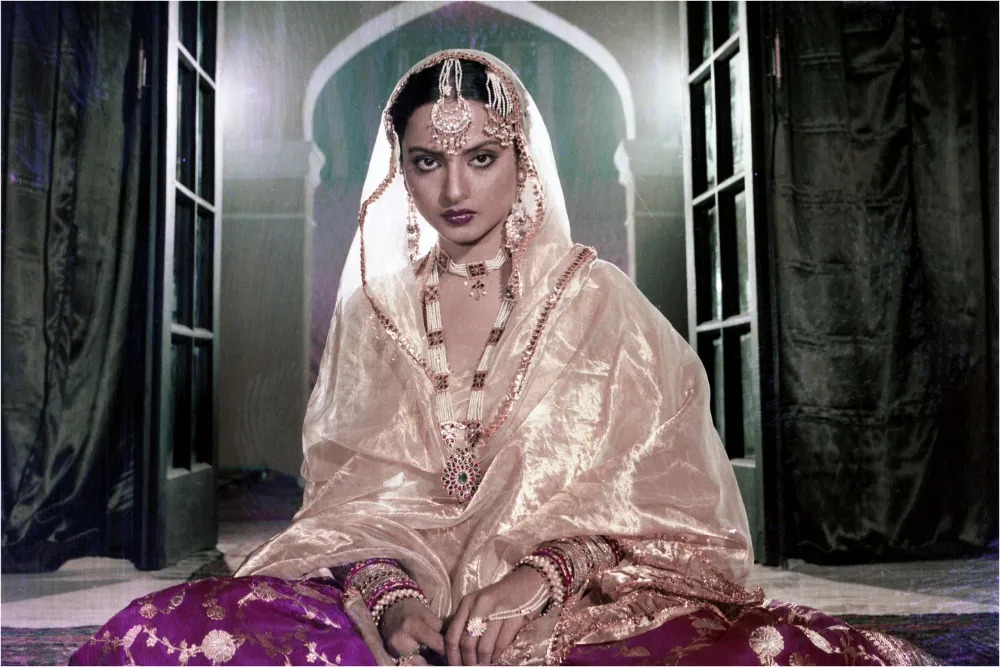

Muzaffar Ali’s 1981 masterpiece, now restored in 4K, is not just a story of Umrao’s life but a slow-burning meditation on beauty, exile, and the irrevocable loss of belonging; Rekha, Khayyam, Shahryar, and Asha Bhosle conjure a world on the verge of vanishing
Muzaffar Ali’s 1981 film Umrao Jaan, which re-released in theatres on June 27 in a 4K restoration, is adapted from Mirza Hadi Ruswa’s late 19th-century novel Umrao Jaan Ada. The film is set in mid-1800s Lucknow, in the final flicker of the Nawabi era, a time of crumbling opulence, dying etiquette, and the fading aroma of a refined culture soon to be overrun by British modernity and masculine nationalism.
Amiran, a young girl abducted from her home in Faizabad and sold to a Lucknow kotha, grows up to become the legendary courtesan and poet Umrao Jaan (Rekha). She dances, writes, seduces, loves, and is ultimately left to survive with nothing but her verse. However, to reduce the film to that arc is to miss its entire method. This is not a bildungsroman. It’s an extended lament. Ali’s gaze is steadier, more fatalistic. He makes a film that moves like grief.
Umrao Jaan is a portrait of suspended melancholy, of beauty in captivity. What Ali offers is neither revisionist feminism nor romantic glorification. Instead, Umrao Jaan becomes an elegy: to a culture, to a woman, and to the idea of belonging itself. His directorial approach is radically restrained.
To say that Rekha is the soul of Umrao Jaan would be accurate but inadequate. She inhabits the role through her body, her gaze, her restraint. It is one of those rare performances that does not rely on dialogue or narrative momentum but lives entirely in the spaces between words, in the flicker of an eyelid, the elongation of a pause, the turn of a wrist as she breaks into a ghazal.
Unlike the brash heroines of early 1980s Bollywood who signalled pain through excess — tears, gestures, background strings — Rekha offers minimalism. Her suffering is decorous. Her desire, internalised. Her dignity, weaponised. There are moments in Umrao Jaan that feel constructed entirely to showcase Rekha’s ability to hold attention in stillness.
The camera lingers on her face longer than seems necessary, but you never want to look away. Her Umrao is always both present and elsewhere, performing even as she withholds some part of herself — some memory, some regret, some warning. Her beauty is never plastic; it’s weighted with memory. Rekha’s voice — often dubbed in other films — is fully her own here, and it adds layers. There’s a measured cadence to how she delivers even the simplest of lines. Her vocal delivery mirrors the film’s architecture: composed, stately, withheld.
For most of the film, Rekha is framed alone — in corridors, on stages, in windows. Her relationships, whether with Nawab Sultan (Farooq Shaikh) or Faiz Ali (Raj Babbar), are significant but not defining. The love stories are secondary. What matters is her solitude: how she bears it, performs it, survives it.
Khayyam’s compositions, Shahryar’s poetry, and Asha Bhosle’s voice made the film what it became. Without them, the walls would collapse. It is through them that the mood, the character, the entire inner life of Umrao Jaan is articulated. Each song is a ghazal in the classical sense: not a pause from the plot, but a philosophical intervention: “Dil cheez kya hai,” “In aankhon ki masti,” “Yeh kya jagah hai doston,” “Justuju jiski thi”. They are self-contained emotional architectures, each rooted in longing, irony, or heartbreak. Shahryar’s writing is erudite and deeply felt. The ghazals remain committed to the form: layered, restrained, and unashamedly literary.
It is, however, in the performance of these ghazals that the film becomes immortal. Asha Bhosle, whose range had long included everything from filmi pep to cabaret to classical renditions, here performs with an unfamiliar restraint. There is none of the flirtatious lilt of Piya Tu Ab To Aaja, none of the playfulness of Jhumka Gira Re. Her voice here is velvet made human. You can hear the breath between lines. You can sense the emotional caution in each word. And in pairing her with Rekha, Khayyam achieves something almost metaphysical: two artists merging into one voice, one persona, one wound.
Khayyam’s instrumentation is minimal. Harmonium, tabla, sarangi, occasional strings — every element is placed with care. There’s no sonic clutter. Every note is given space to bloom, to dissolve. It’s an antidote to the excesses of Bollywood musicals both before and after it. Umrao Jaan sounds like it was recorded in candlelight.
This auditory architecture is complemented, almost miraculously, by the visual grammar of the film. Pravin Bhatt’s cinematography is painterly. Each frame looks like it has been brushed rather than shot. Warm tones, deep shadows, the muted gold of dusk-lit courtyards — this is a world lit by oil lamps. The camera rarely intrudes. It drifts, floats, or sometimes just watches. It is not a participant but a chronicler. The lens feels like it belongs to a historian with a poet’s soul.
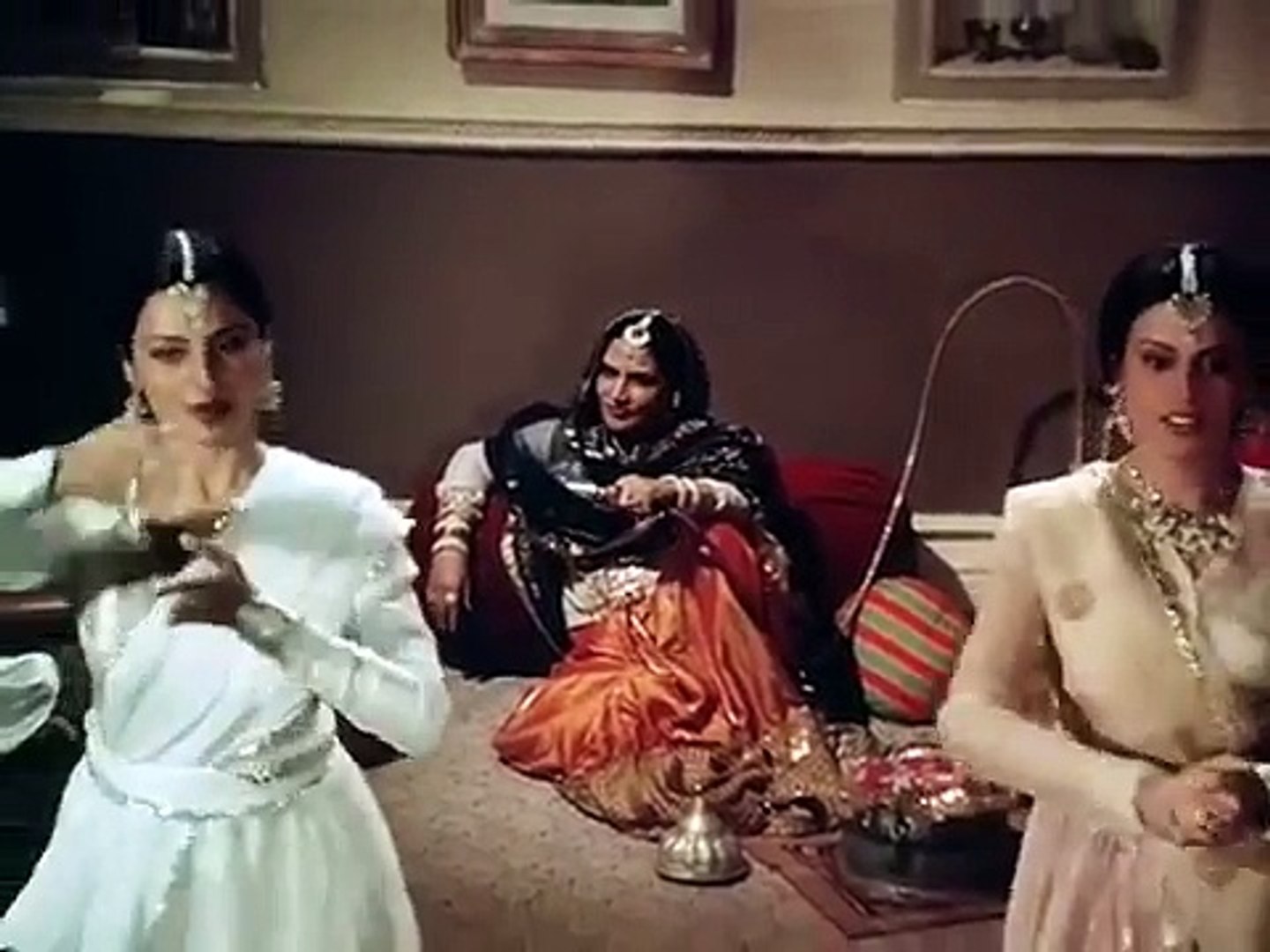
Pravin Bhatt’s cinematography is painterly. Each frame looks like it has been brushed rather than shot.
Costume and set design too seem to be textual. Rekha’s anarkalis, her trailing dupattas, the antique jewellery are signifiers of a woman permanently in performance, costumed even in solitude. The brothel itself, where most of the film unfolds is like a prison with chandeliers. Each room tells a story. Each arch, a pause. Bansi Chandragupta’s art direction understands the tone of the film really well.
Nothing in Umrao Jaan is pristine. Everything — the people, the city, the culture — is in slow decline. The mutiny looms like a metaphor. And through it all, the music never lifts us out of that sadness. It draws us deeper in. Which is to say: Umrao Jaan is a film in which form is content. You do not remember it for a twist in plot. You remember how a line of poetry landed. You remember how Rekha moved her hand as the tabla sighed. You remember how Asha sang “yeh kya jagah hai doston,” and for a second, the entire illusion of belonging shattered.
Umrao, like all courtesans, is trained to be palatable to power. Her life is curated: her poetry, her movement, her manners. She is both commodity and connoisseur. But the tragedy of her existence is not in her sale, but in her impossibility of belonging. She is admired, even revered, but never accepted. Not by the nawab who claims to love her, not by her biological family who cast her out, and not by the culture that consumes her songs while scorning her presence. She exists in a gilded borderland, neither respectable nor reviled, not free, not imprisoned. And it is precisely this ambiguity that makes Umrao Jaan such a vital feminist text.
What Ali does with staggering insight is avoid the trap of glorification. He does not romanticise the kotha, nor does he reduce it to a brothel. He presents it as a complex institution: a space of female agency and exploitation, of beauty and burden. The courtesan in this world is not a prop for male fantasy — she is the cultural memory-keeper. She recites Ghalib and writes original ghazals. She interprets ragas and refines etiquette. The men come and go — clumsy, guilty, distracted — but it is the women who become the repository of taste, art, and language.
But that cultural authority doesn’t translate to personal freedom. When Umrao finally attempts to return to her hometown, hopeful of redemption, she is met with the most banal cruelty: disownment. The doors that once opened with lullabies now slam shut with shame. It is one of the most shattering moments in the film.
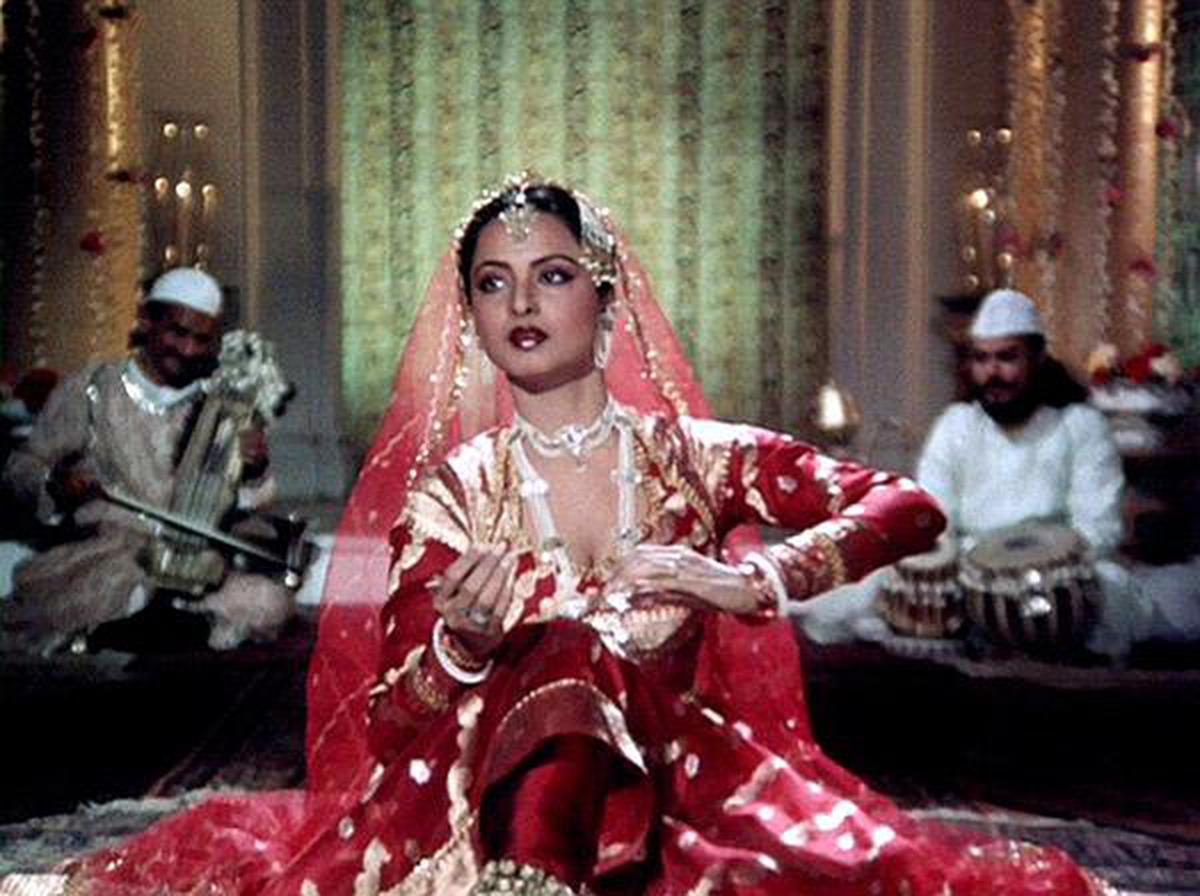
Umrao Jaan remains a singular achievement in Indian cinema.
More than forty years after its release, Umrao Jaan remains a singular achievement in Indian cinema. It has not been bettered, and every attempt to reproduce it — most infamously J.P. Dutta’s garish 2006 remake, starring Aishwarya Rai Bachchan and Abhishek Bachchan —has only deepened its mystique. What made the original so impossible to replicate was not its period setting or its musical score, but its atmosphere. Ali wasn’t interested in making a hit. He was trying to capture something that was already disappearing — an aesthetic, a worldview, a vocabulary of feeling that had no place in the fast, synthetic cinema of the 1980s and beyond.
The film initially didn’t do well at the box office. It grew, slowly, through word of mouth, critical writing, and, most of all, through its music. Over the years, Dil cheez kya hai and In aankhon ki masti ke have been played at concerts, weddings, nostalgia nights, remix albums. For Rekha, the film became not just a landmark but a defining myth. It’s common to hear people say that she was “born” to play Umrao, but that simplifies a far more intelligent process.
What she achieved was not destiny but craft. She studied the courtesan’s gait, immersed herself in Urdu, shadowed classical dancers, and internalised the etiquette of Lucknow’s dying tehzeeb. Her portrayal is so seamless that it can be difficult to tell where the actress ends and the character begins. But perhaps the truth is more haunting: that Umrao was always inside Rekha, and this film simply gave her the vocabulary to articulate it.
Muzaffar Ali, a director of uncommon sensitivity, would never again make a film like this. His other works—Gaman, Anjuman, Jaanisaar — carry glimmers of his style, but Umrao Jaan stands apart, unrepeatable. Perhaps because it arrived at a confluence of serendipitous factors: a literary source with emotional depth, a director with painterly instincts, a performer at the peak of her powers, and a music team that treated the score in the way only they could.
The film is not without limitations. Its pacing is deliberate to the point of inertia at times. For today’s viewers accustomed to pacy stuff, Umrao Jaan can feel static. One could argue that it romanticises an institution — the kotha — that was, historically, as exploitative as it was artistic. But these are minor abrasions on an otherwise seamless weave. The film’s greatness lies in its refusal to compromise. It’s one of the rare Indian films that trusts slowness, trusts poetry, trusts the unsaid.
When Umrao sings “Yeh kya jagah hai doston” to an indifferent gathering, she seems to be speaking not just to the characters in the frame, but to us. The camera lingers on her, exhausted, incandescent, spectral. She is not asking a question; she is making a statement about the futility of seeking refuge in a world that is hell bent on forgetting. And yet, the film itself becomes the refuge she is denied. In preserving her story, Ali rescues her from oblivion.
More from Culture





Comments
*Comments will be moderated