








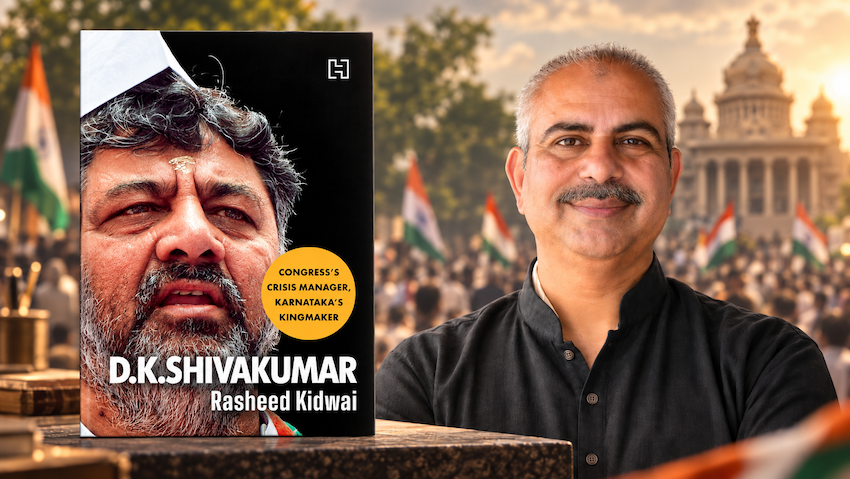
In his new book on D.K. Shivakumar, Rasheed Kidwai looks at the Karnataka leader’s long political journey, his organisational skills, his place in the Congress and the politics that brought him to the chief minister’s chair.
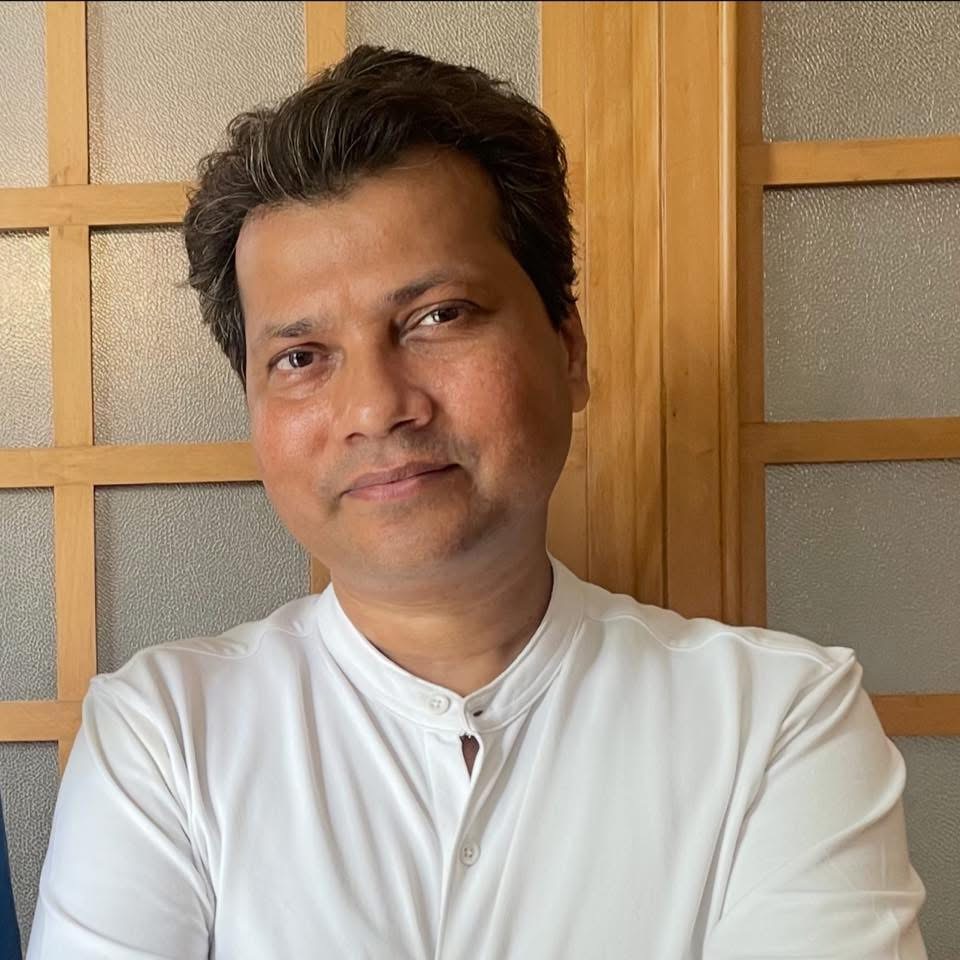
In his new biography, D.K. Shivakumar: Congress’s Crisis Manager, Karnataka’s Kingmaker, veteran journalist and political analyst Rasheed Kidwai looks at the making of one of the Congress’s most important leaders. In this interview, he speaks about why Shivakumar interested him, the difficulties of writing about living politicians, caste and Congress politics in Karnataka, the weakening of the high-command culture, Bengaluru, the party’s problems on the ground and why Shivakumar could have a larger national role
Senior journalist and political analyst Rasheed Kidwai had been thinking about D.K. Shivakumar much before Shivakumar finally became Chief Minister of Karnataka in June this year. By the time Kidwai’s book, D.K. Shivakumar: Congress’s Crisis Manager, Karnataka’s Kingmaker, which marks the beginning of a series of political biographies, was published by Hachette India in July, its central character had moved into an even larger political role.
For Kidwai, though, the reason for writing about Shivakumar was never simply that he was moving closer to the chief minister’s chair. It was about what he represented in Congress: a politician called upon when the party finds itself in trouble. “I think in politics, viability is a very important criterion,” Kidwai says when I ask why he chose Shivakumar.
Kidwai has covered the Congress for decades. He spent 25 years with The Telegraph and has written 13 books. His first major political biography was on Sonia Gandhi. 24 Akbar Road, Neta Abhineta and Ballot are among his other books. Writing about politicians, he says, comes from a fairly simple belief that voters should know more about the people they are voting for.
“Books are not written from a politician’s point of view, but from a reader’s point of view,” he says. “When we go to buy any consumer durable, whether it is a car or a refrigerator or anything, we do some market research. We want to know everything about it. But when it comes to politicians, whom we elect for five years, somehow we don’t do that kind of homework.”
That gap, for him, is reason enough to write political biographies. There was another reason too. Kidwai felt there was a considerable gap in the way politicians from southern India were understood in the north. “There is a bit of a north-south divide,” he says. “A lot of people in the north do not know enough about politicians from the south.”
This is striking, he feels, because the Congress has historically had very deep roots in southern India. When the party was wiped out across large parts of northern India after the Emergency in 1977, southern states gave it political breathing room. Indira Gandhi returned to Parliament through Chikmagalur in Karnataka in 1978. Sonia Gandhi, too, contested from Bellary in 1999, alongside Amethi. Kidwai sees a larger cultural and political difference here as well.
“In the south, basically, people are very religious, but they are not communal in that sense,” he says, making it clear that he sees religion and communal politics as two different things. Language, culture, education and regional histories, he argues, have shaped politics very differently across the southern states. Shivakumar therefore gave him a way of looking not only at one politician but also at Congress politics in a state that could become increasingly important to the party.
Writing about a living politician, however, brings its own problems. Kidwai knows that from experience. The story keeps changing even while you are writing it. A politician moves from one position to another. Alliances shift. Cases move through courts. People who speak glowingly about someone today may fall out with them tomorrow. Those who dislike the politician may have their own reasons for doing so. “You are writing about a person who is active,” he says. “So the narrative keeps changing.” Access is another problem. So is privacy. So is reliable data.
People around powerful politicians tend to fall into camps, he says. Supporters want a flattering book. Critics want the writer to confirm what they already believe. The politician himself may expect something close to a hagiography. “Politicians are very thin-skinned,” Kidwai says. “They want everything to be positive. And then there are critics who will say, ‘Why have you not written this?’ So it is a kind of double whammy.” There are bound to be shortcomings in any biography of a living politician, he says, because the full story is simply not available yet.
Also read: Tabish Khair on Drown All the Refugees and why ‘home is always in a relationship to leaving it’
India also does not have the institutional support for political biography that exists in many western countries, he argues. Archives are difficult to access, political papers are rarely organised for researchers, institutions are cautious about permissions and there is little serious funding for the kind of long-term research a political biography requires. “There is not much money in writing books,” he says simply. “It is more about satisfaction.”
In the West, he says, there is greater institutional encouragement and a much more developed culture around documenting political lives. Political figures also understand that books can become part of the way their public life is interpreted. In India, this remains uneven. What interested Kidwai most about Shivakumar, however, was not intellectual politics. It was practical politics.
“There are two types of politicians,” he says. There are those who are essentially political intellectuals, people who bring ideas, policy or a certain kind of ideological weight to public life. Congress has had many of them. Kidwai names figures such as Manmohan Singh and P.V. Narasimha Rao while talking about that tradition.
Then there are politicians whose strength lies elsewhere: elections, organisation, mobilisation, negotiation, keeping MLAs together, understanding local equations and knowing how political power actually works on the ground. The Congress, he says, has often suffered when it has promoted too many leaders without a real mass base. “Rootless leaders” is the phrase he uses.
A party needs people who can manage an organisation, he argues, just as it needs thinkers. Ahmed Patel was one example of a leader who understood the machinery of the Congress from the inside. Shivakumar belongs to another version of that organisational tradition. “D.K. Shivakumar is a very good leader in that context because he understands organisational needs, he keeps winning, he mobilises,” Kidwai says. And, he adds without trying to dress it up, Shivakumar understands the importance of money and resources in politics.
That is part of political organisation too, in Kidwai’s reading. Elections cost money. Parties need resources. MLAs have to be managed during crises. Campaigns need workers, transport, coordination and quick decisions. Shivakumar’s reputation as a crisis manager has grown precisely because he has repeatedly been willing to take on these difficult assignments. It is also why Kidwai does not find it particularly useful to search for a neat ideological label for him. “The common sense is actually that absence of ideology used to be the Congress’s strength,” he says.
The Congress, he argues, has always accommodated different tendencies. It has had leaders who are economically conservative and leaders who favour a more socialist approach. It has had deeply religious leaders as well as people who describe themselves in secular or agnostic terms. “The Congress cannot be described in two lines,” he says.
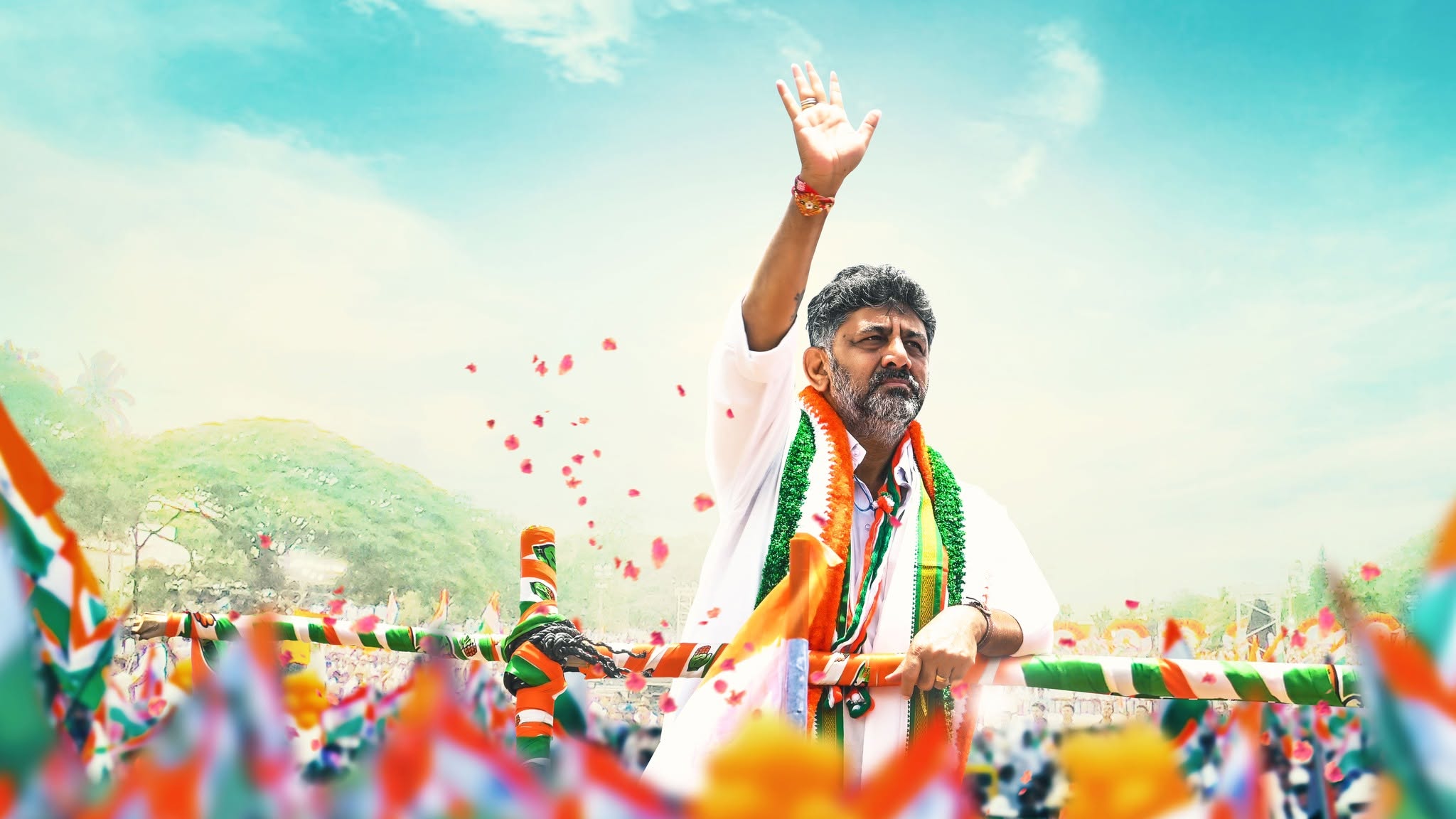
Now that DK Shivakumar has become Chief Minister, Kidwai thinks the test becomes much clearer. “He doesn’t have much time,” he says. For years Shivakumar could point to the limits of being number two in the government. Those excuses no longer exist. Photo: Facebook page of DK Shivakumar
He sees Shivakumar in that old Congress tradition of political pragmatism. Shivakumar is openly religious. His temple visits and belief in astrology are well known. But Kidwai does not see that as automatically placing him outside the Congress’s understanding of secular politics. The Congress historically did not demand personal irreligiosity from its politicians. What mattered was how the state treated different communities. That flexibility, Kidwai feels, allowed the party for decades to contain very different social and political groups under one roof.
Caste, of course, is impossible to separate from Karnataka politics. Shivakumar comes from the influential Vokkaliga community, but Kidwai feels his political project cannot stop there. The Vokkaliga base gives him strength, but it also places him in competition with the Deve Gowda family and the JD(S), which has had a strong claim over the same social constituency. Shivakumar, therefore, has tried to reach beyond it, including towards Lingayat voters.
Kidwai points to the 2023 Karnataka Assembly election as evidence of how carefully social coalitions matter in the state. Siddaramaiah has his own political base through the AHINDA formulation — minorities, backward classes and Dalits — and his politics has been built around social justice. That makes the Shivakumar-Siddaramaiah relationship both necessary and complicated. Kidwai describes Siddaramaiah as temperamentally very different from Shivakumar. Siddaramaiah came out of the Janata tradition and carries a more explicitly socialist political inheritance. Shivakumar is more comfortable with business, development and political management. But both operate in the same Congress coalition.
Caste politics can also become dangerous very quickly, Kidwai says. Questions around caste surveys, reservation and representation can create political opportunities, but they can also upset carefully balanced coalitions. “It is very thin ice,” is essentially how he sees it. Rahul Gandhi has made caste enumeration and social justice a major political issue for the Congress. But implementing these ideas at the state level requires more than slogans because every change creates winners, losers and anxieties.
The larger issue inside the Congress, Kidwai believes, is that the old high-command system no longer functions the way it once did. “The high-command culture is crumbling,” he says. For years, Congress governments were often run through carefully negotiated arrangements from Delhi. Chief ministers were chosen, removed or balanced against rivals through the central leadership. Rotational arrangements and promises of future power have oftentimes created trouble for the party, not only in Karnataka but in states like Madhya Pradesh, Rajasthan and Chhattisgarh. Kidwai believes the Congress has paid a heavy price for this.
The BJP, under Narendra Modi, developed a very different system. It could install relatively low-profile chief ministers because the central leadership was politically dominant enough to carry them. The Congress no longer has that luxury. Nor, Kidwai points out, does a party out of power at the Centre have access to the same instruments of information and authority available to a ruling party. The central leadership must therefore pay much more attention to what is happening on the ground. He gives Kerala as an example of the Congress increasingly having to recognise state-level political realities rather than imposing decisions from Delhi.
Page
Donate Now
More from The Byword


Comments
*Comments will be moderated