








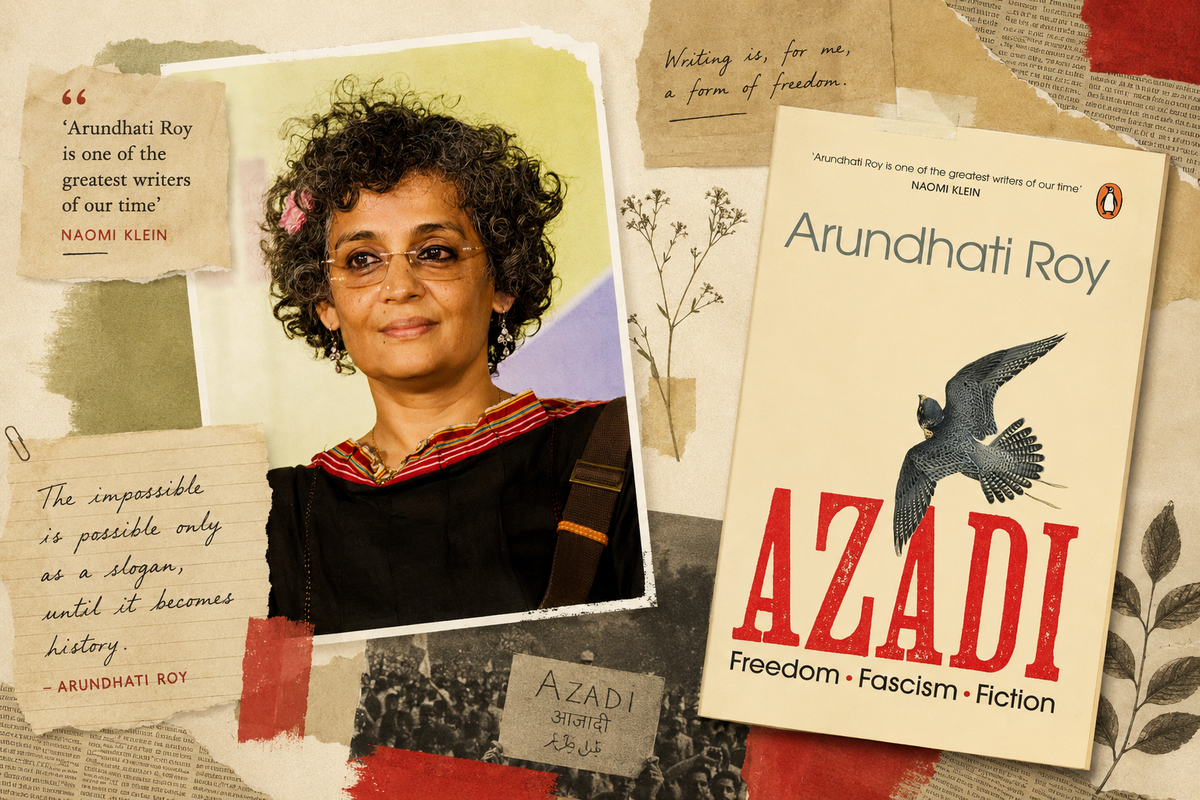

Arundhati Roy’s essays strip away the consolations of ordinary life and ask what freedom can mean when injustice, fear and democratic decay have begun to appear normal
Arundhati Roy’s ‘Azadi,’ a collection of political essays published in 2020 but relevant for years to come, explores grotesque and wounded truths. It mocks our inability — or unwillingness — to see them. These essays are almost cautionary calls: assertive, interrogative and urgent. The nine political essays respond to some of the defining crises of contemporary India: the rise of majoritarian nationalism, the abrogation of Article 370 and its aftermath in Kashmir, the anti-CAA protests, the erosion of democratic institutions and the COVID-19 pandemic.
At times, the book makes you feel your nerves falling and rising, and then falling and rising again. It instils an urgency so palpable that it leaves you with a compelling need to do something — to run barefoot somewhere, to plunge into an ocean, anything but remain still.
It makes you feel as though everything is ending. You should be hoarding food, milk, water and other essentials because incarceration may soon belong not only to prisons but also to homes, minds and language itself. The book reveals one’s precariousness. You are merely a deer drinking water before a lion. And even if the thought briefly occurs to you — “perhaps it is not that serious” — you instinctively know that it is. Perhaps the urgency has yet to reach you, but it cannot fail to come.
Roy repeatedly dismantles the illusion that catastrophe happens only to “other people”. Whoever suffers today was once as oblivious as you are now, as your family is now, as anyone who believes there is still enough time before alarm becomes necessary. The book throws you into a kind of thinking from which emergence seems impossible. I call that the Arundhati effect.
It may sound blunt, but one can begin to feel hostile towards ordinary living. You should not be falling in love. You should not be watching television, talking to friends, eating, drinking, reproducing or feeling exhilarated about anything at this point in time. As these thoughts take hold, one begins to believe that the only ethical response is movement: to stay on one’s toes, to keep running until one discovers some way — however small — to become an active voice against what is unfolding.
Roy writes about how truth is made inaccessible; how tyrannies once recognised from history have returned draped in nationalism; how democratic decay is concealed behind the reconstruction of temples; how the military is turned into the performative face of government; and how failing to feel alarmed is itself a form of narrowness. All of this, she suggests, is a presage of the death of imagination.
Dauntless throughout, she repeatedly reminds us that liberation does not merely mean protected borders or the absence of slavery. It also means freedom from constraints that have existed for so long that they have begun to appear normal.
The book places considerable emphasis on Kashmir: on state atrocities, historical claims, admiration and admonishment. People there could easily persuade you not to dream of Jannat in the afterlife. Daily disruptions haunt the local population. Can one imagine a life perpetually deprived of normalcy? Phone lines shut down. The internet gone. Banks, schools and colleges closed. Loved ones dead. Bodies not found. And through all this, people are told that everything being done is for their own good.
At times, Roy turns to the kind of writing that can make a reader’s blood boil, which is precisely what makes it necessary. She observes how discrimination no longer bothers to hide itself. It manifests openly, without fear of punishment or even mild reproach. Roy also understands what standing on the side of truth demands. The cost may well be incarceration. She knows that possibility awaits her too. Although fearless, she sometimes chooses fiction to convey the world’s most brutally nonfictional truths. Reflecting on literature, she writes: “Fiction has the capaciousness, the freedom and latitude, to hold out a universe of infinite complexity.”
Times in which the cost of truthful journalism is the truth-telling journalist are times of genuine alarm. We are left with a choice: to stand beside those who know how to think, or those who know only how to hate.
Roy makes a commendable effort to ignite concern for causes that may, sooner or later, wound humanity beyond repair. The plague has already entered the veins of many, but should those who still preserve some morality and a just conscience simply surrender? To confront this terror, we need people willing to be unpopular, willing to stand wherever a wrong must be fought. We have had such people before. The need to become them ourselves is now greater than ever.
The decision to make a change is itself a revolutionary act. We see people at one another’s throats. We see monstrous injustices visited upon those already brutalised by life. We see poverty, unemployment and propaganda; we watch democracy being dismantled. But do we not also know that beauty exists? Are we not aware that another way is possible, and that it must be better than this? To find it, Roy argues, we must choose art, truth and bravery.
In its final essay, Roy turns to the lightless days of the pandemic. While the world hoped to become ‘azad’ from the deadly virus, India found itself confronting not one virus but many—or, perhaps more accurately, refusing to confront them. When those with fractured identities took to the streets, the nation’s identity became more sharply defined. For lives already engulfed by starvation, unemployment and injustice, another possible cause of death scarcely altered reality. The only difference was that, for a brief moment, those lives were finally seen.
Roy yearns to expand the bandwidth of our minds. She argues that when we collectively desired nothing more than a return to normality, there could have been nothing more frightening than returning to that reality. As she writes, “What lies ahead? Reimagining the world. Only that.”
Can a democracy become desensitised after years of witnessing such aberrations? Can the poor become too poor to matter? Can emergencies cease to be recognised as emergencies? Can blood on the streets become something one simply steps over? Can one side become immune to questions?
In all her work, most notably ‘The God of Small Things’ and ‘The Ministry of Utmost Happiness’, fiction acts as the red curtain that opens onto the stage of the real world. Reading ‘Azadi’ alongside these novels reveals that Roy has always used literature to illuminate political reality rather than escape from it.
Roy’s writing never arrives stripped of innuendo or moral urgency. You leave the book with your thoughts restructured, your image of the world altered, your existence questioned, your ease abandoned and your bones restless with the desire to act. All that remains is to imagine a way out — not only for yourself, but for everyone with whom you share this world. Impediments never leave. Imagination must never be left behind. The book calls you now, and you must go.
More from The Byword




Comments
*Comments will be moderated
This perspicuous writing and sagacious insight makes for an excellent review. A shrewd writer, and it shows. Great work, hope to read more from you.
Sneha
Aug 15, 2026 at 14:26