








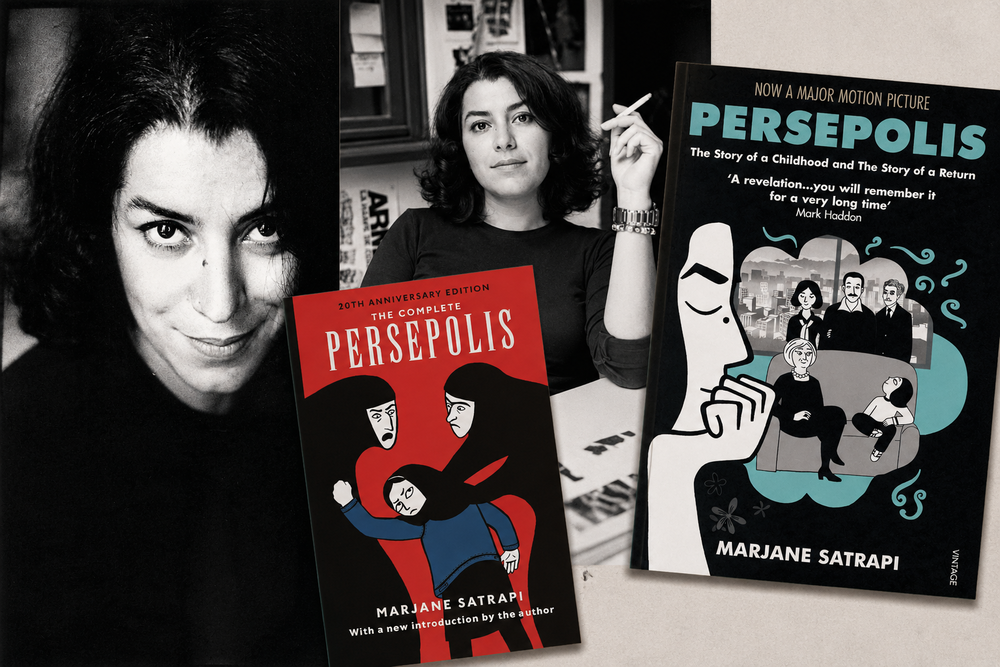
Despite being told through a child’s perspective, the politics of Marjane Satrapi’s Persepolis is never one-note.

Marjane Satrapi’s celebrated graphic memoir remains one of the defining books about Iran, revolution, exile and womanhood. But in an age of renewed scrutiny over representation, propaganda and the Western gaze, how should Persepolis be read today?
Marjane Satrapi passed away recently, leaving behind a body of work that shaped how countless readers around the world understood Iran, revolution, exile and womanhood. Since her passing, the internet has been alive with people recounting their relationship with her graphic memoir, Persepolis, while some debates surrounding the work’s reception in the West have resurfaced as well. One wonders: Can a memoir about Iran, written for transnational and largely Western audiences, ever fully escape an orientalist reading?
I’m a little embarrassed to admit that I hadn’t picked up Persepolis until Satrapi’s passing and the outpouring of mourning and love that followed it. Up until this point, I had only known the memoir through scattered clips from the 2007 animated film and through the discourse constantly surrounding it online. Picking up Persepolis as a Muslim woman in 2026, I was painfully aware of how stories about Muslim women’s genuine oppression can, in less careful hands, collapse into a familiar narrative of “East is bad, women need saving, West is good.” Reading Persepolis, however, became an experience of having many of those assumptions repeatedly challenged, complicated, and sometimes even turned back on me.
What instantly surprised me most about Persepolis was that, despite being told through a child’s perspective, its politics is never one-note. The memoir critiques not only what Marjane experiences under both the Shah and later the Islamic Republic, but also the imperial and colonial forces that helped shape the conditions leading to both. The first volume opens with an introduction penned by Satrapi in 2002, where she briefly traces the history of Iran from the second millennium BC to the 1979 revolution.
I was taken aback by the frankness with which she discusses the repeated destabilisation of Iran by Western powers, whether through the Allied invasion during World War II or the later British and CIA-backed coup that weakened the possibility of democracy while strengthening authoritarian alternatives. Satrapi also makes her intentions behind writing this graphic memoir explicit: “This is why writing Persepolis is so important to me. I believe that an entire nation should not be judged by the wrongdoings of a few extremists.”
The memoir instantly endears itself to the reader through its protagonist. Marji is funny, dramatic, self-aware, and through her eyes, we witness everything from the fall of the Shah and the revolution to the intimate realities of living in a country at war. She moves through moments of joy and grief, brief tastes of freedom and the repeated fear of having it taken away. Because she is a child, we often learn things alongside her, whether it is the political complexities she slowly begins to understand, the brutal realities of war and authoritarianism, or the small acts of rebellion she finds in cigarettes, denim jackets, and band posters.
What makes Persepolis so affecting is how unexpectedly relatable it feels, even across vast differences of time, place and circumstance. Reading it, I often found myself recognising not Satrapi’s exact experiences, but the emotional logic behind them. Marji’s evolving relationship with God, rebellion and even her own country felt deeply familiar in the way childhood beliefs often do: intense, absolute, and slowly complicated by the world around them.
As a child, Marji speaks to God every night, treating him almost like a friend who offers comfort and certainty. In one of the memoir’s funniest and most endearing moments, she imagines creating her own religion, writing commandments in her “holy book”, about how suffering for old people would no longer be allowed, and everyone would own a car. But as political violence, war and repression begin closing in around her, that faith slowly fractures too. By the time her uncle Anoosh is executed, she drives God away entirely.
The same complexity shapes her relationship with Iran. Marji grows up fascinated by the country’s history and fiercely wants Iran to win the war against Iraq, only to gradually confront the human cost of nationalism, authoritarianism and war itself. Yet she is still moved to tears hearing the national anthem play. There is something painfully recognisable in loving a country while mourning what it has become, as she says, “it was really our own who attacked us.”
Despite everything, Marji is still a teenager searching for small acts of rebellion. At one point, she steals a cigarette from her uncle, convinced smoking it will mark her entry into adulthood. Under ordinary circumstances, it might have. But by then, Marji has already lived through bombings, executions and grief. The cigarette feels less like the beginning of adulthood than a child trying desperately to catch up with a reality that has already forced her to grow up too quickly.
Marjane Satrapi herself repeatedly rejected the idea that she was trying to explain an entire country. Her ambitions for Persepolis were much smaller and far more personal.
What ultimately prevents Persepolis from collapsing into a simplistic orientalist narrative is that the memoir possesses too much emotional honesty for easy binaries. Satrapi writes Iran with frustration, grief and anger, but also with affection, humour and longing. Some of the memoir’s most devastating moments are not political speeches or scenes of open brutality, but intimate ones: the pain of leaving family behind, of trying not to turn around for one last look at them because doing so might break you completely.
The second volume further complicates any reading of Europe as a simple site of liberation. When Marji leaves Iran for Austria, the memoir does not suddenly transform into a story of freedom neatly replacing oppression. Instead, she encounters alienation, racism, loneliness and the exhausting pressure of constantly managing how others perceive her identity. In one of the memoir’s most memorable moments, Marji tries to justify hiding her Iranian identity to the imagined voice of her grandmother, explaining, “When I say I’m from Iran they treat me like a savage. They think we’re all crazy fanatics who spend our time killing each other.”
Moments like these turn the lens back toward the West itself. While Persepolis openly critiques religious authoritarianism and repression in Iran, it also exposes the prejudice, simplification and dehumanisation through which many Western societies view Iran and its people. Europe, in the memoir, is never entirely innocent either.
And yet, despite the memoir’s emotional resonance and undeniable importance, it is difficult to entirely separate Persepolis from the political conversations surrounding it, especially in 2026, when many readers have become increasingly conscious of propaganda, selective visibility, and the kinds of narratives that are most easily absorbed into Western political frameworks.
There is, for instance, no harm in acknowledging that Satrapi writes from a position of relative privilege. Her perspective is shaped by her secular and politically aware family, her French education, and the financial ability to eventually leave Iran altogether. None of this diminishes the memoir’s value. Persepolis is autobiographical by design; naturally, it speaks through the limits and particularities of Satrapi’s own experience.
Another criticism frequently directed toward Satrapi is that she inadvertently occupies the role of the “native informant”: someone from a marginalised or colonised society whose testimony becomes especially valuable to Western audiences because it appears to confirm pre-existing ideas about that society’s violence, backwardness or dysfunction. It is a charge that women from the Global South are particularly familiar with whenever we criticize our own culture, country or religion. There is often an immediate guilt, that our experiences, however real, will be appropriated into narratives that ultimately harm the very communities we come from.
And while Persepolis itself is far more nuanced than many of the frameworks through which it is often discussed, that does not automatically insulate it from being absorbed into orientalist readings. A reader approaching the memoir through already existing Western narratives about the Middle East can still interpret scenes of forced veiling, religious repression or war as confirmation of ideas they already hold about Muslim societies being uniquely backward or violent. That possibility exists regardless of Satrapi’s own intentions, and perhaps regardless of the memoir’s own complexity.
Some of Satrapi’s more recent statements surrounding Iran, democracy and politics in the region, alongside her silence on Gaza since 2023 and her public support for Israel on several occasions, have understandably caused many readers to revisit Persepolis with greater scrutiny.
I think that is where much of the anxiety surrounding works like Persepolis comes from, especially among women from formerly colonized societies. There is a constant fear that even honest, necessary criticism of one’s own community may eventually be flattened into propaganda once it enters larger political narratives. Even when someone is not consciously performing for the Western gaze, the afterlife of their work, how it is circulated, interpreted and weaponised, remains impossible to fully control.
Satrapi herself repeatedly rejected the idea that she was trying to explain an entire country. Her ambitions for Persepolis were much smaller and far more personal. If readers came away seeing Iranians as human beings rather than as distant abstractions like “terrorists” or “Islamic fundamentalists,” she considered that enough.
Also read: Aangan: Khadija Mastoor’s timeless novel of Partition, womanhood, and the price of freedom
And, in many ways, the memoir did succeed at that. Persepolis gave readers an Iran filled not with faceless political caricatures, but with loud grandmothers, rebellious teenagers, grief, music, humour and ordinary intimacy. But at the same time, the memoir also contains scenes of compulsory veiling, bombings, executions and religious authoritarianism, because those things were real too. The problem is not that readers notice brutality in the memoir. The brutality is real. The anxiety stems from how selectively that brutality gets contextualised, weaponised and mobilised politically once it enters Western discourse.
That tension becomes impossible to ignore considering the political climate Persepolis entered. The memoir was released during the height of the War on Terror, when Iran was increasingly framed in the West as part of the “axis of evil.” The extraordinary success of an Iranian memoir during that period is significant, but it also inevitably makes one question what kinds of stories Western audiences are most willing to platform, celebrate and emotionally invest in.
And the current political moment matters, too. Reading Persepolis in 2026, amid another war involving Iran, it becomes difficult not to think about how the claims of “saving” women were mobilised alongside the bombing of a girl’s school in Minab.
Readers do not approach books as blank slates and obediently absorb their intended message. They filter stories through political beliefs, media narratives, fears and desires already shaped long before they ever open the book. Persepolis entered a Western cultural environment already primed to consume stories from Muslim-majority countries through orientalist frameworks.
Satrapi’s own later political positioning cannot be entirely separated from these conversations either. Some of her more recent statements surrounding Iran, democracy and politics in the region, alongside her silence on Gaza since 2023 and her public support for Israel on several occasions, have understandably caused many readers to revisit Persepolis with greater scrutiny. But perhaps scrutiny is not inherently unfair to a memoir this political. If anything, reducing Persepolis into either a flawless feminist text or dismissing it outright as orientalist propaganda feels equally inadequate. The memoir deserves to be met with the same nuance and political attentiveness that it itself attempts to employ.
That distortion does not erase the memoir’s emotional truth. But the memoir’s emotional truth does not magically protect it from distortion either. Perhaps that is the uncomfortable tension at the heart of Persepolis. Stories about oppression matter deeply. So does who gets to circulate them, celebrate them, weaponise them and profit from them. The memoir should, therefore, be read with all these contexts in mind, not to condemn or acquit it, but simply to read it attentively, honestly and politically.
More from The Byword




Comments
*Comments will be moderated