








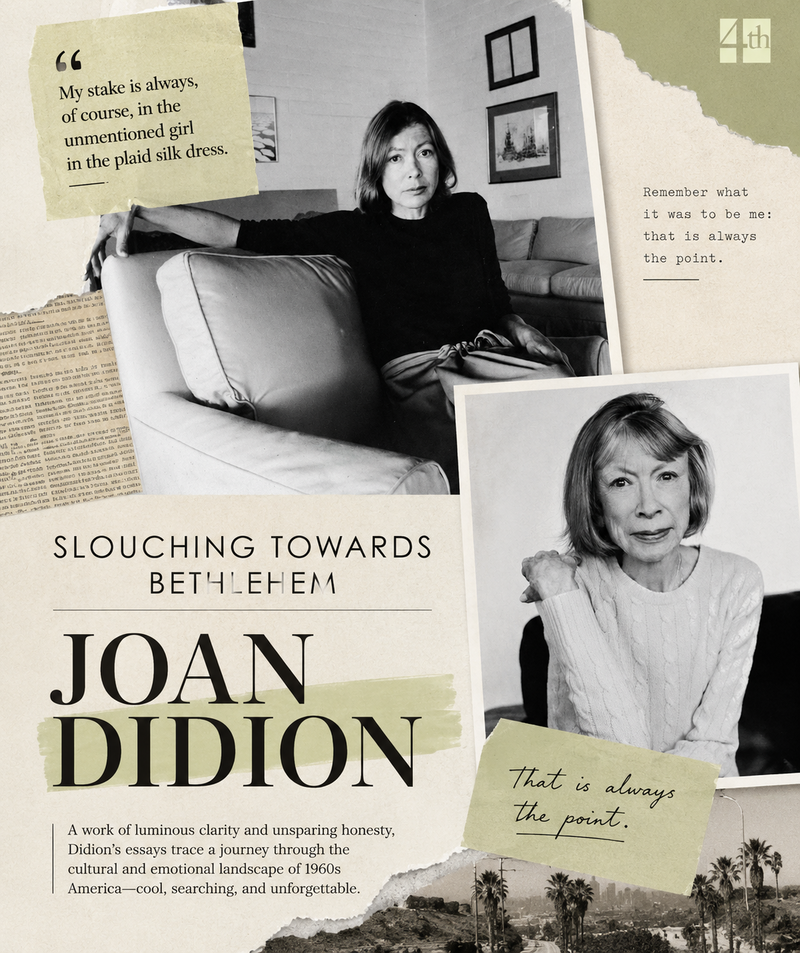
Joan Didion knew something back in 1961, and we’re still catching up to it: self-respect has nothing to do with being liked.

I bought Slouching Towards Bethlehem at 22 looking for a framework to live by. What I found instead, in Joan Didion’s unforgettable essay ‘On Self-Respect’, was a lifelong lesson in agency, accountability, identity, and the difficult art of becoming the person you are rather than the person everyone else approves of
I bought a physical copy of Slouching Towards Bethlehem in 2025. It sits on my nightstand, and I have picked it up countless times since then. It is basically like a painting on my wall, something that I look at every day with a strange sense of reassurance. I bought it after I had familiarised myself quite a bit with Didion’s work. I had read digital copies of Blue Nights, A Year of Magical Thinking, and her famous essay, “On Keeping a Notebook”. I bought it because I was twenty-two and furious, desperate for a framework to live by. I am older now, and still furious, but I have the framework I so consistently and violently desired.
The essay that broke me open was “On Self-Respect”. I first read this essay at the age when I was still doing most things not out of an inner desire or drive, but rather because that is what was expected of me, and I remember sitting there with a sense of deep alienation from the kind of rich inner life that Didion was describing, something I still had not earned. It was the kind of responsibility to the self that was austere and self-possessed, belonging to people who had already figured out that it did not matter if the room did not approve of them. I read the essay multiple times, and each time I found a new meaning in it: discipline, grief, accountability, the specific, uncomfortable practice of being the one person whose verdict on your own life you cannot outsource.
The first few lines of the essay were enough to plunge me into delirious admiration and frenzy: Innocence ends when one is stripped of the delusion that one likes oneself. Haven't we all disliked ourselves at several points in life—focused on the things that went wrong, the mistakes we made, the terrible decisions that catapulted us into catastrophe, the wrong people we trusted. We spiral into self-pity so often that it does not occur to us to substitute it for something stranger and more useful with radical acceptance.
The sentence that stopped me cold — the one that I typed out, wrote by hand, and made into my phone wallpaper for three months — was this: “The dismal fact is that self-respect has nothing to do with the approval of others, who are, after all, deceived easily enough.” The argument stripped to its core is this: self-respect is not self-love, it is not confidence, and it is not the meaninglessness you encounter in countless utterances of the phrase “believe in yourself”. It goes far deeper than that and registers itself as something more demanding and less flattering — the willingness to live with who you actually are, to accept the gap between your expectations of who you would be and who you are, and most importantly, to stop handing everyone else around you the bill for that gap.
Also read: Aangan: Khadija Mastoor’s timeless novel of Partition, womanhood, and the price of freedom
Where does our sense of self even come from? Who are we? We cannot help but construct our sense of self from the outside — the things we consume, the praises we receive, the particular satisfaction of being a certain kind of person in everyone else’s eyes. The structural flaw in this, which we perceive dimly, is that any perception of the self, borrowed from the external sources, can be easily demolished from the outside in. A single withdrawal of approval, a relationship that ends on a random Wednesday afternoon, a long-feared rejection that tastes as pungent as the bile rising to your throat, and the whole edifice crumbles. This is the consequence of never having decided, in some quiet and deliberate way, who you are independent of the audience, a self stripped of the desire to perform for others. Those are the people whom Didion describes as charming but neurasthenic, the ones who never quite have the nerve to be what they are.
You cannot read such a thing and then not have it reverberate through every fibre of your being with the peculiar discomfort of recognising something you have suspected about yourself for quite a while. It does take nerve to look at yourself without the soft cushion of the filter of everyone else's opinions—and to decide that this ought to be enough, maybe not perfect but surely sufficient. It is certainly a disorienting experience to sit there with oneself outside the illusion, an unnerving discovery of self-possession that requires you to take full responsibility for your choices, including the ones that did not work out, particularly the embarrassingly uncomfortable ones. This kind of self-respect and self-worth insists that your life, to a significant extent, is a consequence of the choices you have made, and to take full responsibility for it, even when you jumped into the puddle with your shoes on.
It might also give birth to yet another insidious thought: ought I to condemn myself for these, or is it something else entirely? To stop seeking the location of our problems primarily in the actions of other people also results in an immaculate conception of the thought that you are far more capable of doing something about them. That it is not dramatic, it is not interesting, it is rather just quiet, flat and distinctly your own fault. The only way out then is the only way in—to begin, however awkwardly, to be the person you are rather than the one who seemed most likely to be accepted.
To be and to become are then not as anyone preaches; an expensive face mask and a morning routine, it is something far less comfortable and more permanent. It sits in the decision to be the protagonist of your own life, with all the attendant failures and poor choices and spectacular wrong turns, to stop rearranging yourself according to someone else’s rubric. And to realise it is enough.
More from The Byword







Comments
*Comments will be moderated