








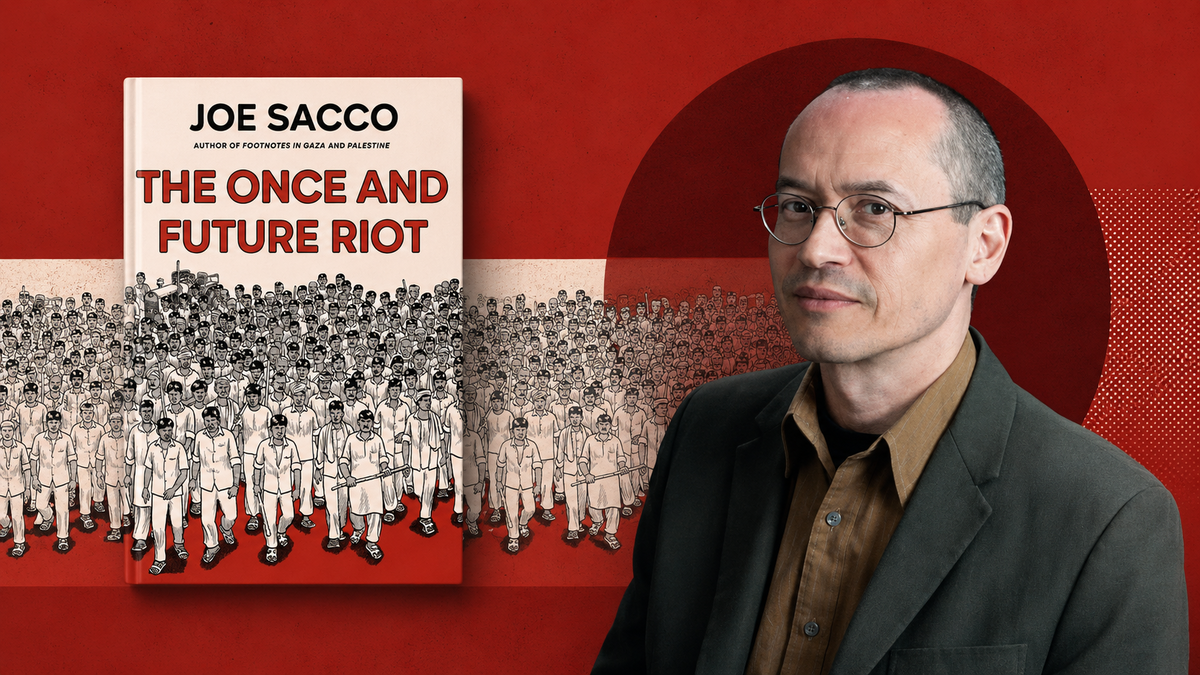

Joe Sacco’s The Once and Future Riot looks back at the 2013 Muzaffarnagar riots through the stories of those who lived through them, chronicling how communal violence upended the lives of people who could never fully return home
More than a decade after the Muzaffarnagar riots tore through western Uttar Pradesh, the violence continues to exist in fragments: in abandoned homes and neighbourhoods, in relief colonies, in courtrooms, and in the memories of those who still carry its fear. For many survivors, the riot did not end when the mobs dispersed. It continued in displacement, loss of land and livelihood, and in the knowledge that a village once called home could no longer be entered without dread. Joe Sacco, the celebrated cartoonist and graphic journalist, attempts to gather these fragments in his book The Once and Future Riot. Through interviews, drawings and reported observation, Sacco reconstructs not only what happened in 2013, but also how different people remember, justify, deny or mourn the violence.
Sacco’s book is a work of reportage that pays attention to the complicated social dynamic of western Uttar Pradesh: Hindu Jats and Muslims who had lived together for generations, village hierarchies, gendered rumours, political speeches, competing versions of truth, and the fear that turned neighbours into enemies. The 2013 riots left more than 60 people dead and tens of thousands displaced. Many of those who fled were Muslims; many never returned to their villages. Sacco’s power lies in showing that communal violence is never only about the day of killing. It is also about the years before it, when suspicion is sown, and the years after it, when survivors are asked to live with what others chose to forget.
It is quite ironic that a book may remain beyond the easy reach of many Indian readers. Penguin Random House India has said it will not distribute Sacco’s book in India because of an allegedly inaccurate map of India and other content-related concerns. The decision has prompted a debate. Is this only about a map and unanswered editorial questions, as the publisher says? Or does the hesitation reveal something larger about the discomfort that surrounds books on communal violence in the new India? A responsible piece cannot claim censorship without evidence. But it can ask why a book of reportage on one of north India’s most significant recent episodes of violence has become so difficult to access in the country where that violence occurred.
To understand why the book’s absence matters, it is important to understand who Joe Sacco is. Often described as a pioneer of graphic journalism, Sacco has spent decades reporting on conflict, occupation and political violence. His major works include Palestine, Footnotes in Gaza and Safe Area Goražde. He is an artist who uses drawing as his method of witnessing. His panels do not merely illustrate a written story, they force readers to notice a face, a street, a silence, a room where someone is remembering what they would rather not remember. In Sacco’s work, the image is not an accessory to journalism. It is journalism.
As he had done in Gaza and Bosnia, Sacco travelled to western Uttar Pradesh, especially the Muzaffarnagar and Shamli belt, and reported from the ground. He visited the region in 2014, a year after the riots, speaking to victims, local leaders, officials, political figures and village residents. His focus is not only the chronology of the riot, though that matters. He is equally interested in the aftermath: how people explain violence to themselves, how rumours become social facts, how political language enters everyday life, and how memory splits along communal lines.
One of the strengths of Sacco’s work is that he does not treat the Muzaffarnagar riots as an isolated eruption of madness. He places them within a longer history of communal distrust in India: Partition, the demolition of the Babri Masjid in 1992, the Gujarat riots of 2002, and the growth of a politics in which religious identity can be mobilised for electoral gain. This does not mean every riot is the same. Nor does it mean local causes should be ignored. The Muzaffarnagar violence had its own immediate triggers, rumours, and village-level tensions. But Sacco seems to suggest that a riot becomes possible when local anger is whipped up in the political climate that has already taught people whom to fear.
The book also shows how insecurity can work differently in different communities. Many Hindus Sacco speaks to describe a sense of grievance: the belief that the Samajwadi Party government favoured Muslims, that the police or administration did not treat them fairly, that demographic change threatened their future. Many Muslims, in turn, describe fear of majoritarian anger, targeted violence, displacement and the loss of trust in neighbours and institutions. The point is not to accept every claim at face value, but to understand how suspicion can be turned into a weapon. In a riot, people do not only fight over facts.
Some of the most painful testimonies are those in which survivors remember a time before the rupture. Hindus and Muslims in many villages had shared labour, festivals, markets, jokes, childhoods and everyday dependence. That is what makes the violence so devastating. It did not always arrive from outside. Sometimes it came wearing a familiar face. People recalled attackers who had once been friends, neighbours, customers, employers or playmates. The horror of such violence lies in the knowledge that the person holding the weapon once knew your family, your name, your courtyard.
This is where Sacco’s form becomes especially important. A written sentence can state that a survivor is afraid, but a drawing shows the fear in the eye. A panel can hold hesitation, shame, anger and disbelief in the same frame. Sacco’s comics allows testimony to breathe. It also reminds the reader that memory is visual. People remember the road they ran down, the smoke above a house, the face of someone in a crowd, the door that did not open, the field crossed at night.
Yet Indian readers may now have to struggle to encounter these testimonies through Sacco’s book. That is the central sadness of the current controversy. A democracy should not be afraid of difficult memory. It should be able to hold disagreement, legal scrutiny, factual correction and public debate at the same time. If a map is inaccurate, it can be corrected. If citations are required, they can be asked for. But when a book disappears from ordinary circulation, the loss is not only literary. It narrows the public’s access to testimony.
The question, then, is not whether Sacco has written the final word on Muzaffarnagar riots. No book can do that. The question is whether Indian readers should be able to read, question, criticise and argue with such a work for themselves. To deny readers that opportunity is to treat them not as thinking citizens. Books like The Once and Future Riot matter because they keep open the difficult space between forgetting and revenge. They ask us to remember without simplifying.
The book also pushes us to think about secularism not as a slogan, but as a lived test. India’s constitutional promise of secularism is meaningful only if it can survive moments when communities are encouraged to fear one another. Communal violence exposes the gap between what a republic promises and what its most vulnerable citizens experience. To write about Muzaffarnagar riots, therefore, is not to write only about 2013. It is to write about the continuing fragility of Indian democracy, and about the moral cost of allowing hatred to become ordinary.
For younger readers, especially those who know the Muzaffarnagar riots only through brief references, Sacco’s work offers a way into the lived experience of the violence. It shows that history is not made only by leaders and official reports. It is also made by widows, labourers, farmers, displaced children, hostile witnesses, frightened neighbours and people who are still deciding what they can safely say. More than a decade later, the wounds of Muzaffarnagar continue to shape lives. Some survivors rebuilt homes elsewhere. Some lost the village forever. Some carry stories that have still not been heard fully.
The Once and Future Riot attempts to preserve these memories before they are forgotten by time, politics or indifference. One may agree with Sacco’s interpretation or challenge it. One may ask whether an outsider sees enough, or whether his account misses something essential. The stories Sacco documents belong to India’s contemporary history. They deserve to be read, discussed, questioned and remembered.
More from The Byword



Comments
*Comments will be moderated