








In-Rhythm: Bice Lazzari and Nasreen Mohamedi at KNMA, New Delhi, brings together the Italian artist Bice Lazzari (1900-1981) and the Indian modernist Nasreen Mohamedi (1937-1990) in a conversation around abstraction, line, rhythm, geometry and restraint.
They lived in different countries, belonged to different generations and, as far as the curators know, never met or encountered each other’s work. Yet In-Rhythm, curated by Andrea Anastasio and Roobina Karode, finds an unexpected kinship between Bice Lazzari and Nasreen Mohamedi: in their devotion to line, rhythm, music, material and silence, and in the sheer independence with which each arrived at abstraction
One of the most arresting works at Kiran Nadar Museum of Art’s new show, In-Rhythm: Bice Lazzari and Nasreen Mohamedi, which places two major women artists in a spare, thoughtful dialogue on abstraction, is almost severe in its economy. Against a dark surface, a thin
vertical structure descends through short pale marks towards a small
block of red. There is very little to hold on to in the conventional
sense: there is no figure scene or story being acted out. Yet Bice
Lazzari’s Sequenza verticale con rosso (Vertical Sequence with Red),
1971, seems to gather intensity the longer one stands before it. The
marks appear measured but not mechanical, as if someone had been keeping
time and, on a whim, allowed a single note of colour to escape.
A few paintings away, Nasreen Mohamedi achieves a different kind of tension with even less. Lines cross, separate, run beside one another, grow denser and then disappear into expanses of paper. In one untitled drawing, horizontal lines gather across the centre like a distant structure glimpsed through heat. In another, a sequence of converging lines creates the faint sensation of entering a corridor or looking into a space whose walls do not quite exist. There are works in graphite, ink, pen and ink; some are so restrained that the untouched paper becomes as active as the marks upon it. The exhibition, which is on till December 22, traces how both artists used line, rhythm, repetition,
geometry and silence to arrive at a language that seems precise, lyrical
and immensely personal.
Andrea Anastasio, who co-curated the exhibition with Roobina Karode, is emphatic about that distinction. “It’s not about similarities, it’s about resonating,” he tells me at the preview of the show. He first encountered Mohamedi’s work in the early 2000s and later saw a retrospective. When the opportunity came to bring Lazzari’s work to India, the thought of placing the two artists in dialogue came naturally. “When I was invited to bring Bice to India, I thought that it would have been perfect to have them in a dialogue,” he says. For Anastasio, both possessed “the capacity to say a lot by subtracting.”
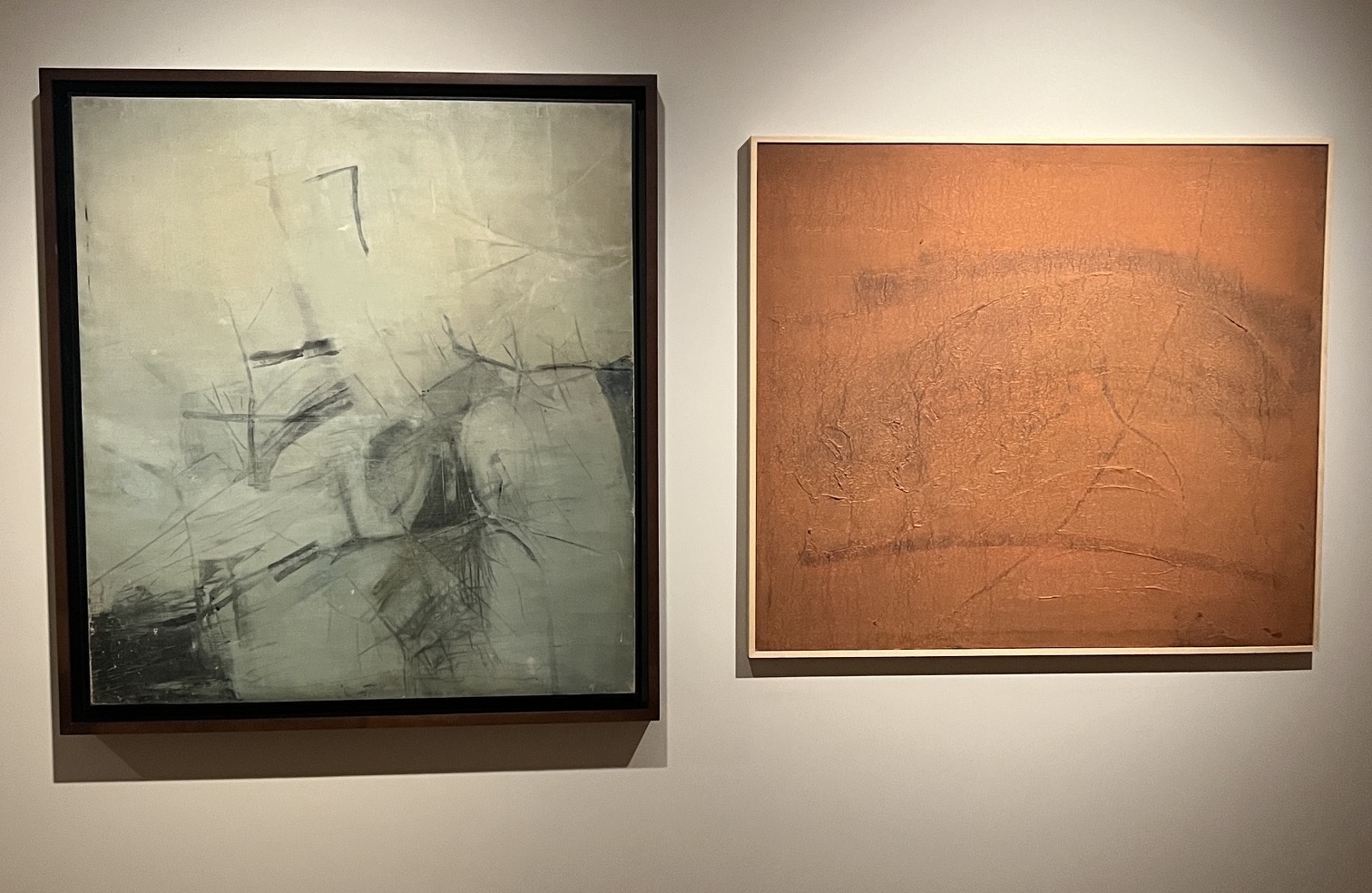
Nasreen Mohamedi, Untitled, 1970, Oil on canvas; Bice Lazzari, Rocco + rocco (Red + Red, 1961, tempera, glue and sand on canvas
That idea of subtraction becomes one of the drives of the exhibition. Neither artist arrived at restraint by adopting a ready-made minimal vocabulary. Their spareness was earned over decades. Marks were tested, materials abandoned, habits reconsidered. Both moved towards an art in which reduction could carry enormous emotional and intellectual moorings.
The curatorial note places their meeting within a larger argument about modernism itself. Lazzari worked in the time of the rise of European modernism; Mohamedi worked within the very different social, artistic and historical conditions of post-Independence India. Both worked within art worlds in which the accepted histories and structures of modernism had largely been written around male experience. Their answer, the curators suggest, was practice: discipline, repetition, concentration and a long search for an independent visual language. “Abstraction for them was not an escape from reality, but a way of confronting it,” the note states.
For Karode, the exhibition is also deeply personal. Mohamedi was her teacher in Baroda. Long before she became a curator of Mohamedi’s work, Karode had known the artist as a presence in the classroom and in her own formation. “She became a very important part of my life, my practice, my understanding, my heart, all of that,” she says. The idea of this exhibition began, she remembers, with something almost speculative. “My first idea was an imaginary conversation.” The first question she asked Anastasio was the obvious one: had Lazzari and Mohamedi ever met?
They had not. They were probably unaware of one another’s practice. But as Karode began learning more about Lazzari from Anastasio, while telling him more about Mohamedi, affinities began to emerge. They concerned temperament as much as form. “They were women of courage. They were women of endurance,” Karode says. Both had, in different circumstances, insisted on pursuing what they believed in despite resistance, illness, lack of visibility and the pressure of prevailing artistic languages.
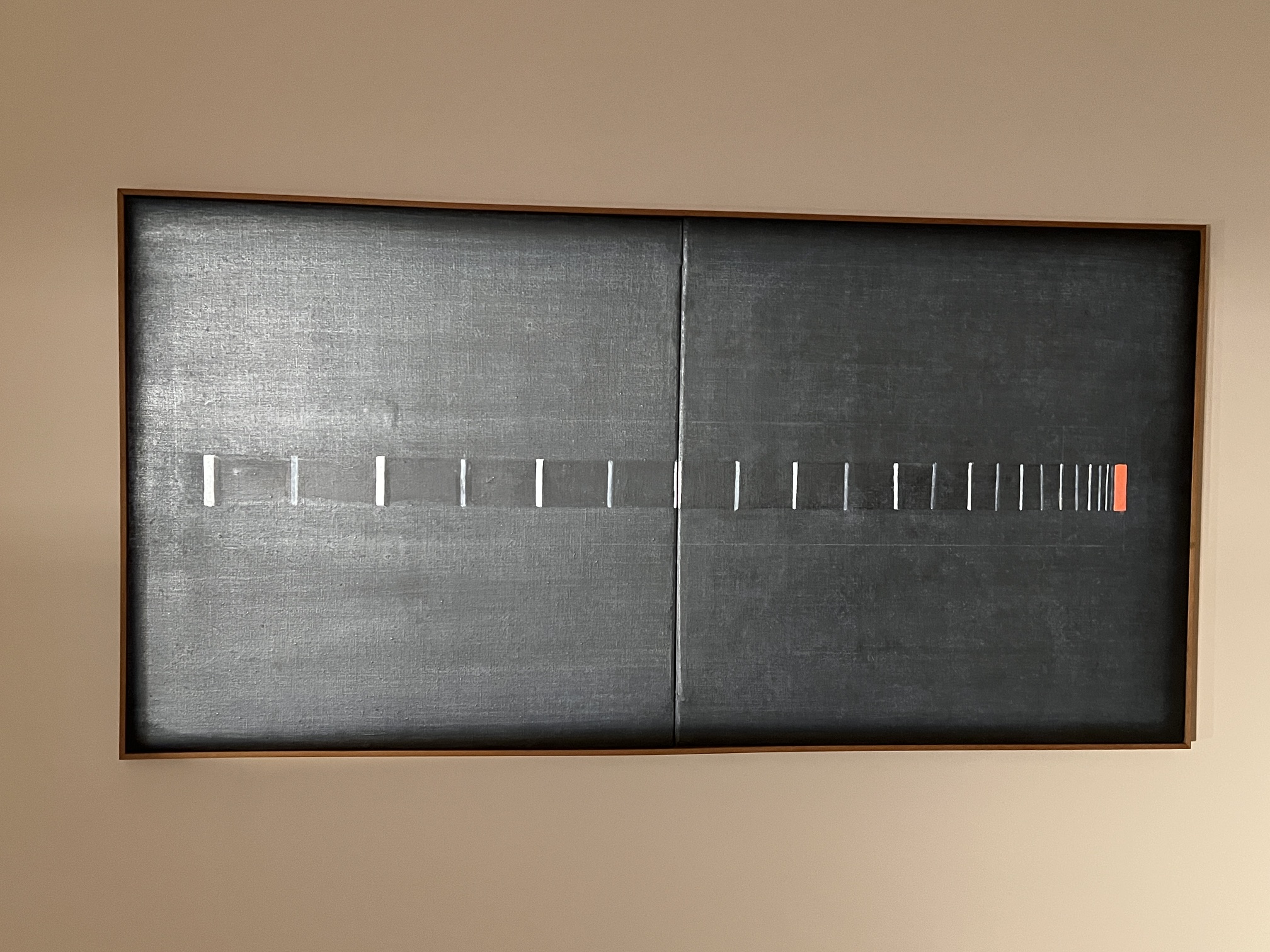
Bice Lazzari, Sequenza verticale con rosso, (Vertical Sequence with Red), 1971, Acrylic on canvas
That makes the pairing more interesting than a straightforward formal comparison. One can certainly find echoes across the walls: grids, repetitions, intervals, the recurrent pull of the line, sudden interruptions of colour, surfaces that behave almost like musical scores. But the real connection lies in the way making art became inseparable from the conduct of their lives.
Lazzari’s work in the exhibition gives a sense of how patiently she worried away at rhythm. Misure e ritmo verticale (Measures and Vertical Rhythm), 1966, made in tempera and pencil on canvas, is organised through repetition but doesn’t look static. Small differences in interval keep the eye alert. In Sequenza cromatica 2 (Chromatic Sequence 2), 1968, colour appears through an ordered structure. In Acrilico n.23 (Acrylic no. 23), 1977, one of the exhibition’s larger horizontal works, grey fields are divided into measured bands and blocks, while orange-red lines run across the lower section. The painting has something of a score, architecture or a woven object. A few small black marks, the pale horizontal lines and the central white-and-red form keep the eye moving. It feels a little like looking at a musical score when you cannot hear the music but can still sense its pace: repetition, interruption, pause, another beat.
Seen within In-Rhythm, the painting also helps explain why Lazzari and Mohamedi work so well together. Both gave great importance to intervals: the spaces between one line and the next, the pattern breaks, where empty space begins to matter. Lazzari's use of colour gives her work a very different mood, but the discipline beneath it finds a strong echo in Mohamedi's spare geometry. You do not come away thinking the two artists were alike. You come away seeing how two very different practices found their own precise ways of making rhythm visible.
, 1972.JPG)
Bice Lazzari, Acrilico n.23 (Acrylic no. 23), 1977
Alba – Prime luci (Dawn – First Light), 1959, made in oil on canvas, points to another phase of Lazzari’s practice. Anastasio and Karode both draw attention to her changing relationship with materials. Lazzari worked with oil before physical reactions to the medium forced her away from it. She moved towards acrylic and other materials, including combinations that allowed sand to enter the surface. Karode sees in this enforced shift something that unexpectedly parallels Mohamedi, who also moved away from oil and increasingly found her language through paper, drawing and other materials.
The comparison is especially persuasive because neither artist treated material as neutral. It changed what could be thought and what could be seen. Lazzari’s paintings carry colour as rhythm: a line of red here, a pale interruption there, a field broken into measured units. Mohamedi eventually made line itself the preoccupation.
Her drawings demand close looking. From a distance, some seem almost empty. Come nearer and they become densely worked fields of decisions. In one untitled work from 1977, made in ink and graphite on paper, linear movements create a shifting geometry that seems to advance and recede at once. Another, dated 1980, uses ink and graphite with a clarity that borders on the architectural but never becomes diagrammatic. Elsewhere, parallel lines are drawn with such patience that they seem to turn into atmosphere. The eye wants to locate horizon, wall, road, shadow, perspective. The work refuses to settle into any one of them.
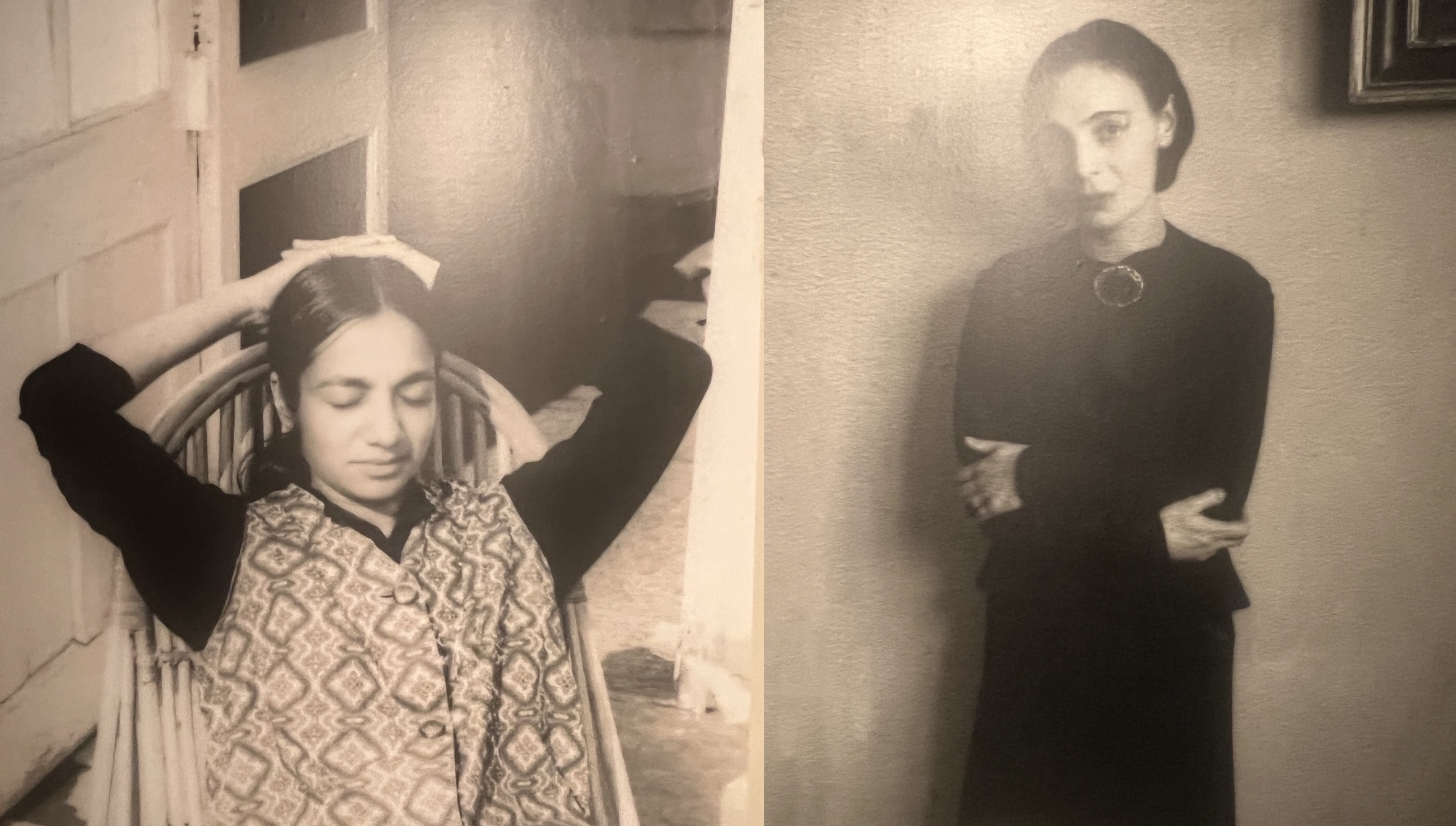
Nasreen Mohamedi and Bice Lazzari
Karode is interested in the physical discipline behind such drawings. She points out that this was long before the computer could generate immaculate repetitions. “If one line goes wrong, you would put the page away and start all over again,” she says. What she hopes younger viewers might notice is “the extent of commitment and the extent of hard work, concentration, rigour.” It is easy now to look at a spare drawing and mistake restraint for ease. Mohamedi’s work makes the opposite case. The fewer the means, the greater the responsibility placed upon every mark.
Karode remembers the artist’s life itself as structured by this attention. She speaks of Mohamedi’s insistence on order, cleanliness, posture, meditation and concentration, of a home pared down so that shadows, light and transient things could be noticed. “Her daily practice was not less than a religious person,” she says, describing an almost ascetic relationship with the surroundings.
This is where In-Rhythm becomes a show about rhythm in a larger sense. There is the rhythm of a drawn line, certainly, and of colour repeated across a canvas. But there is also the rhythm of work done every day, of the body sitting at a desk, of looking, stopping, beginning again. Music mattered to both artists. So did textiles and weaving. Karode recalls Mohamedi’s fascination with textiles, and her own memory of the artist designing leather bags and giving them to students. These interests were not incidental crafts orbiting around a “serious” practice; they fed an understanding of pattern, structure, repetition, tactility and sequence. The curatorial note similarly traces Lazzari’s practice beyond painting into applied arts and objects.
Karode’s formulation is useful because it opens abstraction to viewers who may instinctively think of it as inaccessible. “When people say that abstraction is incomprehensible,” she says, “it’s like saying that many of our emotions are also abstract.” We live with feelings that cannot be neatly pictured or explained; their lack of a visible object does not make them unreal. In that sense, she argues, abstraction is hardly a flight from experience.
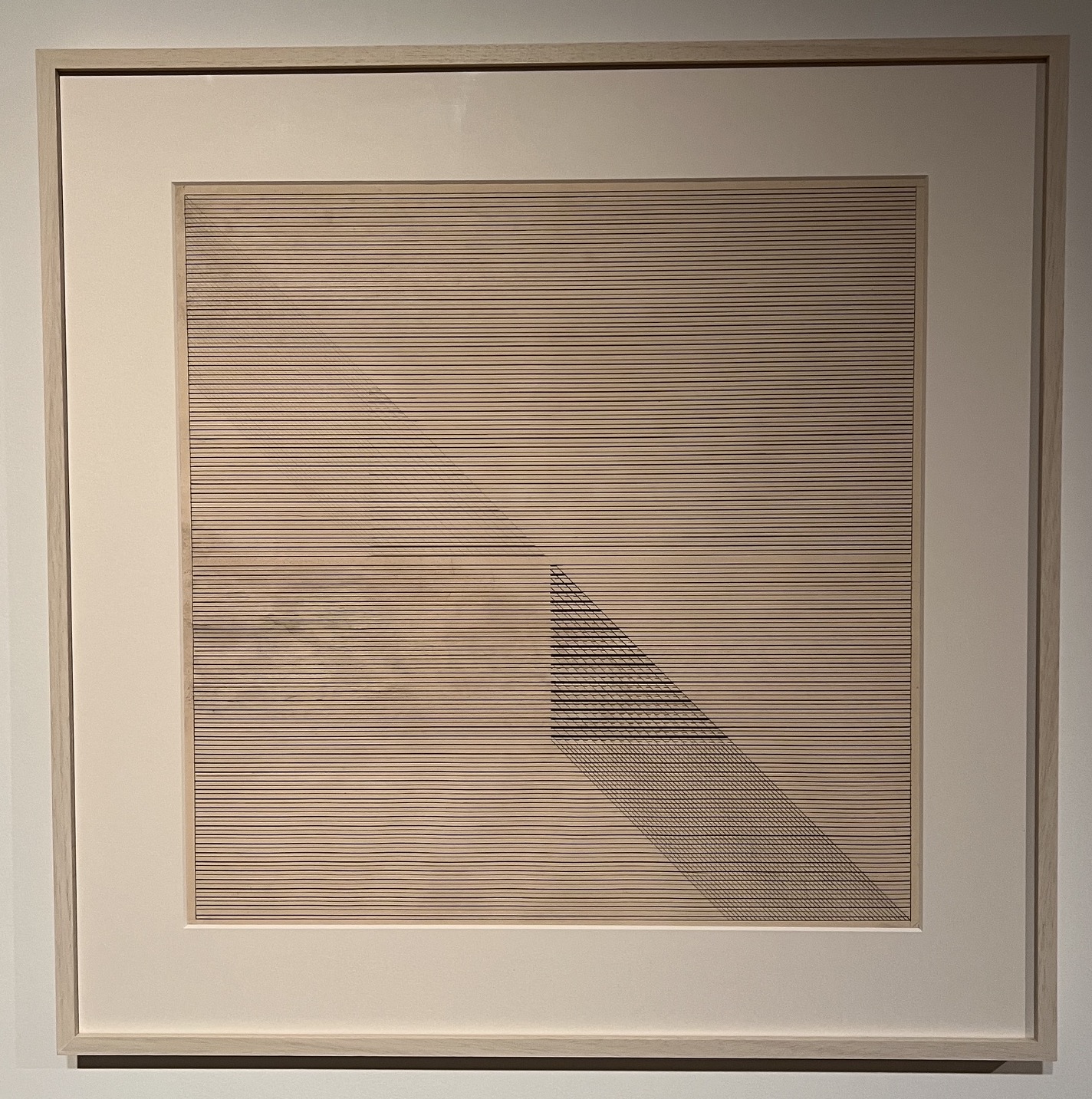
Nasreen Mohamedi, Untitled, Graphite, pen and ink on paper
Mohamedi’s position in Baroda makes the choice even more striking. Karode recalls how strongly figurative and narrative art shaped the environment around her. Mohamedi did not follow it. She found her own severe, increasingly reduced vocabulary and persisted with it. For Karode, that persistence matters as much as the result. “Freedom comes through your conviction. Freedom comes through practice,” she says.
Her life also made that inward movement increasingly complicated. Karode speaks of Mohamedi’s illness and the way multiple sclerosis progressively constrained her body. As it became more aggressive, she says, Mohamedi’s art and writing became quieter. “The more the MS became aggressive, the more silent she went, more inward she went. She felt the need to talk less. She felt the need to write less.”
The exhibition follows that inwardness spatially. Karode describes the opening chamber almost as a “treasure box”: a more intimate space in which objects, textiles and other materials establish a world around the artists. From there, the rooms become progressively sparser. The movement is away from the accumulation of things and towards concentration.
In Mohamedi’s case particularly, Karode sees the journey as one from the exterior world towards interiorisation, towards an attempt to process what could not be controlled or known. Some photographs offer another clue. One black-and-white image reduces an architectural space to planes, edges and dark incisions. The subject is ordinary enough — a paved area, linear recesses, benches or structures at the edge — but the camera makes it shorn of an anecdote. What remains is space organised by tension. Photography was one of the ways Mohamedi trained herself to see.
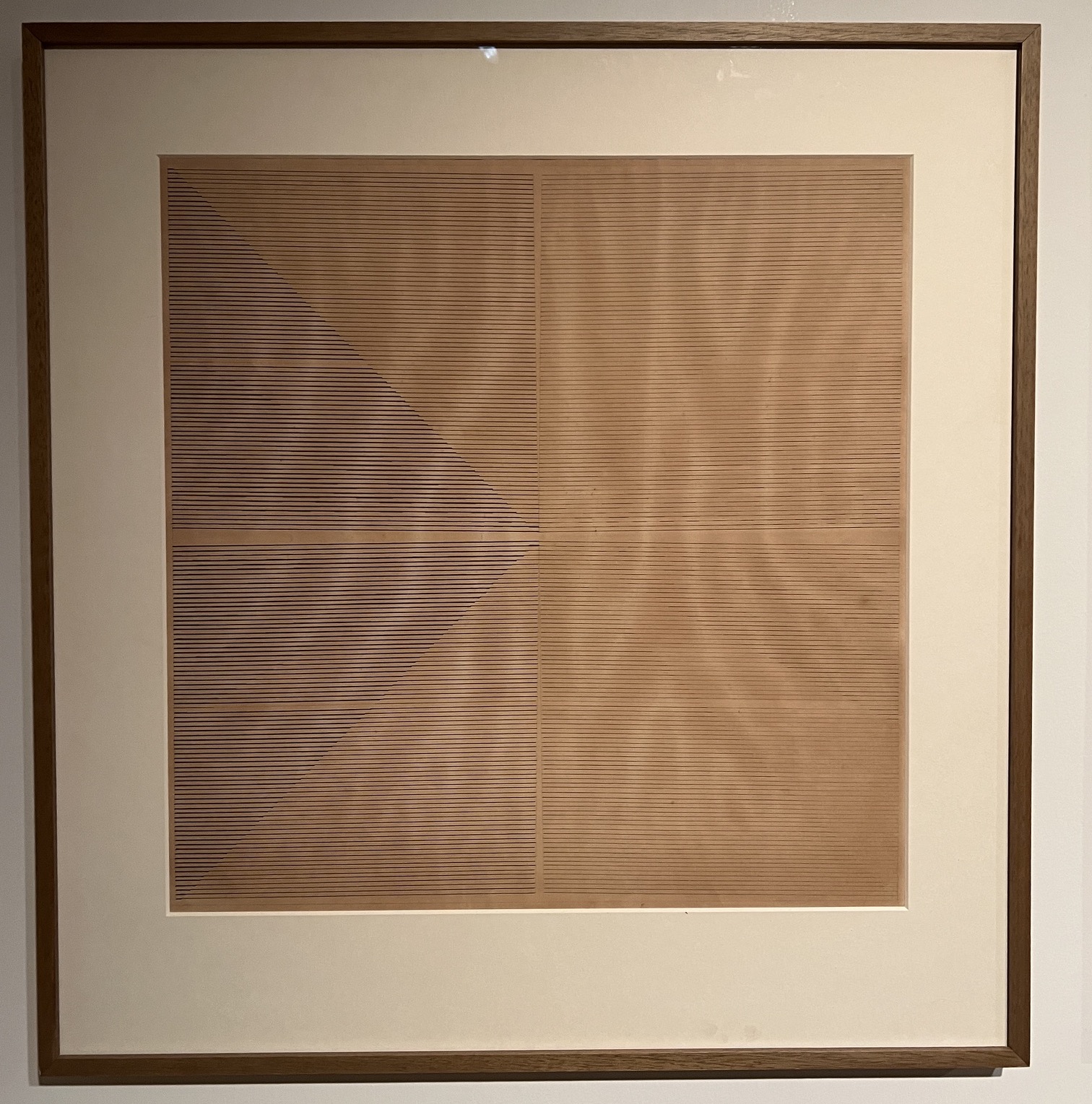
Nasreen Mohamedi, Untitled, Ink on Paper
That way of seeing feeds the drawings. Architecture is repeatedly suggested, then withheld. So are landscape and light. One drawing contains a strong wedge of parallel lines converging towards a central point; another allows a ladder-like sequence to recede across the paper. They are exact and their precision generates uncertainty.
Lazzari achieves uncertainty differently. Her colours are more present; her surfaces can be thicker, rougher and warmer. In the horizontal works, a grid may establish order only for a red line to destabilise it. In a tall dark canvas, pale horizontal bars descend towards that small red interruption near the bottom. The painting seems both controlled and precarious. One becomes aware of time because the eye moves from interval to interval. That is why the title In-Rhythm feels exact. Rhythm becomes the means by which each artist measures experience.
Their biographies do not need to be forced into parallel. Mohamedi chose a largely solitary life. Karode recalls a broken engagement and her decision eventually to live apart from the family home in Bombay and make her life in Baroda, where she taught. Solitude, Karode says, became important to her. Lazzari’s path was different: she too encountered resistance and limited visibility, but her personal life took another course, including the support of her architect husband. Their histories diverge. That is part of the exhibition’s strength. It never needs to turn them into the same woman in two countries.
What links them is what Karode calls, in conversation, an “ethical kinship”: an attitude towards work, discipline and independence. Neither seems to have been much interested in the hurry of recognition. Karode considers the belated international attention both have received and shrugs off the anxiety embedded in the idea of being “discovered” late. Artists such as Mohamedi, she suggests, were not chasing fame. “The fame thing, they know, is so transient.” Their attention was elsewhere, directed towards what she calls a “higher consciousness” and towards work they sensed might only later find the conditions in which it could be properly seen.
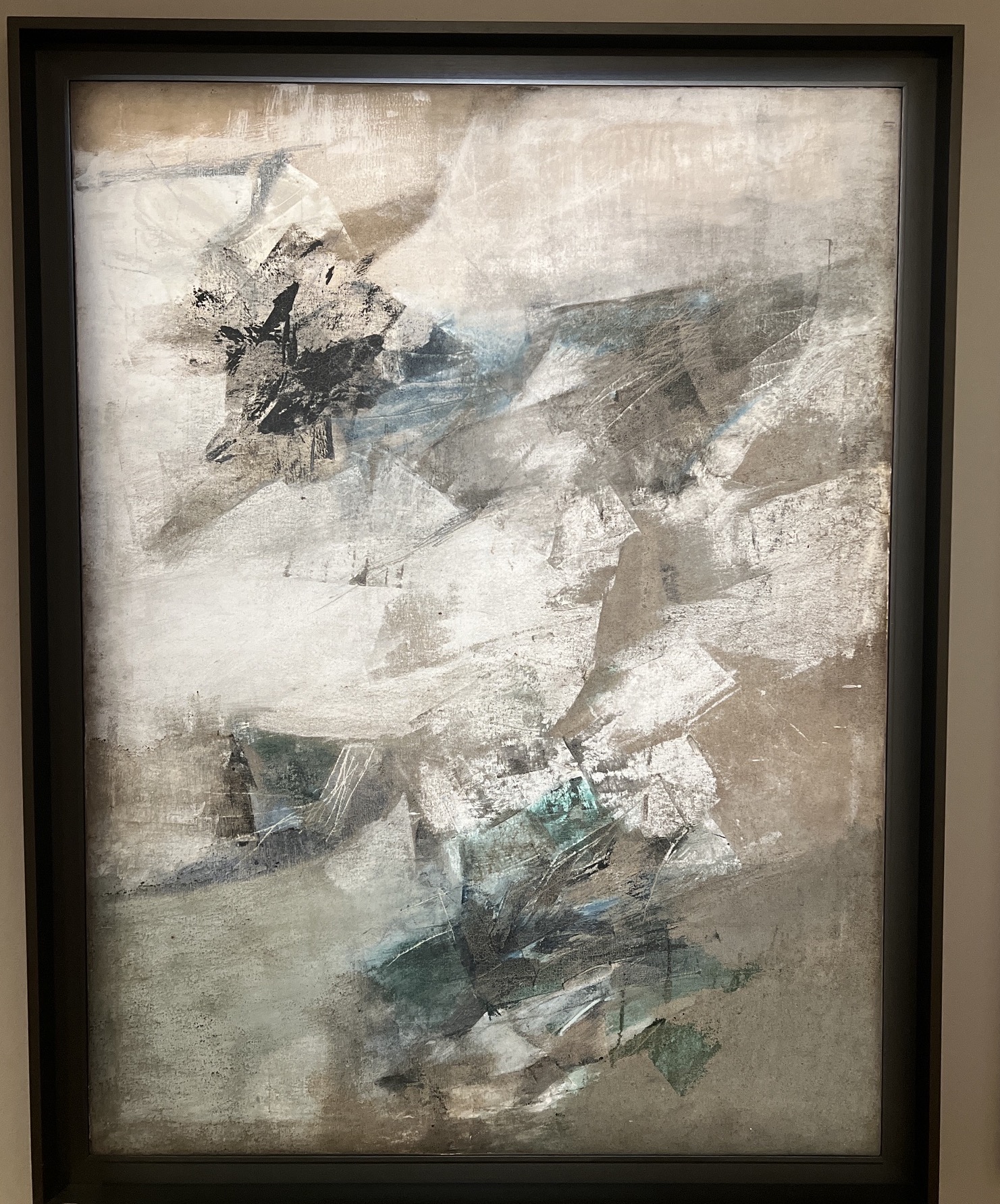
Nasreen Mohamedi, Untitled, Oil on Canvas
Mohamedi’s wider recognition has indeed altered how Indian modernism is discussed, but Karode’s relationship with her predates those institutional revisions. She still speaks first as a former student. Mohamedi, she remembers, did not impose explanations. “She never did,” Karode says of the temptation to dictate meaning. “Never as a teacher, never as a human.” She allowed students to arrive at things in their own time.
That method has shaped Karode’s own idea of curating. “I feel my life has been successful for me — or fulfilling is a better word — because of these artists,” she says. She names the different lessons she has drawn from artists she has worked with over the years: different forms of fearlessness, conviction, inwardness and intellectual stamina. Curation, in her view, begins with learning rather than display.
“I’m not the author of the work,” she says, “but I own the responsibility to really be able to transmit and translate, mediate between the artist and the audience.” That becomes more difficult when the artist is no longer there to answer questions. The curator is left with works, archives, memories and the need to understand a practice slowly enough for the exhibition to emerge from it, rather than being imposed upon it.
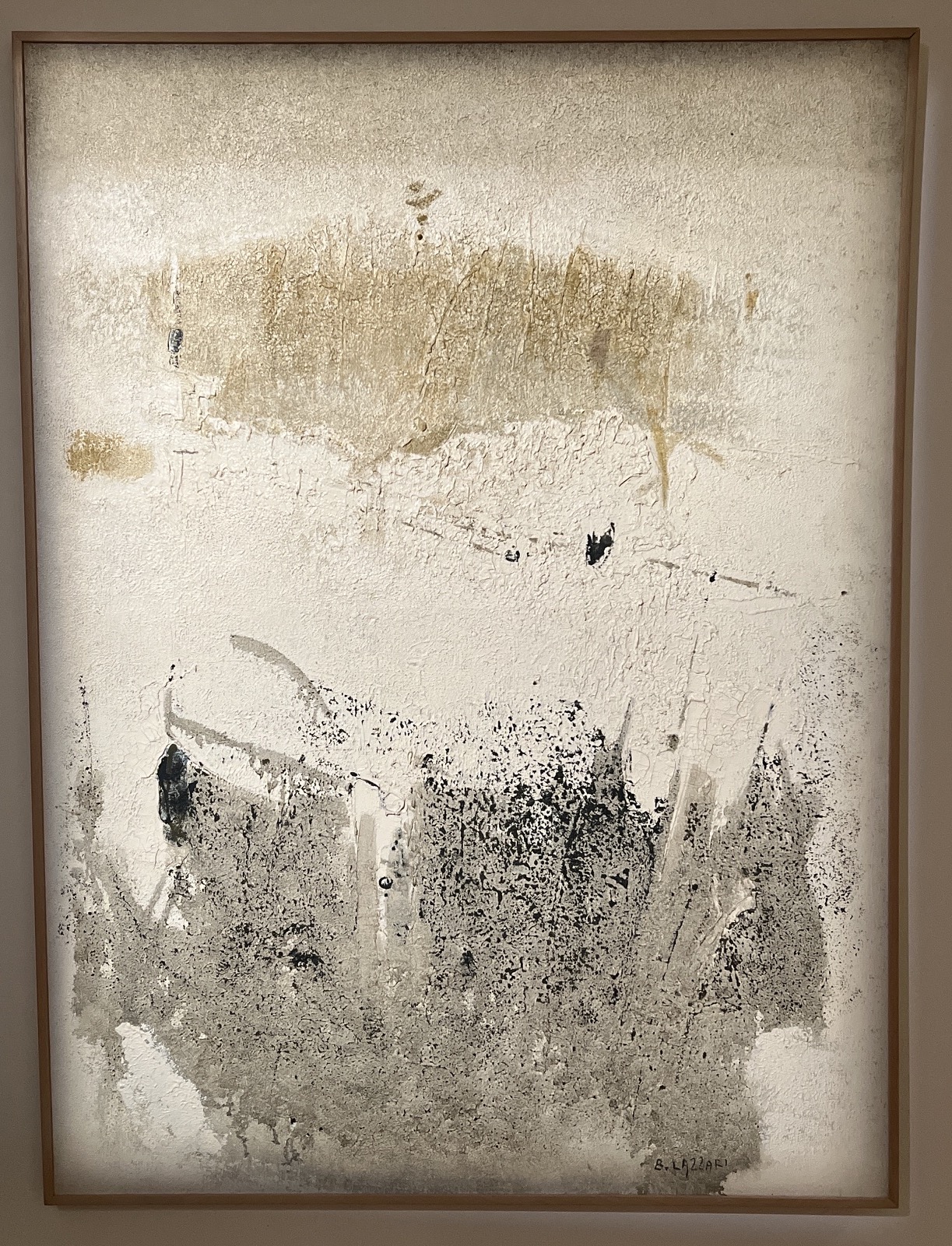
Bice Lazzari, Alba-Prime luci (Dawn - First Light), 1959, Oil on Canvas
Anastasio comes to the encounter from the other side, carrying Lazzari’s work towards an Indian context while having absorbed Mohamedi’s for years. What interested him was not the curatorial trick of finding visual twins across continents, but the possibility that two autonomous practices might illuminate one another without losing their difference. His phrase “say a lot by subtracting” becomes a useful way to look again at both.
Their subtraction is never emptiness. The empty paper in Mohamedi is full of pressure. The restrained red in Lazzari can redirect an entire canvas. A repeated line carries the record of a hand and of time. An interval matters because something has been withheld from it. The exhibition’s institutional framework also underlines the unusual scale of the meeting: KNMA acknowledges the Italian Embassy Cultural Centre in New Delhi, Archivio Bice Lazzari in Rome, and Nasreen Mohamedi’s family for lending artworks and archival photographs. What emerges from those loans is not a survey of two careers so much as a sustained conversation.
At its best, In-Rhythm changes the pace at which one looks. There are works before which a visitor has to slow down because almost nothing announces itself. Thin graphite lines do not cry/compete for attention. A photograph of a floor or a fragment of architecture does not explain why it has been taken. The reward comes with duration.
Stand there long enough and the exhibition’s apparent begins to fill with things: music, woven structures, architecture, discipline, illness, travel, refusal, colour, the daily repetition of work, and the private negotiations through which two women found forms that belonged entirely to them. Lazzari and Mohamedi never needed to meet for that conversation to become possible. The exhibition allows two bodies of work to remain separate and, through proximity, makes each seem newly legible. Their lines do not merge and they answer one another across the room.
More from Arts


Comments
*Comments will be moderated