Returning with his first solo exhibition in India in nearly a decade, which marks Bengaluru-based Gallery Sumukha’s 30th-anniversary, the celebrated sculptor talks about the making of Portrait of Parvati, his new relief works, the women who inspire him, his early experiments with fibreglass, and why he has never stopped experimenting with the human form
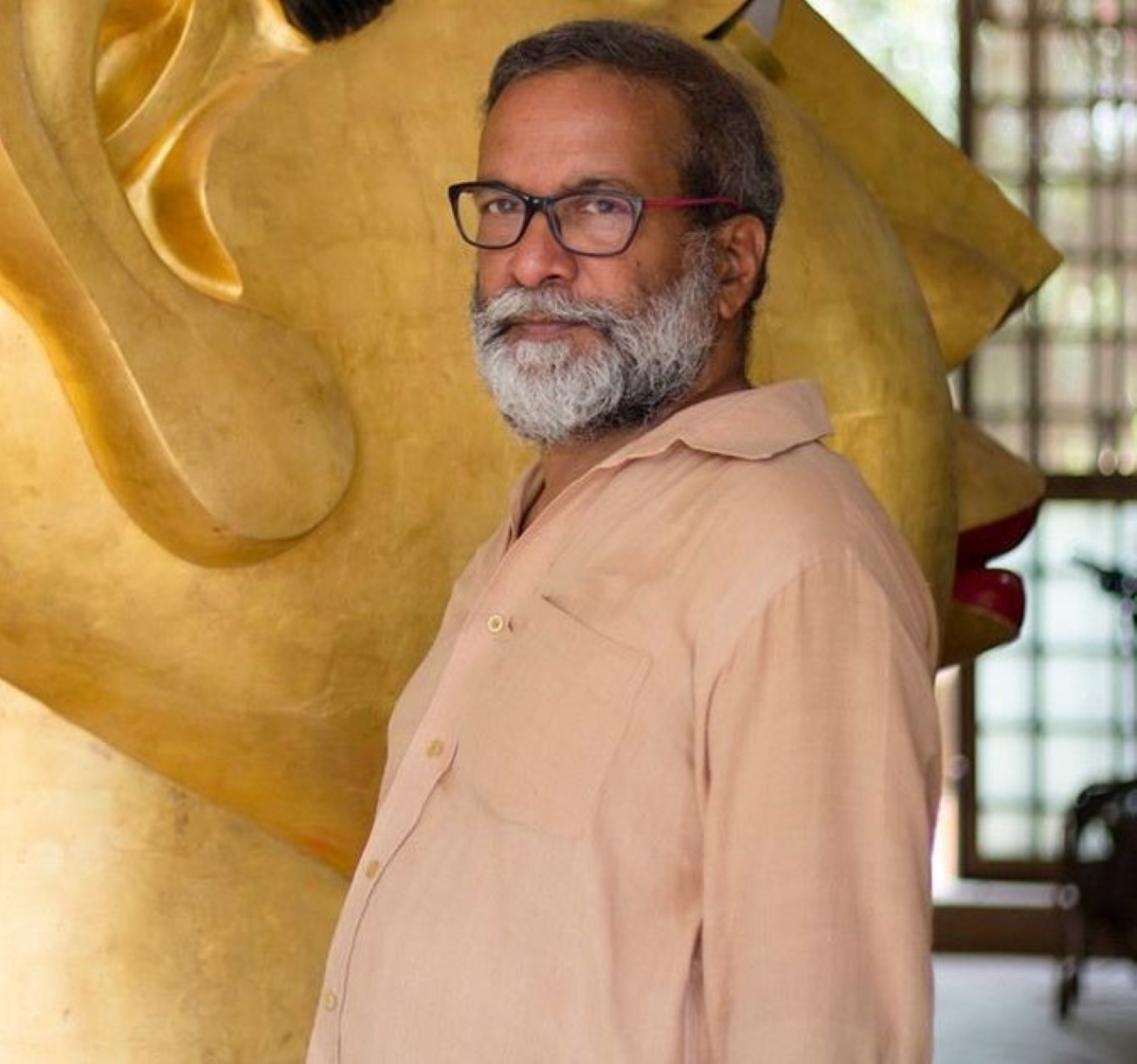
For nearly five decades, G. Ravinder Reddy has been making sculptures of women whose faces are difficult to forget. Their large, unblinking eyes look straight at the viewer. Their hair is coiffured, often decorated with flowers and elaborate jewellery. Their faces are painted in vivid colours, sometimes gold or blue, and their proportions are far removed from those of an ordinary human head. Yet, for Reddy, these women belong to the world around him. He finds them in everyday life, in people he meets and observes, and in the details of how they dress and carry themselves.
His latest exhibition, ‘In Search of the Perfect Image,’ at Gallery Sumukha in Bengaluru, offers an opportunity to see how his work has developed in recent years. Held to mark the gallery’s 30th anniversary, the exhibition, which opened on August 31 and continues until October 3, 2026, is Reddy’s first solo show in India since 2017. It brings together sculptures made between 2018 and 2026, with the monumental Portrait of Parvati (2019) at its centre.
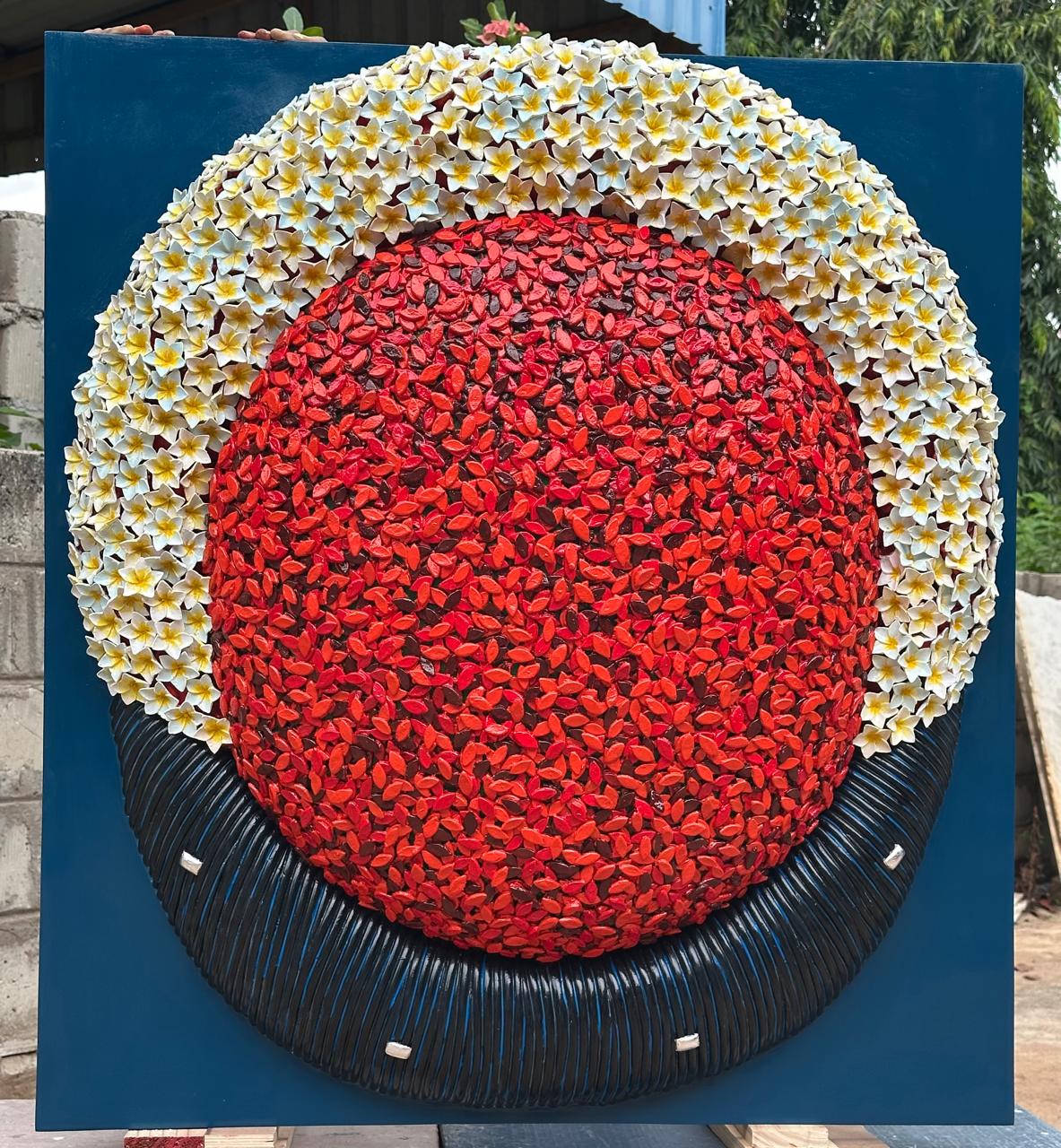
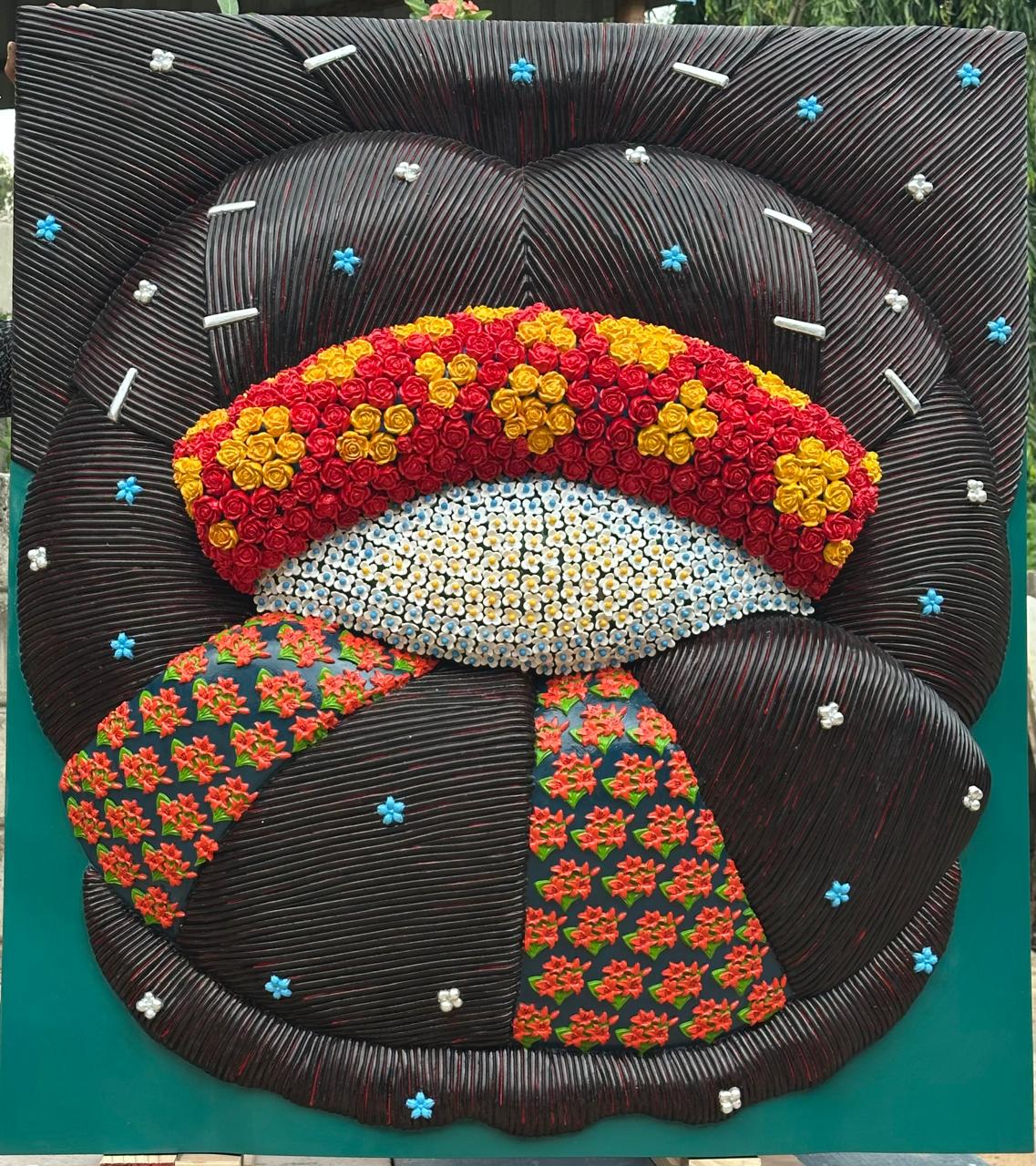
The exhibition also includes four new wall-mounted reliefs, shown for the first time, in which Reddy moves away from the frontal human face that has become his most recognisable image. Hair, flowers, ornaments and other forms associated with the female figure assume a greater presence. Some of the new works use softer colours, while the reliefs themselves present a different technical challenge: how to retain the strength and volume of a sculpture within the restricted depth of a wall-mounted work.
In an interview to The Punch Magazine, Reddy, who lives and works in Visakhapatnam, says his basic concerns have remained the same. He wants his work to appeal to people from different cultures, leave a lasting impression and have a presence of its own. A sculpture, he says, should “breathe by itself, without any other support”.
The new reliefs are an extension of those concerns. “Through those reliefs, I'm not representing a human face directly. But indirectly, it corresponds, it belongs to somebody,” he says. He is also bringing nature into the work through forms associated with women. Even when the face disappears, he wants the viewer to recognise something familiar.
There is another reason why Reddy has waited nearly a decade to hold a solo exhibition in India. He wants to be certain that he has something new to show. Bringing together a body of work allows him to examine his own progress and invite others to respond to it. “For me, first I see, am I growing or not?” he says. “If I'm not growing, then I don't feel like having a solo show.”
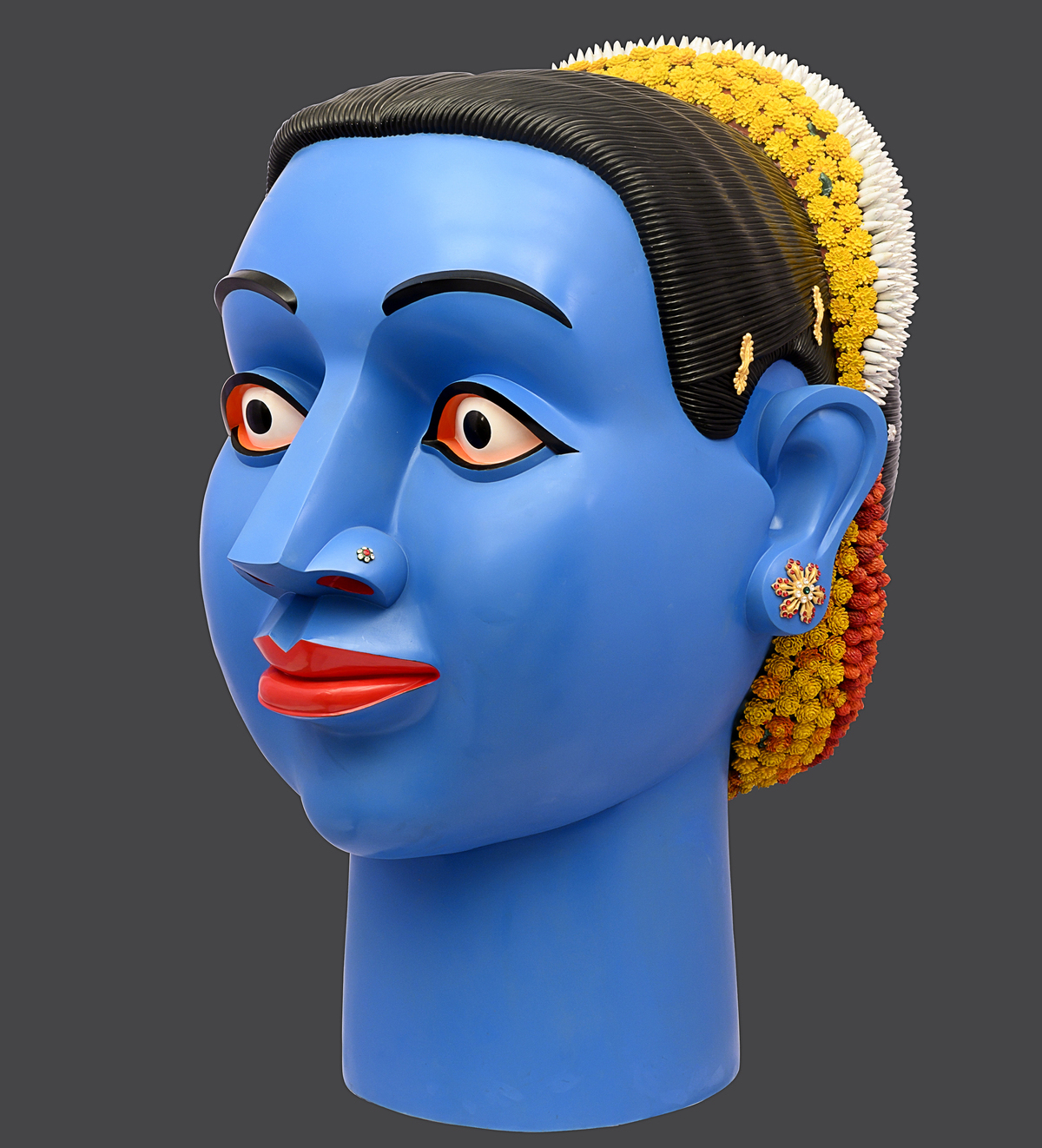
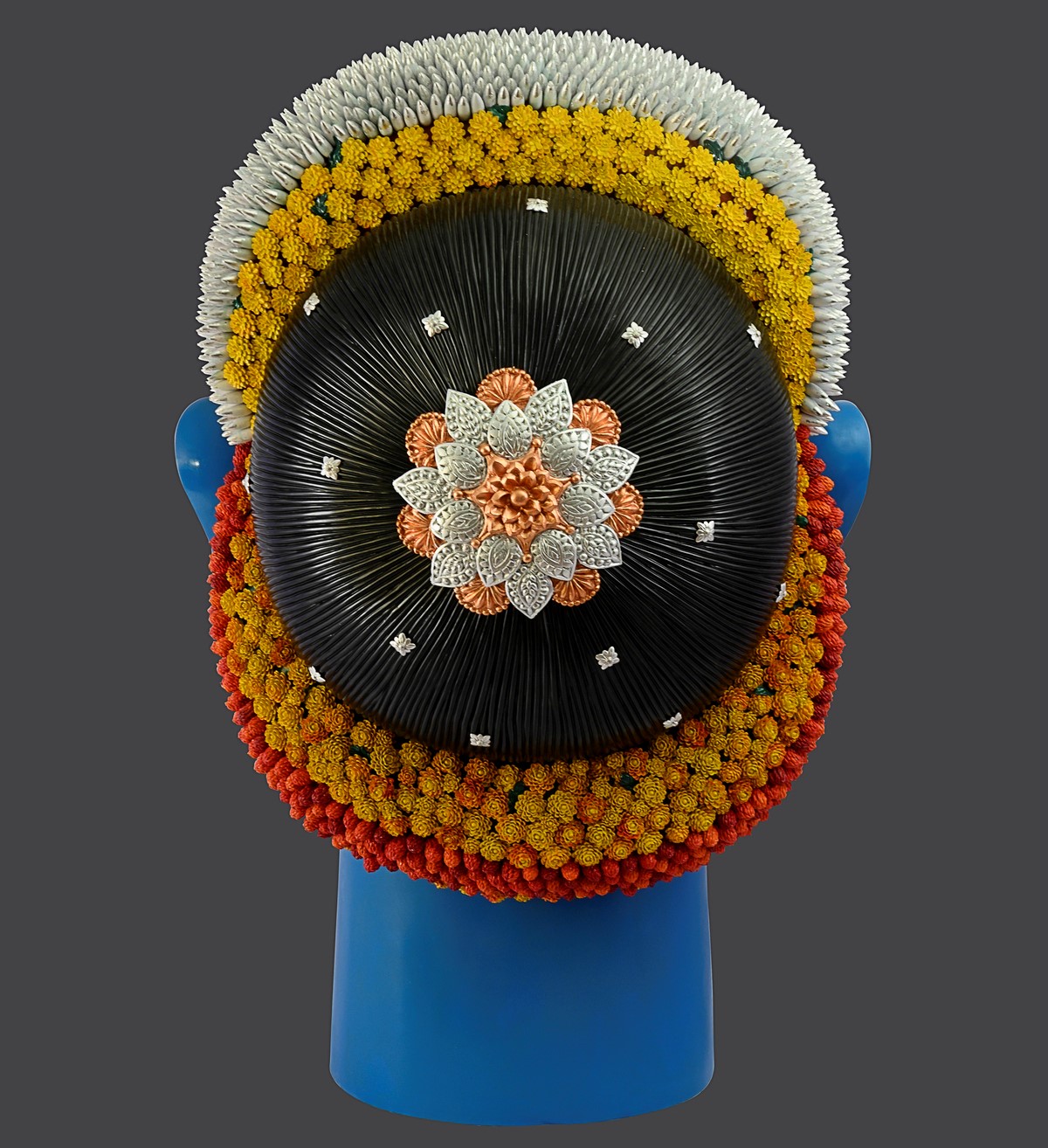
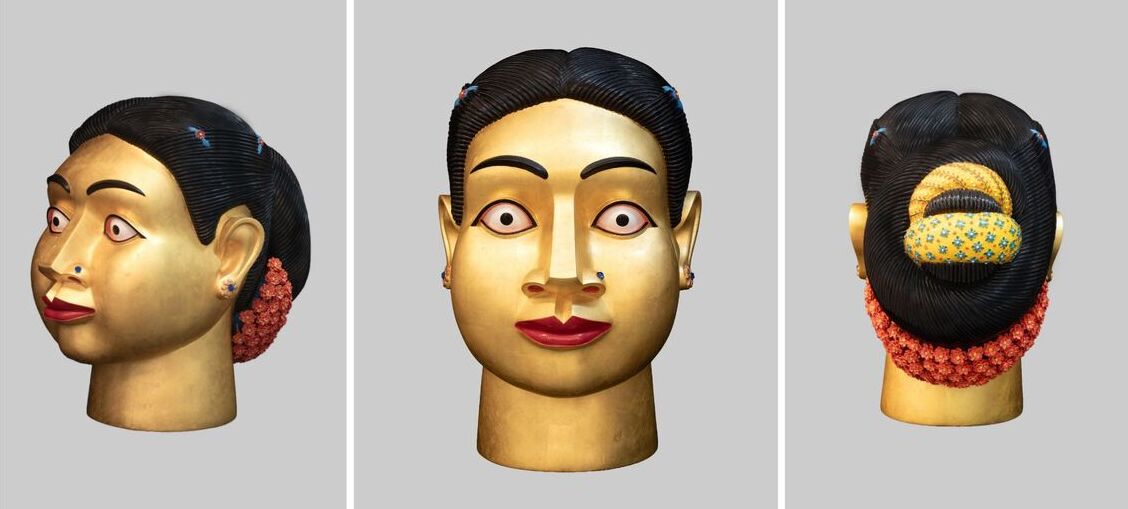
For Reddy, the exhibition is therefore an opportunity to see how far he has come, and to hear what others make of the changes in his work. The exhibition’s central work, Portrait of Parvati, brings together several ideas that have occupied Reddy throughout his career. Made in 2019, it is presented so that viewers can see both the front and the back of the sculpture, allowing them to take in its form, volume and surface from different angles.
The name itself is important to him. In India, Parvati immediately brings to mind the goddess, but Reddy does not want the work to be understood only through its religious associations. Parvati can also be the name of a woman one knows personally: a neighbour, a wife or a mother. “So it has a lot of connotations,” he says. These associations give viewers another way of looking at the sculpture and making it their own. “So the object becomes more closer.”
Portrait of Parvati, G. Ravinder Reddy, painted on polyester resin fiberglass, 2019
In Portrait of Parvati, the human form remains immediately recognisable. The new reliefs take a different approach, allowing the details associated with a woman to become the main subject. Reddy says the concern remains the same, although the new works do not have a recognisable head through which the viewer can identify the figure. The ornaments and other forms provide that connection instead.
Working in relief also required him to rethink the way he builds a sculpture. His large heads occupy space in the round, allowing him to develop their full volume. In the reliefs, he takes a portion of the form and asks whether it can stand on its own, without relying on the rest of the figure. “When you are taking out one portion of it, and seeing it differently, then you would like to make that this little portion should stand by itself,” he explains.
The difficulty lies in retaining the strength of a three-dimensional form when its depth has been substantially reduced. A volume that might ordinarily extend nine inches, for example, has to be brought down to three inches without losing its essential qualities. “You cannot make a full round volume. You make it into a small plane, at the same time, retain those volume strengths.”
This creates a different set of problems for the sculptor. He has to decide how to treat the surfaces and arrange the volumes so that the reduced form still has a convincing presence. A successful relief, in his view, should have the same ability to hold the viewer’s attention as a sculpture in the round. The new works also allow him to explore something that has always been central to his sculptures: the relationship between the female form and its ornamentation.
A flower, a piece of jewellery or a carefully arranged bun can be understood in two ways. It is an object with a familiar purpose, but it also has its own shape, texture and volume. Reddy is interested in what happens when the viewer begins to see these details as forms in themselves. “When I am looking for ornaments, I see them as part of an object, which is its volume, shape and texture,” he says.
He does not want the ornaments to become so abstract that viewers can no longer recognise them. The flower should still be understood as a flower, and the jewellery should retain enough of its familiar appearance to suggest what it is. At the same time, he wants people to notice the forms and volumes that make up these objects. “So it's not complete abstract, it is like semi-realistic,” he explains.
There is a practical consideration here too. Reddy believes that appreciating a completely abstract form requires a certain amount of familiarity with art. By retaining recognisable elements, he gives viewers a way into the work. The familiar image can gradually lead them towards an appreciation of the form itself.
He is equally particular about how the different elements sit together. There must be enough ornament to give the sculpture its character, but no single detail should overwhelm the rest. “It should not be excess, it should not be less,” he says. The various elements should coexist harmoniously.
For an artist whose work is so closely associated with the female face, this growing interest in individual forms raises a question about the women who have inspired him throughout his career. What first makes him notice someone, and what does he carry back to the studio? There is no single answer. It depends on the person and the occasion. Sometimes he notices the way a woman has arranged her hair. On another occasion, it might be some other detail of her appearance. “Everybody has something very distinctive,” he says.
Portrait of Parvati, G. Ravinder Reddy, painted on polyester resin fiberglass, 2019
He remembers these details, sometimes making a note of them, and later brings them into his sculptures. A particular hairstyle might lead him to think about how hair falls around the head, how it creates volume, or how its arrangement changes the overall form.
What begins as an observation of a person can eventually become an experiment in sculpture. This interest in the everyday has remained with him even as his forms have become larger and more elaborate. It also explains why he continues to return to the same broad subject. Each person offers something different to observe, and each detail can lead him towards another possibility. The search does not necessarily end when one work is completed. Asked how he knows when he has finally finished exploring a form, Reddy suggests that the larger pursuit remains unfinished. Each sculpture is an attempt to take it further.
Colour is another area in which he has been making changes. The strong primary colours associated with his work have given way, in some of the new reliefs, to softer pastel shades. He says the change came from the needs of the forms themselves. Having worked with primary colours for a long time, he wanted to see what would happen if certain volumes or shapes were made less forceful. “Some volumes need to be subdued. The shapes need to be subdued,” he explains. Bright colours placed together can begin to compete with one another. If every element demands equal attention, the viewer may lose sight of the form and its relationship with the rest of the sculpture. “They would be fighting with each other,” he says.
The softer colours allow him to give greater attention to particular shapes, while keeping the whole work together. He chooses colours according to how they help reveal the forms around them. The aim is to make the different parts work together so that the sculpture becomes “one unified object”. This concern with the relationship between shape, colour and volume goes back to Reddy’s earliest experiments. Although his name is now almost inseparable from his monumental female heads, these were not the first forms he explored when he began working with fibreglass.
His early studies were drawn largely from nature. He looked at seeds, plants, flowers, minerals and pieces of driftwood, examining their basic structures and the ways in which their shapes and volumes differed. “The exercise was to learn basic structure of form, shapes, and sizes, and volumes,” he recalls.
Untitled, Painted on Polyester resin Fibreglass, 24 x 16.5 x 28 inches, 2019
He was interested in the sensations that different objects produced when one looked at them. Some of these natural and inanimate forms were cast or recreated in fibreglass. Through them, he began to understand how to construct a volume and how its form could affect the viewer. The knowledge gained from those experiments eventually found its way into his figurative work. He says he began making figurative sculptures in 1980.
The human head offered him a subject that had occupied sculptors for centuries. From ancient and early forms of sculpture to the present, artists have repeatedly returned to it. Reddy found that he could bring what he had learnt from studying natural forms into his treatment of the human figure. His use of fibreglass was important to that development.
When he began experimenting with the material in the 1970s, it was unusual for artists in India to use it for sculpture. Bronze, stone and wood were more established materials, but they came with practical difficulties that were particularly hard for a young artist to overcome. Fibreglass gave Reddy greater control over the process of making a work. “It is less expensive, and less time-consuming, and you don't have to depend on external production houses,” he says.
For a sculptor who wanted to keep changing a form as he worked on it, that freedom mattered. Bronze required technical services and facilities that were not readily available to him. Fibreglass allowed him to experiment with shapes and ideas without constantly depending on someone else to produce the finished object. Learning to use the material, however, was not straightforward.
There was little communication between the art world and the industries that understood fibreglass. Reddy had to seek out people working with chemicals and industrial materials and persuade them to share their knowledge.
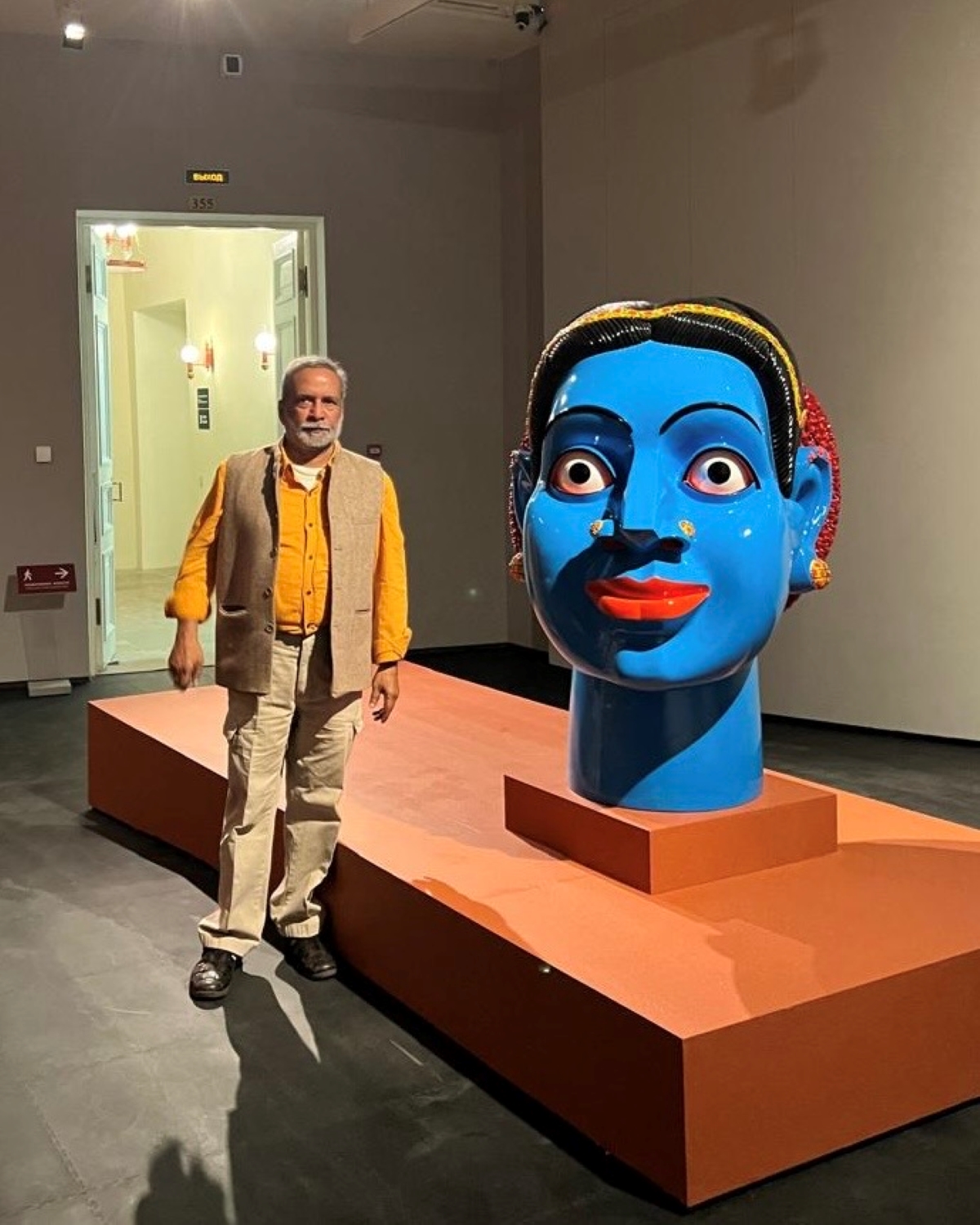
G. Ravinder Reddy with Kali Sculpture at St. Petersburg Museum
In the 1970s, such information was not readily available. Industrial processes were often closely guarded, and someone asking about a material could be mistaken for a competitor trying to obtain production details. “They would not immediately share their knowledge or pass on these production details or material availability,” he recalls.
There was no internet to consult and no easy way to find the information he needed. He had to visit people and places in person, looking for someone willing to explain how the material worked. He remembers it as a period when knowledge was less freely shared, although he points out that the same difficulties affected people working in many other fields. “Nowadays, on your phone, you can gather all the information,” he says.
The process of establishing fibreglass as a material for his own work was relatively quick once he began to understand it. He says he was able to produce a satisfactory work within about two years. A national award followed, giving recognition to a medium that had previously struggled to gain acceptance in the art world.
The award mattered to him personally as well. It encouraged him to continue working with fibreglass and showed that his experiments were beginning to be taken seriously. “Somebody taps you behind your back, that's a great thing,” he says. Fibreglass has remained an important part of his practice, although he is now experimenting with casting works in other materials, including bronze.
Reddy describes himself primarily as a modeller. His working process depends on being able to change the form while he is making it. Clay gives him that freedom: he can add material, remove it, increase the volume of one section or reduce another as the image develops.
Painted Relief III, Painted Polyester Resin Fibreglass, 2026, Unique Piece
Stone and wood are different. They require the sculptor to remove material from a solid block, and once something has been carved away, it cannot simply be added back. “When you are subtracting, you cannot add,” he says. For Reddy, this means that the idea must be adapted to the material when one is carving directly. Working in clay gives him more freedom to develop the image as he goes along, before it is transferred into another medium.
He does not see bronze as a material that would necessarily change the appearance of his work. With the technical facilities available today, he says, the fine details of his sculptures can be reproduced in bronze without losing their precision. Hair, flowers and ornaments can all be retained. “Not a hairline difference,” he says when asked whether bronze can capture the intricate details of his fibreglass works.
He points to the achievements of ancient Indian sculptors, particularly the Chola bronzes, as evidence of what could be accomplished centuries before modern machinery and casting facilities existed. The dancing figure of Shiva, surrounded by flames, is one example he brings up in discussing the technical sophistication of those earlier works.
For him, modern equipment does not necessarily mean that contemporary sculptors have surpassed their predecessors. The skills required to produce extraordinarily intricate forms were already present in Indian sculpture many centuries ago. “Nothing new, it is only your ideas and your concerns, what you want to express,” he says.
He also considers brass a workable material, noting that it is less expensive and somewhat easier to handle than bronze. Steel, too, is being used by contemporary sculptors. What matters is how artists adapt their ideas to the possibilities of a particular material.
People’s tastes change with time, he points out. He offers the example of nylon and synthetic saris, which initially met resistance from those accustomed to cotton, zari and silk. Over time, they became part of everyday clothing because they were affordable and practical. A similar process takes place in art. New materials gradually become familiar, and people learn to appreciate the aesthetic possibilities they offer. “Our aesthetics keep changing,” he says.
For now, he remains happy with fibreglass. He is willing to work in other materials when an idea calls for it, but sees no reason to abandon a medium that continues to give him the freedom he needs. Reddy’s choice of material has always gone hand in hand with his search for a sculptural language rooted in the world he knows.
He studied sculpture at Maharaja Sayajirao University in Baroda before continuing his studies in London, where he encountered different approaches to art. His travels also took him through museums around the world, exposing him to ancient Egyptian and African sculpture, among other traditions.
Yet, he has remained deeply interested in the visual culture of India and in making work that people from his own surroundings can recognise and respond to. “My main concern is I'm living in India. If I don't address my own neighbours, what is the point of existence?” he asks. He is wary of making work that draws its references entirely from somewhere else, leaving the people around him without any connection to it. “If I'm not addressing my own surroundings, I am looking for a utopian land. It doesn't make sense to me.”
This does not mean that he rejects what he has learnt from other cultures. His travels through museums have helped him understand how artists from very different societies have made works that continue to hold the attention of people far removed from their original cultural settings. He mentions Egyptian pharaohs and African art as examples. These works have unmistakable identities of their own, yet they continue to fascinate viewers across the world. “They all have their own distinctive culture, but at the same time, these artworks are mesmerising everybody all over the world,” he says.
The question for him is what gives these works their enduring appeal. He believes that an artist can learn from the qualities that make them powerful while remaining attentive to the people and places that inform his own experience. It is a way of thinking that has shaped his treatment of the female figure. His sculptures may draw on the visual language of Indian sculpture and ornamentation, but the women themselves belong to the present. Their hairstyles and ornaments come from what he sees in everyday life.
He wants people to find something familiar in his work, regardless of their cultural background, and to recognise enough of the subject to develop a personal connection with it. The question of how art reaches people also extends to the market in which Reddy works. Having begun his career at a time when it was difficult for an Indian sculptor to make a living by selling work, he has since seen his sculptures enter major museum collections and attract international attention.
His work is represented in the collections of the Victoria and Albert Museum in London, the Peabody Essex Museum in the United States and the National Gallery of Modern Art in New Delhi, among other institutions. Has that success changed the way he works? “If I say it doesn't influence me, I'm not saying the truth,” he replies.
Financial security, he explains, allows an artist to become more ambitious. When he was struggling to make ends meet, certain projects were simply beyond his reach. He had to work within the limits of what he could afford. With greater financial freedom, he can attempt things that he might previously have avoided. “You become more ambitious. You want to try what you have not tried when you are hand to mouth,” he says.
He acknowledges that success has both advantages and disadvantages, and that its effect depends on the individual artist. In his own case, it has given him the freedom to try more ambitious work without being constantly worried about how to finance it. He is also able to think about reaching more people through his sculptures.
Despite his international recognition, Reddy continues to make almost all his work in India. Most of it is produced in his own studio, with only a few exceptions involving commissions that required him to work abroad. His studio remains central to his life. It is where the forms he observes in the world around him are developed, changed and eventually turned into sculptures.
He is now looking at ways to make that working environment available to other artists through a residency programme. An informal arrangement has already begun, with some artists staying and working in the space. Reddy wants to develop it into a more organised programme, with a formal application process.
He is particularly interested in creating an environment where artists can work without constant interruption. For younger artists, he believes it is important to have other practising artists around them, so that they can learn from one another and develop a sense of what is possible.
At present, he feels that the local environment does not offer enough of that activity. There are relatively few practising artists around, and the market for younger artists is not sufficiently encouraging. He hopes to develop the residency further as the working environment improves.
Painted Relief III, Painted Polyester Resin Fibreglass, 2026, Unique Piece
For more experienced artists, the requirements are different. They may already know what they want to make and how to make it. What they need is the opportunity to concentrate on their work. “They don't require mentorship,” he says. “They just want a silent, undisturbed space so they can produce the works.”
The residency is one of the few things he is willing to discuss as a future plan. When it comes to his own practice, Reddy is reluctant to predict what he will be making five years from now. His approach is to deal with the work in front of him and allow one experiment to lead to the next. “Every day, I wake up, and it's a new challenge,” he says.
He cannot say what he will do tomorrow because he is still occupied with the problems of the present day. What he has learnt in the past, together with the work he is doing now, will shape whatever comes next. Age and health will naturally determine how much he can do, but he intends to continue working for as long as he is able.
An exhibition can provide a useful deadline. If he knows he has to prepare a show two years from now, it may encourage him to spend more hours in the studio. But he does not want to decide too far in advance what the work itself will look like.
The long interval between his solo exhibitions is partly a consequence of this approach. He says putting together a meaningful sculpture exhibition takes time, especially when the artist wants to present a body of work that shows some development.
There are practical considerations too. A sculptor has to support himself while producing new work. Selling individual sculptures along the way reduces the number of pieces available for an exhibition, and making enough new ones takes additional time.
How many works an artist produces in a year, how many he can hold back for a show, and how long it takes to bring them together all affect the timing of an exhibition. But for Reddy, the most important question remains whether the new work represents some progress. “When I'm showing a body of work together, I myself measure, have I grown much or not?” he says.
He does not see much point in inviting people to a solo exhibition if he feels that he is simply repeating what he has already done. Even a small advance is enough to make the exercise worthwhile, provided that he has genuinely taken the work somewhere new. “If I took one step forward, then I can say, I have grown, and please come and see it.”
He wants people to look at the sculptures, respond to them and offer their views. That response is part of the reason for bringing the work out of the studio and into a gallery. In this sense, the new reliefs at Gallery Sumukha are an important development. They have allowed him to separate forms that once belonged to a larger figure, explore them individually and discover how much of the human presence can remain when the face itself is no longer visible.
Portrait of Parvati, standing at the centre of the exhibition, shows the strength of the sculptural language he has developed over the years. The reliefs suggest what he can still do with it. Whether his next works will move further towards abstraction, return to the full human figure or take another direction is something Reddy prefers to leave open. He has spent much of his career returning to familiar forms and finding new things to do with them. For now, there is enough to occupy him in the studio, where the next sculpture is still taking shape.