








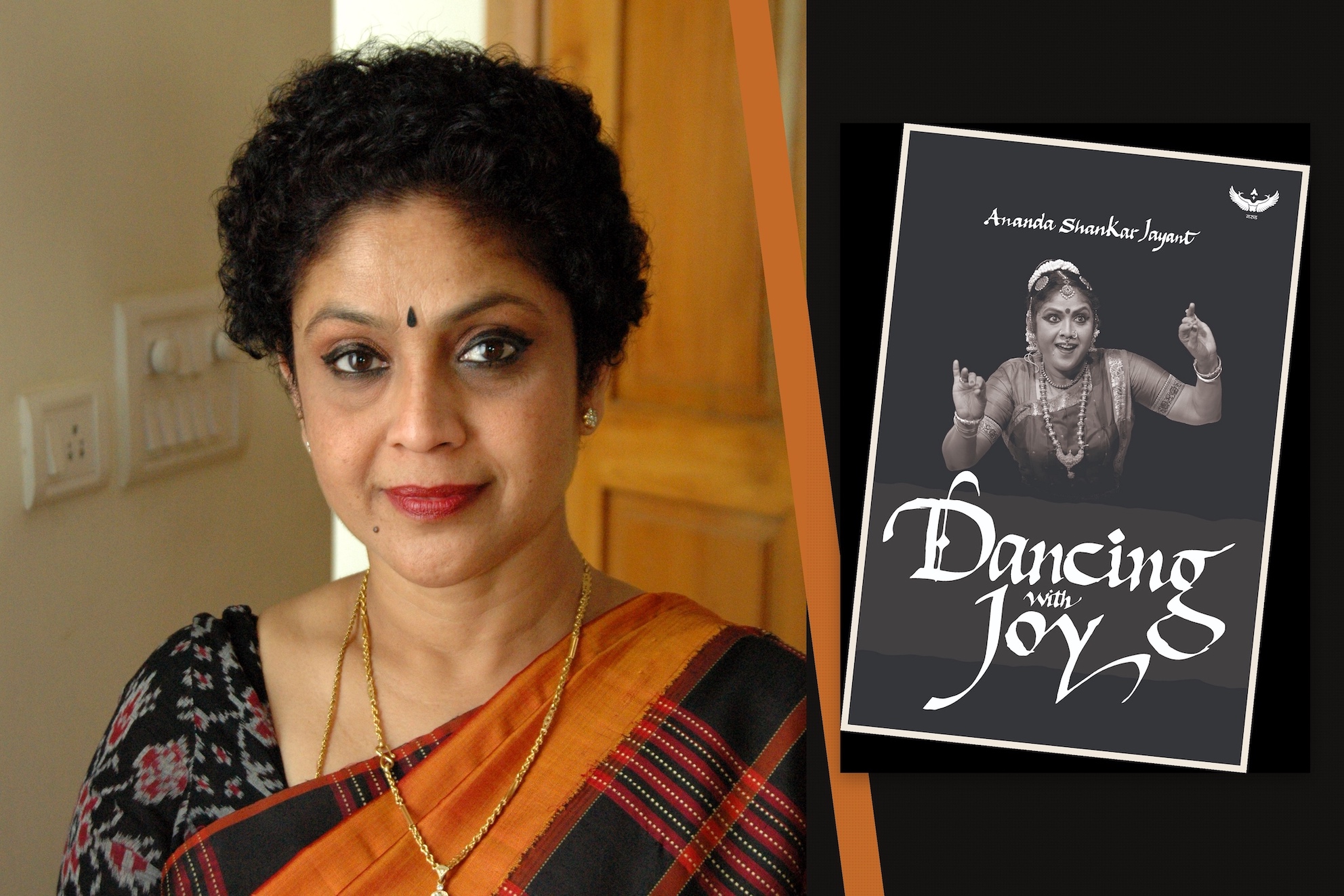
Dancer-choreographer-bureaucrat Ananda Shankar Jayant talks about confronting cancer without allowing it to define her, the changing world of classical dance, the need to support the arts, and the responsibility of passing India’s cultural inheritance to the next generation
Ananda Shankar Jayant’s Dancing with Joy is, at its heart, a memoir about a life in which dance was a way of understanding discipline, resilience and the self. A celebrated Bharatanatyam and Kuchipudi dancer, choreographer, teacher, scholar and beuracrat , Jayant began learning dance at four and joined Kalakshetra at 11, where she trained under the institution founded by Rukmini Devi Arundale. She later founded Shankarananda Kalakshetra in Hyderabad, while also pursuing an academic and professional life that took her into the Indian Railway Traffic Service.
That unusual double life — as an artist and a senior government officer — is central to ‘Dancing with Joy’ (Garuda Prakashan). Jayant spent more than three decades in government service while continuing to work across dance as a performer, teacher, choreographer and scholar. The memoir also confronts the most difficult interruption to that journey: her diagnosis of breast cancer in 2008. Rather than presenting illness as the defining story of her life, the book places it within a much larger account of work, art, family, learning, setbacks and the sustaining force of dance. Its opening assertion, “Dancer is better than Cancer!”, sets the tone for a memoir in which resilience is understood as something cultivated through years of practice.
The book also looks beyond Jayant’s personal journey to her larger concerns about Indian classical arts and cultural education. Her years in government and her life as an artist give her a distinctive perspective on the relationship between art and administration, tradition and contemporary life, and education and cultural inheritance. ‘Dancing with Joy’ argues for taking the arts seriously as part of education and public life, and records her vision for Vidyakalakshetra, an institution in Hyderabad where students could receive a mainstream education while training in the arts under experienced acharyas and professionals.
Much of the journey you describe in ‘Dancing with Joy’ involves discipline, illness, fear, setbacks and starting again. What does “joy” mean to you today? Is it something we find, or something we have to practise?
Every aspect of life centres around discipline. Practising joy is also a discipline of the mind and spirit. Owning joy is a conscious choice! Joy is difficult to enunciate! A state of happiness, of balance and choosing a state of being joyful, finding it around you in the small and the everyday and the magnificent, too. Finding snatches of what brings us joy will then become the bridge to transcend the daily irritations. And soon that will become a habit — of finding joy in the smallest of things. Like all habits, we need to cultivate it.
You entered Kalakshetra when you were very young, and dance has remained at the centre of your life ever since. In the book, you return often to the idea of sadhana. After all these decades, what does sadhana mean to you now? Has it moved beyond dance and become a way of living?
Sadhana is life! We humans are naturally aligned to discipline and sadhana. It is what keeps the wheels of life well oiled. We all do it as daily practice and ritual, of everyday life and learning. A training in any art form teaches you to go to the higher level of practising sadhana. Every aspect of life — be it the personal, social, familial or spiritual — requires that commitment to sadhana. Sadhana is trivialized to mere practice — I believe it is more than that — it is being invested in the process. Sadhana is the spine of every human growth and transformation — and yes, sadhana gives you inordinate courage.
For more than three decades, you lived two demanding lives as a classical dancer and as a senior officer in the Indian Railways. How did you manage those two worlds without treating either as a side interest? And did being an artist make you a different kind of administrator?
Through my 33-plus years of Government service in various, high-stress administrative positions, I continued to engage with dance 360 degrees — as a dancer, teacher, choreographer, arts scholar, and recently as an arts entrepreneur. In retrospect, I see that I brought the systems and structure of bureaucracy to my artist world, and took back the egalitarian and aesthetic world of arts to my office desk! Both my worlds are enriched by the other!
Also read: Tabish Khair on Drown All the Refugees and why ‘home is always in a relationship to leaving it’
I truly believe that these binaries, of chasing your dreams or being responsible, are but constructs of our own mind and society. Should it be work or passion? Life is not an either-or option now, is it? A choice of passion or pension? I said yes to both! The trick here is balance; like a good dancer, between what you love to do, and what you need to do, to keep doing what you love to do.
You begin the book with the striking line, “Dancer is better than Cancer!” Dance clearly gave you enormous strength after your breast-cancer diagnosis. But when you look back now, what were the moments when courage failed you? Was there fear, anger or helplessness that people did not see?
At your office desk, you learn to both lead and follow, and take the moods and idiosyncrasies of fellow workers and not let it get under your skin! Scholarship and being an author teaches you patience, loads of it!
.JPG)
Dance has always been the anchor: Ananda Shankar Jayant
Looking back, yes, there were times when I was trapped in the side show that cancer throws at you. The depletion of physical strength, the visible and perceivable side-effects of the treatment, the wild mood swings — yes, all these affected me, too, like it does to every cancer patient. But then, from that angry and frustrating space, I reached into the wellspring that dance brought to me, and I bounced back.
Your TED talk took a very private experience (cancer) and turned it into a public conversation about fear, the mind and the strength you found in dance. Did speaking about the illness publicly change your relationship with it? And is there anything about that period that you understand differently now than you did then?
From the very first day of learning that I was diagnosed with cancer, I spoke about it. I made three loud affirmations. First, I said, ‘I will ride this out, and I won’t allow the cancer to ride me.’ Second, I said, ‘I will not say, Why me?’. Third, I said, ‘This is only one page of my life and not the book of my life.’ I added one more affirmation to the other three; ‘I will talk about it,’ I told myself.
From the very next day, I called up family and close friends, ‘I’m diagnosed with breast cancer!’ I announced grandly. Silence, shocked voices on the other side, and it was I who was telling them — Hey, it’s ok! With those few phone calls, I unburdened myself from the secrecy that is associated with cancer. Remember, this was 2008. Many in India still didn’t talk about cancer, and even those who were in the know were sworn to secrecy. But I had no patience for this cloak-and-dagger way of life. I have always been forthright and honest in whatever I did.
There was another reason, too. In India, particularly, when families and friends called on a medical patient, almost always, they carry along a long sad face, and have conversations that are even sadder. I have always been an emotional person! Sentimental love stories too can make me cry! I imagined people coming home not knowing what to say or worried that any humour may be misunderstood, and I would end up just being miserable. This I wanted to avoid at all costs.
My quick decision to pick up the phone myself and tell everyone worked like magic. Hearing my cheerful voice put them at ease. This way, whoever came to see me did so with cheerful faces! Speaking at TED was an extension of that. But each person deals with illness differently. There is nothing grand about talking about it or keeping it to oneself. Whatever works for you!
Classical dance comes with a strong tradition of the guru, discipline and years of training. Young dancers today are also growing up with Instagram, short videos, instant visibility and the pressure to build a public profile. What worries you about the way young dancers are being trained today, and what do you think their generation is doing better than yours did?
The young are extremely hard-working. I have students of all generations! A-Z! They are all deeply committed to learning, practising and honing their talent. Also, the guru-shishya parampara is alive and very well! The innate respect for the art and the guru is palpable in the young. Their exposure to myriad artistic inputs, via access to the best of arts through social media, makes them push the bar of excellence. What worries me is the shrinking support to the classical arts from civil society. Films, sports get the big budgets, while the classical arts are sidelined. It is up to us as a society to support our arts and artists — by nurturing artists, artistic endeavours, and creating arts infrastructure.
Much of your choreography draws on mythology, the Ramayana, philosophy and India’s older cultural traditions. At the same time, you have used dance to speak about contemporary questions. How do you keep tradition alive without simply repeating it? Should a classical artist also be willing to question the tradition she inherits?
It’s not ‘mythology.’ It is our ‘Itihasa.’ It is my history and culture that this land has bequeathed to me and to every Bharatiya. Tradition is alive and well — just look around you — it is breathing and living – from our many festivals, arts, way of life – tradition is that flowing river from our ancestors to us and onwards over the future millennia.
What seems contemporary today was yesterday’s tradition. These are just words we box ourselves in! And we ought to revel and be proud of this ancient civilisation that has withstood the test of time. A civilisation that has embraced knowledge and wisdom as its leitmotif and the arts as its soul. During our lifetime on this planet, we are just retainers here, and it is our bounden duty to pass it on to the next generations!
Yes, one is welcome to question! Our civilisation is proof of that. However — I add — one can question when one garners enough knowledge! Else it will be like tilting at windmills!
In recent years you have created platforms such as the Ramayana Kalpavrksam festival and Bharata Uvaca, and in the book you speak strongly about bringing India’s civilisational knowledge to younger generations. At a time when culture can so easily become political, how do you make sure that a conversation about “Bharat” remains open, curious and welcoming to different histories and points of view?
We owe our young the correct history! Not the convoluted or truncated history. Truth is truth. It ought not to be white-washed, and I think that is what we owe to the young.
You argue in the book that people who make decisions about arts and culture, including administrators, need a much deeper understanding of the arts. You have seen the system both as an artist and from inside government. What is India still getting wrong in the way it supports culture? If you could change the system, where would you begin?
In-depth training of administrators in our arts and culture. Support to the arts by corporates and media. I always wonder, why is there no time for arts on national television? When we were young, Doordarshan had the weekly National Programme that was telecast at prime time — where is it now? What about print and digital media? Can they ask themselves how much space/time they allot to culture? Creating world-class infrastructure. Introduction of arts as an essential part of education. Arts and culture belongs to the nation — we all need to shoulder it.
Retirement did not really make you retire: you continued teaching, performing, choreographing, travelling and building new cultural projects, even after another serious health scare. At this stage of your life, what remains unfinished? Is there one dream — an institution, an idea, a body of work — that you feel you still have to make happen?
One as yet unfulfilled dream is of creating an institution — a place where a student could receive a ‘normal’ school education, even as they honed their artistic talent under acharyas and professionals. I am still hopeful that this dream of setting up a world-class arts institution for Hyderabad will become a reality.
Presently, there are many national institutions, such as IITs, IIMs, medical and technical educational institutions, that prepare our youth for stunning careers. Cultural institutions such as Kalakshetra, on the other hand, prepare a child for life. However, we don’t have any leading institution that prepares a child for both a career and life. Existing national institutions exist in silos, catering to any one stream of learning.
For a developed, educated, knowledge-based society, nurturing strong roots in the cultural ethos of the nation is an imperative. With a rising and confident nation, Indians are now slowly shedding their colonial cloaks, and are yearning to discover and learn from the wealth of India’s centuries-old cultural heritage.
My vision: Integrating modern education with cultural knowledge, where sanskriti and sanskar. To establish Vidyakalakshetra — a vidyalaya which is also a kalakshetra. Vidyakalakshetra to be world-class — equipped with state-of-the-art learning tools, wherein the students live with maestros to learn and hone their passions even as they receive their basic mainstream education.
More from The Byword

Comments
*Comments will be moderated