








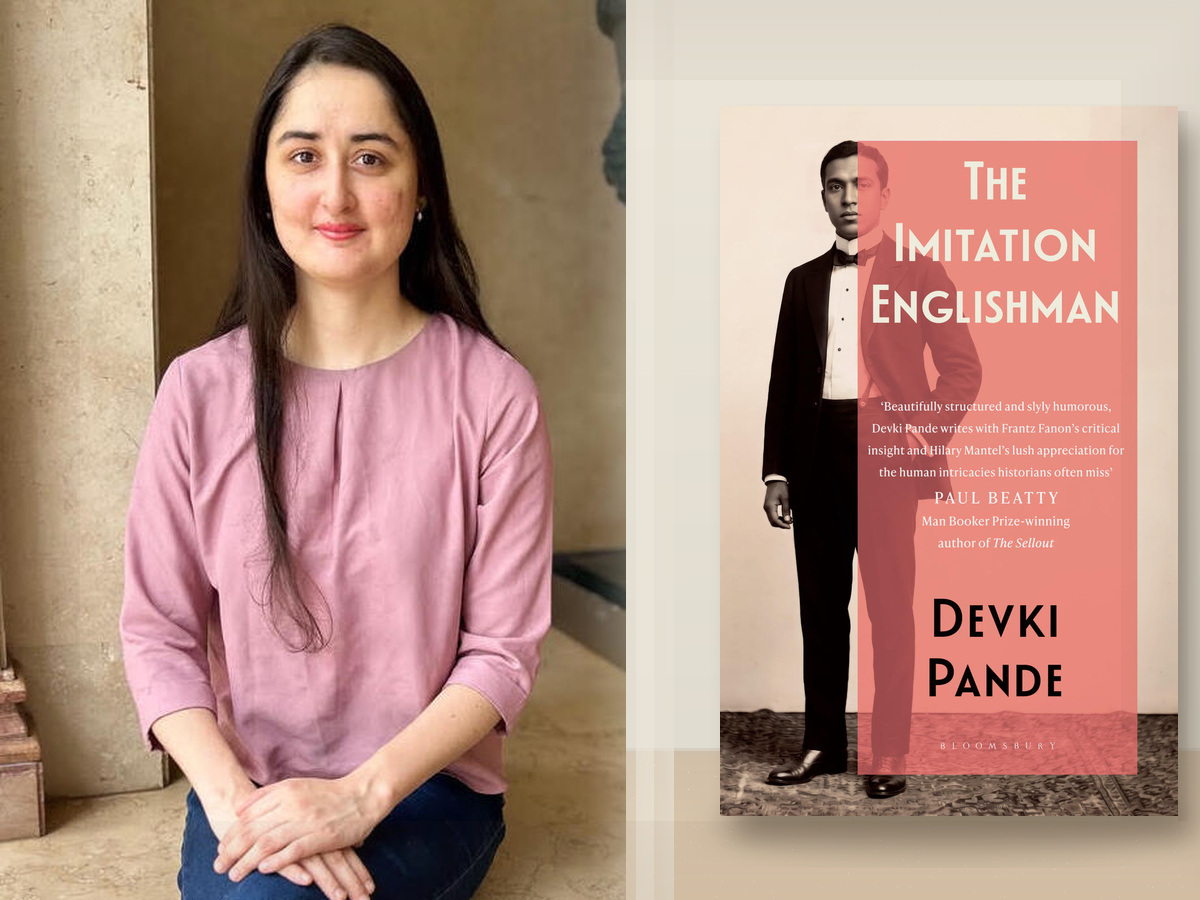
The writer-producer on her debut novel — ‘a historical fiction novel inspired by the heroes’ journey of a fantasy novel’ — writing from a gap in her own family history, the uneasy politics of empire and revolution, language and belonging, and finding her voice as a novelist
In 1916, Madhusudan Chandra Joshi, a young clerk from Almora, leaves India for Heidelberg to study law, hoping that education will open up a different future. A chance encounter with Amir Farooqui, a committed revolutionary, draws him towards the Hindu-German Conspiracy, the transnational attempt by Indian nationalists, with German support, to challenge British rule during the First World War. As the war closes in, the two men take different paths. Madhusudan heads to London to continue his studies, while Amir travels to San Francisco and deeper into the revolutionary network.
Pande’s debut, The Imitation Englishman (Bloomsbury), began with the largely unspoken European years of her own great-grandfather, but the novel soon grows beyond family history. Through Madhusudan’s uncertain political awakening, it looks at race and colonial power, the uneasy promise of English education, class among Indians abroad, the sacrifices hidden inside families, and how the idea of home changes once someone has travelled far enough to see both home and himself differently. The novel’s historical scale is held together by a young man slowly realising that, as Pande writes, the world is “much bigger than his own heart”.
In this interview to The Punch Magazine, Pande, known for City of Dreams (2019), Criminal Justice (2019) and Rudra: The Edge of Darkness (2022) as producer, speaks about turning inherited family memory into fiction, why hunger complicates lofty ideas of freedom, Madhusudan’s movement from uncertainty to conviction, and the precarious choices available to Indians caught between Britain and Germany. She also talks about losing and recovering languages, writing historical truth without being trapped by fact, what prose gives her that screenwriting cannot, and the fantasy writers who unexpectedly helped her shape the novel. Excerpts:
What did you discover about your great-grandfather while researching the novel that surprised you or changed the way you had always thought of him? Also, did you ever discover something about Madhusudan, your fictional character, that made you look differently at your great-grandfather?
So if someone existed decades ago, we naturally assume that the difference between us and that person is in decades. In my head, badebaju is immortalised and frozen at 40 years old. But writing the novel made me realise that my great-grandfather was 21 at one point as well, with many similar doubts about his place in the world. I knew of him as stern, austere, almost frightening in his accomplishments. But he had been a kid once as well. A kid trying to make a life for himself, in the middle of a war-torn world. Looking at the state of the world, that was when I realised — maybe there isn’t such a gulf between us. Maybe we went through the same things at similar points in our lives. Obvious really, but it was a revelation to know that people who you’ve heard of as fables and myths had the same doubts and questions that you do.
You begin the novel with Amir trying to recruit Indian prisoners of war in a German camp. Some are prepared to listen to him, while others still feel loyal to the British Army. One soldier tells him that they have had enough of extraordinary causes and simply want to go home. What interested you about beginning the story with these men? When someone has already fought a war, lost his freedom and barely has enough to eat, what does another man’s promise of freedom mean to him?
Chronologically, this scene happens first, although isn’t why I made it the prologue. But I felt that starting the novel off with this scene sets the stage for the world that Madhusudan is about to enter, and the triangulation of Britain, Germany and India right at the get-go.
What interested me about the opening scene was how freedom is such an arbitrary concept for people who are cold and hungry. When there are famines, or there isn’t enough food to eat, but you tell someone that they’re free, or not free — what does that mean exactly? Later on, once wars have been won, people always claim that they did something because it was the right thing to do, or the call of the motherland was simply too insistent for them to refuse. But in that moment, when the choice is between a blanket and a chicken leg versus a cold, rainy hut: what’s the reason what you’re choosing what you’re choosing?
Madhusudan’s brother Mrityunjay joins the British Indian Army and takes on the family’s responsibilities so that Madhusudan can have a different life. By the end of the novel, we understand just how much he has sacrificed for his younger brother. Were you interested in the private reasons that can lead someone to serve an empire? And how did you approach the relationship between two brothers whose lives take such different courses, although each is trying, in his own way, to secure a future for the family?
More than the private reasons that would lead someone to serve an empire, it was about the things that Mrityunjay felt he had to do, in order to make sure Madhusudan had everything he needed to fulfil his potential. If Mrityunjay could have done something else, he would have, but being a sepoy was what was available, since the choices for Indians were so few in 1916. The idea of responsibility and someone shouldering a burden that they don’t have to, so that the person they love can take a shot at the world was fascinating to me.
Also read: Shivani Sibal on Moms: ‘We must not just live a good life, but actively appear to be doing so’
When I started talking to people, I realised that many families have a great-grandfather who went to Europe to study law, or engineering, and then returned to India, with his experience directing changes in the family. But he — and Madhusudan — wouldn’t have been able to go abroad if there wasn’t a brother or a sister who supported him, or a community of people who pooled together money to finance the trip. Mrityunjay is a representation of the idea that Madhusudan couldn’t have done it by himself, no matter how brilliant he is. It’s also a homage to my own sibling. I have a twin sister, but my entire life, she’s always looked out for me, and it’s one of the reasons I’ve been able to walk on the road not taken.
There is a passage in which Madhusudan reads the letters Amir has given him about the Conspiracy and realises that the world is “much bigger than his own heart,” and that there are other things to care deeply about. He has spent much of his life worrying about his studies, his family and his own future. What does it take for someone like him to begin caring about people he has never met? And how does that new sense of responsibility change the way he understands his own life?
Madhusudan’s arc was what I found the most difficult to write. Even during my post-grad, when I submitted drafts to my seminars, the question I kept getting was that Amir seemed the more potent character to follow, because he knows exactly what he wants. Madhusudan, on the other hand, doesn’t know what he wants, which is why the Germany section was so difficult to write. But that was also the point of the novel: following a character who moves from uncertainty to certainty.
The octave-shift took me a while to figure out. Pivots don’t happen in vacuums; there’s a build-up of pressure, and that’s when I realised that in those parts, I had to draw in Madhusudan’s past and everything in his life that he has chosen to ignore for the sake of mental peace. But silence isn’t peace, and it takes Amir’s barbs to make Madhusudan finally admit it to himself. For Madhusudan’s journey, it’s similar to the idea that with any amount of power, comes a degree of responsibility. He is in a position to move the lever, but he’s been choosing to ignore that it exists. Until he can’t anymore.
Like a snowball effect. Once the snowball is formed, it gathers momentum on its own. But for the snowball to even be created in the first place, there has to be snow, and wind, and a slope. Creating the metaphorical snow and wind and slope was what took me a bit of time to figure out.
The Hindu-German Conspiracy brings together Indian revolutionaries working across several countries, with Germany supporting their efforts against Britain during the First World War. Amir knows that the Germans have their own interests, and that their support comes with expectations. How did you approach this difficult relationship while writing the novel? What happens to a struggle for freedom when the people supporting it have their own plans for the country they are trying to free?
The idea of finding allies when your own country isn’t even recognised as sovereign was something I really wanted to explore. So what I kept thinking about was — as an Indian abroad at that time, if you got into a fix, what embassy would you go to? Who has your back? And when I considered that question, was when I realised how truly precarious the whole situation was.
For people like Amir and Bhagwan Singh, picking an ally is choosing odds that are never going to be in your favour. You could be optimistic about it, sure, but everyone who you deal with at a political level knows that when you come from a country that is a colony, there is no leverage. If Germany reneged on a deal, there would be no accountability: as they’ve learned under the British. There is no international blowback. But what makes the Hindu-German conspiracy so interesting is that it was helmed by people who probably knew that it was doomed to begin with: they were all students of law, philosophy and history. They knew that the movement would fail.
But they went ahead with it because of the recognition that every step forward, no matter how infinitesimal, is still a step forward. Sometimes, you do something because it is the only thing to do, even though you know from the get-go that you will never win. You do it just to show people that it is possible — like the Cockroach Janta Party protests, for example. And although the Hindu-German conspiracy failed, it set the stage for future victories. Subhas Chandra Bose cited the Hindu-German conspiracy as a major influence on his own ideology.
Your grandfather’s loss of Kumauni, the language he once spoke with his mother, gave you the title The Imitation Englishman. In the novel, English can open doors, but the way someone speaks can also reveal where they stand in society. Madhusudan’s education gives him opportunities that many other Indians in Britain do not have. How did you think about language while writing these different Indian lives? And did writing the book in English make you think differently about your own relationship with the languages you have inherited?
I was so conscious of the irony of writing a novel titled The Imitation Englishman, in English. I’m fluent in Hindi, but definitely not as a writer, only as a speaker. The language is something that I’ve had to excavate from within me. I’ve told people that it feels like archaeology, because I dig and I dig, and then suddenly a barrier collapses and there are words gleaming within like half-buried Roman coins. Dusty and forgotten from disuse. They’re there, but they’re not brimming right at the tip of my tongue like English. I have to work to bring the language up to the surface.
Also read: Pia Ghosh-Roy on And I Am the Arrow: ‘I wanted to excavate the inheritance of invisible things’
And this idea is cultivated by community, too. Even as a student, when I told people that I wanted to write books and write prose, the first reaction of many of my Indian mentors was that they hoped that I was writing in English.
While a writer of novels, I’m also a producer in the Hindi film industry, where we’re constantly on the hunt for writers who have a spectacular command over Indian languages. But when written screenplays go to platforms and studios for review, the expectation and requirement is that they come in Romanised Hindi, for ease of reading.
So, in India, there’s a separation between fluency in speaking and writing. We demand fluency in speaking Indian languages because that’s how any work will get done, but not necessary in the literacy of the script, at least at a white-collar level. Even though they’re not different things. It’s an interesting conundrum.
The men in the novel travel across continents, take part in political movements and make decisions that change their lives. But I was also interested in the women, particularly Vimla, who remains in India, and the women Madhusudan encounters in London. Their opportunities and expectations are very different from those of the men around them. How did you approach their lives while writing a story centred on two young men? Were there parts of their experiences that you wished you could have explored further?
For me, writing is about satisfying my own curiosity. I write until I’m done being curious. And although the premise of the novel is specific, my interest in the world was of a much broader nature: I wanted to know more about the lives of the different kinds of Indians who existed during the 1910s/World War I period. Although my protagonist is singular, his journey consists of interactions with other Indians — the title ‘the Imitation Englishman’ is meant to serve not just as a description of him, but also an anthropological portrait of all the Indians Madhusudan meets once he sets off on his journey.
The more I read, the more curious I got. I read about lascars, about ayahs who were set up on Jewry Street in London, whose passports were kept by their English mistresses. I read about Indians who had left India for London much earlier, as part of household staff for English landed gentry, and I wondered what their descendants would be doing on the Continent. It was actually difficult to stop writing, but for the sake of cohesion and to keep the novel at reasonable length, I had to decide on an end point, and keep some of the stories for a sequel. So I made an executive decision to restrict Book I to Imitation Englishmen in Europe.
The sequel, in fact, builds on more. I’ve gotten a review about how the novel has not written other famous Indians who were in London at that point of time, and when I read that critique, all I could think was — wait for the sequel!
The novel shuttles between Madhusudan’s experiences in Heidelberg and London and Amir’s involvement in the revolutionary movement, including the events in San Francisco. You also bring real historical figures into a story whose central characters are fictional. How did you decide when to stay close to Madhusudan and when to follow Amir? And when the historical record gave you a particular event or a real person, how did you work out how much freedom you had to imagine the conversations and private lives around them?
Even though it’s a World War I novel, I didn’t want the facts to come in the way of the truth. That being said, the novel is grounded in a lot of research, and the world is accurate. But whenever there came a choice between fact versus the story I wanted to tell, I chose the story. That was how I made most of the decisions. It was quite intuitive, actually.
You have spoken about how storyboarding helps you when a scene is difficult to write. But some of the most affecting passages in the novel are centred on a letter, a pair of shoes, food offered to hungry soldiers, a chess piece in Madhusudan’s pocket; these small things begin to mean more as the story progresses. How do you know when a detail deserves that kind of attention? And what did writing this novel teach you about what prose can express that might be harder to capture on screen?
There’s a quote which says that when an event is huge and overpowering, like war, you write small. You write about a child’s shoes left on the side of the road. While I read this quote much after I had written a fair bit of the novel, I knew that capturing the effects of great historical incidents, or of heart-wrenching separations could only be felt if they’re personified. And you decide which detail deserves this attention by how important it is to the character. Madhusudan isn’t going to see his brother for years; the chess piece becomes a symbol of that bond. Food offered to hungry soldiers is a simple act, but when you consider the context it becomes something more.
But scenes are rarely as mathematical as that and when I was writing these details, I didn’t think about story writing or screenwriting principles — it just felt natural that Madhusudan would have a keepsake from home; it felt authentic that letters become a prized commodity at a time when communication is restricted. Ultimately my litmus test for a passage or a scene affecting the reader is that, it has to affect me first. If it’s boring for me to write, it’s going to be boring for anyone to read.
In terms of the difference between prose and screenplays, I’ve written screenplays, but I love prose because it really allows you to play with language in a way that is superfluous in a screenplay. It allows for a great deal of interiority, it allows you to really meditate on words and languages. In fact, what prose is to a novel, I would say cinematography is to film and screenwriting.
The final chapter and the epilogue bring Madhusudan back to Almora, but the homecoming is very different from the return he might once have imagined. The town has changed, and even those who knew him struggle to recognise the man who has come back. You describe him having to learn his land once again. What interested you about ending the novel at this point? After everything he has experienced abroad, how does he begin to understand what home means to him now? And what remains of the young man who left Almora three years earlier?
It was Tolstoy who said that all great literature is one of two stories. A man leaves on a journey, or a stranger comes to town. The novel begins with Madhusudan going on a journey. The homecoming was a full circle moment for me, but it’s more nuanced because once you leave home, it ceases to be your home. I’ve experienced that as well — once I packed my bags and left, returning is not the same. In the shadow of the war, Madhusudan has changed completely from the man who left, and even Almora has changed irrevocably. He’s not returning home, but a stranger coming to town. I thought it was very poetic to leave it off there — an ending that feels like a new beginning.
Since The Imitation Englishman is your debut novel, I’d love to know how you found your voice as a writer. How did you work on the language and the sentences, and how did you know when a passage was saying exactly what you wanted it to say? Also, have you been particularly fond of some prose writers who might have been an influence or unwittingly been at the back of your mind while writing this novel?
Finding one’s voice as a writer is basically writing and rewriting until what you set down on the page feels true. It’s a lot like moulding, clay until the shape and form feels right. The only technique is that I kept on writing until what was in my head and what was on the page were aligned.
I read and re-read a lot of Jhumpa Lahiri while drafting the novel. But I also am a big fan of high fantasy, and I read a lot of Robert Jordan and Brandon Sanderson, Naomi Novik, and David Eddings whenever I went through a writer’s block or encountered a difficulty in the drafting process. Not just because there’s a lot to learn from their immersive and meticulous world-building, but also because I wanted The Imitation Englishman to be a historical fiction novel inspired by the heroes’ journey of a fantasy novel. I hope I’ve been successful in that!
More from The Byword






Comments
*Comments will be moderated