








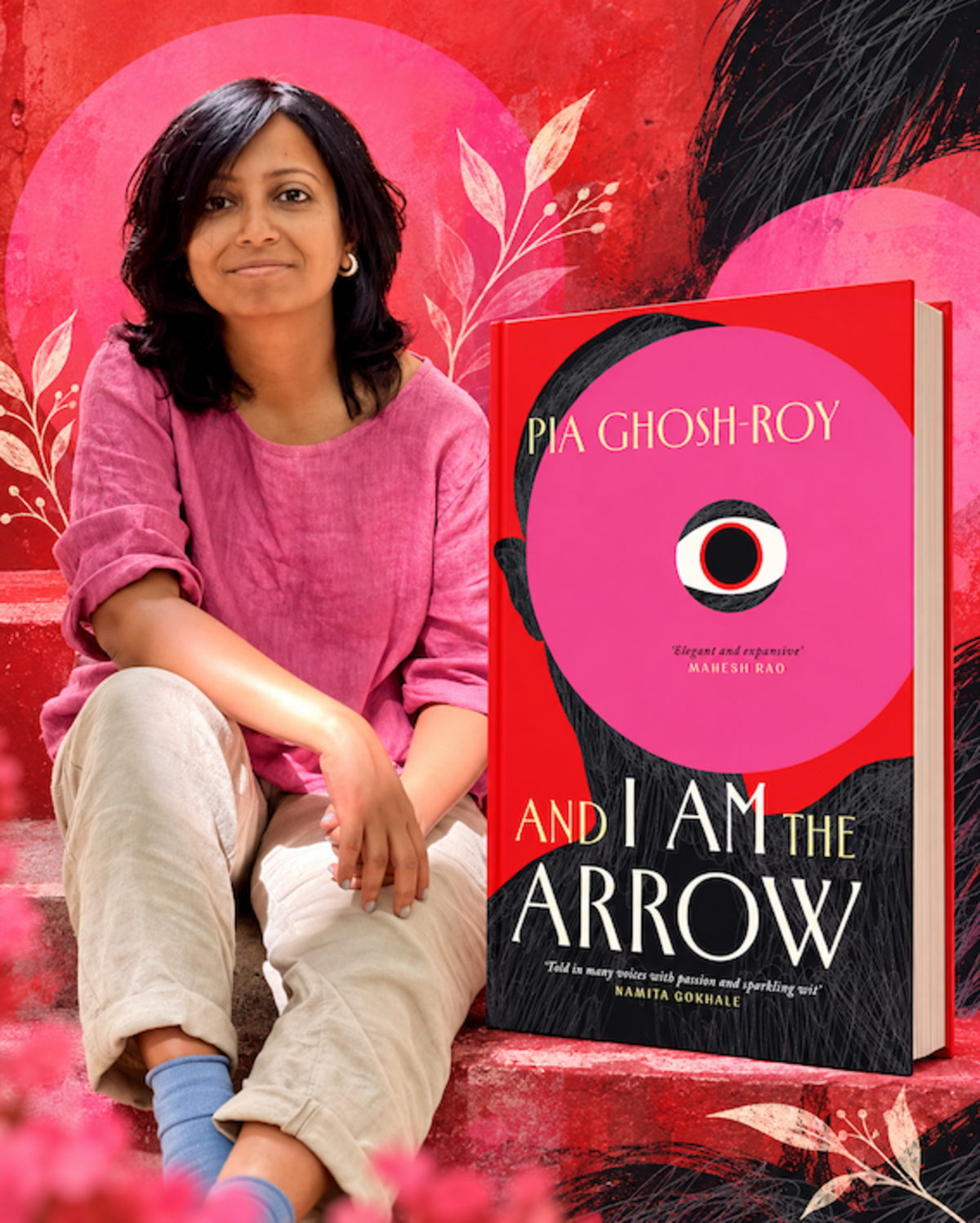

The Calcutta-born and Cambridge-based author talks about the “unspokens” families pass down, the shifting voices of And I Am the Arrow, and why we may never fully know even those we love most
Pia Ghosh-Roy’s debut novel, And I Am the Arrow (Pan Macmillan/Picador), is a family story that keeps changing shape as you read it. Set across Calcutta, London and New York, it careens through decades and generations, but its real home is Chatterjee Mansion, the 1940s Art Deco house where Mishu returns as her grandmother Niyoti lies in a coma. Around them are Mishu’s mother Ira and Bani, the woman who has spent years inside this household without ever quite belonging to it. As old stories begin to shift, so does Mishu’s understanding of the people who made her.
Ghosh-Roy grew up in Calcutta (now Kolkata) and currently lives in Cambridge, England. Before turning to fiction, she worked as an advertising copywriter for nearly a decade; her short fiction went on to win the Hamlin Garland Award and the Cagibi Macaron Prize, alongside recognition from several international short-story prizes. That ear for rhythm and compression is everywhere in the novel, particularly in the very different voices she gives her characters, and in the playful, sometimes philosophical interventions of Opor/Neech, the dead man who exists outside ordinary time and helps hold the story together.
What makes And I Am the Arrow more than a family saga is the way it keeps asking what families do with the things they cannot say aloud. Niyoti is sharp, funny, difficult and larger than life; Ira initially seems quieter, almost lost beside her; Bani occupies an uneasy space between employee and intimate; and Mishu is trying to understand herself through women whose lives she only partly knows. History, too, keeps entering the house (including the Bengal famine and the political upheavals of twentieth-century India) but Ghosh-Roy largely lets us feel those events through what they do to private lives.
There is also something deliberately unruly about the book. The dead speak, time refuses to move neatly forward, points of view shift, and people who first appear peripheral gradually claim the centre of the story. The title comes from Sylvia Plath’s Ariel, and that shifting “I” feels apt since the novel repeatedly asks who owns a story, who has been allowed to tell it and what happens when someone who has stayed silent finally speaks. Beneath its secrets and revelations lies the idea that love does not necessarily mean knowing another person completely, and that the people closest to us may always retain a life beyond the version of them we carry in our heads.
In this interview to The Punch Magazine, Ghosh-Roy talks about the uneasy space between intimacy and individuality, how Niyoti and Ira grew beyond the roles she first imagined for them, the shifting power between Niyoti and Bani, the freedom Opor/Neech gave her to play with language and structure, and the “unspokens” families pass down, experiences and wounds that shape us long before we fully understand them. Excerpts:
At one level, And I Am the Arrow is a big family story but it seems to ask how well do we really know the people closest to us, especially our mothers and grandmothers? When you began writing it, what was the story you most wanted to get at?
Intimate is the right word. I wanted to explore the liminal space between the ‘intimate’ and the ‘individual’. It is a space that is both blurred and sharp, fraught and essential, nourishing and depleting.
How do these co-exist, how does the intimate alter the individual? What happens to the outlines of two individuals when they’re held within the larger shape and boundary of an intimate relationship? What parts of their realities do they share with each other, what do they hold back, and which elements do they tweak to suit the expectations of the other? And in doing so, how do they reshape their own outline, their own individuality, and, in time, their own reality?
And given all of this, how does one come to terms with the fact that they can never really, wholly know anyone, not even their closest people? How do we hold that truth — while keeping both the ‘intimate’ and the ‘individual’ intact? Because the nature of those two experiences, of the ‘I’ and of the Intimate, constantly shapeshift as they rub against each other. More that wanting to get at a story, I wanted to consider these questions. The story was a means to that end.
Mishu comes back to Chatterjee Mansion just as Niyoti, her grandmother, falls into a coma. She is also carrying the grief of losing her father when she was eight, and there are things about his life and death that have never really been spoken about. Why was Mishu the right person through whom to start opening up this family’s past?
And I Am The Arrow initially started off as a single-narrator story — there was only Mishu, none of the other characters existed, so at that point the choice was quite simple. I thought it would be the story of a granddaughter who, after her grandmother’s death, finds a box of letters and documents and embarks on a journey into her grandmother’s unknown past, as well as into her own self.
When the novel begins, Mishu is in her twenties, standing at a crossroad that she’s at odds with, angry with herself, angry with the world, struggling to figure things out — and the most natural place to look at, when we’re looking to understand ourselves, is our childhood and the people who made us who we are. In Mishu’s case, her childhood started and ended with her grandmother, Niyoti.
At one level, And I Am the Arrow is a big family story but it seems to ask how well do we really know the people closest to us, especially our mothers and grandmothers? When you began writing it, what was the story you most wanted to get at?
Intimate is the right word. I wanted to explore the liminal space between the ‘intimate’ and the ‘individual’. It is a space that is both blurred and sharp, fraught and essential, nourishing and depleting.
How do these co-exist, how does the intimate alter the individual? What happens to the outlines of two individuals when they’re held within the larger shape and boundary of an intimate relationship? What parts of their realities do they share with each other, what do they hold back, and which elements do they tweak to suit the expectations of the other? And in doing so, how do they reshape their own outline, their own individuality, and, in time, their own reality?
And given all of this, how does one come to terms with the fact that they can never really, wholly know anyone, not even their closest people? How do we hold that truth — while keeping both the ‘intimate’ and the ‘individual’ intact? Because the nature of those two experiences, of the ‘I’ and of the Intimate, constantly shapeshift as they rub against each other. More that wanting to get at a story, I wanted to consider these questions. The story was a means to that end.
Mishu comes back to Chatterjee Mansion just as Niyoti, her grandmother, falls into a coma. She is also carrying the grief of losing her father when she was eight, and there are things about his life and death that have never really been spoken about. Why was Mishu the right person through whom to start opening up this family’s past?
And I Am The Arrow initially started off as a single-narrator story — there was only Mishu, none of the other characters existed, so at that point the choice was quite simple. I thought it would be the story of a granddaughter who, after her grandmother’s death, finds a box of letters and documents and embarks on a journey into her grandmother’s unknown past, as well as into her own self.
When the novel begins, Mishu is in her twenties, standing at a crossroad that she’s at odds with, angry with herself, angry with the world, struggling to figure things out — and the most natural place to look at, when we’re looking to understand ourselves, is our childhood and the people who made us who we are. In Mishu’s case, her childhood started and ended with her grandmother, Niyoti.
Also read: Shivani Sibal on Moms: ‘We must not just live a good life, but actively appear to be doing so’
But even with Mishu as the narrator, Niyoti’s presence in that first chapter was so loud and clear that after writing it, I knew that Niyoti would not die; at least, not anytime soon. She demanded the space to tell her own story. The other characters too arrived in their own time, and spoke up in their own way, as the story emerged and grew.
Niyoti is such a vivid presence. We first meet this woman who drinks Scotch at half past six, dresses beautifully, fights with Bani, makes cutting remarks to Mishu and refuses to care what the neighbours think. Yet there is much about her life that Mishu doesn't know. Were you interested in the gap between the grandmother a child thinks she knows and the woman who existed long before she became somebody's grandmother?
Every woman I’ve ever known has lived an inner (and outer) life rich enough for a novel. But, where men are easy with their anecdotes and retellings of youth — confident that their stories are interesting and entertaining to the room, worthy of the time and attention of others — women can live an entire life assuming the opposite. They can live an entire life never taking up that space, never centering themselves during an evening’s conversation. They can take all of their rich and fertile thoughts, imagination and lived experience to the grave with them and think nothing of it. Why?
Why are they the listeners, applauders and head-nodders in the room, sitting tight on a wealth of stories? In what insidious ways do society and patriarchy take away the safe space for them to tell those stories? To share their experiences and opinions, feats and foibles? Because the truth is that women don’t keep it to themselves without reason. Their stories are shared with those who earn their trust, whether boy or girl, man or woman. It’s the room that must be worthy. I’ve grown up around very strong women, from all walks of life. So, to have women, and their minds, be slap bang in the centre of my novel felt like the most natural thing in the world.
Ira initially appears much quieter than Niyoti, almost as though she has spent years fitting herself around other people. You’ve said that while writing the novel you realised she wasn’t simply the quiet, sacrificing, obedient woman you had first imagined. What changed when you began allowing Ira to speak for herself?
When Ira first came to me, she was very much a ‘character’, almost a stock character. It’s how she presented herself: quiet, submissive, with a tone-of-voice that was hesitant, almost apologetic. A contrast and foil to Niyoti and Mishu, as if that was her raison d'être within the story. But even as I began to write her first chapter, I could sense that she was on the cusp of some kind of transition; like many women in their forties, she was beginning to question things, to seek Purpose. So, in a way, I’d always known that Ira would ‘emerge’ from the shadow, though I didn’t know the How and When. Through her I wanted to explore and recognise the many women who do not have much power within the home but quietly steer their lives and make changes that have its own impact.
What I didn’t foresee, however, is her past — because as writers, we have the strange gift and power of doing that on the page. And I didn’t know the ways in which she would slowly release that backstory. How she wasn’t just waiting for me to make her ‘emerge’, but had already done her emerging in ways I had not envisaged when I started writing her.
Bani is called the servant of the house, but Mishu describes her as the centre of all her “abdaar” — affection, demands, complaints and tantrums. And the exchanges between Bani and Niyoti can be affectionate and savage within seconds. What interested you about a relationship that is clearly shaped by class but has also become much more complicated and intimate over the years?
For me, one of the most interesting elements of writing this novel, especially as it developed and became its own creature, was getting into the weave of the fabric of Bani and Niyoti’s relationship. All intimate relationships are complex — but what happens when class is at the core of one? How do two people navigate the space between class and closeness? There is mutual dependency, and a mutual mindfulness of that dependency — hence, given time, the lines of hierarchy can blur.
The centre-of-power shifts between Niyoti and Bani constantly as the story progresses. At the beginning, the one with loud and obvious power is Niyoti. But when someone is very aware of their own power, does that awareness make them underestimate the power of others? And when they do, how might it limit them, make them short-sighted?
Bani stands in the shadows, essential but invisible. From a young age she has been trained to serve and not be seen or heard. But what happens when the one standing in the shadow decides to speak? Could invisibility have been their strength all along? Could silence be a form of power that is, in a way, just as loud? Those were fascinating questions for me to explore.
Then you bring in the ghost of a man who has been cut in two on a railway track and give him a voice of his own. The women are trying to understand the past from inside the family, while the dead can see it from somewhere else entirely. What did the ghost allow you to say or see that Mishu, Ira and Niyoti couldn’t?
What the ghost, Opor/Neech, really allowed me to do was…have fun. Fun with the language: its grammar and syntax, its rhythm, its idiosyncrasies. Writing Opor/Neech was my playtime. Also, and just as importantly, he allowed me an immediate intimacy with the reader, and let me bring in an element of ‘adda’ into the novel. He holds this large story together, and, hopefully, becomes the reader’s guide and companion as it all unfolds.
In terms of structure, Opor/Neech is the scaffolding I needed to support this narrative’s complex architecture. He is someone who exists outside the constraints of Time and sees the past, present and future all at once — and having that in mind helped me execute the non-linear structure of the novel in the way I saw it in my head.
The novel spans a long stretch of twentieth-century history, including the Bengal famine of 1943. You’ve said you wanted the politics of the city and country to remain in the background while we feel their effects through the relationships. How did you decide when history needed to come forward and when it was better understood through what was happening inside this family?
When I started writing this novel, what I wanted to do was explore the politics of intimacy and the politics of memory: how we tweak, shape, and change both — often without intention or premeditation — in order to live and love the best we can. As the story began to breathe on the page, what came in organically was the politics of geography and governance. It’s a story that spans several decades and navigates times of great flux – that history not only shaped the characters but also the larger arc of the narrative in ways I had not foreseen at the start.
Every woman I’ve ever known has lived an inner (and outer) life rich enough for a novel. But, where men are easy with their anecdotes and retellings of youth — confident that their stories are interesting and entertaining to the room, worthy of the time and attention of others — women can live an entire life assuming the opposite. They can live an entire life never taking up that space, never centering themselves during an evening’s conversation. They can take all of their rich and fertile thoughts, imagination and lived experience to the grave with them and think nothing of it. Why?
Why are they the listeners, applauders and head-nodders in the room, sitting tight on a wealth of stories? In what insidious ways do society and patriarchy take away the safe space for them to tell those stories? To share their experiences and opinions, feats and foibles? Because the truth is that women don’t keep it to themselves without reason. Their stories are shared with those who earn their trust, whether boy or girl, man or woman. It’s the room that must be worthy. I’ve grown up around very strong women, from all walks of life. So, to have women, and their minds, be slap bang in the centre of my novel felt like the most natural thing in the world.
Ira initially appears much quieter than Niyoti, almost as though she has spent years fitting herself around other people. You’ve said that while writing the novel you realised she wasn’t simply the quiet, sacrificing, obedient woman you had first imagined. What changed when you began allowing Ira to speak for herself?
When Ira first came to me, she was very much a ‘character’, almost a stock character. It’s how she presented herself: quiet, submissive, with a tone-of-voice that was hesitant, almost apologetic. A contrast and foil to Niyoti and Mishu, as if that was her raison d'être within the story. But even as I began to write her first chapter, I could sense that she was on the cusp of some kind of transition; like many women in their forties, she was beginning to question things, to seek Purpose. So, in a way, I’d always known that Ira would ‘emerge’ from the shadow, though I didn’t know the How and When. Through her I wanted to explore and recognise the many women who do not have much power within the home but quietly steer their lives and make changes that have its own impact.
What I didn’t foresee, however, is her past — because as writers, we have the strange gift and power of doing that on the page. And I didn’t know the ways in which she would slowly release that backstory. How she wasn’t just waiting for me to make her ‘emerge’, but had already done her emerging in ways I had not envisaged when I started writing her.
Bani is called the servant of the house, but Mishu describes her as the centre of all her “abdaar” — affection, demands, complaints and tantrums. And the exchanges between Bani and Niyoti can be affectionate and savage within seconds. What interested you about a relationship that is clearly shaped by class but has also become much more complicated and intimate over the years?
For me, one of the most interesting elements of writing this novel, especially as it developed and became its own creature, was getting into the weave of the fabric of Bani and Niyoti’s relationship. All intimate relationships are complex — but what happens when class is at the core of one? How do two people navigate the space between class and closeness? There is mutual dependency, and a mutual mindfulness of that dependency — hence, given time, the lines of hierarchy can blur.
The centre-of-power shifts between Niyoti and Bani constantly as the story progresses. At the beginning, the one with loud and obvious power is Niyoti. But when someone is very aware of their own power, does that awareness make them underestimate the power of others? And when they do, how might it limit them, make them short-sighted?
Bani stands in the shadows, essential but invisible. From a young age she has been trained to serve and not be seen or heard. But what happens when the one standing in the shadow decides to speak? Could invisibility have been their strength all along? Could silence be a form of power that is, in a way, just as loud? Those were fascinating questions for me to explore.
Then you bring in the ghost of a man who has been cut in two on a railway track and give him a voice of his own. The women are trying to understand the past from inside the family, while the dead can see it from somewhere else entirely. What did the ghost allow you to say or see that Mishu, Ira and Niyoti couldn’t?
What the ghost, Opor/Neech, really allowed me to do was…have fun. Fun with the language: its grammar and syntax, its rhythm, its idiosyncrasies. Writing Opor/Neech was my playtime. Also, and just as importantly, he allowed me an immediate intimacy with the reader, and let me bring in an element of ‘adda’ into the novel. He holds this large story together, and, hopefully, becomes the reader’s guide and companion as it all unfolds.
In terms of structure, Opor/Neech is the scaffolding I needed to support this narrative’s complex architecture. He is someone who exists outside the constraints of Time and sees the past, present and future all at once — and having that in mind helped me execute the non-linear structure of the novel in the way I saw it in my head.
The novel spans a long stretch of twentieth-century history, including the Bengal famine of 1943. You’ve said you wanted the politics of the city and country to remain in the background while we feel their effects through the relationships. How did you decide when history needed to come forward and when it was better understood through what was happening inside this family?
When I started writing this novel, what I wanted to do was explore the politics of intimacy and the politics of memory: how we tweak, shape, and change both — often without intention or premeditation — in order to live and love the best we can. As the story began to breathe on the page, what came in organically was the politics of geography and governance. It’s a story that spans several decades and navigates times of great flux – that history not only shaped the characters but also the larger arc of the narrative in ways I had not foreseen at the start.
Also read: Avni Doshi on The First House: ‘My focus is to allow the characters to have psychic autonomy’
It was interesting for me to explore how the politics of a city, a country, seeps quietly into domestic life. How the chaos and confusion of a nation is mirrored in the intimate lives of its people. I’m interested in human stories, and both history and anthropology are what all human stories sit on. In a way, history and politics are the undercurrents that knead and sculpt the body of this story.
Chatterjee Mansion holds different generations of the family, their arguments, losses and secrets, and Mishu returns to it at a moment when everything she thinks she knows is beginning to shift. Did you always imagine the house as the place that would hold the different strands of the novel together?
I did. In my mind, the house was as much a character as the rest of them, a silent observer of all their choices and regrets. It is also a place where Niyoti, Mishu, Ira and Bani are simultaneously together and alone, so it is a place of both thick walls and connecting corridors in more than just the literal sense. And while the novel moves through decades and continents, Chatterjee Mansion is where its heart lies; the nest where the story returns to roost time and again. The house is where the present plays out, it is the Now of the novel, sitting in the middle of a very fluid, non-chorological narrative that frequently travels all over time.
Memory in the book is never completely reliable because people remember differently, leave things unsaid and pass their own wounds down to the next generation. You’ve spoken about Mishu discovering that she has been shaped by parts of Niyoti’s life she didn’t even know about. Do we inherit family history even when nobody actually tells us the story?
I love that you’ve articulated this. One of the core concerns of this novel is the inheritance of invisible things, the inheritance of ‘Unspokens’. It’s something I wanted to excavate and understand through the course of this story — of how we’re made up of experiences that far predate us, and how the very ‘I’ of us — that which feels most uniquely and wholly ours — is a mosaic of the inner realities of those who had guardianship of, or influence on, our childhoods. So, how much of our instincts and reflexes, our thoughts and predispositions, our entire seeing of the world, are truly ours? And once we begin to process the circus of it all, how might we understand that cartography and claim back some sense of an ‘I’, the shape of our Self?
The title comes from Sylvia Plath's Ariel, and “I” keeps shifting from one character to another, each person moves into the light and then out of it again. After writing the book for ten years, did that also change the way you looked at your characters? Did someone you thought you understood at the beginning become a very different person by the end?
Midway through writing this, I felt like I was seeing the whole thing unfold, almost like a stage production where the spotlight switches off from one character and they disappear, and switches on over another who’d been invisible and without power, but suddenly has voice and agency, and ownership of the narrative. Until it shifts again. They all surprised me in some way or another, going down unexpected paths, pivoting in unexpected places. But, if I had to choose, I think Ira might be the one who surprised and delighted me the most by the end
More from The Byword





Comments
*Comments will be moderated