








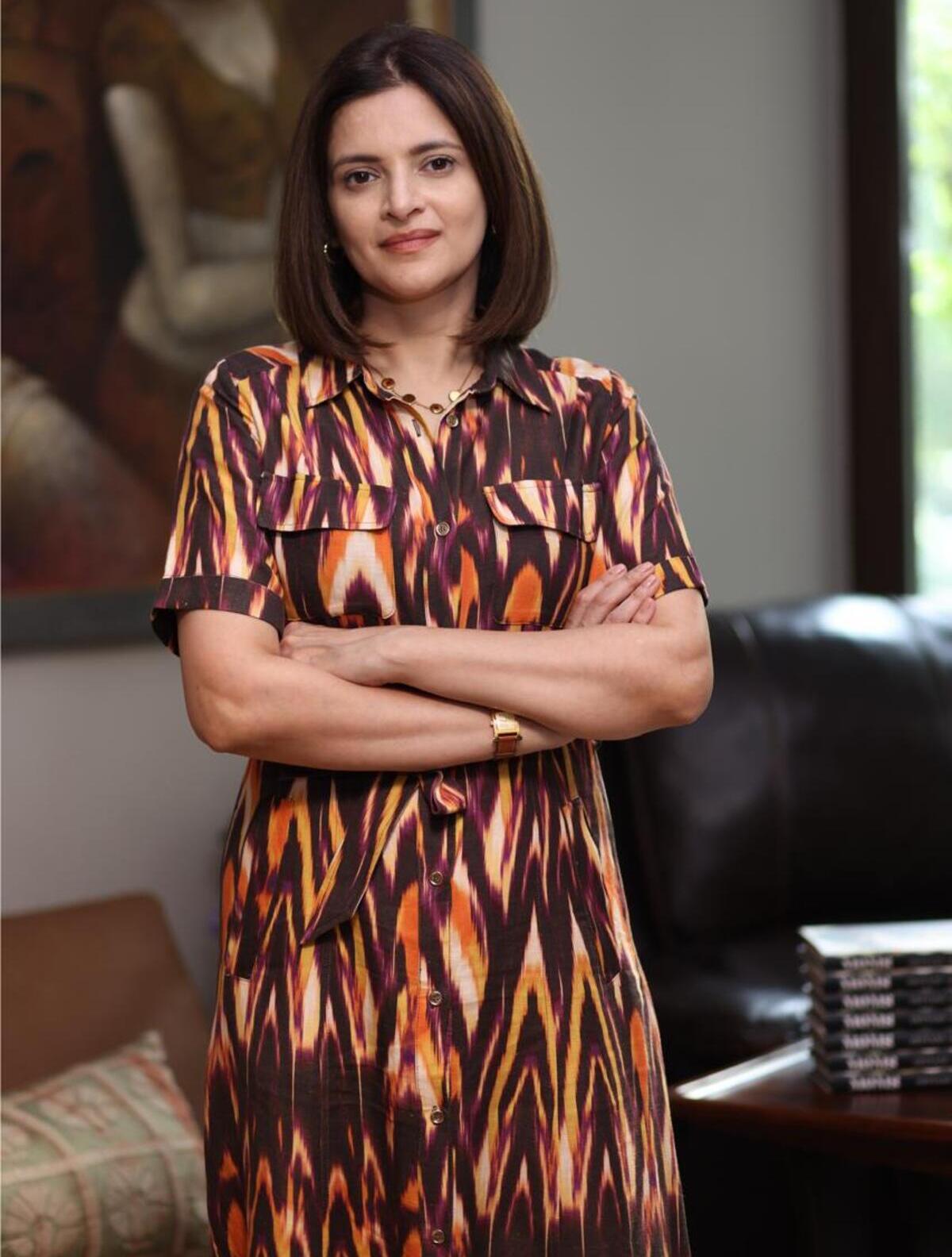
Delhi-based author Shivani Sibal, whose second novel, Moms, looks beneath the polished surface of privilege, motherhood, school-gate politics, loneliness and the exhausting performance of having it all. Photo courtesy of the author

In her sophomore novel, Moms, the author of Equations returns with a sharper, more intimate look at women, friendship, social power and the distance between a perfect life and a lived one
Five years after her debut novel Equations, Shivani Sibal returns to the Delhi she knows well, but looks at it from a different room. Her second novel, Moms (HarperCollins), takes us inside the lives of women in an affluent corner of the city where good schools, beautiful homes, premeditated parties and social standing are part of everyday life. At its centre is Radhika Khanna, a wife and mother whose life seems, from the outside, enviably complete. Sibal is interested in what that appearance demands of a woman, that’s the constant work of keeping things together, looking composed and making a complicated life appear effortless.
Motherhood gives the novel its title, but Moms is really interested in the world that gathers around it. There are school gates and WhatsApp-like social circles, friendships that contain affection as well as rivalry, discreet calculations of status, and the peculiar intimacy that develops between women who are watching one another raise their children. Sibal writes about that ecosystem without turning it into a simple story of supportive female friendship or competitive “mom culture”. What interests her are the contradictions. Women can care for one another and judge one another, feel secure one moment and threatened the next. Privilege may make their lives comfortable, but it does not necessarily make them uncomplicated.
Also read: Avni Doshi on The First House: ‘My focus is to allow the characters to have psychic autonomy’
It is territory that connects Moms to Sibal’s earlier work while also taking her fiction somewhere more intimate. Equations, published in 2021, examined class, aspiration and power through the lives of two childhood friends from different social worlds; in the new novel, those questions of hierarchy and control enter the home, the marriage, the body and the private life of a woman. Social media adds another layer, the requirement not merely to live well, but to be seen living well. Through Radhika and the women around her, Sibal looks closely at the distance between the picture presented to the world and everything that cannot quite be made to fit inside the frame.
In this interview to The Punch Magazine, Sibal talks about the performance of perfection, the hierarchies of motherhood, female friendship, privilege, loneliness and the pressures women absorb without always naming them. She also reflects on why school-gate politics fascinated her, how social media sharpens the demand to appear effortless, and why power remains one of the themes she keeps returning to. Excerpts:
Radhika seems to have everything that is supposed to signal a successful life: the home, the husband, the daughter, the social standing. However, almost from the start, we see how anxious and controlled her life really is. What made you want to look at motherhood through this gap between how a woman’s life appears to everyone else and how it actually feels to her?
One distinctive marker of our times is that we must not just live a good life, but actively appear to be doing so. What interested me was the gap between the life a woman is seen to have and the life she is actually living. On the face of it, Radhika embodies a particular urban ideal: an advantageous marriage, motherhood, position, beauty and affluence. I wanted to explore the strain beneath maintaining this image of perfection.
The title is Moms, in the plural, even though the novel revolves around Radhika. Around her are other mothers, school groups, friendships and the small hierarchies that form among women. Were you interested in the pressure mothers put on one another as much as the pressure that comes from husbands, families or society?
Yes, very much. I wanted to explore not just one woman’s experience, but an entire ecosystem. I don’t think I could have written this book had I not been a mother myself and experienced some of those particular nuances from within. The supportive nature of female friendships aside, I wanted to explore it from a more layered prism.

Moms by Shivani Sibal, HarperCollins India, pp. 254, Rs 499
I was interested in the world mothers create around one another — the small hierarchies, the latent competition, the alliances, the judgments, the insecurities. I also wanted to explore female friendship through a more layered prism, of jealousy, one upmanship, sometimes sabotage. Female friendships are rarely simple, and I wanted to look into their intricacies.
Radhika begins as an admired committee head at her daughter’s school, and one confrontation is enough to turn her into someone other mothers whisper about. What interested you about the school-gate world, where friendship, parenting, reputation and social power can become so tangled up with one another?
Power: who holds it, who bows down to it, and how it governs almost everything has always fascinated me. In this context, the school-gate world can look trivial to the casual viewer, but beneath the surface there is so much simmering. It has a charged mix of competition, class anxiety, moral theatre, and female friendships and exclusion at play, and makes for very interesting writing and reading in my opinion.
Social media is part of Radhika’s world too: the polished posts continue while she is becoming increasingly lonely. You’ve spoken about how performative our lives have become. Do you think mothers today are being asked not only to do everything well, but also to make doing it look effortless?
Indeed, I do think this is true. Not just mothers, all women today are expected to manage everything, and making that management look effortless is an integral part of that performance.
Also read: ‘There are a million Marilyns out there’: Andrew Wilson on Marilyn Monroe beyond the myths
Grace under pressure is further pressure, erasing natural feelings like fatigue, hopelessness, and pain, these are not overly welcome in the Insta world.
Radhika’s private life becomes harder to hold together even as there are gala weekends, themed dinners and the destination party in Rajasthan. Why did you want so much of the story to unfold against this very visible world of privilege, parties and social performance?
The contrast between privilege and pain, beauty and private despair is something which I wanted to explore. Certainly, privilege insulates one from many, many things, but it cannot erase unhappiness, loneliness, control or private distress. It is easy to forget this when one views the public performance of privilege, and I wanted to dispel this notion.
Your first novel, Equations, also looked closely at class and privilege of Delhi’s elite. In Moms, the gaze is much more intimate. What did Radhika allow you to examine that you hadn’t been able to get at in Equations?
Equations and Moms both concern themselves with class and privilege. Moms, and Radhika’s character in particular, allowed me to examine the same themes with a different lens of a woman’s family life and interior life, and what perfection often looks and feels like from the inside.
More from The Byword





Comments
*Comments will be moderated