









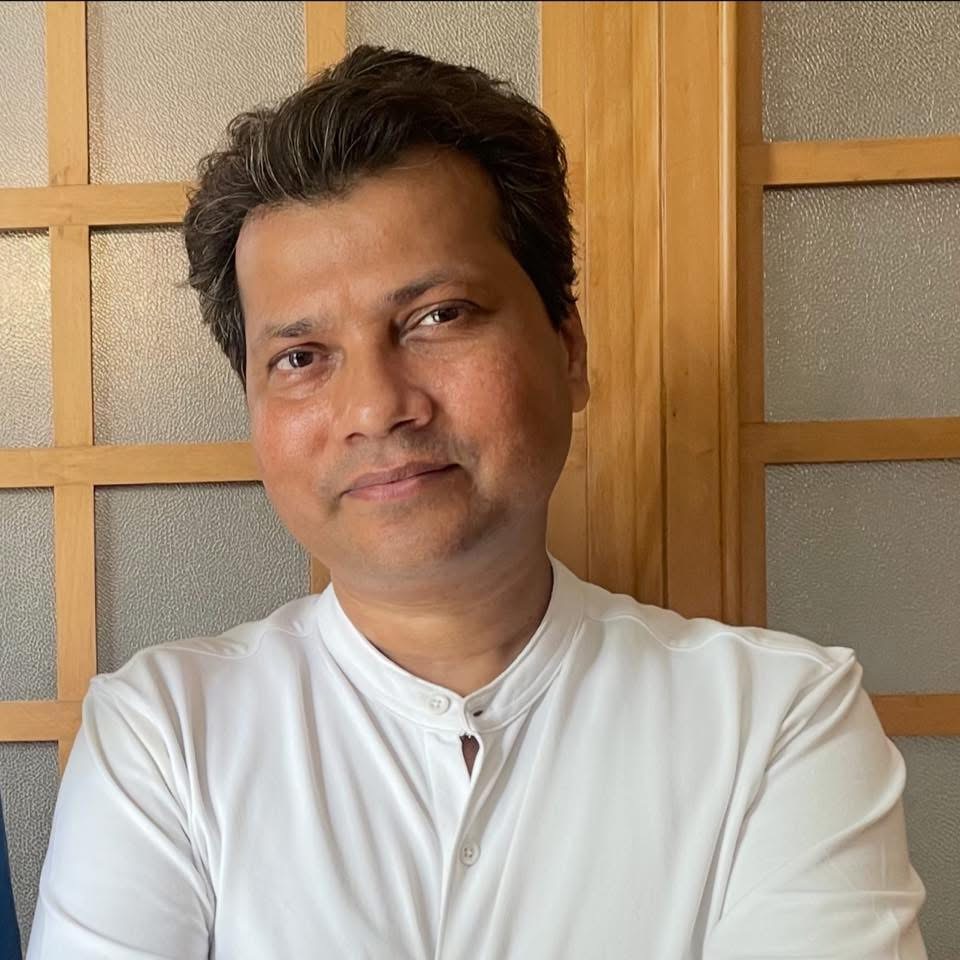
A Song for Eresha, AK Srikanth’s debut novel, follows a Bharatanatyam dancer whose ordered life is unsettled by her feelings for a young student. The author and filmmaker speaks about adapting the story for two forms, writing desire through silence, and creating a landscape governed by water
AK Srikanth’s A Song for Eresha began with the screen, but the novel is not a mere adaptation written after the film. Srikanth worked on the screenplay and the book almost at the same time, allowing each to find its own shape. The film stays close to its two central characters and follows their relationship in a largely linear fashion. The novel gave him more room to move beyond them, enter the life of the institute where much of the story unfolds, and build the fictional coastal town of Azhagankarai in greater detail. “The novel gave me the freedom to widen the lens,” he says. “I could bring the fictional town of Azhagankarai, modelled on the mangrove marshlands of Muthupet, to life in a way that simply isn’t possible on screen.”
That wider world is fascinating because Eresha’s story is closely linked to place. Azhagankarai lies at the edge of the Cauvery delta, where lagoons, mudflats and mangroves determine the pace of daily life. Boats move according to the tide; plans can change with the weather; land and water seem to keep redrawing their boundaries. Srikanth spent time in Muthupet and researched the region before recreating it in the novel. “I never saw Azhagankarai as just a backdrop,” he says. “It is the world that shaped these characters long before the story begins.”
At the centre of this world is Aalayam, a prestigious institute of classical arts in South India. Eresha first came there as a student and has now spent three decades of her life at the institution. A celebrated Bharatanatyam dancer, teacher and director, she has acquired an almost forbidding public stature. Generations of students see her as the living embodiment of Aalayam: disciplined, intellectually rigorous and always in control.
As the institute prepares for its fiftieth anniversary, Eresha begins choreographing a production based on the story of Urvashi and Arjuna from the Mahabharata. Urvashi declares her love for Arjuna and is rejected by him. The episode gives the novel its central dramatic frame, although its real force comes from how closely the story begins to resemble Eresha’s own life.
Anvesha, a young exchange student from the experimental arts community of Shantigram, arrives at Aalayam. She does not possess the technical finesse of its most accomplished dancers, but Eresha recognises an emotional intelligence in her. She decides to play Urvashi in the anniversary performance and casts Anvesha as Arjuna. During the rehearsals, Eresha slowly understands that what she feels for her student has travelled beyond the boundaries of mentorship.
Srikanth was drawn to Eresha because her commanding public presence conceals a private life for which she is poorly prepared. Everyone around her assumes that a woman who has taught discipline and emotional control for so long must have risen above ordinary vulnerabilities. He saw her differently. “She isn’t a superwoman,” he says. “She’s just a human being who has been carrying the burden of other people’s expectations for a very long time.”
An early literary memory also found its way into the making of the character. Srikanth read Muriel Spark’s The Prime of Miss Jean Brodie as a teenager and was struck by the idea of a teacher falling from the pedestal on which her students had placed her. The image remained with him. In Eresha’s case, the fall is not so much a public scandal than a slow disturbance in how others perceive her. Students begin to question a teacher they once accepted without hesitation. Colleagues grow uncertain about her judgement. The institution to which she has given most of her adult life no longer knows quite what to make of her.
“Admiration can sometimes prevent us from seeing people clearly,” Srikanth says. “Eresha has the same fears, doubts and emotional needs as anyone else. The difference is that she has spent a lifetime hiding them.” The emotional tension between Eresha and Anvesha rests on a crucial imbalance: the love exists only in Eresha’s mind. Anvesha does not return it. She does not even realise what her teacher is experiencing. For her, Eresha remains a remarkable dancer and mentor, someone she reveres and hopes to learn from.
This took away most of the familiar devices available to a writer building a love story. There could be no flirtation, coded exchange or shared moment of recognition. Each meeting between them is sincere, but it means something different to each woman. While Anvesha believes she is growing closer to a teacher, Eresha finds herself becoming emotionally dependent on a student who has no idea that their relationship has changed for her. “That gap between their two realities keeps widening as the novel progresses,” Srikanth says.
He was also clear that Eresha should never act on her feelings. She remains conscious of her position as a teacher and the trust Anvesha has placed in her. Her struggle stays within her until a private rehearsal allows Urvashi’s declaration to slip dangerously close to a personal confession. The point is not whether a relationship might develop. The novel is interested in the cost of having feelings that cannot be spoken or returned.
Its emotional register is deliberately restrained. Longing appears through glances, pauses, gestures and ordinary conversations whose meaning becomes clear only gradually. Part of this came from Eresha herself. After thirty years of being defined by Aalayam, she has no language for an emotion that does not fit the life she has built.
Srikanth’s own preferences as a writer shaped the treatment as well. “I’ve never really been drawn to grand emotional drama,” he says. “I find that some of the most affecting moments in literature happen almost in passing. A glance, a pause, an ordinary conversation or a silence can stay with you far longer than a dramatic declaration ever could.”
Bharatanatyam offered him a natural way to think about such restraint. The smallest movement of the eyes or a fleeting change in expression can hold an entire emotional passage. He tried to carry something of that quality into the prose, leaving the reader to notice what the characters cannot say.
Dance, however, does not offer Eresha an easy means of escape. It has organised her days and given her a sense of who she is, but it cannot tell her what to do with Anvesha. She must continue teaching and rehearsing while carrying a private turmoil through the routines of the institution.
“We like to believe art heals us or gives us clarity, but I’m not sure it always does,” Srikanth says. “Sometimes it simply gives us a way of continuing with life while we’re trying to make sense of what we’re feeling.” He was wary of using dance as a convenient source of redemption. It cannot resolve Eresha’s predicament, nor can it protect her from loneliness or desire. It remains central to her life without becoming a cure for it.
Srikanth knew the world he was writing about at close quarters. His involvement with contemporary dance theatre began in 2010, when he founded TSSPC Pvt Ltd as a space for creating work outside the conventional mythological and religious frameworks associated with classical dance. He wrote four stage productions — Soul Cages, Yudh, The Prophet and Chains: Love Stories of Shadows — which were performed more than 150 times across 14 countries. Years spent in rehearsal rooms allowed him to observe the labour behind a performance and the relationships among dancers, teachers and musicians.
Classical dancer Savitha Sastry, who plays Eresha in the film, helped him check the practical details of Bharatanatyam while he wrote. “If I was unsure whether something would happen in a rehearsal, or whether a particular interaction felt authentic, I could simply ask,” he says. Eresha, he stresses, is not based on Sastry or any other dancer. She is entirely fictional. Sastry became the natural choice for the screen because she already understood the discipline and physical world the character inhabits.
Srikanth has worked across forms for much of his career. Since 2018, he has written and directed short films dealing with rebirth, relationships and social questions, among them Dvija, Beyond the Rains, Ghost of the Lighthouse and Slow Rivers, which features Ashish Vidyarthi. He studied at BITS Pilani and later completed an MBA at Case Western Reserve University in Cleveland. He now lives and writes in the Nilgiri hills.
That closeness to landscape can be felt throughout A Song for Eresha. In the novel’s opening, Anvesha travels by catamaran through the backwaters towards Aalayam. The lagoon, salt-covered plants, fishing nets and muddy banks are observed patiently, as if the place must be understood before the characters can be. Azhagankarai changes with the tide, much as Eresha moves between moments of composure and sudden uncertainty.
Srikanth wanted the reader to know this place beyond its scenic beauty: to smell the mudflats after rain, hear the boats crossing the lagoon and understand how people organise their days around shifting water. “If someone closes the book feeling they have actually spent a few months in Azhagankarai,” he says, “then I think the landscape has done exactly what I hoped it would.” A Song for Eresha, published by Cogitabund, an imprint of Booksthakam, is available in paperback, ebook and audiobook editions.
More from The Byword






Comments
*Comments will be moderated