









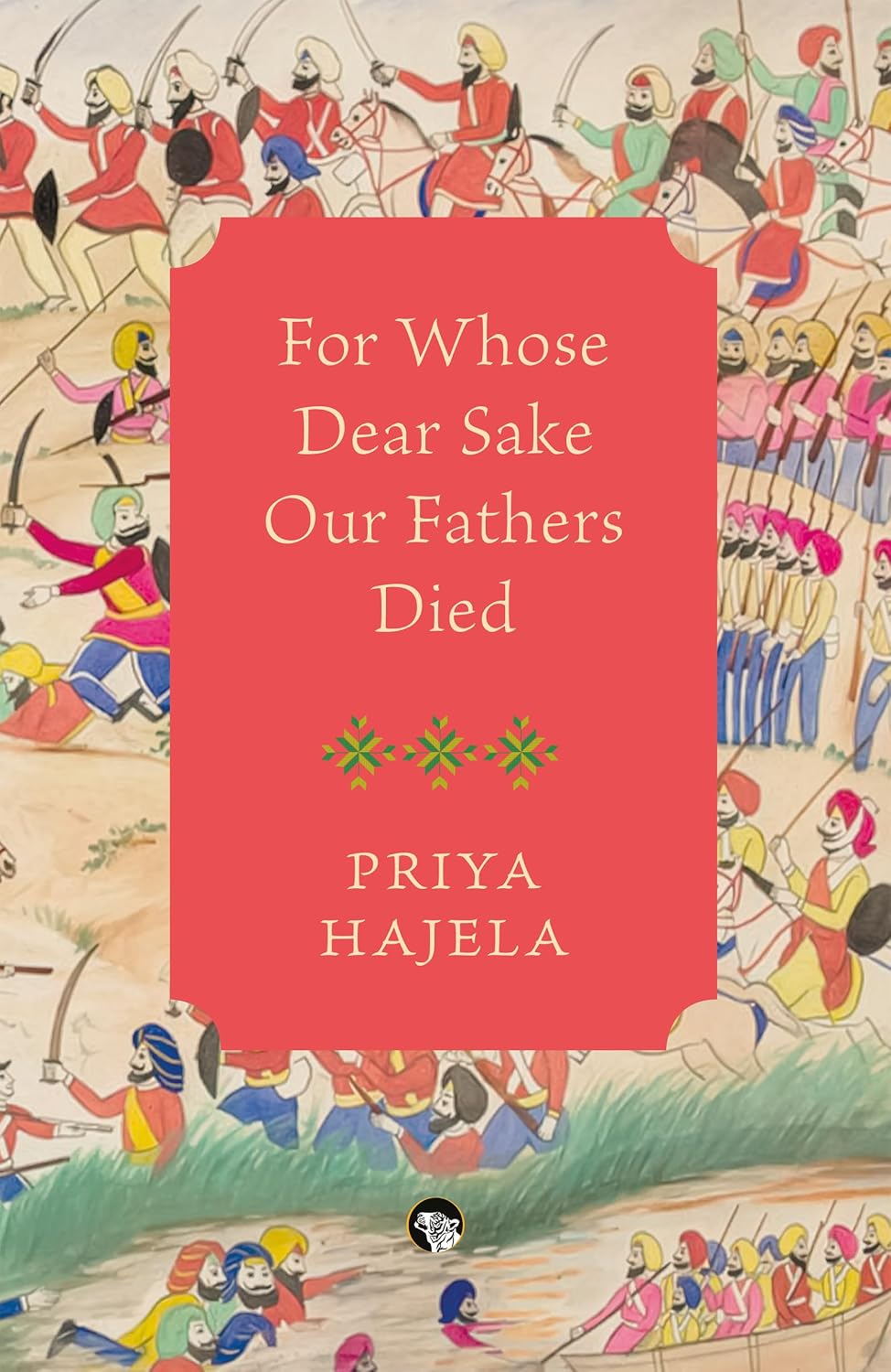
Priya Hajela’s second novel is a story about inheritance, not simply land, blood or family name, but the decisions, silences and half-remembered stories that run from one generation to another and become part of how a family understands itself.

The author of For Whose Dear Sake Our Fathers Died discusses a Sikh family’s journey from fighting the British to serving and resisting them, the choices survival demands, and the stories passed from one generation to the next
Priya Hajela came to fiction after more than two decades in the corporate world, working in telecom and IT before completing an MFA in Creative Writing at Goddard College in Vermont in 2017. Her first novel, Ladies’ Tailor (2022), followed Gurdev, a Partition refugee trying to begin again after being uprooted from everything he knew. Her second novel, For Whose Dear Sake Our Fathers Died (Speaking Tiger), returns to the same family, but travels backwards through the generations to understand the history that made Gurdev the man he became.
The novel begins in the world of Maharaja Ranjit Singh and follows a Sikh family through almost a century of war, British rule and resistance. Iqbal Singh fights the British and dies in 1846; his son Balwant later finds himself serving them. Harjit goes further into that world, while the next generation begins to question it. Along the way come 1857, the Komagata Maru episode, the freedom movement and, eventually, Partition. History becomes something people stumble through while trying to earn a living, protect their families and decide where their loyalties lie.
Holding these lives together is Beant Kaur, who gathers her family around her and tells them where they come from. Much of what she knows has arrived through memory: stories heard from elders, fragments repeated over the years, details made clearer or blurred by retelling. That gives the novel its most interesting tension. Hajela is not interested in judging her characters from the safety of the present, but in asking what choices were actually available to them at the time. Balwant can resent British power and still depend on a British officer. He can fight men who resemble him and remain troubled by what he has done.
The novel is, in the end, is a story about inheritance, not simply land, blood or family name, but the decisions, silences and half-remembered stories that run from one generation to another and become part of how a family understands itself. In this interview to The Punch Magazine, Hajela explains why Balwant’s decision to serve the British was, for her, a matter of survival rather than betrayal, and why she wanted his divided loyalties to remain unresolved. She talks about restricting the novel to what her characters could actually know at the time, rather than giving them the hindsight that history gives us. And she reflects on different forms of courage, the family memories behind the story, and the question contained in the title. Excerpts:
The novel begins with Iqbal Singh in Maharaja Ranjit Singh’s Fauj-e-Khaas, and he dies fighting the British in 1846. However, in the same family, Balwant and later Harjit end up serving the very power Iqbal fought against. I found that shift fascinating because you don’t treat it as betrayal. Were you trying to understand how one family’s idea of loyalty can completely change within a couple of generations?
It isn’t betrayal. For Balwant, it is survival. At the time, all he wants is to be a soldier like his father was. That he would be fighting for the army that killed his father is a thought he buries deep within him because there is nothing else he can do to survive, nothing else he would rather do. At this point, I wanted to recognize that Punjab and much of the rest of the country was shape-shifting. The people who lived in that time could either adapt or fight. But fight what? I think many were simply going along. The Maharaja was dead. His heirs had been summarily dismissed. His Generals had betrayed the foot soldiers. There were few options for the common man.
Balwant is probably the most conflicted figure in the book for me. His father has been killed fighting a force led by the British, he thinks of the East India Company as an evil presence, and yet he develops a very real loyalty towards Jeremiah Brasyer. At one point he begins asking himself why he is fighting for these people rather than against them. Did you always know you wanted his contradiction to remain unresolved, rather than eventually making him choose a clear political side?
Balwant lives with these contradictions for the better part of his life. It is only when his grandson returns to Lahore and tells him that he doesn’t want to be a real estate lawyer that he voices his support for the movement that is focused on ushering the colonial power out. I wanted these contradictions to remain. I wanted Balwant to wonder from time to time where he belonged. I think that was the lot of many people in that time.
The scenes around 1857 and the Ferozepur Regiment are particularly disturbing because Sikh soldiers are fighting men who look and speak much like them; you even have that detail of turbans being removed in the confusion of battle. Then there are men turning their faces away while rebels are blown from cannons. How did you write Balwant’s guilt here without giving him the benefit of our hindsight? What can he understand about what he is doing at that moment, and what can he simply not know?
In my mind, Balwant was trapped between an affiliation with his people and loyalty to his superior officer. He was also fairly certain that the British would prevail, despite some extraordinarily well fought battles against the rebels. He was quite clear eyed with regard to the fighting prowess of the rebel forces but he was also disdainful of their approach — killing white women and children. It was not possible for him to rise above what was directly before him and see things for the way they really were. I chose not to give him that perspective. I chose to let him make decisions only based on what he knew and could see in the here and now.
Henry Lawrence and Jeremiah Brasyer are interesting because you allow us to see them as individuals, even while they remain part of a colonial system. Beant herself seems aware that the family may be uncomfortable hearing anything positive about British men. How difficult was it to write that relationship without losing sight of the larger history of British rule?
It was important for me to write the story as my characters saw it and later narrated it, as Balwant did to Beant. They saw people as they appeared before them and not as symbols of oppression in a much larger landscape of British rule. That did happen but much later, when the freedom movement began taking shape. When Balwant returns to the garrison looking for Brasyer, he knows that if anyone can help him, it is this man. He is not sure what will come to him, but at a minimum a land grant and a pension. British rule changed lives — for the better for some and for the worse for many. Much as we don’t want to now, we must acknowledge there were people who benefitted, thrived, in their purpose built colonies and their access to education, and even some social hobnobbing.
Harjit takes the family’s relationship with the British even further, repeatedly putting himself at risk in their service, while his son Amrik eventually fights the British in an entirely different way, through law. That movement from Iqbal’s battlefield to Amrik’s legal resistance gives the family history a remarkable arc. Was Amrik important because you wanted the meaning of courage itself to change across the generations?
Harjit takes the family’s relationship with the British even further, repeatedly putting himself at risk in their service, while his son Amrik eventually fights the British in an entirely different way, through law. That movement from Iqbal’s battlefield to Amrik’s legal resistance gives the family history a remarkable arc. Was Amrik important because you wanted the meaning of courage itself to change across the generations?
Amrik is critical to the story I wanted to tell. Like his father and grandfather, Amrik too could have been a career soldier, joined the 14th Sikh or some other regiment but times were changing around them. He had choices, unlike those who came before him, and he exercised those choices. He also had the option of doing nothing, as most people in India did in the face of the changing landscape. What I wanted to get across with Amrik was that dramatic heroism is not the only way to participate. Some of us are not made like that. But standing on the sidelines is also not an option.
Beant is telling a family story that has travelled through generations, much of it passed down by people who lived through these events. When you were writing her, how did you work out where family memory ended and where you had to step in as a novelist and imagine the rest?
Technically, the entire story is as Beant is telling it. But yes, in writing it, I had to step away from her and fill in the details and then let her step in again and provide her very unique perspective. That dance was necessary to take the story forward.
You’ve said an early draft became almost like a history textbook and that you had to pull it back to what Balwant himself could actually see and understand. I think that limitation becomes one of the strengths of the novel because he doesn’t know the big historical meaning of the moment he is living through. How did that change the way you told his story and the larger history around him?
You’ve said an early draft became almost like a history textbook and that you had to pull it back to what Balwant himself could actually see and understand. I think that limitation becomes one of the strengths of the novel because he doesn’t know the big historical meaning of the moment he is living through. How did that change the way you told his story and the larger history around him?
In order for me to tell the story, I had to read the history. I had the benefit of omniscience, the ability to find and read whatever I needed to understand the times, the events and the people. But I quickly realized that the story has great value if I reduce the perspective and give it line of sight only. I revealed only what Balwant could see before him, providing a bird’s eye perspective only if needed, through a secondary story that was passed on to him at a later time — such as what happened in Kanpur. Balwant wasn’t there but that story came around because it was so tragic, so appalling that it was likely passed around very deliberately than by chance.
The book eventually reaches the Komagata Maru, and by then the relationship between Sikhs and the Empire has changed again. Men from a community that supplied soldiers to Britain are being denied entry into another part of that same Empire. Did that episode become important to you because it exposes the limits of the loyalty that earlier generations such as Balwant and Harjit had placed in the British?
For me, the Komagata Maru incident laid bare Britain’s racist policies when it came to India. The promise of access to enter and live in any Commonwealth country didn’t apply to Indians. The loyalty that Balwant and Harjit had for their British bosses had created the basis for a new soldier class for the British — the Sikhs.
This is also a kind of prehistory to Ladies’ Tailor. That novel gives us Gurdev and the aftermath of Partition, while here Beant takes us backwards through the generations that produced him. When you returned to this family, did you discover anything about Gurdev that you hadn’t understood when you wrote the first novel? Did his behaviourin Ladies’ Tailor begin to look different once you knew what his family had carried before 1947?
I had begun writing For Whose Dear Sake Our Fathers Died with the premise that adventurism runs in families. I already knew that Gurdev came from that stock. What specific adventures his forefathers were going to undertake, I had yet to find out. But adventurers they were going to be — in order to make Gurdev one. Looking back, when I wrote the part about Gurdev racing to Ajodhan and handing over his parents to his friend, I knew that his forefathers would be undertaking foolhardy excursions not too different from that one.
Your title comes from Kipling’s The Children’s Song: “For whose dear sake our fathers died.” You’ve said the manuscript was originally called Battle Lines, until you realised that fathers and sons carried the emotional centre of the book. But after reading Iqbal, Balwant, Harjit and Amrik, the word “whose” starts to feel almost like the question the entire novel is asking. Who or what did these men believe they were sacrificing themselves for: a king, a commanding officer, the British Empire, Punjab, family, an idea of honour? And did you yourself have a clearer answer to that when you finished the book than when you began it?
The title is a question that I did not intend to answer either as part of the story or in my own head. It is a question that I think should forever float in our heads as we contemplate service or any endeavor really. For Whose Dear Sake?
More from The Byword



Comments
*Comments will be moderated