








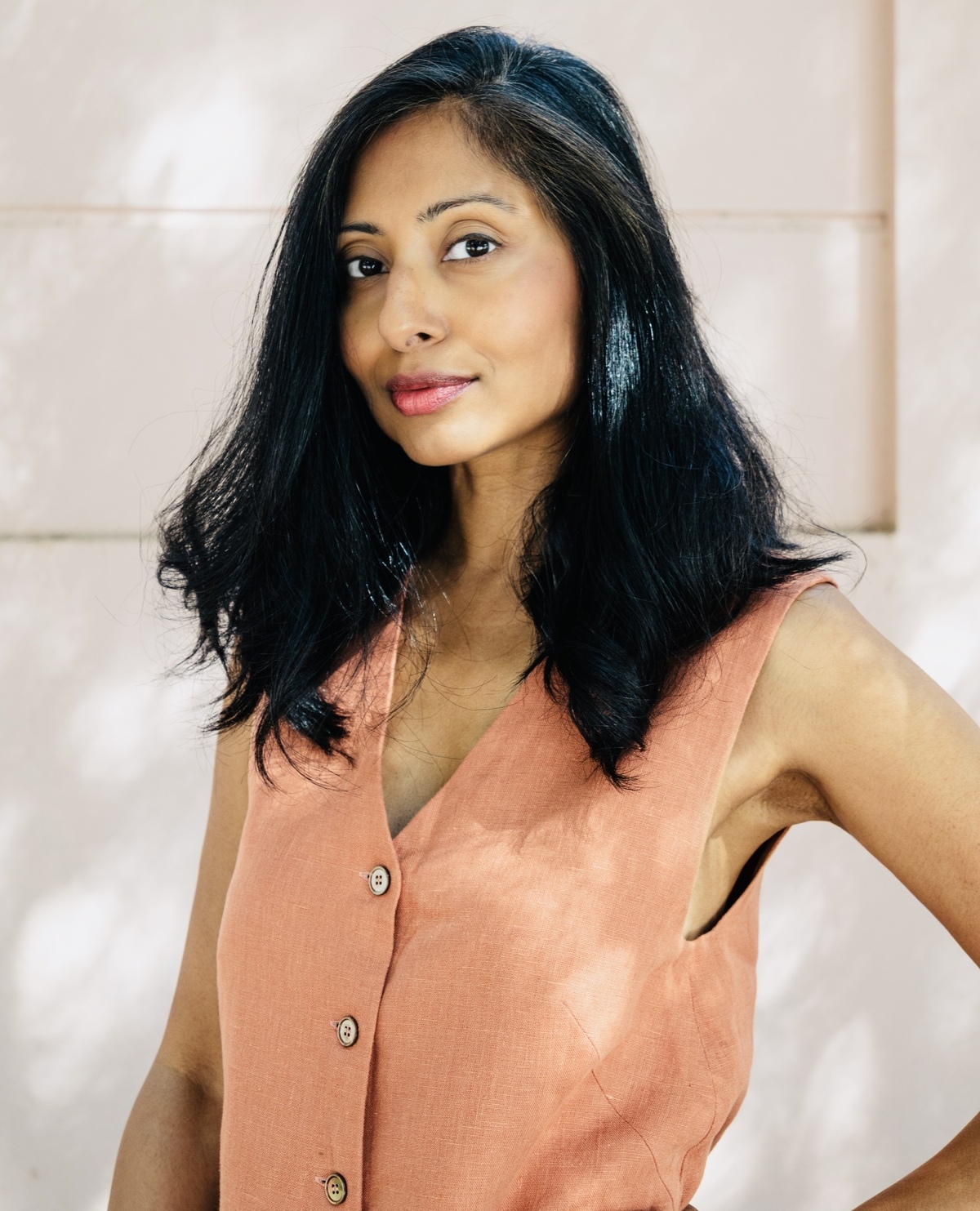
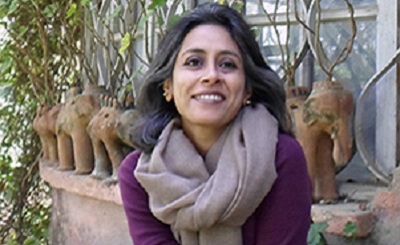
Memory is so easily infected by motivation and desire: Avni Doshi. Photo: HarperCollins India
In her second novel, Avni Doshi looks at a marriage coming apart and the stories people build around love, family and themselves. She talks about memory and self-deception, motherhood and creative life, the unsettling intimacy of marriage, and whether we can ever truly escape the patterns of our past
Six years after Burnt Sugar brought Avni Doshi to the Booker Prize shortlist, she returns with The First House, a novel that begins with a sentence capable of dismantling an entire life: after 13 years of marriage, a husband tells his wife that he no longer wants to be married. She is left in the house they built together, with their two young daughters, trying to understand how a marriage she believed in could suddenly be given a completely different history. Published in India by HarperCollins India and in the UK by Hamish Hamilton, The First House is Doshi’s second novel, and it takes the domestic rupture of divorce into stranger territory: memory, family, desire, motherhood, inherited patterns and the stories we tell ourselves in order to keep a life coherent.
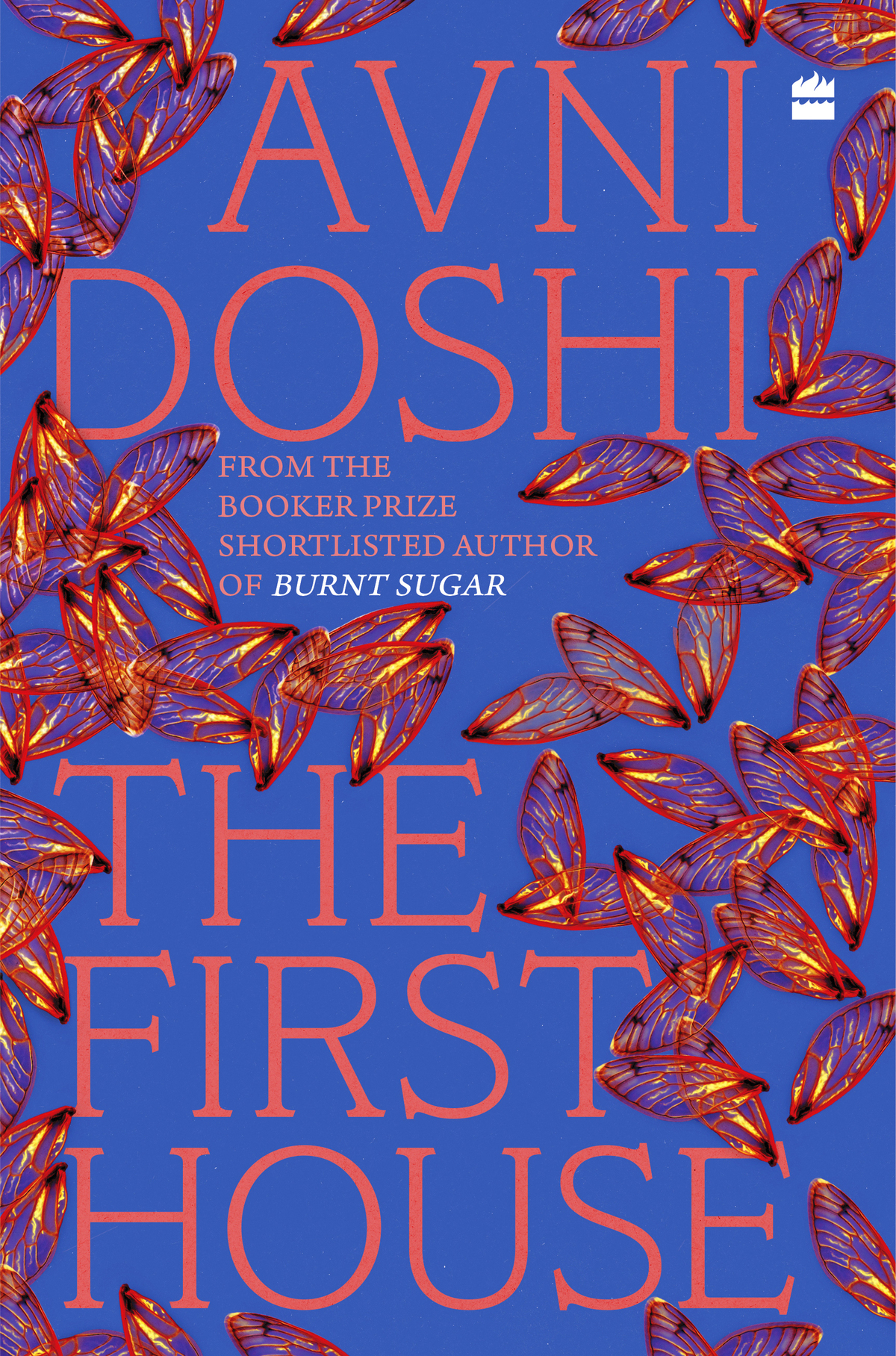
Doshi’s first novel was published in India as Girl in White Cotton and internationally as Burnt Sugar. Its difficult, often brutal mother-daughter relationship made it one of the more distinctive debuts of recent years: the novel was shortlisted for the 2020 Booker Prize, later longlisted for the Women’s Prize, and has been translated into 26 languages. Born in New Jersey and now based in Dubai, Doshi studied art history and worked as an art curator before turning fully to fiction. That visual background feels particularly relevant to The First House. The new novel often advances through things seen, overlooked and suddenly noticed: a statue of Diana in the neighbour’s garden, the strange life cycle of periodical cicadas, the physical spaces of a home, and images that acquire meaning as the narrator’s old certainties begin to give way.
But divorce is only the visible break in the novel. Doshi is interested in what lies underneath it: the narratives on which marriages and families depend, the parts of ourselves we suppress to remain inside them, and what happens when those narratives stop working. The unnamed narrator has once been a novelist herself, but her writing has stalled after marriage and children. As her husband leaves and her complicated family moves back into view, she begins to look differently at relationships she thought she understood. Memory becomes unstable; what she notices begins to change. Mythology and astrology enter the book alongside the ordinary business of children, money and domestic life. Diana, the Roman goddess associated with Artemis, becomes a recurring presence, while the cicada, spending much of its life underground before painfully shedding its old form, offers Doshi an image for transformation that is as awkward and frightening as it is hopeful.
Also read: Tabish Khair on Drown All the Refugees and why ‘home is always in a relationship to leaving it’
This also makes The First House an interesting companion to Burnt Sugar. Both novels distrust any single account of a family and are alert to the way memory can be shaped by need, anger and desire. Yet the questions here spread further outward: how much can we really know about the people closest to us? What must we choose not to see in order to remain part of a family? And when an old version of the self collapses, is it possible to become someone genuinely different, or do we simply repeat familiar patterns in another form? Doshi does not tidy these questions into a conventional story of recovery. Her narrator’s movement towards another life is hesitant and sometimes ungainly, closer to the cicada she watches: the old body has been left behind, but inhabiting the new one takes time.
In this interview to The Punch Magazine, Doshi talks about the private mythologies that hold marriages and families together, and the things people train themselves not to see. She discusses motherhood and creative paralysis, memory and self-deception, Diana and the cicada, the pressure that followed Burnt Sugar, and the larger question running beneath The First House: how much agency do we actually have in becoming someone else? Excerpts:
In The First House, a woman’s life seems to collapse because her husband decides to leave, but the deeper rupture is perhaps that she suddenly has to ask who she is without the structure of her marriage. Was that question (who are we when the life we built around ourselves disappears) at the heart of the book for you?
The central question in my mind when I was writing was about the mythologies that make up our lives, the kinds of storytelling we engage in to build a sense of psychological and emotional coherence, and what new (or old) stories do we adopt or invent when these no longer hold up.
I remember I was reading a novel called A Heart So White by Javier Marias several years ago and I came across the sentence: “Marriage is a narrative institution.” This struck me as incredibly powerful, and relevant to all institutions, to all of the organising structures in our lives. Families are built around narratives. Relationships, too. Tribes. Nations. Religions.
Simultaneously, I was interested in the stories that are left out. In other words, if some stories, or mythologies, are central to our self-understanding, what do we do with the stories that negate the way we see things? What do we do with the counter evidence? The novel is also about the stories we cannot know, because knowing them would destroy us.
I found it interesting that you don’t make the husband an obvious monster. There are secrets, control and things he withholds, but he remains more complicated than a conventional villain. Why was it important to resist giving the reader someone easy to blame?
I suppose I don’t think of any of the characters as villains or heroes. I don’t even really think of them as having flaws, per se. My focus when I am writing is to allow the characters to have psychic autonomy. That inevitably reveals light and shadow. And it often shows us more about ourselves than the characters, I think. Some readers feel the husband is an abject monster. Others feel he is actually a good person, though maybe driven to some questionable action because of his circumstances. In this way, the act of reading is like a Rorschach test.
The narrator is a former novelist whose writing has stalled after having children. That detail felt particularly loaded to me. Did you want to explore what happens to a woman’s creative self when motherhood, marriage and domestic life gradually occupy all the available space?
I think that becoming a mother or a wife and taking on duties can certainly colonise people and affect creative output. But I wonder if that is the only reason her writing has stalled. It seems to me that she has cut off so much of herself in the process — that she has put on blinders with regards to many of her most intimate relationships.
If creativity is in some way connected to being curious and open — she is (at least unconsciously) closed off. She doesn’t see her guardian statue in the next-door garden for more than a decade. Her vision is so narrow. To me, that seems like the reason her work has truly stalled. Does that have to be the reality for all mothers? For all wives? I don’t know if that’s the case.
You’ve spoken about the book beginning with images (Diana, the cicada, particular visual ideas) rather than with a straightforward plot. Do you generally discover your stories through images first? And when you write, are you trying to preserve something of that visual strangeness on the page?
Certainly there are images and a sensibility, maybe an atmosphere that I sense before I begin writing. But once I start writing, I am not actively trying to hold on to the images. One of the primary ways I thought of this book taking form was through the image of a person circling something. Again and again and again, circling something at the center.
What is at the center? Whatever is at the center, we can’t see it, we can’t approach it. It defies language, and straightforward interpretation. But each time that center is circled, images arise. The images are all we know about the center — which still remains in itself mysterious.
The cicada becomes such an extraordinary metaphor because its transformation involves breaking out of an old skin. But metamorphosis can also be frightening. Did you think of the narrator’s transformation as liberation, loss, or both at the same time?
I liked the image of the periodical cicada and its particular metamorphosis because so many of those phases take place underground. We only see the final instar above ground. So many little deaths take place before it takes flight. It is frightening, it seems impossible for that little creature to survive that long, so many winters, with fewer and fewer trees to feed on, the ground soaked in pesticides, and so many predators waiting. And yet miraculously so many do survive.
Also read: Mihira Sood on the unfinished fight for gender equality: ‘The law is perhaps the strongest tool we have’
There’s something grotesque and very public, very exposing about the way the exoskeleton breaks open, and actually remains attached to trees and houses, sometimes for days afterward. The trace of the abandoned body remains, haunting. But also, there’s something clumsy about the imago, the sexually mature adult. It doesn’t fly gracefully, it falls at first, it tumbles down to earth. It takes time for it to learn how to be in its new body.
There’s something unsettling about the idea that a person can live beside someone for 13 years and still not really know them. Do you think intimacy necessarily involves a certain amount of self-deception, that perhaps we need not to know everything about another person in order to stay with them?
I think it’s very possible to know very little about the people we are most intimate with. We see this all the time. Children who barely know anything about who their parents really are. Parents who wouldn’t recognize their children if they really knew them. Again, I think this comes down to our narratives. We can only hold on to the parts of the story that fit with our thesis of who someone really is.
Like Burnt Sugar, this book is interested in memory, but here memory seems almost unstable enough to become its own kind of threat. What fascinates you about the gap between what happened and what we need to believe happened?
Both the novels ask questions about memory as the narrative force in our lives. And both novels are focused on interiority. Even the exterior details all hinge on what the characters are noticing. I’m interested in that process of selection. What we see says something about what is alive in us, about what wants to be known inside of us, perhaps something latent that wants to be made manifest. I find the need to convince others of our perspectives fascinating — the attempt to be objective, to present the truth. Particularly because we know that’s impossible. Every perspective is subjective, incomplete, permeable, malleable. Memory is so easily infected by motivation and desire. It can also be used to control and manipulate.
Your women are rarely written to make the reader comfortable. They can be contradictory, selfish, angry, observant, cruel and vulnerable within the same few pages. Do you feel that fiction still gives women less permission to be morally unpleasant than it gives men?
I’m not sure about whether it has to do with fiction. It’s more about our culture, which is born out of the deranged marriage of the patriarchy and capitalism, where men can rape and murder children with impunity.
Did the success of Burnt Sugar make The First House harder to write, or did it give you the freedom to become stranger and less accommodating as a writer?
I did feel a pressure initially, before I started writing. But once I started thinking about the book in a serious way, once I descended into the world of the story, that all vanished. I don’t think about audience when I’m writing, I don’t think about what the reader might like or not like. I can fall into people pleasing, and I try my best to kill that tendency before it rears its head.
By the end of the novel, I was less interested in whether the narrator was going to “recover” her old life than in whether she even wanted it back. When you think about the book now, do you see it primarily as a story about the destruction of a marriage, or about the destruction of one version of the self, and what might emerge afterwards?
The marriage was only one aspect of the story for me. I was thinking about the possibilities of transformation. About agency. I reference many stories of gods and heroes in the novel, and yet this isn’t a heroic story. Can we really change? Or do we keep moving through the same patterns in different clothes? Do we have control over our lives? Can our will move us forward or are we unconsciously tied to our pasts, and destined to keep repeating them?


Comments
*Comments will be moderated