








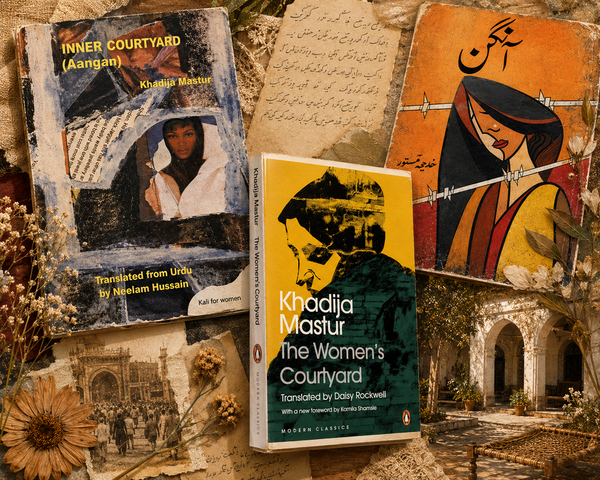
Winner of the Adamjee Literary Award, Aangan transforms the Indian freedom struggle into an intimate family saga, revealing how history’s greatest upheavals were often borne silently by the women inside the home.
Published in 1962 and now available in acclaimed English translations by Neelam Hussain and Daisy Rockwell, Aangan (The Courtyard) is a masterpiece of Urdu literature that chronicles the freedom struggle through the intimate tragedies of ordinary women
Last summer break had me searching for a book that would leave me awestruck and would be completely different from what I had been reading over the past few months. After browsing Google for the best Urdu novels, I picked Aangan by the Pakistani Urdu novelist and short story writer Khadija Mastoor, published in 1962. The reason was simple: Google described it as a masterpiece of Urdu literature that won Mastoor the 1963 Adamjee Literary Award for Urdu prose and noted that its excellence had inspired translations into 13 languages. Neelam Hussain’s English translation, titled The Inner Courtyard, and Daisy Rockwell’s translation, The Women’s Courtyard, were published in 2001 and 2008, respectively. It is usually classified as historical fiction or a period novel, but it is much more than that. It is also a feminist classic.
Aangan is a book that both exposes and challenges the ugly face of societal norms, satirizes false family pride as well as class barriers, portrays both romantic and familial love with depth and passion (love that knows sacrifice and is sometimes nothing more than sheer obstinacy) and, most importantly, captures the emotional pain and suffering of families who lost their sons and fathers in the fight for freedom while their own houses crumbled from within. Written in the years following Independence, it captures major historical events from 1930 onwards, including the Indian freedom struggle, the outbreak of the Second World War, the creation of India and Pakistan, the violence of Partition, and its aftermath. Although most of the story unfolds in the courtyard of a single house, the outside world reaches us through the conversations of the main characters, most of whom are women.
The author chooses Aliya, one of the main characters, as the voice of the novel. Her unconventional and bold personality, her dialogues, and her inner thoughts invite us to witness a story that appears to take place before our eyes. Among the women, she is a rebel who, despite all the odds, continues her education, establishes herself as a financially independent woman, takes it upon herself to teach poor children in post-Partition Pakistan, and never succumbs to the temptation of love or marriage in the way other women around her do. There are other memorable characters like Chammi, Badi Chachi, Jameel, Shakil, the illegitimate child Israr, the three brothers (Azhar, Mazhar, and Zafar), and finally Kariman Bua, the family’s long-serving housekeeper, whose interactions with one another gradually unravel the destruction and misery that befell the families of those involved in the freedom struggle.
Freedom came at the cost of lives, and by lives I do not just mean physical death but also the psychological and emotional wounds that destroyed countless households. On one hand, revolutionaries were leaving no stone unturned to secure the country’s future and free it from the clutches of colonial rule; on the other, disorder, chaos, poverty, and loss were closing in on their own homes. This is what Mastoor depicts with remarkable subtlety through the plot of Aangan, where everything is falling apart. The heads of families are arrested for protesting against the British, and the ripples of this struggle engulf those left behind. Some are robbed of their childhood, while others lose their dignity, security, and peace.
There is a wife who has waited all her life for her husband to look at her with love, longing for just a few words of meaningful conversation. But all she ever receives is the crushing responsibility of holding the family together in his physical and emotional absence, unceasing uncertainty, and tear-filled prayers for the safety of first her husband and then her son, who, despite her desperate pleas, chooses to follow in his father’s footsteps. There is another son whose neglect transforms him into a thief and eventually drives him away from home, leaving him to wander from place to place like a lost soul.
Also read: Politics of hostel rooms: What student rooms reveal about class, gender, aspiration and loneliness
Aliya’s inner struggle to adjust to one residence after another, initially because of her father’s frequent transfers as a government employee under British rule, later because of his arrest following an act of defiance against a firangi, and finally because of Partition, leaves readers in emotional turmoil, allowing them to experience every emotion that Aliya herself endures. The number of deaths she witnesses, including those of her loved ones, and the countless losses she suffers leave her deeply scarred, but none of this stops her from rising again in the face of adversity. Lastly, there is Israr Mia, who, in the aftermath of Partition, is denied even a roof over his head by the family housekeeper, who believes she is entitled to do so because of the supposed superiority of her birth. After all, he is an illegitimate child.
Apart from its devastating impact on people, the freedom struggle also shatters the family’s financial structure, stripping them of their wealth and pushing them into abject poverty, where making ends meet becomes a daily struggle for those who once lived in a mansion. This economic decline is poignantly reflected in Kariman Bua’s nostalgic recollections of the family’s prosperous days. Having served the household for generations, she has witnessed everything: the prosperity and the poverty, the glory and the ruin. This political upheaval not only scatters the family members but ultimately divides the family in two, separating them forever.
The ending of the story is both moving and memorable. Mastoor’s spare and deceptively simple prose gives the novel an effortless momentum, making you turn the pages quickly. Her meticulously crafted dialogues, nuanced characterisation, and the seamless intertwining of personal tragedy with political upheaval transport the reader straight into the era in which the novel is set. The novel was adapted into a Pakistani television series of the same name, which aired between 2018 and 2019 and starred Sajal Aly, Mawra Hocane, and Ahad Raza Mir. The adaptation renewed public interest in the novel, helping it become one of the bestselling books in Pakistan in 2019. Watching the series a few days ago drew me back to the finely woven narrative and compelling world of Aangan, ultimately inspiring me to write this review.
The novel is at once heartbreaking and heartwarming, filled with hope and despair, love and loss, empathy, affection, and conflict. Even decades after its publication, it remains as powerful and relevant as ever. Aangan is not simply a novel about Partition or the freedom struggle; it is a profoundly human story about the women who endured history from within the walls of their homes while the world outside was being remade. That alone makes it a book worth reading.
More from The Byword



Comments
*Comments will be moderated