








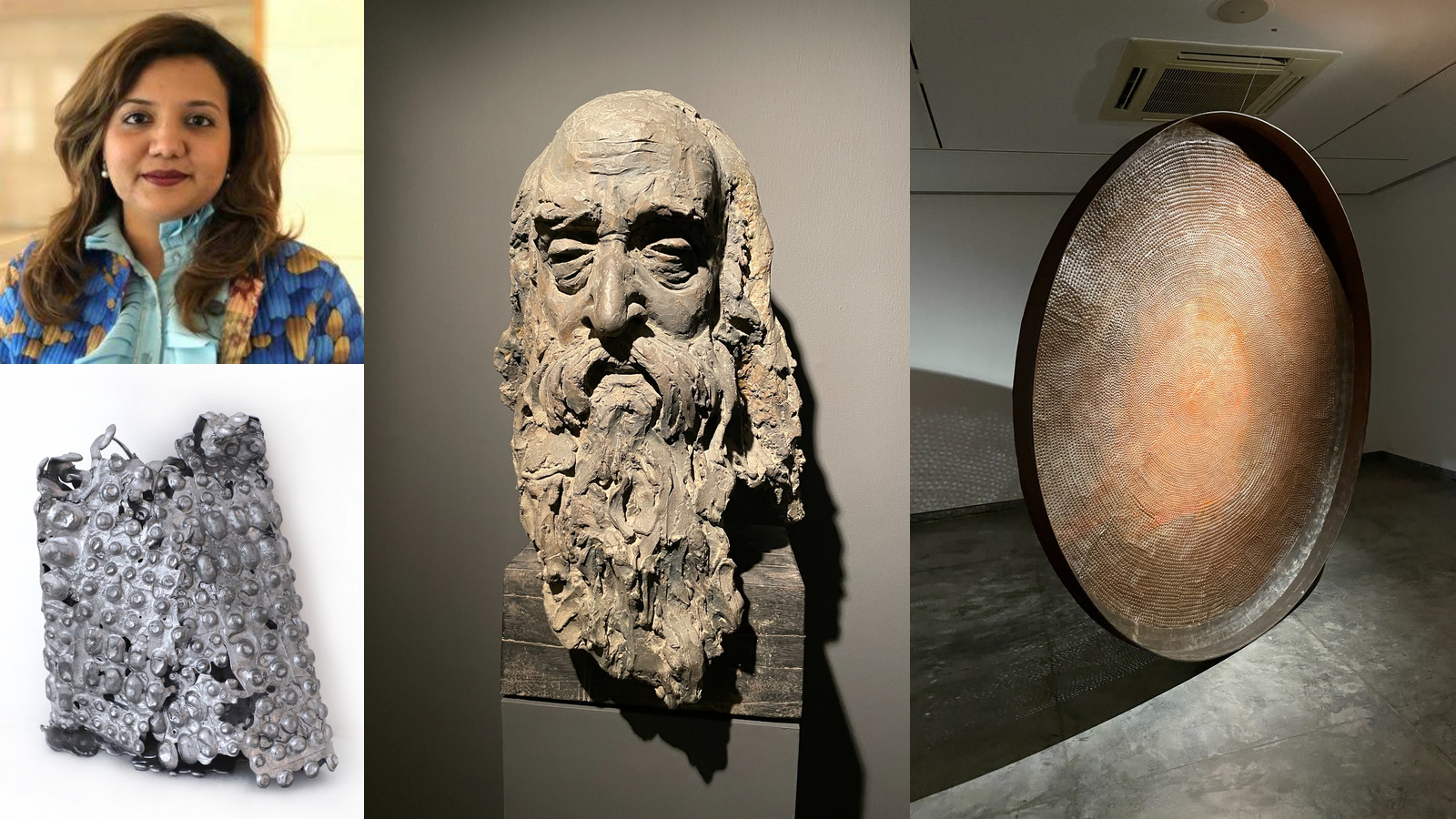
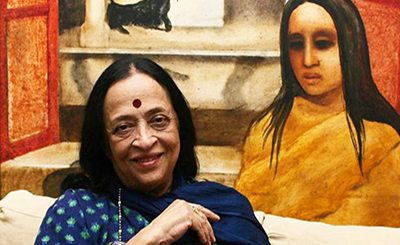
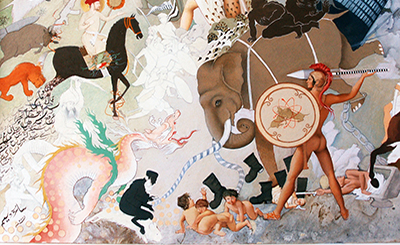
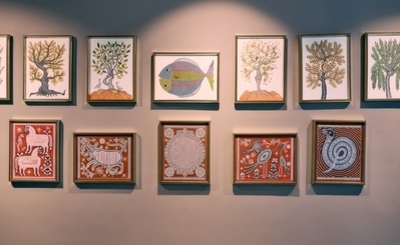
(clockwise from top left) Curator Nainvi Vora, Chinmayananda by Latika Katt, Shambhavi's Braille and Poojan Gupta's Remained. Photos: Gallery Espace and Shireen Quadri
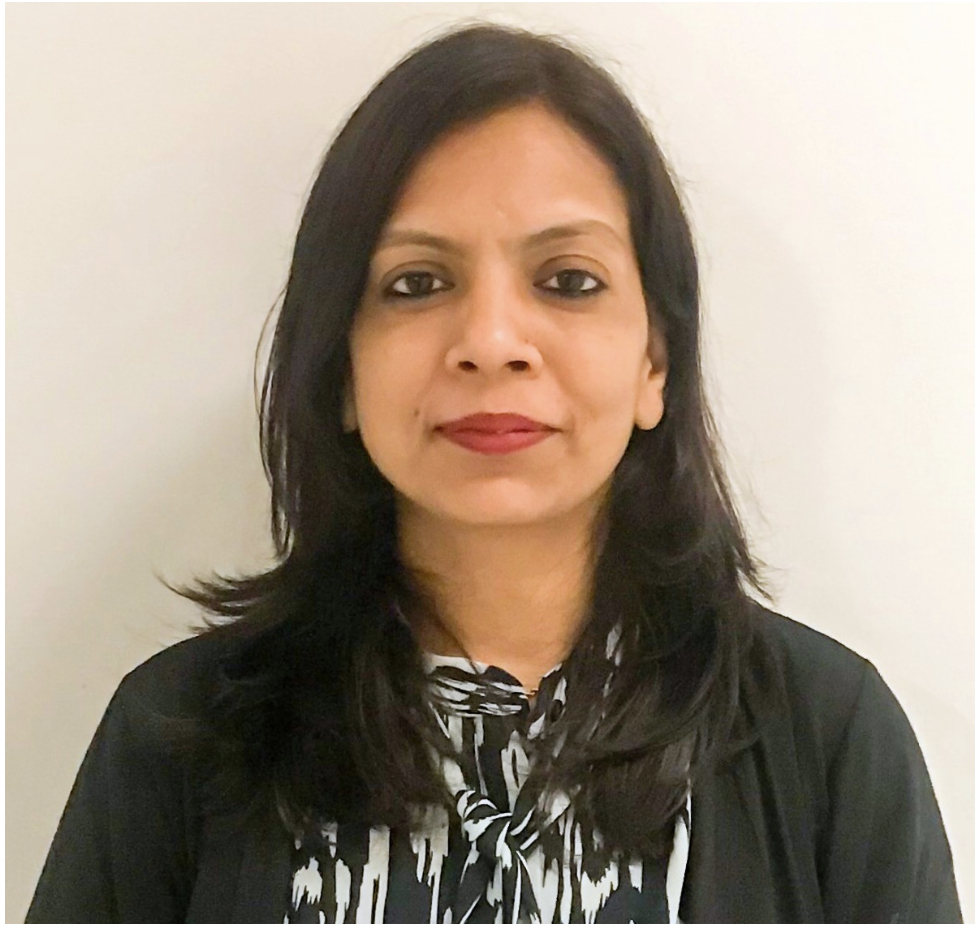
The curator of Gallery Espace’s show, Sculpting Lineages: Women Across Generations, on bringing six women artists across nearly seven decades into conversation, and rethinking how the history of Indian sculpture has been written
Indian sculpture has often been told through a familiar line of male modernists, leaving women artists visible as individual names but rarely seen in relation to one another. Curated by Nainvi Vora, Sculpting Lineages: Women Across Generations at Gallery Espace revisited that history through six artists working across nearly seven decades: Ira Chaudhuri, Latika Katt, Shambhavi, Sojwal Samant, Radhika Agarwala and Poojan Gupta. Rather than presenting them as a single school or suggesting a direct chain of influence, Vora places their practices with one another to reveal how sculptural ideas travel, disappear and return in altered forms.
The exhibition showcased Chaudhuri’s functional ceramics and Katt’s bronze portraiture and socially engaged works to a much wider field of sculptural practice. Shambhavi enlarges objects associated with rural life into iron forms shaped by agrarian memory; Samant uses familiar domestic objects to bring hidden tensions into view; Agarwala preserves the scars of damaged natural matter; and Gupta turns discarded medicine packaging into objects that resemble relics. Across these works, sculpture becomes closely tied to use, touch, work, illness, environmental loss and the materials people leave behind.
In this interview, Vora discusses the research, conversations and curatorial choices that shaped the exhibition. She reflects on what these six artists reveal about the changing language of Indian sculpture and the gaps that remain in the history written around it. Excerpts:
The exhibition looked at women artists across several generations. When you began putting it together, what did you feel had been left out of the usual story of Indian sculpture?
What has been missing is not simply the presence of women in the history of Indian sculpture, but the recognition of the intellectual, material and social continuities between their practices. Our histories of modern Indian sculpture have tended to privilege narratives of individual genius, monumental form and formal innovation, often organised around male pioneers. Women, meanwhile, have frequently been positioned as exceptional figures whose achievements are acknowledged individually but rarely connected into a sustained historical narrative. The consequence is that each generation of women artists appears to begin anew, without predecessors, interlocutors or intellectual ancestors.
This is where feminist art history becomes important to my curatorial thinking. Gerda Lerner, in her writing on the construction of feminist consciousness, examines how the fragmentation of women’s historical knowledge prevents subsequent generations from recognising the achievements of those before them. Griselda Pollock, similarly, has demonstrated how the canon produces exclusion not only through omission, but through the ways in which artistic significance itself is defined. I was interested in what might happen if we approached Indian sculpture through these questions.
My conversation with Ira Chaudhuri in December 2025 was particularly illuminating in this regard. Speaking to her in person allowed me to understand the specificity of her position as a potter, her experiences of learning and experimentation at Baroda, and her insistence on the value of utility. She did not want her practice casually absorbed into the category of ceramic sculpture. That distinction mattered to me because it revealed how the boundaries of art history are not merely theoretical; they are also lived positions, shaped by artists' experiences, choices and refusals.
I had also been in touch with Latika Katt before her passing in 2025, and her extraordinary range of practice remained central to my thinking about the exhibition. Her movement between portraiture, organic abstraction, environmental concerns and responses to social violence makes it difficult to contain her contribution in a single account of sculptural modernism.
Bringing these artists into conversation with Shambhavi, Sojwal Samant, Radhika Agarwala and Poojan Gupta allowed me to construct a different kind of genealogy. I was not attempting to establish a definitive lineage or suggest that one artist directly influenced another. Rather, I wanted to trace how questions of material, labour, ecology, embodiment and memory recur across generations, acquiring new meanings in different historical circumstances.
For me, the exhibition is ultimately an intervention into how we write art history. It asks us to recognise women not as supplementary figures in an already established narrative, but as active agents in shaping the very terms through which Indian sculpture has evolved.
The show included older forms of sculpture as well as works that deal with memory, labour, ecology, domestic space, waste and care. Do you see this as a change in material, or a change in what sculpture can hold?
I would resist framing this as a straightforward transition from traditional materials to contemporary ones. Such a reading risks producing another linear history in which the older generation appears formally conservative and the younger generation more progressive. What interests me instead is how the meaning of material, and the conditions under which it acquires artistic value, change over time.
Ira Chaudhuri offers a particularly compelling starting point. During our conversation in December 2025, she emphatically identified herself as a potter rather than a ceramic sculptor. Her insistence on utility challenges the hierarchy through which autonomous, non-functional art has often been privileged over craft and functional objects. Her pots are carefully composed sculptural bodies, but their capacity to be used remains integral to their significance. I find this position especially important because it unsettles the assumption that an object must relinquish function to acquire aesthetic or intellectual value.
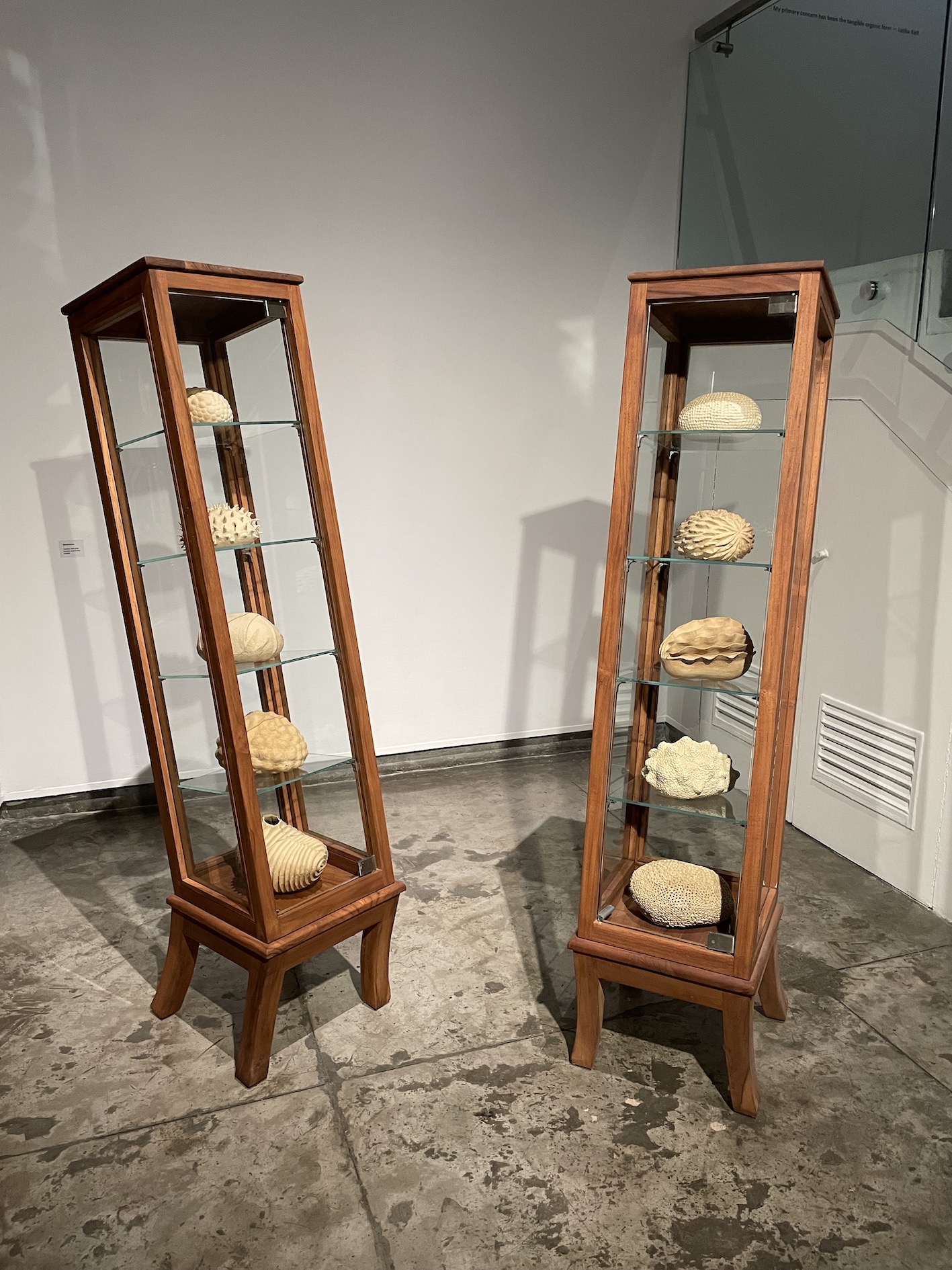
Works by Sojwal Samant. Photo: Shireen Quadri
Latika Katt similarly demonstrated that sculpture could move between radically different material and conceptual registers. Her engagement with organic forms and ecological processes existed alongside her portraits and socially responsive works. In her practice, material was never simply a means of producing form; it was a way of attending to presence, vulnerability and transformation.
The contemporary artists extend these possibilities in different directions. Shambhavi’s iron surfaces invite us to consider touch as a mode of knowledge, challenging the dominance of vision in the museum. Sojwal Samant’s ceramics transform domestic objects into sites of psychological and social inquiry. Radhika Agarwala works with the afterlives of damaged organic matter, while Poojan Gupta transforms discarded pharmaceutical packaging into objects that evoke relics, ritual and devotion.
I would describe this as a shift from understanding sculpture primarily through the autonomous object towards understanding it through relationships: between a material and its previous life, an object and the body, labour and value, or human activity and the environment.
Ecofeminist thinking is useful here because it questions the hierarchies that separate culture from nature, productive labour from reproductive labour, and human agency from the material world that sustains it. Materials such as domestic ceramics, tree bark and pharmaceutical waste become significant precisely because they expose these entanglements.
The transformation, then, is not simply in what sculpture is made from, but in what it is capable of holding. Sculpture can register the histories of use, the residue of labour, the consequences of consumption and the vulnerability of living systems. It can also challenge the systems of value that determine which materials, experiences and forms of knowledge deserve to be preserved.
What connects their practices despite their very different materials and concerns?
I was interested in bringing these four artists together precisely because they do not share a single aesthetic language. Their practices resist easy categorisation, and I did not want the exhibition to produce a superficial unity around the idea of women artists or a common feminist style. What connects them is a deeper methodological question: how can material become a way of thinking, rather than merely a substance from which an artwork is made?
Shambhavi approaches sculpture through the sensory and material knowledge of agrarian life. Her use of iron, handmade agricultural implements, paper pulp and weathered surfaces emerges from her memories of rural Bihar, but her work is not an exercise in nostalgia. The perforated surfaces of her sieve-inspired sculptures, including the work that invokes Braille, ask us to consider how histories of labour might be understood through touch. The marks of agricultural work become a language that challenges our dependence on sight as the primary means of encountering art.
Samant's practice operates through a different register. Her ceramic works often begin with ordinary objects or familiar situations, but they gradually destabilise our expectations of them. In Seismic, a seemingly familiar rug conceals a form beneath its surface. The domestic object becomes a metaphor for pressures that remain hidden until they can no longer be contained. In My Sitting Laundry, ceramic forms evoke folded garments, but their transformation into hardened material makes the familiar strange. Samant's work frequently draws its power from this tension between recognition and discomfort, humour and melancholy.
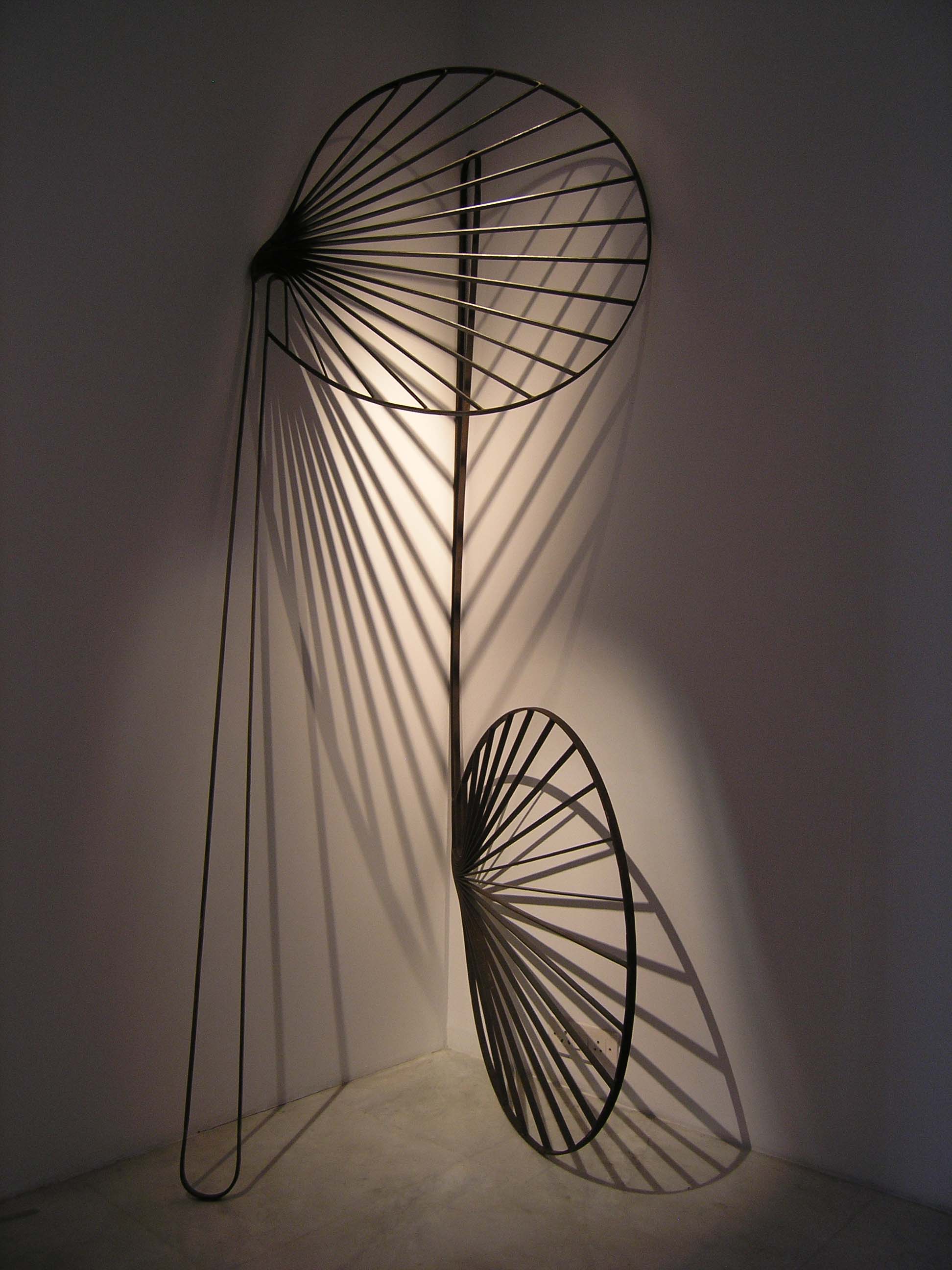
Shambhavi's Lullaby. Photo: Gallery Espace
Agarwala, meanwhile, approaches matter through processes of collection, preservation and reconstitution. In works such as Beneath the Ashes, We Were Trees barks are cast in bronze, preserving the irregularities and injuries of a discarded fragment. Made from specimens collected after forest fires extend this concern towards environmental destruction. The material is transformed, but the circumstances of its damage remain legible.
Gupta begins with an object that is almost entirely excluded from conventional sculptural histories: the empty pharmaceutical blister pack. Through stitching, repetition and casting in metals such as brass and pewter, she transforms this disposable object into something resembling a relic or devotional artefact. The blister pack becomes a record of bodily experience, but it also points towards pharmaceutical production, consumption and the environmental afterlife of medical waste.
These practices share an interest in transformation, but they do not arrive at the same conclusions. Shambhavi asks how knowledge embedded in rural labour might be made perceptible; Samant investigates the psychological and social structures concealed within ordinary life; Agarwala explores the unstable relationship between destruction and regeneration; and Gupta questions how value and reverence are assigned to objects.
Their connection lies in their refusal to treat matter as inert or disposable. Each artist allows material to retain traces of its previous existence, even as it acquires a new form. Sculpture becomes a process of attending to those traces, making connections between experiences that might otherwise remain separate.
Did these four artists help you think of sculpture as a record of the everyday pressures around us?
Yes, although I would distinguish between sculpture as a record and sculpture as an interpretation of those pressures. I am interested in how these artists make the structures underlying everyday life perceptible without reducing their work to illustration or documentary evidence.
Consider the relationship between labour and visibility. Shambhavi's sculptures draw attention to the knowledge embedded in agricultural practices and rural life, forms of knowledge that are frequently marginalised as economies modernise and landscapes change. Her use of perforation and tactile surfaces is particularly significant. In her work, touch becomes an alternative way of reading the world, bringing attention to bodies whose histories are not necessarily preserved in written archives. This is also an argument about whose knowledge is recognised as knowledge in the first place.
Samant approaches the everyday from within the domestic sphere. Feminist scholars have long questioned the division between public and private life, particularly the ways in which domestic labour and care have been naturalised as women's responsibilities rather than acknowledged as work. Samant's sculptures make this division visible without resorting to straightforward representation. In Unencumbered, a wooden basin laden with ceramic vessels occupies an ambiguous space between the domestic and the staged. The objects suggest the aftermath of use, but their accumulated presence also raises questions about the roles we perform and the expectations attached to them. The work asks us to consider how private experience enters public life, and what happens when the ordinary becomes available for scrutiny.
Agarwala's work introduces the pressures exerted upon landscapes by environmental destruction and urban transformation. The scorched bark in Beneath the Ashes, We Were Trees bears the physical traces of fire. When such fragments are transformed into sculptural forms, they do not become images of an abstract ecological crisis; they retain evidence of damage. The landscape begins to resemble a vulnerable body, carrying scars that cannot simply be erased through an act of restoration.
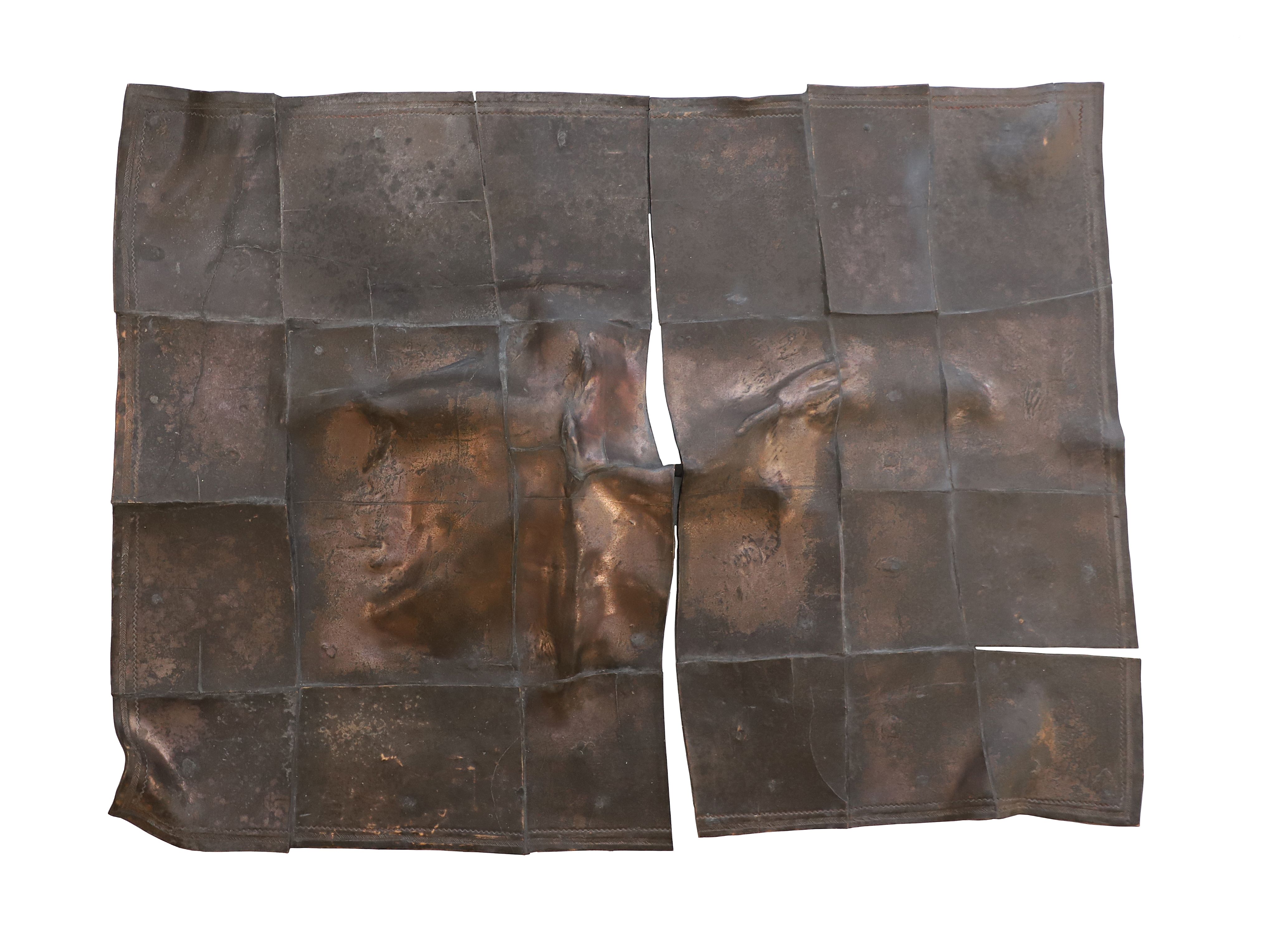
Sojwal Samant's Seismic
Gupta brings us to the intimate experience of illness and recovery. An empty blister pack may appear insignificant once the medicine has been consumed, yet it has participated in an encounter between a body and the systems designed to care for it. Her sculptures ask what remains after that encounter. Through repetition and manual assembly, she gives these emptied objects a second life, while keeping their association with medical consumption intact. Their transformation also exposes a contradiction: the infrastructures that sustain bodily health produce forms of waste that remain in the environment long after their immediate purpose has ended.
These practices reveal different dimensions of what might be called the politics of the everyday. They connect agrarian labour, domestic responsibility, environmental damage and medical consumption without suggesting that these experiences are interchangeable.
For me, the significance of sculpture lies in its ability to slow our encounter with what we usually overlook. It can turn a familiar object into a question, a discarded fragment into evidence, or an accumulated gesture into a form of collective memory. These artists do not simply record the pressures of contemporary life; they change how we perceive and understand them.
How do the younger and mid-career artists change the larger conversation on women’s place in Indian sculpture?
Placing these artists together allows us to reconsider the relationship between modernism, feminism and the material histories of sculpture in India. I would not describe the younger artists as breaking away from an older generation. Rather, they reveal how the possibilities opened up by earlier practitioners can be rethought under changing social and ecological conditions.
Chaudhuri's practice is significant because it unsettles the hierarchy between art and craft. Her insistence on pottery as a distinct discipline challenges the idea that functional objects must be subordinated to autonomous sculpture. This is not simply a question of terminology. It brings into view the gendered and institutional structures through which particular kinds of making have historically acquired prestige. Her work asks us to recognise the intellectual ambition of the pot without requiring it to become something else.
Chaudhuri's practice is significant because it unsettles the hierarchy between art and craft. Her insistence on pottery as a distinct discipline challenges the idea that functional objects must be subordinated to autonomous sculpture. This is not simply a question of terminology. It brings into view the gendered and institutional structures through which particular kinds of making have historically acquired prestige. Her work asks us to recognise the intellectual ambition of the pot without requiring it to become something else.
Katt offers another important point of departure. Her practice moved between portraiture, abstraction, environmental forms and direct responses to social violence. Her Sati series, made in response to the death of Roop Kanwar in 1987, confronted patriarchal and caste violence through a sculptural language that refused the reassuring conventions of the heroic monument. Her later work, Murda, made in the aftermath of the Covid-19 pandemic, approaches death without idealisation. The human body becomes matter, vulnerable to dissolution. Across these works, Katt demonstrates that sculpture can engage with difficult social realities while remaining attentive to material form.
The younger and mid-career artists extend these questions beyond the conventional sculptural subject. Shambhavi foregrounds rural knowledge and embodied perception; Samant makes visible the emotional and social pressures of domestic life; Agarwala considers the afterlives of ecological damage; and Gupta examines the relationship between medical care, consumption and waste. Their practices expand feminist inquiry beyond the representation of women's bodies to consider the systems, environments and forms of labour through which life is sustained.
This expansion resonates with ecofeminist thought, particularly its critique of the hierarchies that separate human beings from the natural world and devalue forms of labour associated with care, maintenance and reproduction. It also invites a broader understanding of feminist sculpture: one that is not defined by a singular subject or medium, but by the questions it asks about power, value, vulnerability and interdependence.
I am equally interested in the question of transmission. The relationship between these artists is not necessarily one of direct influence, and I would be cautious about imposing such a narrative. Instead, lineage emerges through resonance. Chaudhuri's challenge to the hierarchy between function and art finds a different expression in Samant's unstable ceramic objects. Katt's attentiveness to organic processes resonates with Shambhavi's ecological thinking and Agarwala's preservation of damaged matter. Gupta's transformation of discarded packaging into objects of reverence opens another conversation about material value and what societies choose to preserve.
These are not identical positions, but they reveal how artistic questions can travel across generations without remaining unchanged. Ultimately, Sculpting Lineages proposed that women artists have not merely expanded the representation of women within Indian sculpture; they have transformed the discipline's conceptual, material and ethical horizons. They have challenged inherited distinctions between art and craft, monument and residue, public history and private experience, human agency and ecological life.
For me, that is what makes a lineage living rather than fixed. It does not demand continuity through sameness. It makes room for disagreement, interruption and reinvention. The history of Indian sculpture becomes richer when we recognise these relationships, not as a supplementary account of women's achievements, but as an integral part of how the medium itself has been made and remade.
More from Arts
Comments
*Comments will be moderated