








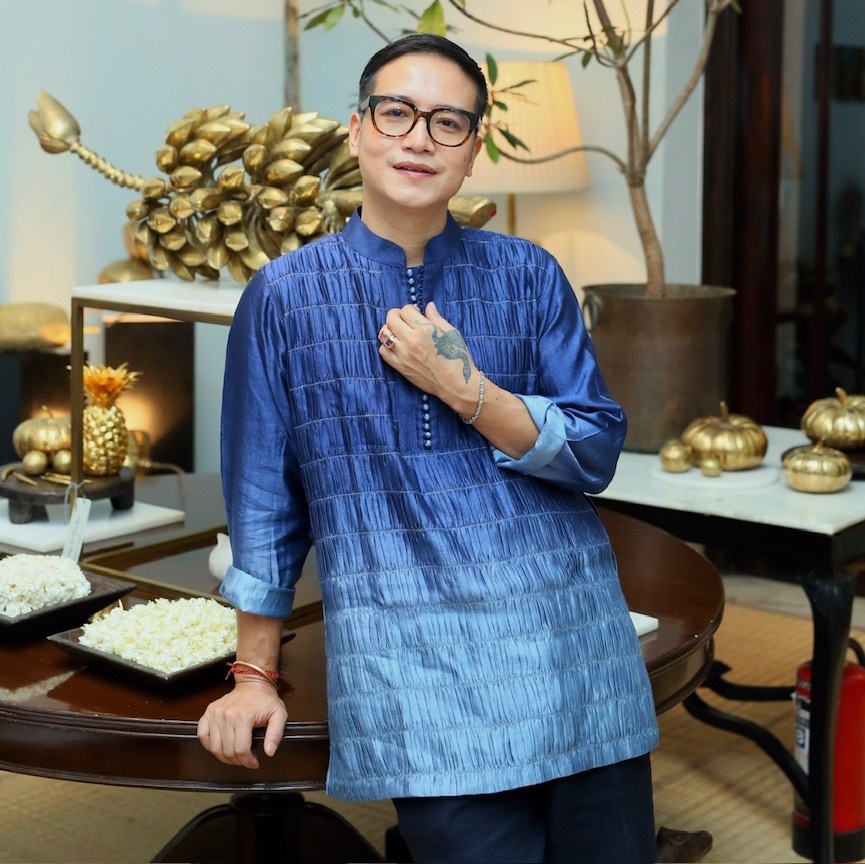
Jenjum Gadi; Ngok Dolu,’ which means ‘My Village’ in Galo, brings together more than 30 new works drawn from Jenjum’s childhood in Tirbin, Arunachal Pradesh. Photos: Gallery Vayu
In his new show, ‘Ngok Dolu,’ Jenjum Gadi returns to the Arunachal Pradesh village where he grew up, recasting its homes, fields, plants and memories in brass. In this interview, he speaks about his mother, the loom that first drew him to making, his two decades in fashion, the changes he sees in Tirbin, his choice of brass, and the two places he now calls home: Arunachal and Delhi.
At Gallery Vayu on Lodhi Road in Delhi, Jenjum Gadi has rebuilt a version of his village in brass. Against the gallery’s deep green and white walls are bamboo houses, paddy fields, vegetables like bitter gourd and lady’s fingers, birds, fruits, trees, clouds and fragments of village life. They are things he has known closely and does not want to lose the memory of. ‘Ngok Dolu,’ which means ‘My Village’ in Galo, brings together more than 30 new works drawn from Jenjum’s childhood in Tirbin, Arunachal Pradesh. There are sculptural pieces and beaten-brass wall works, some dense with foliage and small incidents, others derived from a single remembered form.
At the preview, what struck me was how easily one could enter the show. “…the brass forms do not depict isolated objects so much as points within a larger, interconnected whole, each shape implying the ones it once depended on. Jenjum brings these fleeting impressions into brass, giving permanence to forms rooted in a landscape that is itself constantly changing. There is a deliberate tension in this translation, and through this juxtaposition, the familiar becomes unfamiliar, allowing everyday forms to be seen anew,” read the curatorial note. But you did not quite need an explanation before recognising the world in front of you.
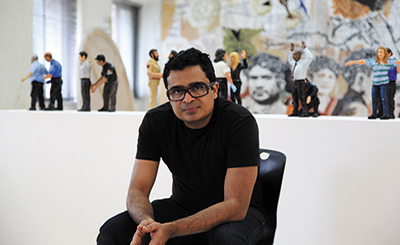
Jenjum himself has much the same lack of performance about him when we speak after the preview. He is warm, gracious and grounded, and talks about the work without trying to make it sound more complicated than it is. I ask him which part of Tirbin he feels he has managed to bring back most closely. He refuses to pick one. “Not one thing in particular,” he says. “Everything as a whole.” What pleased him was seeing the separate pieces come together to create the feeling he had carried in his head. “The whole idea is to give people a glimpse of my village, my childhood.” In that sense, ‘Ngok Dolu’ is not a reconstruction of a precise place than a reconstruction of how a place survives in the memory of someone who has been away from it for years.
Gallery Vayu is the curatorial initiative of Vayu: Design for Living, founded by designer Vivek Sahni, who is also a co-founder and chairman of Kama Ayurveda. Sahni’s Vayu has been bringing art, objects, textiles and Indian craft into the same conversation, without being overly anxious about where one ends and another begins. That approach suits Jenjum, whose own life has straddled fashion, textiles, craft and now sculpture.
The roots of the current show lie in a much smaller patch of land. Jenjum’s 2024 debut solo, ‘Apase – From My Mother’s Garden,’ took the fruits and vegetables grown by his mother and remade them in brass. The response surprised him. People who had never been to Arunachal would tell him that the pieces reminded them of their own childhood, their grandmother’s garden or a village they had left behind. “I could share my memory with people, and people could also connect to it,” he tells me. That gave him the confidence to work on ‘Ngok Dolu.’
There has been another stage in between. In March 2025, ‘Transcendent Memories’ at Bikaner House pushed Jenjum’s brass practice further through repoussé, chasing and imagery influenced by Pichwai painting. He had first encountered Pichwai as a young student in Delhi and was drawn to the way nature, animals and foliage carry the narrative around the central figure. ‘Ngok Dolu’ now opens the frame further still. The mother’s garden has become the village around it: homes, farms, rivers, forests, animals, crops, people and weather. There is also a sense of urgency behind all this remembering. “With time, your memory is kind of fading away,” Jenjum says. Making these works became, in his words, a slightly “selfish” attempt to bring those memories back into life and make them “as permanent as possible”.
_Material-Brass_Size- 23.2 x 18 inches each_Installation Images_Ngok Dolu by Jenjum Gadi_Gallery Vayu (2).JPG)
Amo Tami (Triptych), Material-Brass, 23.2 x 18 inches each, installation image, Ngok Dolu by Jenjum Gadi, Gallery Vayu
Jenjum says his mother has had one of the strongest influences on the person he became. He remembers watching her take on hard physical work in a village where work was often strictly divided between men and women. More importantly for his own creative life, she let him cross a boundary boys were not expected to cross. He wanted to sit at the loom. She let him. “She never for a second said, ‘This is a girl’s thing, not a boy’s thing,’” he recalls. He has wondered what might have happened had she stopped him. The loom gave him colour, pattern, rhythm and the pleasure of making with his hands long before he knew fashion design could become a profession. “I think being a creative person really goes to my mother,” he says. “That’s where it all started.”
One of the most personal works in ‘Ngok Dolu’ brings that debt to his mother into the gallery. In a brass panel, Jenjum imagines her with a loin loom, descending onto a lotus. The image also carries traces of the Raja Ravi Varma calendar prints he remembers seeing while growing up. It turns an ordinary childhood sight, his mother weaving, into something almost devotional without taking away its intimacy.
His mother, Jenjum says with a laugh, is considerably less interested in the story of the successful designer or artist than everyone around her. She never went to school, and the worlds of fashion weeks, galleries and press coverage are far removed from the life she has known. When he tells her something has gone well, the response can be pleasingly matter-of-fact. What makes her truly happy is when neighbours or younger people in the village arrive with a newspaper clipping, or something they have seen on social media, and tell her that her son is doing well. Then she is proud. Mostly, though, she worries about him in Delhi. News of flooding, crime or some other city calamity reaches her phone and she calls to check if he is safe. “She worries more about my well-being,” Jenjum says. And, like mothers everywhere, she still asks when he is coming home.
Home, says Jenjum, is made up of remarkably small things. He remembers evenings of storytelling and waiting for his grandmother to return from the fields, often carrying wild berries and other things she had gathered. He remembers sitting for hours beside his mother while she worked at the loom, drawn as much to its sound as its colour: the repeated “tak, tak, tak” and the bright textiles slowly taking shape in front of him.
Also read: Subodh Gupta interview: ‘Even the most ordinary objects can carry extraordinary human histories’
Jenjum also remembers his childhood friends. They would move from one mountain to another, look for things they could eat, search for birds’ nests, go down to the river to catch fish, or drift from one garden to another looking for cucumbers, corn and fruit. There was no need to schedule “nature” as an activity. It was part of their everyday life. “The whole day was activity,” he says.
That childhood is also why the changes in Tirbin trouble him. Jenjum is careful not to romanticise hardship or pretend that change can be stopped. Roads, electricity, phones and access to information have made life easier in obvious ways. But when he returns now, he sometimes feels the village he remembers has slipped away. Bamboo and thatch houses are being replaced by concrete. Families that once lived close together are more dispersed. Some homes stand empty after grandparents have died and younger family members have chosen to live in towns. Children surrounded by mountains and forests can be as attached to their phones as children in Delhi.
“When I go back, it doesn’t feel like I’ve come back to my village anymore,” he says. What he misses is a quality he reaches for in Hindi: saadgi, the old simplicity of the place. He remembers homes where several branches of one family lived together, with children constantly moving between them. Now, he says, homes can be physically farther apart, with boundaries between families more sharply marked. Sometimes he walks the same paths he walked as a boy and knows exactly where he is, yet it no longer feels quite the same. That sadness is one of the reasons ‘Ngok Dolu’ exists. Making the work, he says, allowed him to revisit those memories while they were still vivid.
His concern is not only sentimental. He talks at length about what happens when change arrives without enough thought about the land supporting it. Trees are being cut, he says, and some mountain streams that people depend upon have begun drying. The Galo have traditionally practised jhum, or shifting cultivation, and water sources on the hills are directly connected to farming. Jenjum describes the connection plainly: if forests disappear and streams weaken, having land is no guarantee that it can continue to be cultivated. Research on Galo communities in the Tirbin region also documents the long connection between their livelihoods and shifting cultivation.
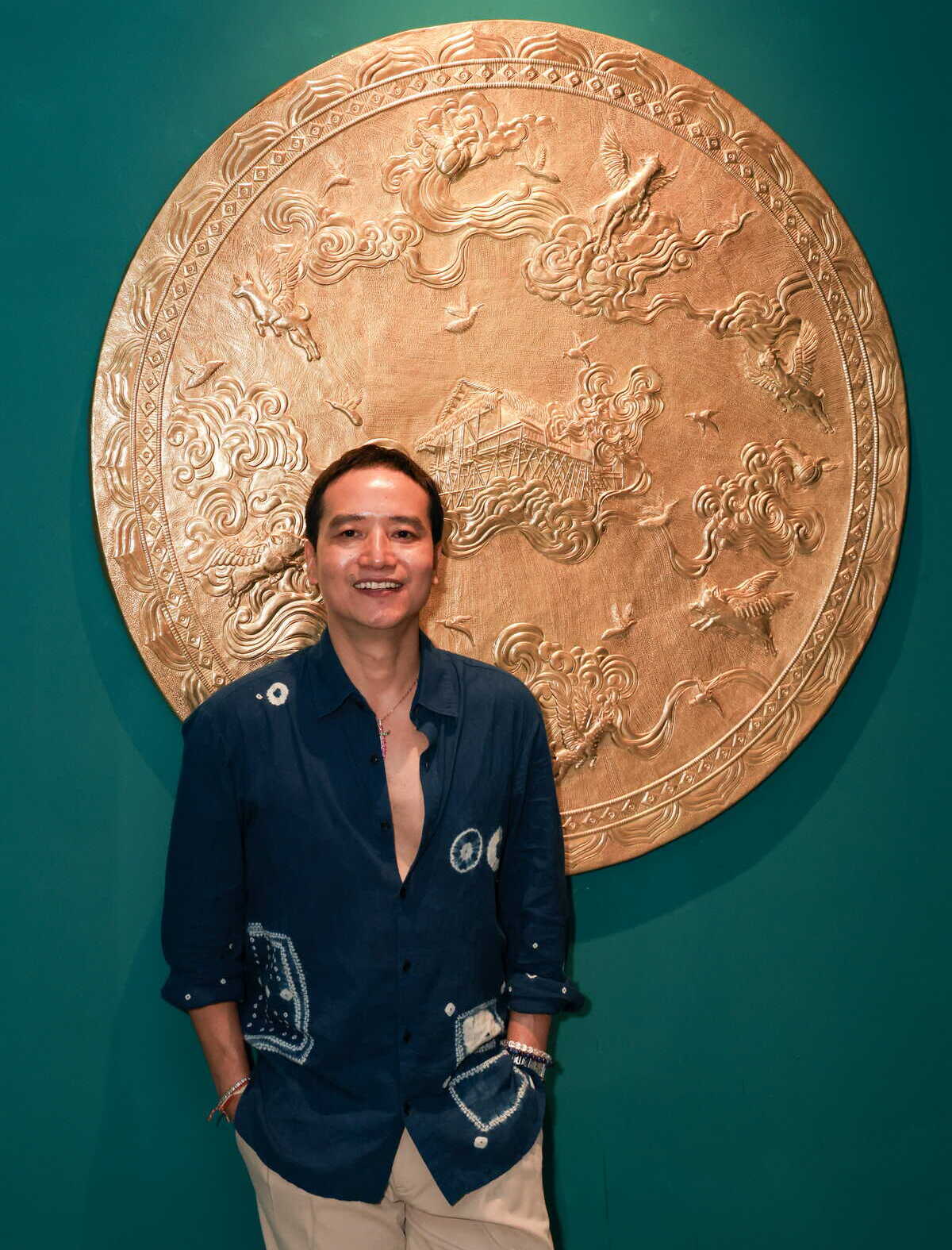
Jenjum Gadi with Ayo Gv Doyw, Brass, 45.5x45.5 inches
Jenjum sees younger people organising to do something about it. Village youth groups are becoming more conscious about protecting forests and water sources, he says, identifying areas where trees should not be cut because the forest sustains the streams below. His feelings are mixed because the reality is mixed. “Change is inevitable,” he says. What bothers him is change without awareness of its consequences.
The older he gets, the clearer his attachment to Arunachal becomes. Jenjum admits there was a time when he was not especially proud of where he came from. Distance changed that. “As I grow older and older, I start realising where I come from,” he says. Living in Delhi did not erase the imprint of Tirbin; it made it easier to see. The colours, materials and natural forms that kept entering his fashion collections did not just have to do with aesthetic decisions. They were memories working through him before he had quite named them as such.
“That’s what shaped me,” he says. “That’s what makes me unique from other people, and that’s what made me who I am.” You realise that Jenjum is not discovering his “roots” in ‘Ngok Dolu’ because heritage has become fashionable. The roots were present throughout his work. He has only become more willing, with age, to look directly at them. Brass allows him to hold on to memory without making it feel fixed. He chose it partly because, like nature, it changes. It reacts to its surroundings, darkens and acquires a patina. “Nature also changes,” he says. He wanted a material that could act in a similar way over time.
There were practical reasons, too. For the kind of relief and surface work he wanted, brass offered possibilities other metals did not. He initially considered silver, but quickly realised that working at this scale in silver would be prohibitively expensive. Brass also belongs naturally to an Indian world of domestic and ritual objects and craft. For his work, Jenjum has collaborated closely with metal artisans in Rupa, Arunachal Pradesh, where generations of craftspeople have worked with repoussé and other metal techniques, producing everything from jewellery to architectural elements for temples and monasteries.
His move into art can look, from the outside, like a clean career switch. It is not. Jenjum has spent roughly two decades in fashion. After coming to Delhi from Tirbin, he found his way into fashion school, trained at Wigan & Leigh and later worked with Rohit Bal and went on to build his own label. Before his eponymous label in 2012, he started Koga in 2008 with his batch-mate Jasleen Kochhar, and the two made their Lakmé Fashion Week debut that same year. Koga became known for its use of cool and creative fabrics, embroidery and colour.
Jenjum does not see one practice cancelling out the other. “My approach to both is the same,” he tells me. An idea begins personally, through something he has experienced, remembered, seen while travelling or carried from childhood. What changes is what happens once the object leaves him. Fashion taught him how quickly something personal can become negotiated. You finish a garment, then a client arrives. A sleeve or fit change, a detail is removed or added. Even a ten per cent alteration can change his relationship to something he conceived as a whole. Clothes also end up inside wardrobes, brought out for particular occasions. Art offers him another kind of continuity.
.JPG)
Pinku Pintv, Brass, 15 x 22 inches, installation image, Ngok Dolu by Jenjum Gadi, Gallery Vayu
“With art, you make it and it is there,” he says. Someone might buy the work and place it in another context, but they take it essentially as he made it. “They’re taking a piece of your art, or a piece of you, as it is.” There is no bitterness when he speaks about fashion. He still loves it and has not ruled out returning to it. For now, however, he likes art because it remains more personal.
If anything, working in metal has made him more disciplined. He still follows a process familiar from fashion: inspiration, research, sampling, refinement. But while cloth can be altered, metal doesn’t have that facility. Once a surface has been hammered, a mistake can be extremely difficult to undo.
He tells me about one large work in which he noticed a small cut only after different light fell on it. He called the craftsman and learnt that the metal had overheated at that point. There was no clever gallery fix. The piece had to be done again. “There’s no going back,” he says. “With metal, I have to be more precise.” Some of his works are singular; others are made in small editions of three, five or ten, depending on the piece. The finished objects may look effortless, but their making involves repeated testing and an attention that borders on stubbornness.
Jenjum has lived in Delhi long enough to know how much talent from the Northeast still remains outside the usual art, fashion and media circuits. He is now developing the Northeast India Public Art Trust, through which he hopes to create more opportunities for artists and craftspeople from the region and connect them with audiences elsewhere in the country.
His advice to a younger artist arriving from the Northeast is refreshingly uncomplicated. “Don’t change who you are. Be as authentic as you are.” When Jenjum arrived in Delhi, he had to find his own way into a city and an industry that did not always understand where he came from. Over the years, he says, he managed to “build a bridge” for himself. He now wants others to be able to use it. “There is no dearth of talent,” he says. “It is just about giving an opportunity.”
It’s a pertinent point because an artist does not need to explain an entire region to make it visible since specificity can do that work far better. Jenjum tells you what his mother grew, what his grandmother brought home from the fields, what the loom sounded like, where he wandered as a boy, what people planted, what houses looked like. Through those details come the bigger concerns of the show: ecology, migration, belonging, disappearing ways of living and the question of who gets to tell the story of a place.
Having lived in Delhi for more than two decades, Jenjum does not pretend he is waiting to return “home”. Delhi is home, too. His friends are here, his house and work are here, and it is the city in which he built his adult life. He laughs that if he stays in Arunachal too long, he gets restless. He describes himself as a workaholic who cannot simply sit around with nothing to do.
At the same time, Delhi’s pollution and the exhaustion of city life have made him think seriously about spending longer periods in Arunachal. Part of his reason for starting the new initiative, he says, is that it gives him something meaningful to do there rather than merely going home on holiday. He has begun speaking with craftspeople about things they might make together, though he is quick to stress that these ideas are still at an early stage. He has also spoken elsewhere about a possible future body of work inspired by his walks through Lodhi Gardens, the patch of Delhi green that has become part of his own daily landscape.
By the end of our conversation, asking him to choose between Delhi and Tirbin feels almost beside the point. He does not want to choose. One place gave him his earliest images: his mother’s loom, the river, fields, birds, gardens and the habit of looking closely at nature. The other gave him his career, friendships, a fashion language and eventually enough distance to see those first images differently.
“My village is my identity,” Jenjum says. “Delhi is what made me who I am today.” ‘Ngok Dolu’ lies precisely between those two homes: a village remembered from a city, made solid in brass, and still changing even after the hammering has stopped.
Ngok Dolu (My Village) is on view at Gallery Vayu, Lodhi Road, New Delhi, through September 30, 2026
More from Arts

Comments
*Comments will be moderated