








As one of his installations ‘Family Tree’ makes its way to Riyadh, Subodh Gupta looks back on his journey from Bihar to the international art world, the kitchen vessels and humble materials that have shaped his practice, the ideas of home, memory, migration, labour, faith and loss running through his work, his recent show, ‘A Fistful of Sky,’ his emotional return to Bihar, the craftspeople behind his monumental installations, his hopes for a younger generation of artists, and more
For more than three decades, Subodh Gupta has transformed the ordinary objects of Indian life into vessels of memory. Stainless-steel plates, tiffin boxes, milk pails, battered pots and even cow dung appear in his work, evoking homes left behind, shared meals, unacknowledged labour and lives upended by migration. In his hands, the kitchen becomes an archive and the familiar acquires the weight of history.
Born in Bihar in 1964, Gupta travelled with a theatre group before studying painting at the College of Art in Patna. After moving to New Delhi, he expanded his practice to include sculpture, installation, photography, video and performance. The material world of his childhood, however, remained central to his art. Drawn from lived experience, his objects gathered wider meanings as his work travelled: a tiffin carrier could suggest hunger and home, migration and aspiration, private memory and economic change.
The movement between the intimate and the monumental defines many of his best-known works. ‘Very Hungry God’, ‘Line of Control,’ ‘What Does the Vessel Contain That the River Does Not,’ ‘My Mother and Me,’ ‘Proust Mapping’ and his steel ‘Stupa’ differ in scale and form, but share a common inquiry. They consider what objects retain, whose work remains unseen, and how the materials of daily survival can acquire dignity, mystery and an almost sacred presence. Gupta regards them not as separate statements but as chapters in a continuing journey.
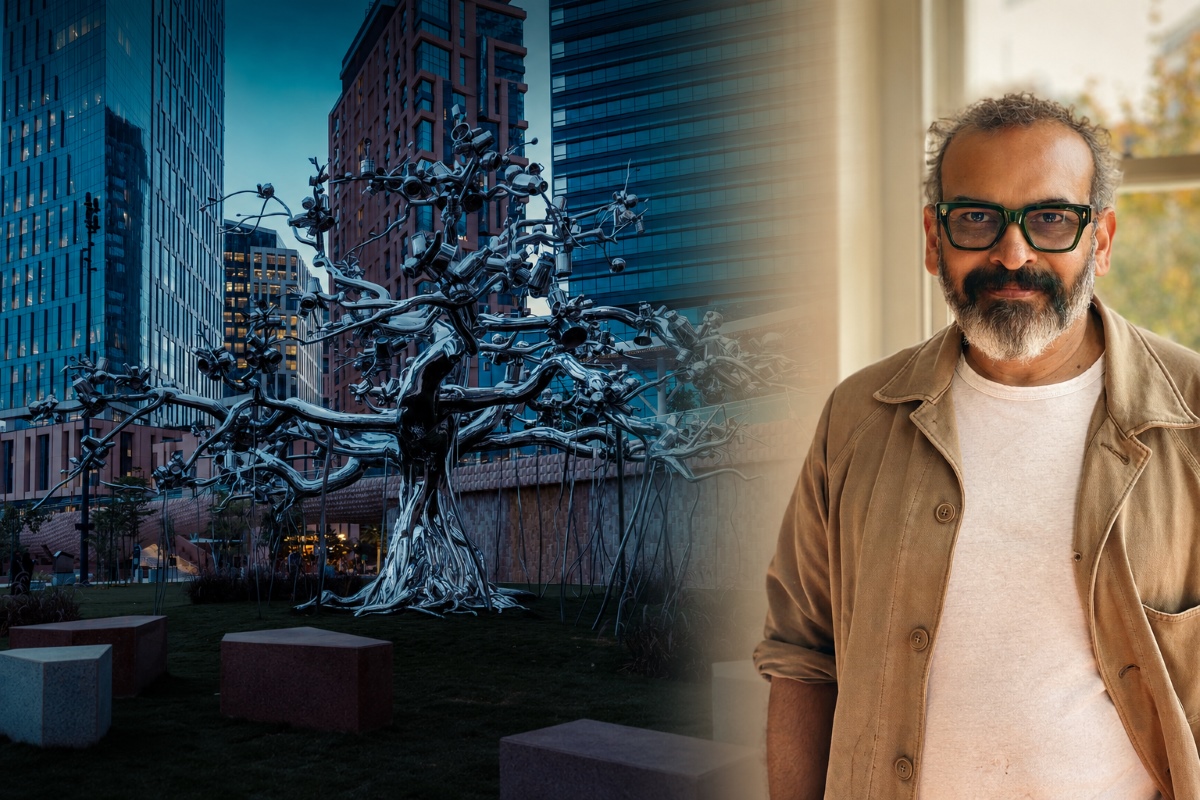
The latest chapter has brought ‘Family Tree’ (2020) to Riyadh. Installed at the arrival plaza of the King Abdullah Financial District, the sculpture has joined the Riyadh Art Permanent Collection and is being displayed in the city for the first time. Made from stainless steel utensils, including tiffin boxes, thalis and milk pails, it takes the form of a Peepal, or Bodhi tree. The work turns domestic objects into a public landmark as well as a place for gathering and reflection.
Its roots and branches suggest ancestry, renewal and lives growing out of other lives. For Gupta, the tree belongs to no single faith or geography; it represents continuity and connection. The utensils are similarly universal, since every culture has vessels for cooking, carrying and sharing food. In Riyadh, these two visual languages come together: the enduring symbolism of the tree and the familiarity of objects associated with nourishment, care and home.
These ideas also run through Gupta’s recent exhibition, ‘A Fistful of Sky,’ curated by Clare Lilley and presented across all four floors of the Art House at Mumbai’s Nita Mukesh Ambani Cultural Centre from April 3 to May 17, 2026. Through cow dung, mosquito nets, saris and well-used pots, the exhibition revisited materials shaped by touch, smell and work. Gupta considers it deeply personal and among his strongest bodies of work. Pieces such as Kingdom of Earth point to new directions in his practice while remaining rooted in where he comes from. That connection was equally palpable in The Way Home, his return to Bihar, which brought pride in the Bihar Museum and the joy of reconnecting with old friends, but also disappointment at the poor facilities and shortage of teachers at his former art college.
In this wide-ranging conversation with The Punch Magazine, Gupta discusses the way public art enters a city’s collective life; the ability of trees and kitchen vessels to cross cultural and religious boundaries, his restrained approach to memory, migration, violence and loss, and more Excerpts from the interview:
Your work has travelled across the world for years, but ‘Family Tree’ now becomes part of a city’s permanent landscape. Does that feel different from making a work for a museum? Does a sculpture begin to belong to the city more than to the artist after a point?
My role as an artist is to create works of art, and it gives me great satisfaction when a work finds a home, whether in a museum or in a public space. Both are important in their own way. A museum offers a place where people come with the intention of experiencing art, while public art becomes part of everyday life, accessible to everyone regardless of who they are. Yes, I do believe that over time a public sculpture begins to belong to the people and to the city. That is one of the most rewarding aspects of public art. Once it enters the public realm, it becomes part of the collective memory, and the artist is no longer its only owner.
‘Family Tree’ turns the Peepal or Bodhi into a structure of stainless-steel utensils tied to domestic life. How did you decide to translate a spiritual symbol into everyday materials, and what tensions or conversations about faith, secularism, and modern urban life did you hope the work would spark in Riyadh’s public space?
The tree belongs to everyone, that is why the work is called ‘Family Tree’. Across cultures, trees tell stories. They teach us about life, time, continuity, and our relationship with one another. I have always been fascinated by the Banyan tree, where one root gives birth to another, and then another. It is a beautiful metaphor for family, generations, and the interconnectedness of life.
For me, the tree is sacred not because it belongs to any particular religion, but because it embodies a philosophy of life. The stainless-steel utensils connect this universal idea to everyday human experience.
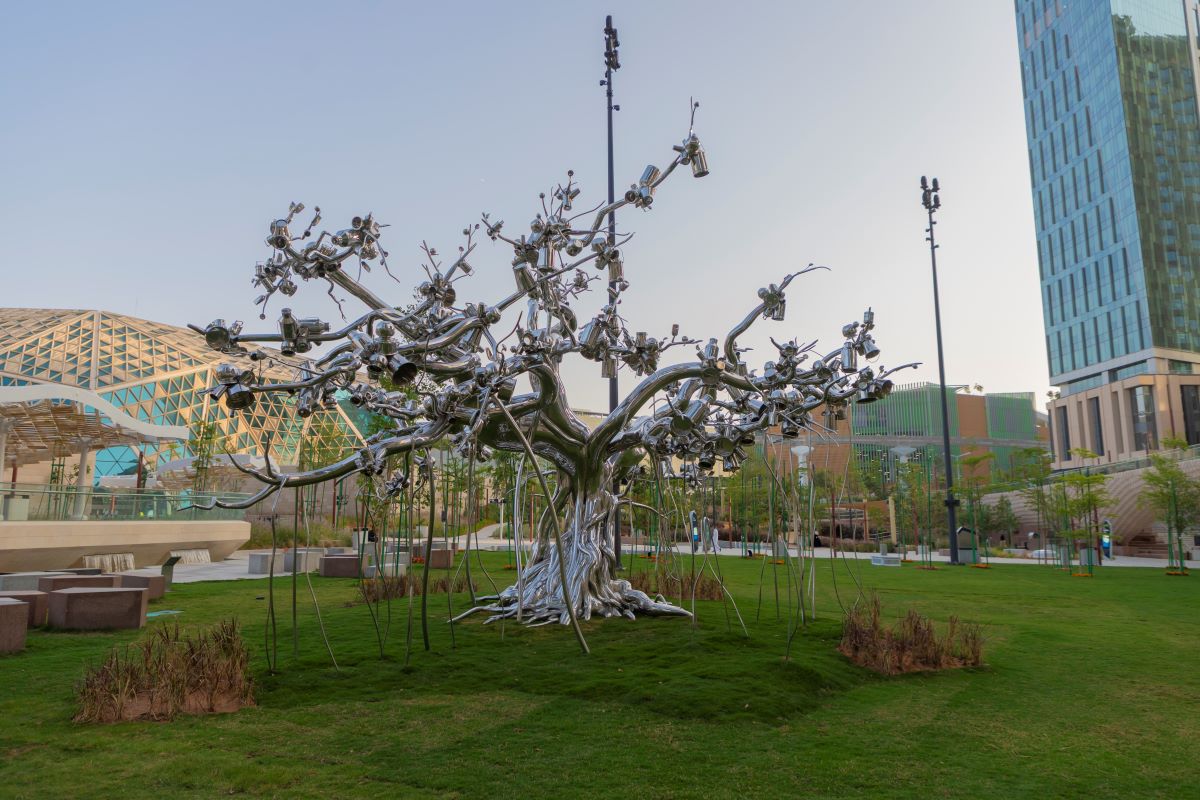
Made from stainless steel utensils, including tiffin boxes, thalis and milk pails, it takes the form of a Peepal, or Bodhi tree, Family Tree turns domestic objects into a public landmark as well as a place for gathering and reflection. Photo courtesy Riyadh Art.
They are objects we all recognise, objects that speak of nourishment, home, memory, and shared existence. By bringing these domestic materials together to form a tree, I wanted to bridge the ordinary and the spiritual.
I never want to prescribe a single meaning. The work is open to interpretation. Every person brings their own experiences, beliefs, and memories to it, and that is what completes the artwork. In the end, ‘Family Tree’ is less about religion than about our shared humanity and the invisible connections that bind us together.
The sculpture links household objects to ideas of sustenance, migration, labour, and economic change. Can you talk about how the specific choice of tiffin boxes, thalis and milk pails maps onto personal or collective family histories — yours or others’— and how you imagine viewers from different cultural backgrounds reading those family narratives?
The utensils I use are not just Indian objects, they are universal objects. Every culture has vessels for cooking, carrying food, sharing meals, and feeding families. That is why people from different parts of the world connect with them in different ways. They remind us of home, of care, of memory, and of everyday life.
For me, these objects also carry personal memories. They remind me of my childhood, my family, and the people whose daily labour often goes unnoticed. At the same time, they speak about migration, work, survival, and aspiration. These simple objects have travelled with people across generations and across borders, carrying not only food but also stories, traditions, and identity.
I never want to define a single meaning. Someone in India may see their own family history in a tiffin box or a milk pail, while someone elsewhere may be reminded of completely different memories from their own culture. That openness is important. The work is not about my story alone, it is about the shared human experiences that connect us all.
Culinary objects recur in your practice and are often linked to memory, migration and shared domestic rituals. How do you balance the intimate, autobiographical dimensions of these items with the ambition to address collective histories and national mythologies?
If you look at our basic human needs, there is very little that separates us, no matter where we live. We are all deeply connected. Cultures, climates, and rituals may differ, but the fundamental rhythms of life do not. Every person, every family, and every society has its own daily routines around food, care, work, and gathering.
My work begins with those ordinary moments. The objects I use come from my own memories and experiences, but they are not only autobiographical. They become a way of talking about something much larger. Through these everyday objects, I hope to reveal the shared experiences that connect people across cultures, histories, and generations. For me, the personal and the collective are never separate. The more honestly I speak about ordinary human life, the more universal the work becomes.
Your large-scale installations and public commissions frequently alter the viewer’s bodily experience. How important is scale and materiality to the phenomenological impact you seek, and how do you decide when a work should be intimate versus monumental?
Scale and material strongly shape how people experience my work. Large pieces affect movement and perception, encouraging viewers to slow down, feel small, or engage more closely. Material also influences connection, whether something feels soft, heavy, or familiar changes how it is perceived.
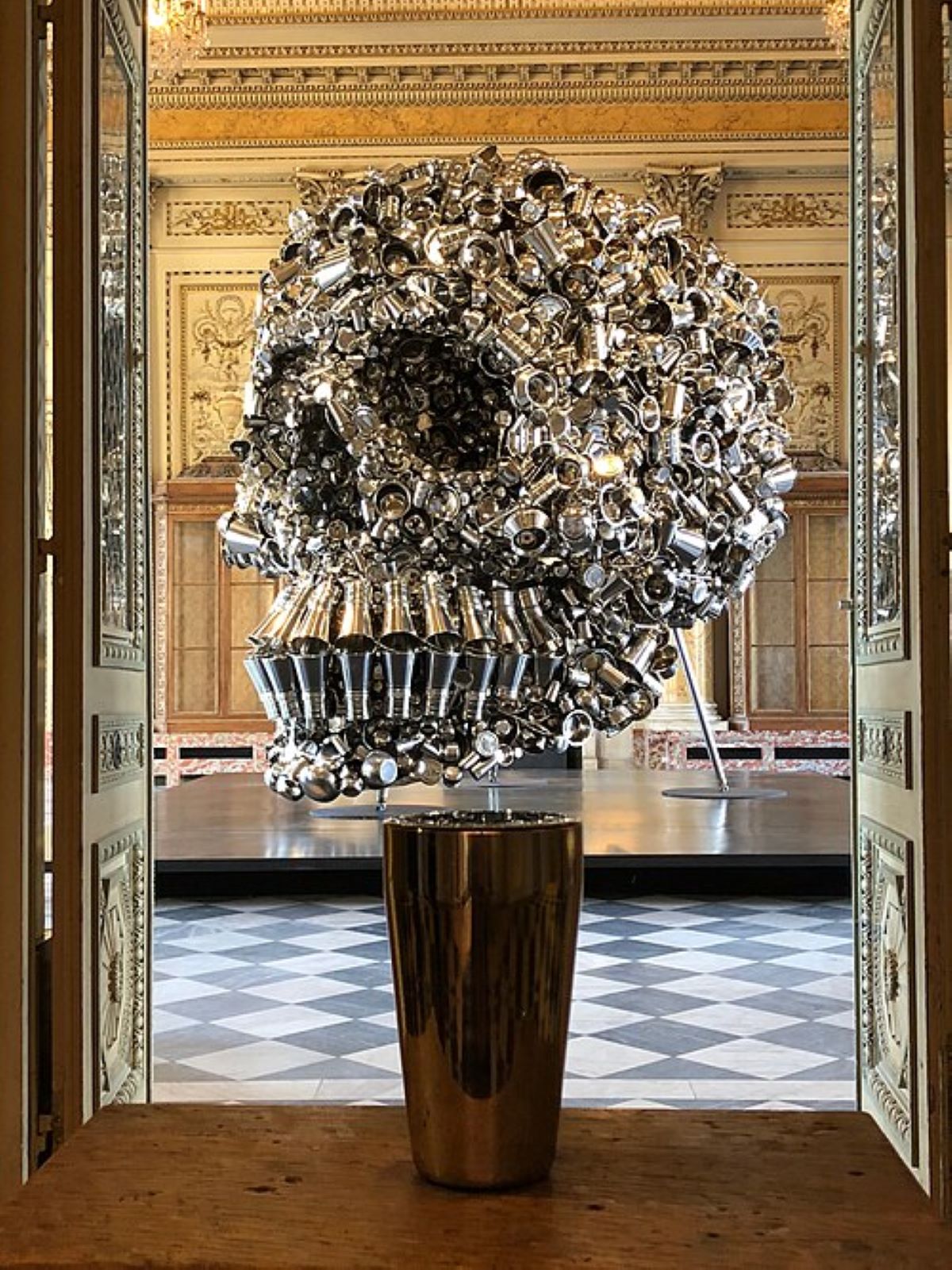
Subodh Gupta, Very Hungry God, 2006
Recently, I have become increasingly interested in how sound, movement, and the surrounding environment can deepen that experience. I am curious to explore these possibilities further, not to create spectacle, but to make the work feel more alive and responsive to its setting. However, size alone does not determine impact. Small works can be equally powerful, inviting close attention and deeper reflection.
I choose scale based on the idea, the space, and what the work needs to express. Sometimes it calls for openness and presence; other times, for intimacy and quiet. Ultimately, I want each viewer to experience the work in their own way and take from it what they can.
Collaboration with artisans, welders and industrial fabricators is integral to realising your projects. How do you negotiate authorship, labour and craft in those relationships, and what ethical responsibilities do you feel toward the makers you work with?
I work with many people, artisans, welders, engineers, and fabricators, and for me it is always a collaborative process, but with clearly defined roles. Each person brings exceptional technical skill and years of experience in their craft. My responsibility is to imagine the work, carry its vision from beginning to end, and guide every decision so that the final piece remains true to the original idea. I am always closely involved in the process because even the smallest detail can change the meaning or presence of a work. We discuss, experiment, solve problems together, and learn from one another.
I have enormous respect for the people I work with. Without their knowledge, dedication, and craftsmanship, many of my works could not exist. At the same time, the artistic responsibility, the concept, the direction, and the final decisions, rests with me. It is similar to architecture: an architect relies on the expertise of many people to realise a building, but the overall vision and responsibility remain with the architect. I see my practice in much the same way.
Several of your pieces engage explicitly with violence, displacement and mortality (e.g., references to migration, makeshift boats, or empty vessels). Can you talk about how you approach the challenges of representing trauma and whether there are limits you set for yourself?
I find it very difficult to speak about these subjects, especially now, when the world feels so fragile and exposed. When I look around and see violence, displacement, and loss, I often feel powerless and overwhelmed. I constantly ask myself: what does it mean to make art in such a context, and what is my responsibility as an artist?
I do believe that artists respond to the social and geopolitical realities around them, but that response does not always have to be direct or literal. For me, it happens through the work itself — through the materials, the silences, the absences, and the questions the work carries.
When I approach these themes, I try to do so with care and restraint. I am not interested in illustrating trauma or making something sensational. Instead, I try to create a space for reflection — something that can suggest fragility, vulnerability, displacement, or loss without showing everything. Art may not be able to solve these realities, but it can help us remain sensitive to them.
Conservation and longevity are practical concerns for works made from everyday materials that may corrode or age. How do issues of preservation, ephemerality and site specificity influence your decisions during fabrication and installation?
Conservation and longevity are central considerations in my practice, especially when working with materials that are exposed to environmental conditions. When I create outdoor works, I think carefully about how they will age over time and how they will interact with their surroundings. I aim for a balance between durability and sensitivity to context, choosing materials that can withstand weather while still maintaining a certain visual and conceptual integrity.
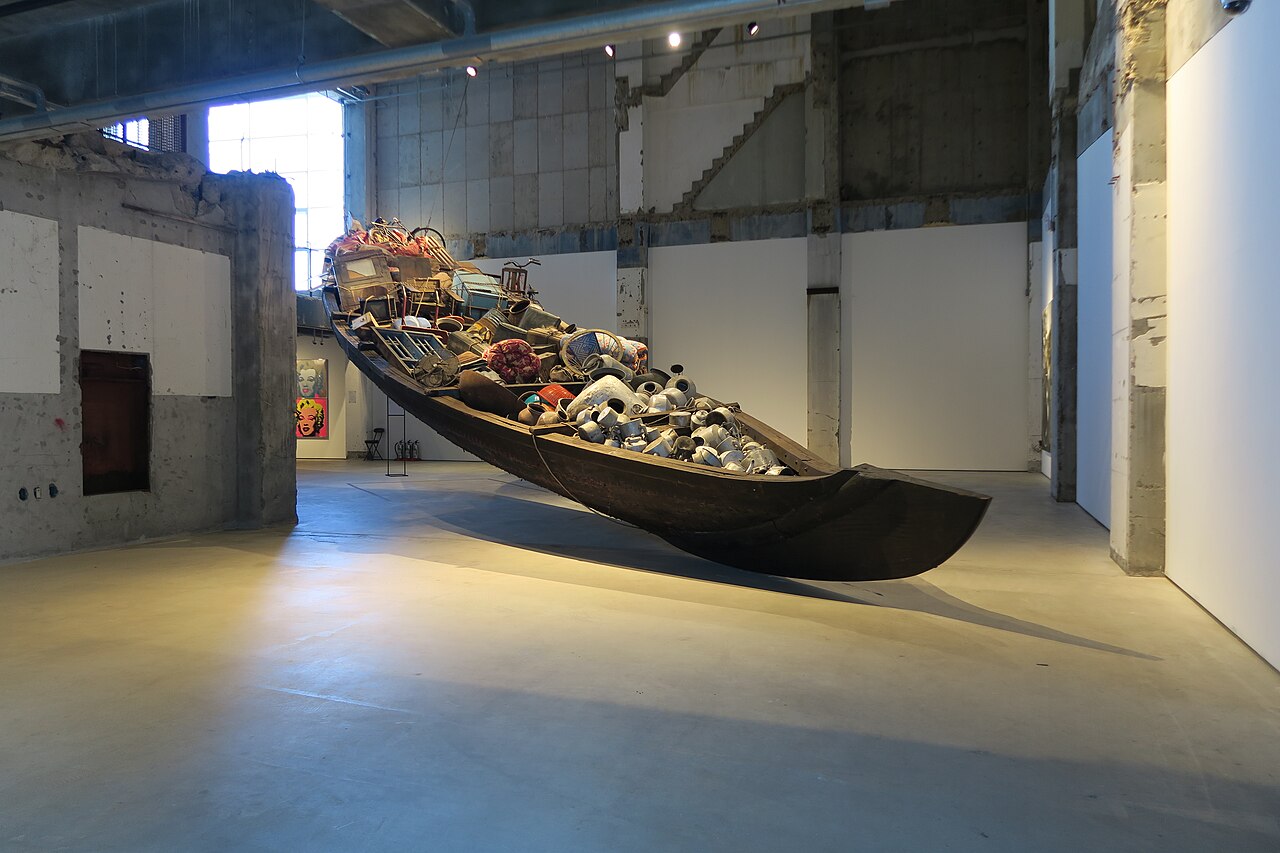 Subodh Gupta, What Does the Vessel Contain, That the River Does Not, 2012
For outdoor works, I carefully select materials, such as 316 stainless steel, that can endure demanding environmental conditions. This choice is not only practical but also conceptual, it reflects a desire for the work to remain present and stable within its environment, even as conditions change around it.
At the same time, I am aware that no material is entirely permanent. Ephemerality is always present, whether through subtle surface changes, shifts in light, or the evolving relationship between the work and its site. Rather than resisting this completely, I try to acknowledge it as part of the life of the artwork. Sometimes, artworks can even become more compelling as they age over a long period of time, gaining character and depth through their interaction with the environment.
What personal or inherited feelings of nostalgia, longing, or resilience did ‘A Fistful of Sky’ help you touch or release?
Like I said before, it is very personal, also connected to what I think of as a Proust effect. These materials carry memories that are not always visible but deeply felt. They remind me of my country, of the way home feels, of everyday life that is often overlooked but full of meaning.
‘A Fistful of Sky’ is one of my strongest works and very close to me. I was able to touch feelings of nostalgia and longing, but also resilience, the quiet strength that exists in daily labour and in the objects that hold those histories. It allowed me to reconnect with inherited memories, things passed down through gestures, textures, and smells rather than words.
At the same time, it marked a turning point in my practice. There were small shifts in how I approached materials and meaning, but it still remains deeply rooted in where I come from. It continues to remind me of that connection, even as my work evolves.
Works like ‘Proust Mapping’ (with its flattened, history-laden vessels) and the ‘Stupa’ built from kitchen steel seem to hold entire lifetimes. What does it feel like to elevate these traces of ordinary struggle into something almost sacred or eternal?
My practice has grown out of the life I have lived. For more than 30 years, I have worked with objects that come from the same world I grew up in. The kitchen vessels, the everyday materials, the marks of use, they all carry memories of labour, family, migration, hope, and survival.
When works like ‘Proust Mapping’ or the ‘Stupa’ begin to evoke something sacred or timeless, it gives me a quiet sense of satisfaction. Not because I set out to make monuments, but because ordinary objects are able to tell the stories they have always contained. They represent millions of lives that often go unnoticed.
As an artist, I feel grateful that I have been able to transform these humble materials into works that invite reflection and dignity. It reminds me that even the most ordinary objects can carry extraordinary human histories.
Returning to Bihar for ‘The Way Home’ must have been layered with emotion, pride, reflection, perhaps even a sense of circling back. What did that homecoming awaken in you, and what hopes do you carry for the next generation of dreamers from similar small towns?
Yes, absolutely. Returning to Bihar for ‘The Way Home’ was deeply emotional. It was a homecoming filled with many layers: pride, gratitude, memories, and reflection. My pride was not only in having an exhibition there, but in seeing that Bihar finally has a museum of the quality and ambition of the Bihar Museum. For a long time, I dreamed that the state where I grew up would have a place where art could be experienced at this level. Meeting old friends and reconnecting with places from my childhood made the experience even more meaningful.
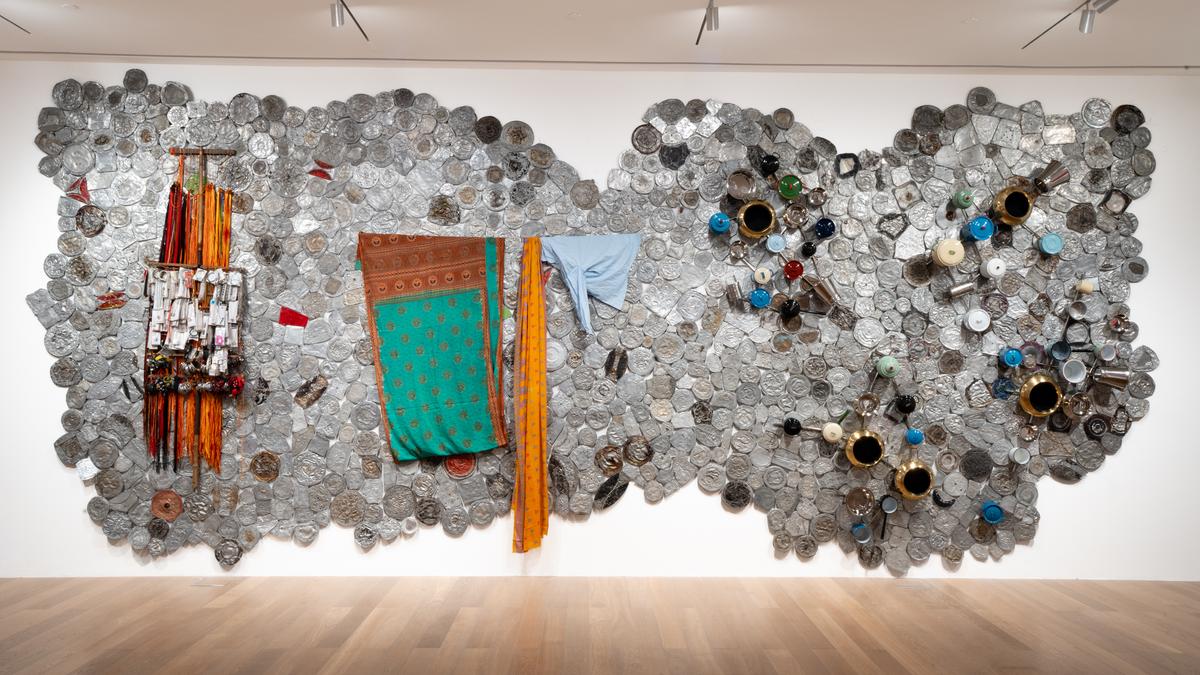
Subodh Gupta, Proust Mapping (2024-26), made from flattened stainless steel cooking vessels, aluminum, enamel and found objects.
At the same time, it was also painful. I visited the art college where I studied, and I was saddened to see that very little had changed. There are still serious shortages of teachers, including art history faculty, and many of the facilities remain inadequate. I say this not to criticise, but because it is the truth, and because I care deeply about where I come from.
My hope is that the next generation of young artists from Bihar will have opportunities that my generation did not. Talent exists everywhere, but talent also needs encouragement, education, and institutions that believe in it. If ‘The Way Home’ can inspire even a few young people to imagine a different future, then the exhibition has achieved something beyond the artworks themselves.
If you had to place ‘Family Tree’ in conversation with one of your earlier works — ‘Very Hungry God,’ ‘Line of Control,’ ‘What does the vessel contain, that the river does not,’ or ‘My Mother and Me,’ which one would it speak to most closely, and why?
It is difficult for me to choose just one because all of these works are deeply connected. They may look different, but they come from the same questions that have stayed with me throughout my practice. The conversation between them also depends on the context: where I am speaking, who I am speaking to, and what aspect of the work we are discussing.
‘Very Hungry God,’ ‘Line of Control,’ ‘What Does the Vessel Contain, That the River Does Not,’ ‘My Mother and Me,’ and ‘Family Tree’ each explore different ideas, but they all deal with memory, identity, migration, labour, history, and our shared human condition. Rather than seeing them as separate works, I think of them as chapters in a much longer journey. Each one grows out of the previous one while opening up new questions.
Looking forward, are there materials, techniques, formats or conceptual territories you have not yet explored but would like to pursue? How do you envision your practice developing in relation to younger Indian artists and the changing scenes of contemporary art globally?
I think I have always been exploring new ideas, and that curiosity will never stop. I don’t feel that I have reached a destination. Every project pushes me into new conceptual territory, even if I continue to work with materials that people associate with my practice.
If you look at ‘A Fistful of Sky’, especially works like ‘Kingdom of Earth’, you can already see how my thinking is evolving. The ideas, forms, and relationships between objects continue to change. I will keep exploring, and I hope the future works continue to open up new ways of seeing and thinking, for me as much as for the viewer.
I don’t think about following trends or changing my work to fit the contemporary art world. I simply try to remain honest to my own questions. If I stay curious, the work will continue to evolve naturally. Supporting younger artists is also something I care deeply about. I hope to contribute in a meaningful way, and I will be announcing an initiative very soon. I believe every generation deserves encouragement, opportunities, and the freedom to develop its own voice.
More from Arts
Comments
*Comments will be moderated