








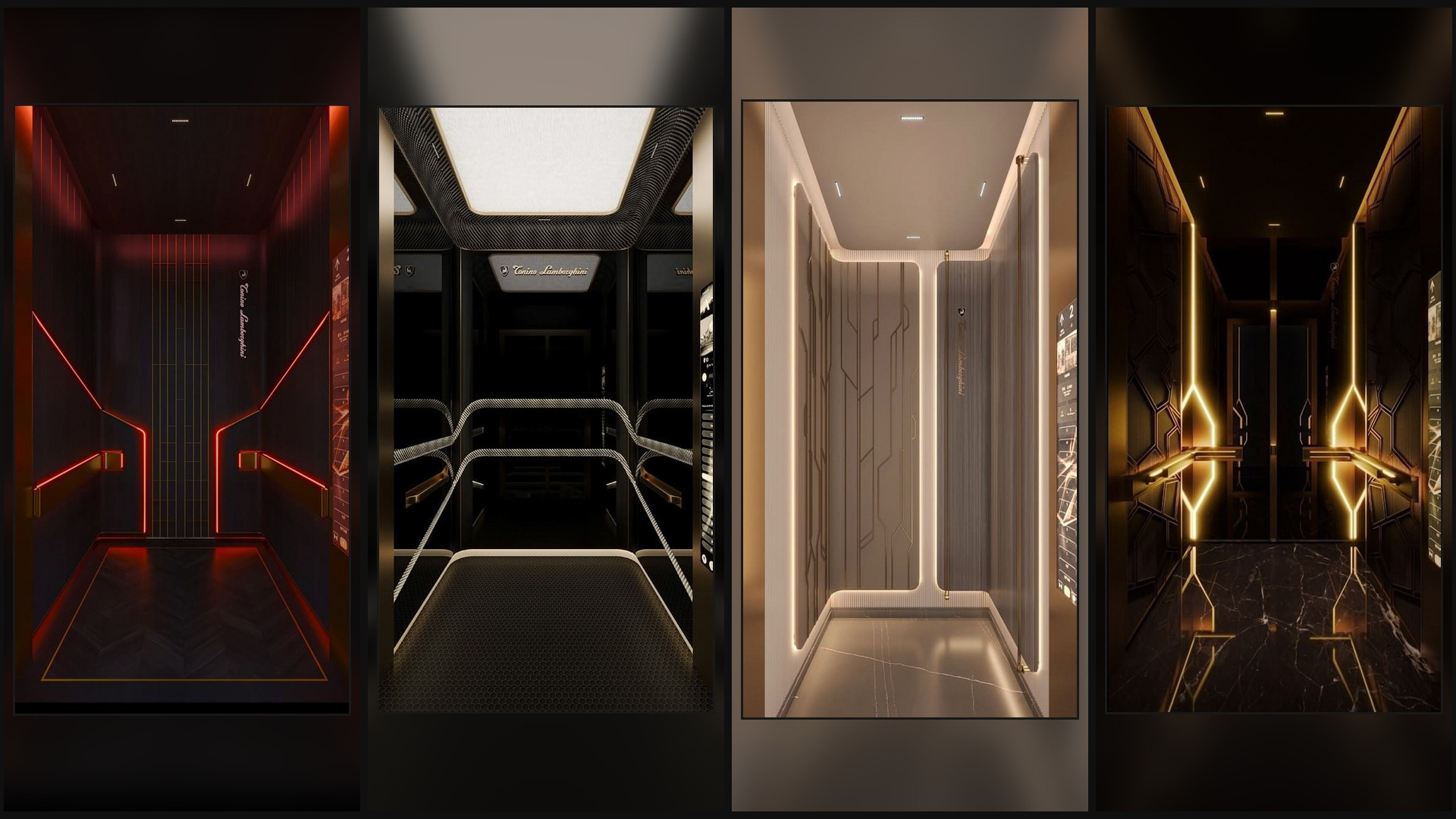
The collection consists of four cabin experiences. Sommo favours minimalism, restrained detailing and recessed lighting. Marte combines biomimetic steel with acoustic elements and a more futuristic mood. Dinamico uses changing materials and spatial effects to create a sense of movement. Imperio is the grandest of the four, with sculptural forms and handcrafted details.
The Hybon Tonino Lamborghini Collection brings fashion, technology and connected service to an overlooked part of luxury architecture, the elevator. With four distinctive cabin designs, it also reflects India’s growing appetite for homes and spaces in which every detail matters
There are only a few seconds between the closing of an elevator door and its opening on another floor. Yet, at the launch of the Hybon Tonino Lamborghini Collection in Gurugram recently, those few seconds were presented as something that could be designed, personalised and enjoyed. The elevator, in this telling, is no longer merely a machine hidden inside a building. It is part of the building’s character, and part of the life lived within it.
Unveiled recently at XS Club by A Dot, the collection brings together Hybon Elevators & Escalators, an Indian manufacturer of premium vertical-mobility systems, and Tonino Lamborghini, the Italian design and lifestyle house established in 1981. The collaboration has arrived at a particularly interesting moment. India is now the world’s second-largest elevator and escalator market after China, according to the India Brand Equity Foundation.
At the same time, premium housing has claimed a larger share of residential sales in the country’s leading cities. Buyers are no longer judging luxury only by location, square footage or the marble in the lobby. They are looking at privacy, technology, service, material quality and the completeness of the experience.
“India is growing, and luxury living is increasing,” said Ratan Singh Sehgal, Managing Director of Hybon Elevators & Escalators Pvt. Ltd, in an interview to The Punch Magazine. “As the trend towards luxury living is increasing, we wanted to show the world that India is capable of doing something extraordinary. That is why we collaborated with Tonino Lamborghini, to give a mark to this industry.”
Founded in 2013 and backed by the Sehgal Group’s manufacturing experience, which dates to 1975, Hybon entered a field long associated with large international companies. Sehgal is candid about the difficulty of building confidence in an Indian premium engineering brand. “Our legacy was in electronics. In 1975, we started with electronics,” he said. “The hardest part was India. As Indians, sometimes we don’t believe Indians. We don’t believe in India or in Indian manufacturing.”
That barrier, he believes, was overcome gradually through “luxury, premiumness, the best service and the best experience”. Hybon has completed around 7,000 installations, with Delhi’s Imperial Hotel among its clients. “It took us time,” Sehgal said. “But now people are beginning to believe, and that is why we have Lamborghini with us.”
For Tonino Lamborghini, the choice of partner was tied to both engineering capacity and knowledge of India. “We were looking for a partner that had the capacity to identify a product that could create a seamless journey for a consumer entering one of our Tonino Lamborghini-branded buildings, where every single detail carries the brand,” said Lorenza Lavezzi, Head of Business Development and Licensing at Tonino Lamborghini.
A decorative cabin carrying a famous name would not, by itself, have been enough. “In that case, we would just have been designing it and giving it an aesthetic feature,” Lavezzi said. “But Lamborghini is also a synonym for innovation and technological research. Hybon is at that particular stage in its company journey where it was ready to create something new, something luxurious, and something that communicates to the world: we are ready, we are here.”
The collection consists of four cabin experiences. Sommo favours minimalism, restrained detailing and recessed lighting. Marte combines biomimetic steel with acoustic elements and a more futuristic mood. Dinamico uses changing materials and spatial effects to create a sense of movement. Imperio is the grandest of the four, with sculptural forms and handcrafted details. Together, they acknowledge that Indian luxury is not one fixed taste. It can be contemporary, but it can also be rich, expressive and ceremonial.
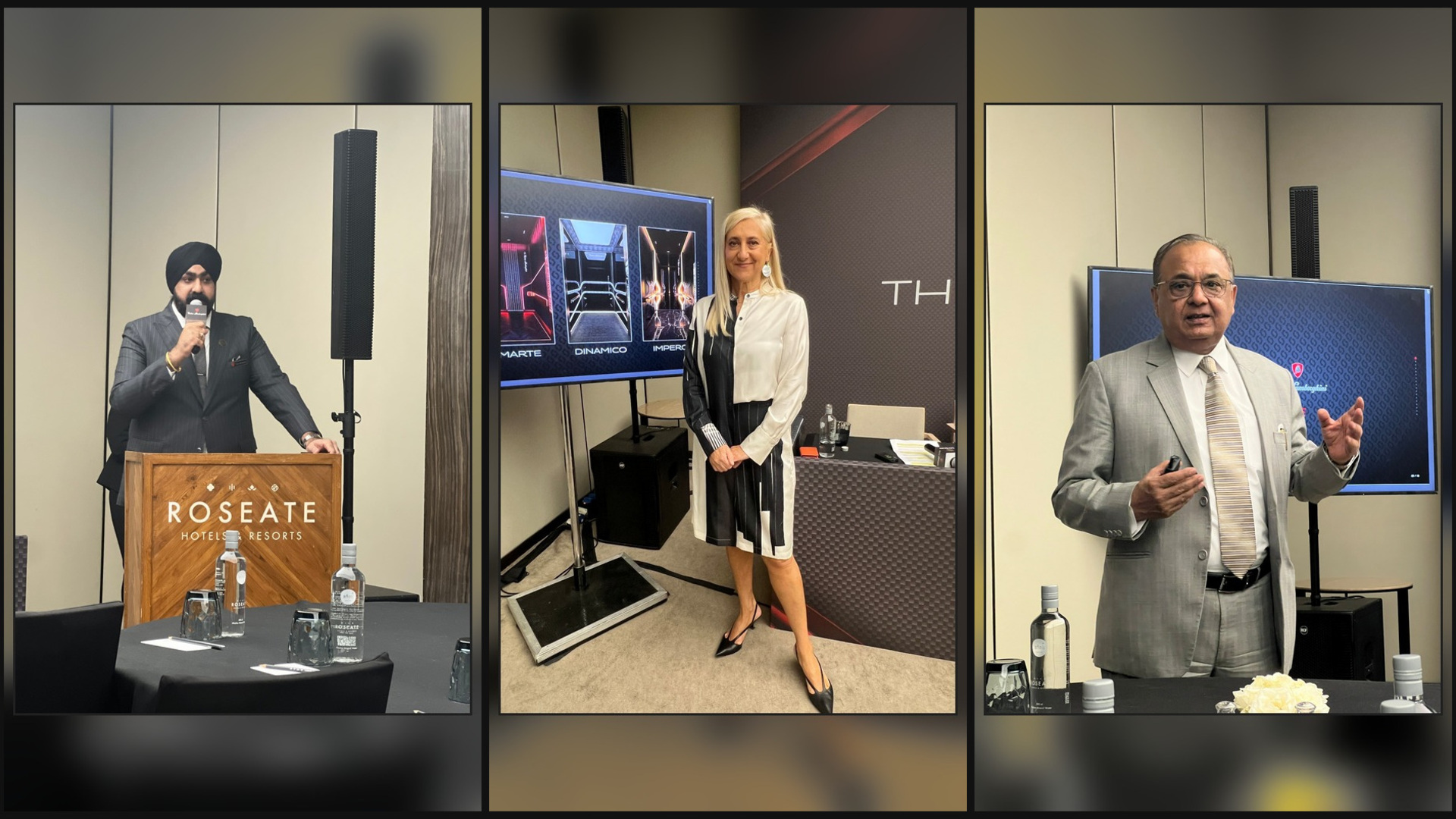
(from left) Ratan Singh Sehgal, Managing Director, Hybon Elevators & Escalators Pvt. Ltd; Lorenza Lavezzi, Head of Business Development & Licensing at Tonino Lamborghini, and Hybon Elevators & Escalators CEO Prabpdh Kumar. Photos: Nawaid Anjum
The designs emerged through a long exchange between the Indian and Italian teams. “We worked together and understood Indian taste and sensibility,” Sehgal said. “We can’t be all Italian. We have to sync both interests and tastes. The designs match what India likes. It is not just Italian; it is Indo-Italian.”
Lavezzi said Hybon’s familiarity with personalisation allowed the discussion to begin at a more advanced level. Tonino Lamborghini, she explained, seeks partners who understand not only the geography and changing needs of a market, but also the industry in which they operate. “Hybon has a very deep knowledge of personalisation and luxury elements, so we started from a good point,” she said. “I did not start talking with a company specialising in mainstream or mass-market elevators, but with a company already in that niche.”
The Italian team then began pushing the possibilities of the product. “We could offer them new ideas and new challenges,” Lavezzi recalled. “We were saying, ‘Can we have this? Can we do this? Can we implement that?’ And they were pushing themselves beyond their boundaries. This is the result. I think it is great because it is not only aesthetic, but also technological.”
The cabins can travel at speeds of up to 1.75 metres per second and include a 39-inch LED touchscreen with customised themes and floor labels. Features include air-conditioning, music, lighting and three-dimensional door sensing, intended to detect an approaching person before they reach the door line. The company is also offering a 15-year warranty and service commitment.
She sees the elevator as an intimate, if brief, part of everyday life. “The elevator is not only a means of transportation. It is more than that,” she said. “It accompanies you in your life, even if only for a few seconds, but it should do so in a pleasant way. These elevators are equipped with air-conditioning, music and lighting to keep the experience smooth. We are a lifestyle-experience brand.”
That emphasis is significant in India, where service has often mattered as much as finish. A beautiful elevator that remains out of order quickly loses its luxury. Hybon is therefore using the Internet of Things to enable app-based control, remote monitoring, health checks and automatic complaint generation.
“We have to be with the world as it transforms,” Sehgal said. “That is why we have introduced the Internet of Things in elevators. It has enabled the application, remote monitoring, health check-up and an auto-ticketing system. If a lift shuts down, a ticket is automatically generated and engineers come to your house.”
Such predictive and connected maintenance is becoming central to the Indian market as high-rises spread beyond Mumbai, Delhi-NCR, Bengaluru and Chennai to cities such as Jaipur, Lucknow, Indore, Surat, Kochi and Coimbatore. In premium developments, the elevator is expected to connect with the wider building-management system and provide real-time information rather than wait for a resident to report a fault. Artificial intelligence may change the game further. “We are talking about IoT now,” Lavezzi said. “In future projects, we will probably implement more and more innovative solutions, including applications of AI.”
Hybon says the collection offers strengths in “safety, service, reliability, features and usability”. “We have made all of this the best, and we are far ahead of the competition now,” Sehgal said. “We have covered everything a client can expect. Whatever you can think of in an elevator, we have it, and even more.”
For Tonino Lamborghini, vertical mobility is also connected to its growing work in branded residences and hospitality. Lavezzi referred to its real-estate engagements in South Africa, Brazil, Georgia and China, explaining that the company likes “to be the first mover, or among the first movers”. “Vertical mobility was a natural consequence of what we were doing,” she said. “When you do a palace, a villa or a building, you need an elevator. So why not have a dedicated elevator?”
In India, the brand has signed with Signature Global and entered collaborations in other categories, including writing instruments, energy drinks and spirits. More discussions are underway, though Lavezzi said the details remain under embargo. “There are other negotiations,” she confirmed.
Hybon plans to make the new elevators available through its branches and expand their reach as its network grows. “It could be pan-India,” Sehgal said. The company is also considering overseas markets, collaborations and expansion, although he would prefer to announce those plans only after they are finalised.
For Sehgal, however, the larger ambition remains deeply domestic. “You will feel like you are in a seven-star hotel,” he said of the collection. “I personally want every Indian home to experience luxury. It should not be limited only to hotels.”
That wish captures the changing meaning of luxury in India. It is moving beyond display towards experience, and beyond imported objects towards collaborations in which Indian manufacturing carries international design. “It is a holistic approach,” Sehgal said. “It is not just a brand. It is the design, philosophy and brand essence. Everything is there.”
He believes the global market has been ready for an Indian company to make this move. “The world was waiting for it because there was no one else,” he said. “We are the first to bring fashion into the elevator.”
The collection’s real test will come not under the lights of a launch evening, but inside homes, hotels and towers, one ride at a time. If it succeeds, it may change a small but revealing part of Indian luxury: the journey between one floor and the next.
More from Business


Comments
*Comments will be moderated