








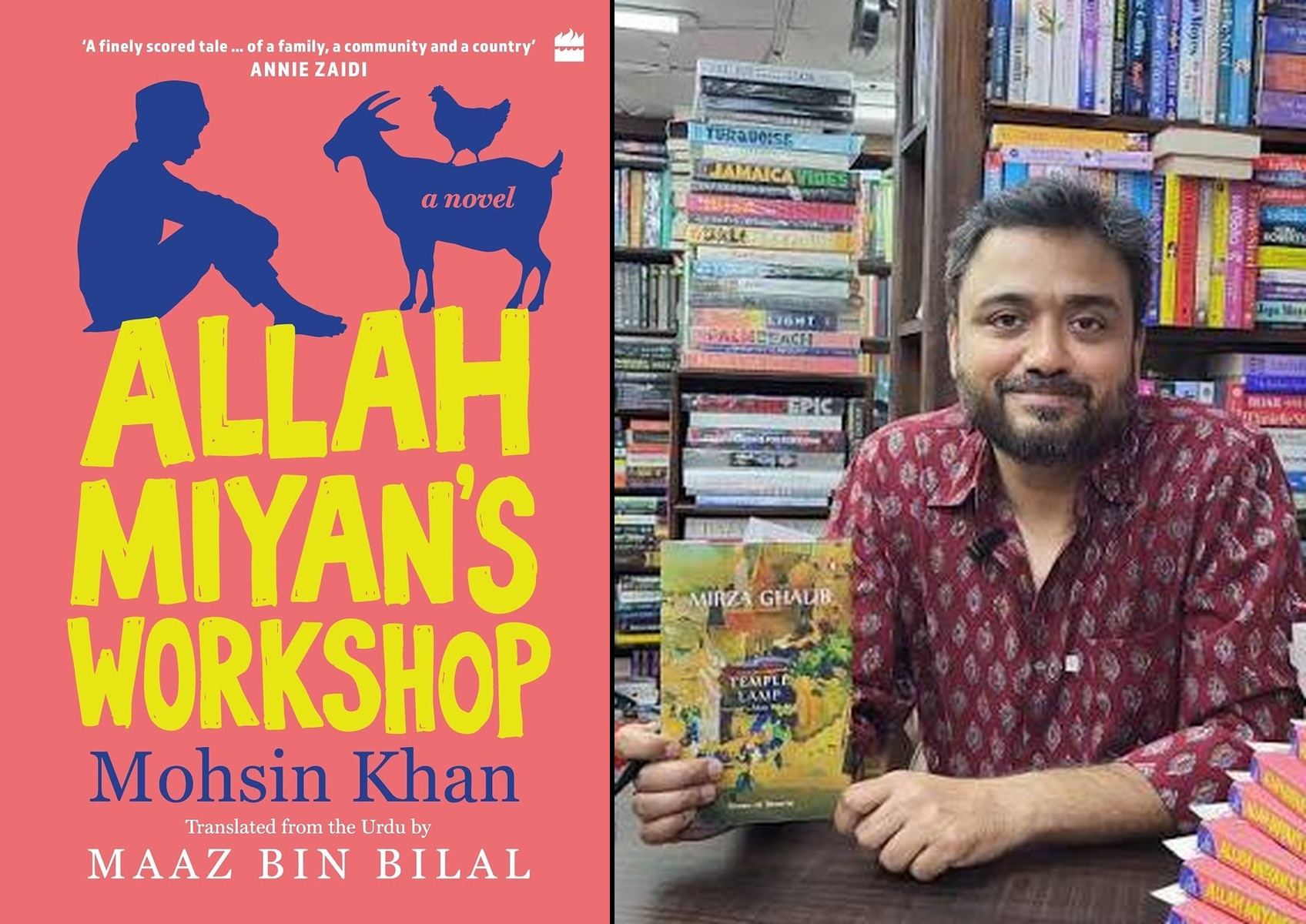
Allah Miyan’s Workshop follows 14-year-old Gibran in a village in Awadh, and much of its force comes through the ordinary details of childhood: kites, dragonflies, the madrasa, questions about Allah, animals, creation and the strange logic of the adult world.

As ‘Allah Miyan’s Workshop’ brings Mohsin Khan’s Urdu novel to English, the poet-translator speaks about the childhood and questions at its heart, memory, Ghalib, Ballimaran and the continuing conversation between Urdu and English
For Maaz Bin Bilal, translation seems less like a separate literary activity than something that has grown alongside his own poetry and his long engagement with Urdu. His first collection, Ghazalnama: Poems from Delhi, Belfast, and Urdu (2019), brought his English poems into conversation with translations of Urdu poetry. That same year came The Sixth River: A Journal from the Partition of India, his translation of Fikr Taunsvi’s account of Lahore during Partition. In 2022, he turned to Persian and to one of Mirza Ghalib’s most important Persian works with Temple Lamp: Verses on Banaras, his translation of Chiragh-e-Dair, the first complete direct Persian-to-English translation of the poem. Now comes Allah Miyan’s Workshop, his English translation of Mohsin Khan’s Urdu novel Allah Miyan Ka Karkhana, published by HarperCollins India.
Asked how each project has differed in its demands and rewards, Bilal points readers towards an essay, ‘Confessions of a Reluctant Translator’, included in the Harper edition. But he sums up his approach quite precisely: “in my literary translation praxis, I try to carry across form, meaning, tone, and cultural specificities of the original, thus foreignising the target language, but without making it awkward.” The differences between poetry, non-fiction and fiction, and between translating from Persian and Urdu into English, have meant that he has had to approach each work according to its particular character. The result, he says, can be seen in the books themselves and in the translator’s notes accompanying them.
That relationship with the source material is especially personal when it comes to Ghalib. Bilal spent the first 25 years of his life in Ballimaran, part of Shahjahanabad, where Ghalib lived during the later years of his life. “I have been drawn to Ghalib and his world since a long time,” he says. His connection is not just literary. He describes Shahjahanabad as a place that “continues to face destitution and decline as a ghetto in independent India”, drawing a parallel with the decline and political upheaval of Ghalib’s own time. What he admires in Ghalib is his “strong forbearance and the performance of his immense passions of love, life, and grief distilled through beauty”.
Ghazalnama, he says, and his poetry today “owe a lot to the poetics, ideas, and emotions of Ghalib”. His translations of Ghalib’s Urdu ghazals and Chiragh-e-Dair are, in his words, “direct homage”. Temple Lamp was published by Penguin Random House India in 2022 and translates Ghalib’s Persian poem on Banaras in full.
Also read: Tabish Khair on Drown All the Refugees and why ‘home is always in a relationship to leaving it’
The move from Ghalib to Mohsin Khan’s Allah Miyan Ka Karkhana might appear like a sharp turn, but Bilal’s reason for taking on the novel is again steeped in recognition. He says the novel “moved me greatly”. He “laughed and cried with it” and found himself identifying with different parts of it “as a child, a boy, a Muslim, a sceptic, a man”. The novel’s treatment of “life and death and joy and play”, its family relationships and friendships, also spoke to him. So did its politics.
The novel follows 14-year-old Gibran in a village in Awadh, and much of its force comes through the ordinary details of childhood: kites, dragonflies, the madrasa, questions about Allah, animals, creation and the strange logic of the adult world. Bilal recognises some of himself in Gibran, though he is careful about the differences. “To a limited extent, yes,” he says. Gibran’s life is rural and marked by poverty and hardships greater than those Bilal himself experienced. Yet there are points of connection. “I too lost a parent as a child,” he says, and shares Gibran’s “general scepticism, his questioning nature, and some of his restlessness and thirst for play”. There is one small difference he adds with a touch of humour: “although I have never flown a kite on my own.”
That sense of where one lives and works also comes into his understanding of literary practice. Asked whether his immediate surroundings, relationships, room, bookshelves or whatever he happens to be reading affect the work, Bilal begins by correcting the premise: “I am not in a cell, and also too old to live in a hostel or such, I am afraid, to have inmates.” He is currently in transition, having resigned from a professorship in India that he held for a decade and recently moved to England. What shapes his work now, he says, is less the physical room around him than “the world of Urdu and English poetry, poets, and the current socio-political world around me” as he engages with it through his poetry, translation, fiction and scholarship.
He also sees the moment for Indian-language literature in English translation as a relatively healthy one. He points to the growth of translations from regional languages and to the increasing visibility of translated writing in Indian publishing. Allah Miyan Ka Karkhana itself won the inaugural Bank of Baroda Rashtrabhasha Samman in 2023 in its Urdu original alongside Saeed Ahmad’s Hindi translation. Bilal also points to the JCB Prize, which he says had helped bring translated Indian fiction into greater visibility before being discontinued in 2025.
But he is sceptical of the idea that prizes alone explain the current interest in Indian literature in translation. The International Booker has certainly brought global attention: Geetanjali Shree won in 2022 for Tomb of Sand, translated by Daisy Rockwell, while Banu Mushtaq and Deepa Bhasthi won in 2025 for Heart Lamp, translated from Kannada. But Bilal believes translators have been doing this work long before such recognition arrived. “Many translators like myself were either already working before these awards,” he says, “or do this work out of a sense of love, duty, and personal connection to the works they translate.” He is also blunt about the economics and visibility of the profession: “There is not much money in it, the translators are often ignored, and only a handful of books each year may win any prize.”
For Bilal, then, translation remains tied to a much longer literary journey rather than to the current fashion for translated literature. His next poetry collection is almost ready, and he is looking for the right publisher. He is also translating a major Urdu poet and working on prose by another major Urdu poet about other poets. The new collection, he says, can be understood as “a completion (for now) of the Ghazalnama project” because it consists entirely of English ghazals.
His advice to younger writers is straightforward. “To young poets: read a lot, don’t rely on AI, develop your own voice through reading, writing, editing, and rewriting.” For translators, he asks for both courage and humility: “be adventurous, take risks, but also remember that you are translating someone else’s work and that it is so good that you decided to translate it.”
More from The Byword



Comments
*Comments will be moderated