








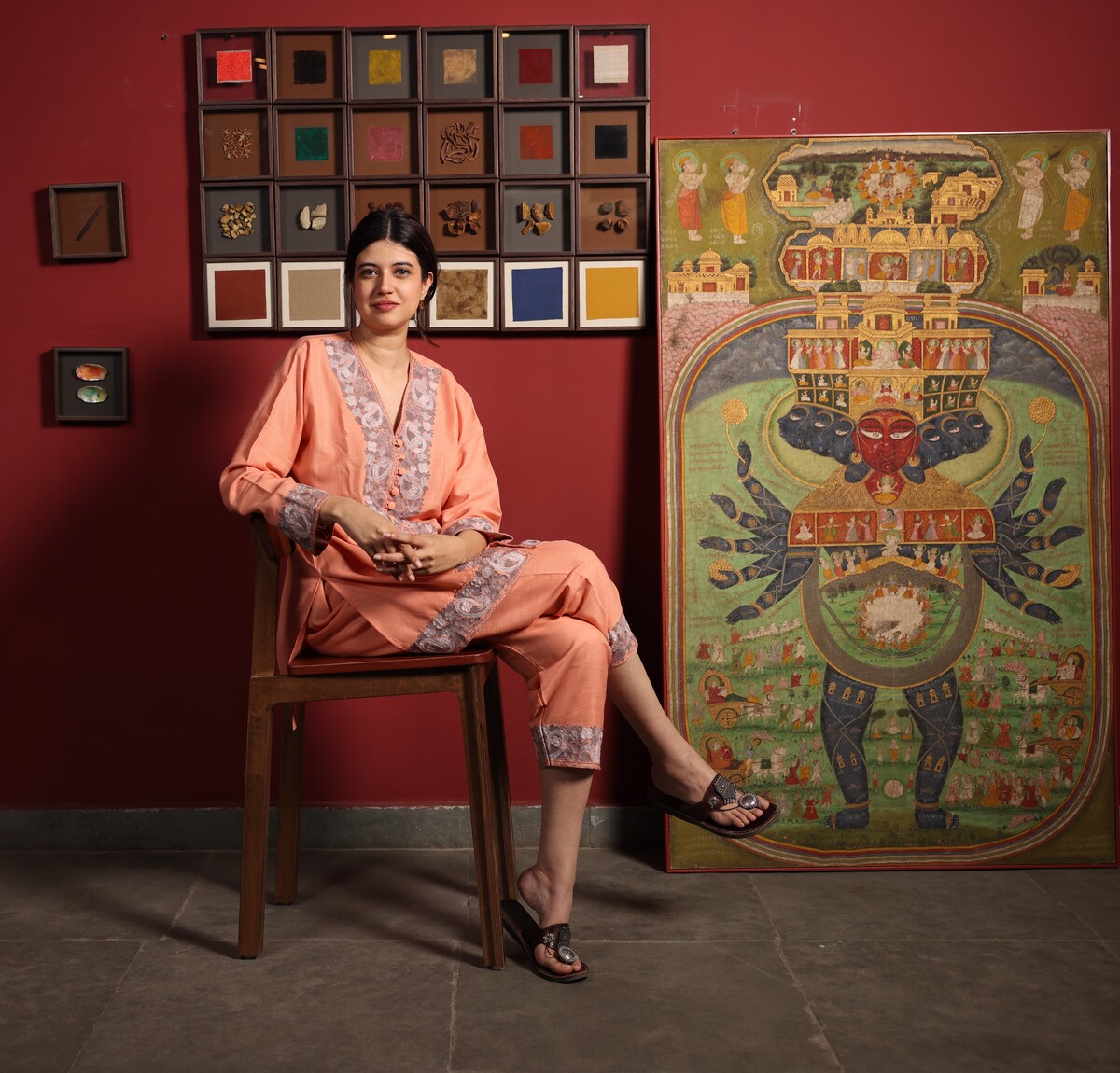
At Studio Bridge Bharat’s Fields of Chamba, Lalita Vakil’s double-sided embroidery opens a thoughtful conversation with founder Aakanksha Singh on the delicate task of carrying India’s living art traditions into contemporary spaces without stripping them of their soul. Photo courtesy Bridge Bharat
In a conversation around ‘Fields of Chamba,’ Bridge Bharat founder Aakanksha Singh speaks about working with Lalita Vakil, reimagining inherited art forms for contemporary spaces, and why India’s living traditions need care, context and new possibilities rather than mere preservation
A recent exhibition at Studio Bridge Bharat in Gurugram spotlighted Lalita Vakil’s double-sided Chamba Rumal, reimagined through a contemporary lens, with Cherrapunji Gin, distilled from rainwater and botanicals, served alongside it. The exhibition, ‘Fields of Chamba,’ asked visitors to slow down before a form of embroidery where the hand is everything and yet, somehow, the stitch almost disappears.
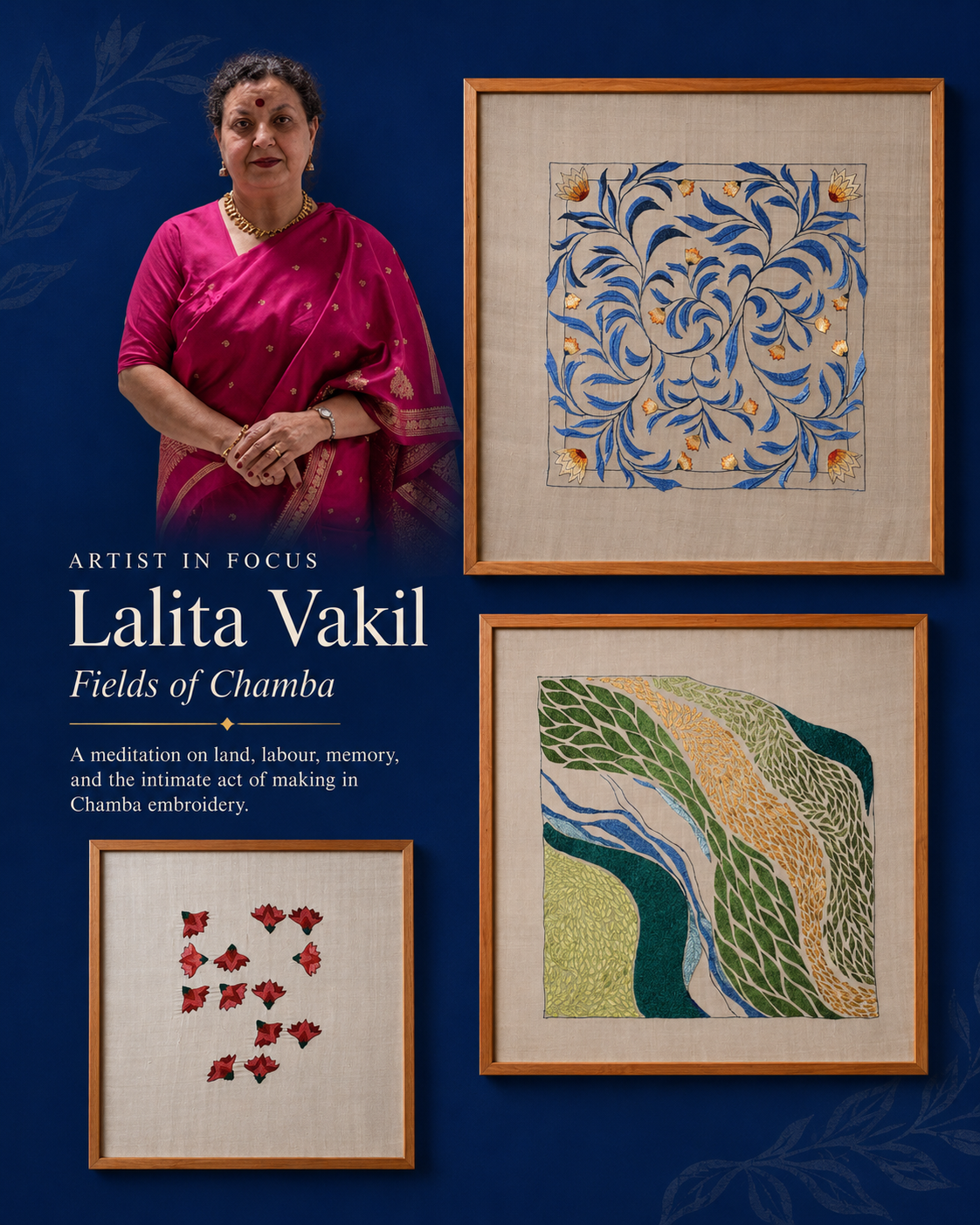
The Chamba Rumal has the old-fashioned grace of something made without hurry. Its great marvel is technical and poetic at once: the front and the back are identical. There is no untidy reverse or private mess hidden behind the beauty. It is often described as “stitchless embroidery” because the work is so refined that the thread seems to have settled into the cloth.
For Aakanksha Singh, founder of Bridge Bharat, this was precisely the kind of tradition that needed fresh attention, placement and life. “I met Lalitha Vakil for the first time in 2019,” Aakanksha says. “We were still ideating the business, what we wanted to do. She was one of the first artists I met.” Vakil, the formidable Chamba-based artist, has spent decades keeping the Chamba Rumal alive. Aakanksha’s description of her is affectionate and exact: “She’s now 84. She’s a fierce, fierce lady, amazing to speak with.”
Vakil, who was honoured with the Nari Shakti Puraskar in 2018 and the Padma Shri in 2022, has trained an atelier of around 13 women in Chamba. What drew Aakanksha to her was the fight behind the work. “Her story is incredible,” she says. “She fought her entire family to be able to do Chamba Rumal, or practise Chamba Rumaal as an art form full time.”
That explains a great deal about why Bridge Bharat exists. It is interested in art forms and people who have held on to them when it made little economic sense to do so. It is interested in the stubbornness of artists who continued to work in inherited forms even when their children were being told to seek other careers, when patronage shrunk, when tastes changed, when the urban market began to classify living traditions as “craft” and contemporary art as something else altogether.
Aakanksha’s own route into this world was through research, finance and investment. Her father was in the forces, which meant she grew up across different parts of India, often away from the large cities. “Forces stations put you further away from the cities,” she says. Looking back, she now sees how those years gave her a familiarity with communities, local cultures and older forms of making. “I now connect the dots back,” she says. “It is something that I have always been interested in.”
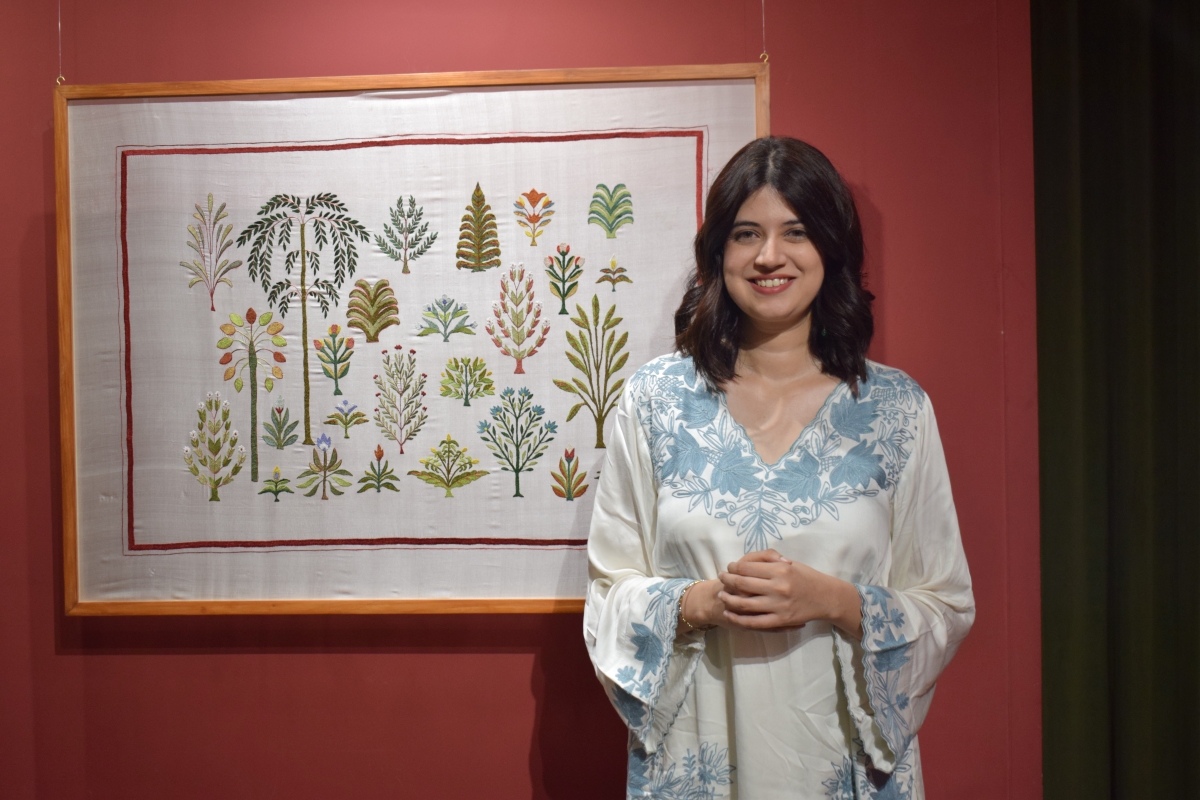
Aakanksha Singh with Lalita Vakil’s Directory of Trees, Chamba Rumal, Himachal Pradesh, 34x48.5 inches. Photo: Nawaid Anjum
Before founding Bridge Bharat, she had worked as a research fellow at Digital Desh, a nationally recognised initiative later acquired by Reliance Jio, where she studied digital behaviour, economic participation and MSME growth across Tier-2 and rural India. She later worked as an investment analyst at Hunch Ventures & Investments, looking at early and growth-stage businesses in luxury, lifestyle, media and art. She also worked in credit research at IL&FS Financial Services and in analytics at the consumer brand FREECULTR. It sounds, at first, like a very different world from Chamba Rumaal, Pichwai, Gond, Bhil or Warli art. Aakanksha does not see it as a contradiction. “I like the fact that I come from finance and investment banking,” she says. “When we are building our whole team, getting people not from the art space brings in new ideas and new perspectives.”
Founded in 2022, Bridge Bharat is a design platform focused on Indian art, culture and storytelling, rooted in a practical question: how can old art forms remain alive when the world around them has changed? Aakanksha wants the traditional works to be placed in contemporary homes, hotels, public spaces and private collections in a way that respects their origin without making them look trapped in the past. “These are art forms that date back centuries and centuries. But our homes have changed and the base palette or composition of these art forms has not changed.”
A Chamba Rumal made for a ceremonial or devotional setting enters a very different world when it is placed in a modern apartment, a farmhouse, a hotel lounge or a collector’s wall. The old compositions may be beautiful, but they do not always fit easily in the visual grammar of contemporary interiors. “You have incredible stories,” she says, “but they don’t really fit in your design language. Or they become ornamental. Or they become folksy. And we don’t want that. We wanted Indian art to be very core to the design language of the space.”
This is where ‘Fields of Chamba’ becomes an instructive exhibition. Instead of repeating the older religious or courtly compositions associated with Chamba Rumal, Bridge Bharat looked closely at old works and noticed what often remained in the margins: the flowers, plants and leaves. Older Chamba Rumal pieces frequently show scenes from mythology, especially compositions around Krishna, Ras Leela and devotional worlds. But around these figures, there is a landscape. The more Aakanksha and her team studied the works, the more they realised that the botanicals were not generic.
“When we archived and studied older Chamba Rumal works, more traditional pieces, we realised that there are a lot of botanicals,” she says. “When we deconstructed those motifs, we realised that a lot of the plants and flowers and leaves are botanicals native to the Chamba valley.” So the exhibition turns the background into the subject. The valley comes forward. The flowers that once stood around the divine or the courtly now take centre stage. “We came up with an idea of actually just focusing on botanicals,” Aakanksha says. “That’s why we call it ‘Fields of Chamba’. But if you study each piece, it is derived from older pieces or motifs from older pieces.”
This is a delicate kind of intervention, which does not try to make Chamba Rumal fashionable by stripping it of its past. Nor does it leave the form untouched as a museum specimen. The old motif remains, but the eye is led differently. The palette is more contemporary. The composition has more air. The work begins to speak to a modern interior. Aakanksha is careful to distinguish between embroidery and painting in Bridge Bharat’s process. With textile work — Chamba Rumal and some chikankari collaborations — the core composition may be created by the in-house design team. The work is then traced and executed by artists trained in the technique. With painting, however, the process cannot be handled in the same way. “You cannot compose and tell the artist to copy it,” she says. “You give them a framework. This is the collection we are thinking of. This is how our framework is.”
Bridge Bharat’s creative director, Barkha Gupta, plays a key role in this process. A textile designer who has also studied contemporary painting, she brings a viewpoint that Aakanksha values because it is not burdened by the usual expectations of Indian art. “The fact that she does not have Indian art as a background was very exciting to me,” Aakanksha says. “She brings in a very new perspective.”
The word Aakanksha returns to is “co-creative”. Artists are brought into the studio and spend time with the team. There are conversations about technique, possibilities and limits. The design team tries to understand what can work and what must not be disturbed. This is important because Bridge Bharat works with community art forms. “It’s not one artist who owns Chamba or one artist who owns a Pichwai,” Aakanksha says. “These are art forms and techniques that have been brought down generation to generation for centuries now.”
That community inheritance, however, does not mean every artist works the same way. In fact, one of the pleasures of listening to Aakanksha is hearing how closely she has watched the differences between artists. She speaks of children beginning at six or seven, learning basic strokes for years before being allowed to complete a full work. She recalls Dinesh Soni, a Pichwai artist from Bhilwara, Rajasthan, who told her that for the first six years, he was allowed to do only parts of the work, not finish an entire Pichwai. That patience is almost unimaginable in the age of quick skill, quick content and quick visibility.
Bridge Bharat’s note on Soni describes him as a third-generation Pichwai artist carrying forward the legacy of his grandfather Badrilal Chitrakar and father Prabhulal. He was honoured with the National Award in 2019 and continues to make and teach Pichwai, a devotional art centred on Lord Shrinathji. The platform also works with artists like Venkat Raman Singh Shyam, who extends the Pradhan Gond lineage of his uncle Jangarh Singh Shyam into a more contemporary vocabulary, with works that encompass myth, nature and memory. His art has travelled to collections including the Philadelphia Museum of Art.
What links these artists is not style but depth of training. These are not weekend revivals. They are lives shaped by slow apprenticeship. “These are artists who spend 10 years, 15 years studying the most traditional format and then have built their own stylised versions of it,” Aakanksha says. She often cites contemporary Madhubani artist Avinash Karn, who once told her that what we now think of as “traditional” Madhubani is itself not some fixed, ancient thing. It has changed over time. What existed 600 years ago was different from what exists now. This is Aakanksha’s argument against the lazy idea that tradition must remain still to remain authentic. “It is an evolution of the art anyway,” she says. “We are just building the next level of it.”
The harder question is whether the market understands this. Aakanksha thinks it is beginning to. She sees more Indians taking pride in inherited visual cultures, and more collectors looking beyond the established circuit of modern masters. “People have become more proud of India,” she says. She also notices younger collectors responding to works that feel culturally closer to them. A Pichwai, a Gond work, a Chamba Rumal, a Bhil painting, these can carry stories and symbols that do not feel remote or imported.
This does not mean Bridge Bharat is casual about commerce. Its average order value begins around Rs 1 lakh to Rs 1.2 lakh, which means people may discover the platform online but do not always buy with one click. “I don’t expect people to come and transact online because of higher ticket prices,” Aakanksha says. Instagram and the website are therefore not merely sales counters. They are places of discovery, conversation and brand memory. “Online would be more of brand building for us and lead generation, not conversion as such,” she says.
The real work often happens through relationships with collectors, architects, interior designers and artists. Bridge Bharat works in two broad ways. Sometimes a collector or homeowner chooses a single piece, and the team helps decide where it should live in an already finished room. In other cases, the work is more site-specific. When architects and designers are building homes, Bridge Bharat studies the space, understands the client’s personality, looks at what they collect or might collect, and maps what kind of art can go where. “We understand from the customer what persona they have, what kind of art they are collecting, have they collected before, any of that,” Aakanksha says. “And then we map out the entire movement.”
This is where the “bridge” in Bridge Bharat becomes literal. On one side are artists, many of them working from towns, villages and inherited family ateliers. On the other side are architects, designers, collectors and homeowners who may want cultural depth but do not know how to find or place it. Between them is a gap of language, access, pricing, presentation, trust and taste. Bridge Bharat is trying to occupy that gap without swallowing either side.
Trust, Aakanksha says, takes years. She is frank about the suspicion many artist families feel when outsiders arrive with new promises. “I don’t believe as an outsider you can walk into an art community and expect them to welcome you with open arms and say, we’ll work with you,” she says. “It takes time to build that relationship.”
Her first artist conversations began long before Bridge Bharat had its present shape. “The first artist I spoke to was in 2018,” she says. “It’s been eight years now.” The early relationships then led to others. “We initially had two or three artists that we built relationships with. Those references really work. Because they will refer you to people in other states, in other communities.”
That is how trust travels in traditional art worlds: not through pitch decks, but through people. If one artist believes you paid fairly, credited properly and did not distort the work, another may listen. If you fail once, the news will travel just as quickly. Aakanksha seems to understand that this is not a sector where clever language can substitute for conduct.
The Studio Bridge Bharat space in Gurugram is important for this reason. It is not only a showroom. Artists come there. They spend time there. The design team works there. Collections take shape there. Aakanksha wants the space to be warm rather than forbidding. “I want people to walk out with a smile,” she says. “We don’t want it to be intimidating.”
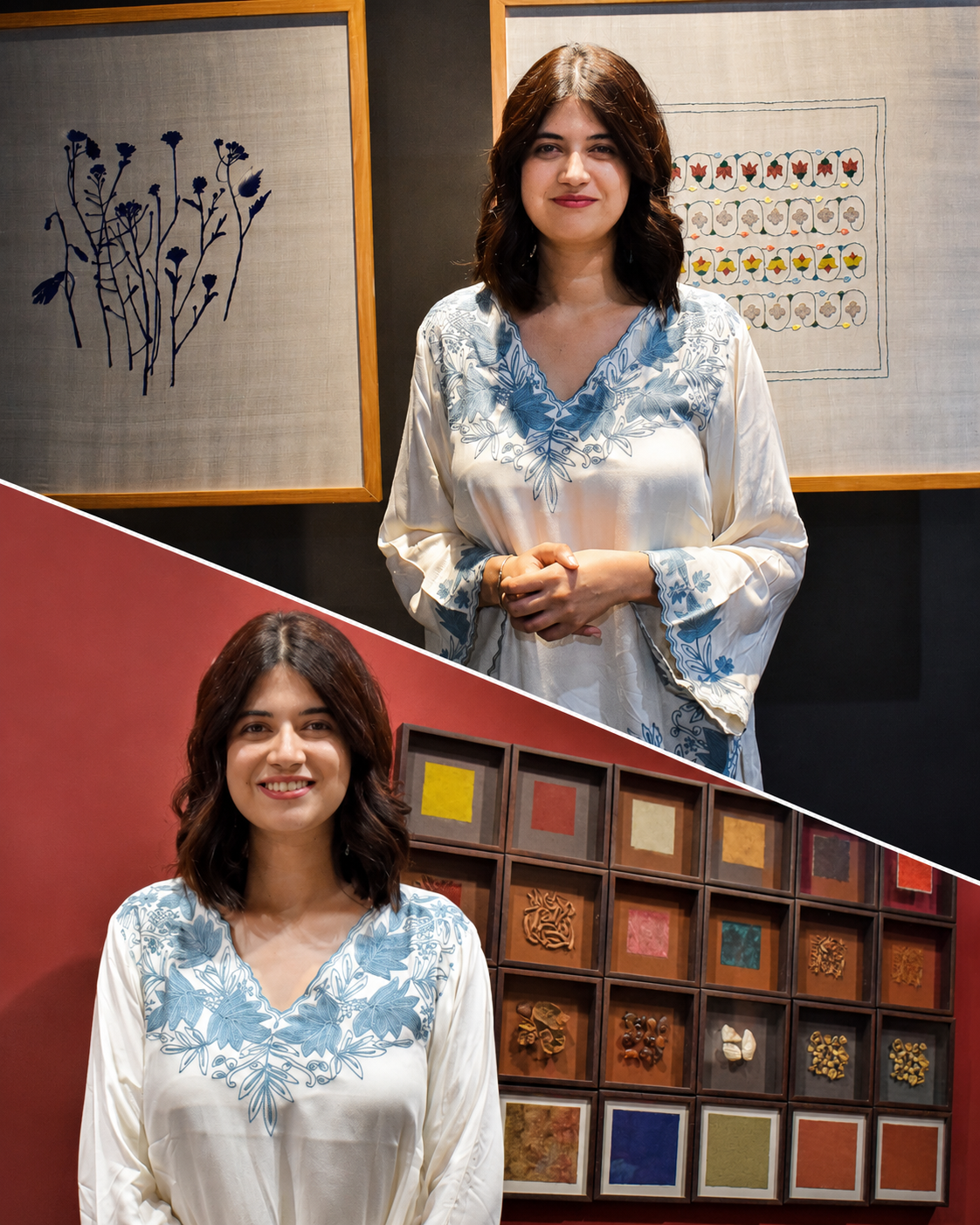
Aakanksha Singh wants the traditional works to be placed in contemporary homes, hotels, public spaces and private collections in a way that respects their origin without making them look trapped in the past. Photos: Nawaid Anjum
It is a small but telling remark. So much of the art world runs on exclusivity: the hushed room, the knowing vocabulary, the fear of asking a simple question. Bridge Bharat’s project depends on the opposite: bringing people closer to traditions they may admire but not understand. It wants to make the experience serious without making it stiff.
The platform currently works with 50 legacy artist families and says it has helped increase annual incomes for more than 100 artists over the past two years. Its network includes Padma Shri and National Award recipients, and its larger circle covers traditions such as Pichhwai, Kalamkari, Mata ni Pachedi, Phad, miniature painting, Gond, Bhil and Warli. The company is led by Aakanksha, an alumna of the Creative and Cultural Businesses Programme at IIM Ahmedabad, and has backing from AC Ventures, Amity Incubation, VSS Invest Trust, associated with Paytm, and angel investors. Its advisory world includes leaders linked to companies such as Google India, Delhivery and Paytm.
The future plan is clear. “Fields of Chamba” is the second collection Bridge Bharat has launched this year. Aakanksha wants to do around four collections a year. Delhi is the home market, but Mumbai has already responded strongly even without a physical space. “We were able to generate a lot of interest in that market,” she says. Bridge Bharat now wants to focus on Delhi, Bombay, Calcutta, and later deepen its presence in Hyderabad, Chennai, Ahmedabad and other markets. She also mentions Raipur as an interesting upcoming city. Dubai, too, is beginning to appear on the horizon because customers have found Bridge Bharat online, bought works and then told the team, in effect, that it needs to come there.
“Fields of Chamba holds all these questions together: beauty, livelihood, memory, design, market, authorship and change. It shows how old skills can still produce new feelings. The botanicals of Chamba, far from being quaint motifs, become a way of reading a valley, a climate, a history of looking. At its best, the exhibition also reminds us that Indian art traditions have never belonged only to the past. They have moved across courts, temples, homes, rituals, cloth, walls and bodies. They have documented, decorated, worshipped, remembered and narrated. The danger today is that they will be changed badly, stripped of their makers, reduced to mood-board references and luxury accents without lineage.
Aakanksha Singh’s Bridge Bharat is trying to offer another route. It is not perfecting the past, but negotiating with it. In the Chamba Rumal, the front and back are the same. That is a miracle. There is no hidden underside where the labour becomes ugly. Perhaps that is also the standard Bridge Bharat is setting for itself: that the visible elegance of the work should match the ethics behind it. The cloth should carry the flower, but also the hand that made it, the valley it came from, the woman who kept the form alive, and the possibility that tradition, when treated with intelligence and care, need not fade into memory. It can bloom again, quietly, in thread.
I had reached the gallery after a tiring commute, but the experience of partaking in all the show had on display was every bit enjoyable. Besides an exclusive conversation with Aakanksha, I also had a chance to meet and chat with the affable and soft-spoken Mayukh Hazarika, who has scripted a success story of its own kind in Cherrapunji Gin, and his wonderful team, who kept the conversation going, along with the competent representative of Jaipur Rugs, who demonstrated a remarkable understanding of indigenous art forms and its practitioners.
More from Arts

Comments
*Comments will be moderated