








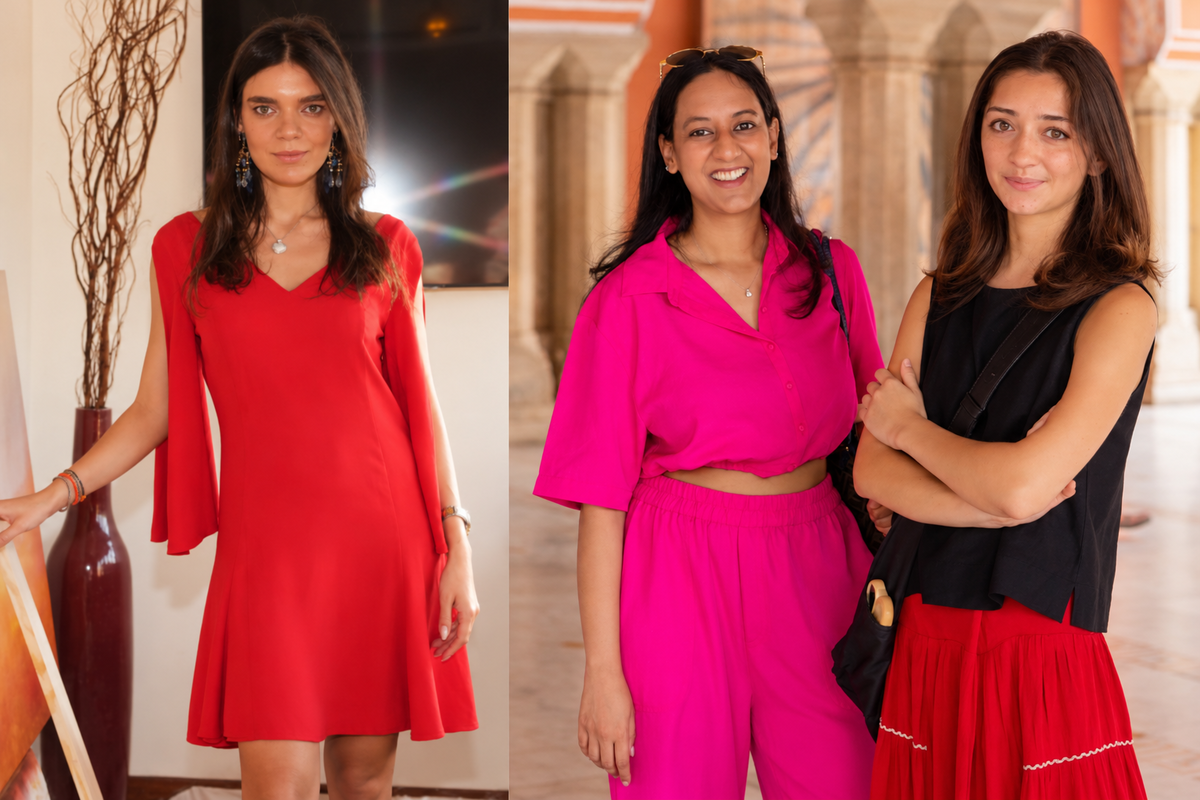
(From left) FAACII chairwoman Eirini Meze and artists Mary Pye and Parnika Mittal. Photos courtesy of FAACII
For Art and Culture in India chairwoman Eirini Meze and artists Mary Pye and Parnika Mittal talk about the first the New-York-based non-profit’s first residency in India, moving between Mumbai and Jaipur, and how craft, heritage, mentorship and place shaped the work in progress
For Art and Culture in India (FAACII) was set up as a New York-based non-profit to support the development of contemporary art in India. Its first Artist Residency India, held from August 21 to September 27 across Mumbai and Jaipur, was designed around the idea that artists need time, space, professional feedback and real encounters with place. For Eirini Meze, Chairwoman of FAACII Inc., the residency also had to begin with trust. “This is the charity’s first residency and we want it to run for years, not as a one-off,” she says. “A lot of people also put their trust in it, and they deserved a proper process.”
The open call was international. Artists from anywhere in the world could apply, and FAACII received applications from as far as Ghana. Selection, Meze says, was based “purely on professional merit” through CVs, portfolios, references and a short statement on the work the artist hoped to make during the residency. Mary Pye, a London-based painter and graduate of the Slade School of Fine Art, was chosen first. “Mary Pye had the strongest CV and the strongest answers,” Meze says.
Once Mary was selected, FAACII felt the residency would become richer if an Indian artist worked with her. The open call was reopened for Indian artists, leading to the selection of Parnika Mittal, an MA Painting graduate of Central Saint Martins, UK, who has also held a residency with British sculptor and draftsman Antony Gormley. “She bridges that gap very naturally,” says Meze. “Both of them studied in the UK, so they share an understanding of what it means to work as a professional artist: using curatorial feedback, dealing with mentors, and navigating the art world rather than building from scratch.”
The residency is free for the artists. It has been supported by FAACII board member Sethu Vaidyanathan, while Abedin Sham provided accommodation, studio space and events at Abode Bombay and Abode Jaipur. Sana Bhatia sponsored a short documentary on the residency, and Meze has covered the cost of materials herself. The larger ambition, she says, is not limited to two artists alone. “I hope it’s the whole contemporary art ecosystem in India that benefits. That’s what FAACII exists for: art education, exposure, and seeing contemporary practice from a professional perspective.” That need for exposure, she believes, is still urgent. “The gap is bigger than people realise,” she says. “I’m still surprised when I speak to very established people here who have never heard of Yayoi Kusama or Mark Rothko.”
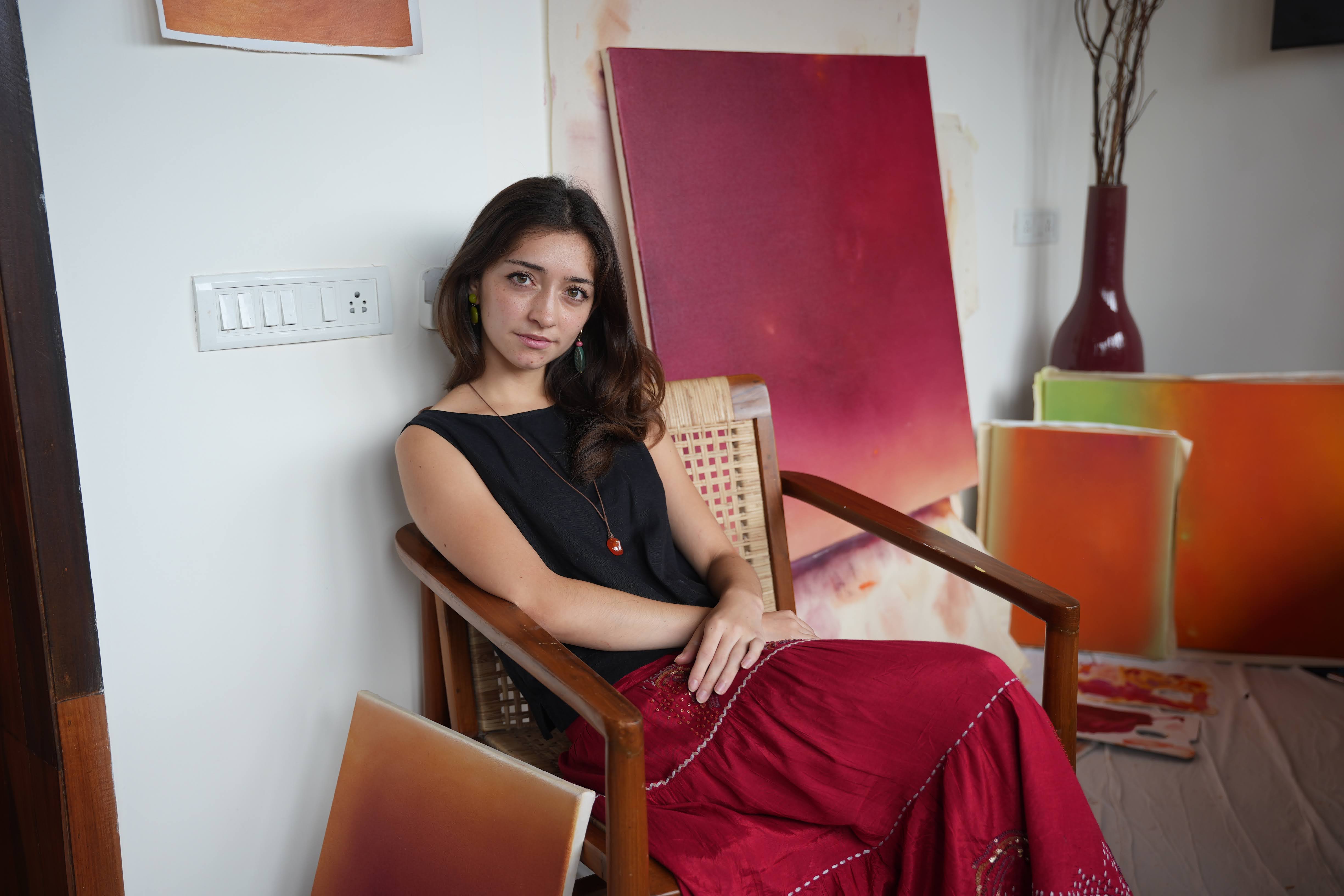
Mary Pye, a London-based painter and graduate of the Slade School of Fine Art.
The two-city structure came from the residency’s partnership with Abode Boutique Hotels. The artists began in Mumbai and moved to Jaipur for the final two weeks. “They had the noise and pace of Bombay first, then Jaipur, the Pink City, which moves at a completely different speed and is so rooted in craft and heritage,” says Meze. Mary had never been to India before, making five weeks across two cities an intense immersion. For Parnika, who is Indian but has her studio in New Delhi, the experience has meant looking at her own work from within two unfamiliar working environments.
The shift is already visible. “The colour palette has changed in both Mary’s and Parnika’s new work in Jaipur,” Meze says. “The bigger change is in perspective. Bombay was chaotic and very high-frequency, and Jaipur is calm. They’ve moved into a quieter, more peaceful way of working, and the work is showing that transition.”
The architecture is part of that experience. In Mumbai, the artists lived and worked at Abode Bombay, on the fourth floor of Lansdowne House in Colaba, a 1910 colonial heritage building. In Jaipur, they moved to Abode Jaipur, a 300-year-old family home inside the UNESCO-listed Walled City. “Both buildings are heritage properties, and that was an important part of the residency for us,” says Meze. “The artists have gone from the layered history and energy of old Bombay to the colours, crafts and everyday life of Jaipur.” For now, she is cautious about claiming too much for the impact of these spaces on the work. But Jaipur, she says, has given both artists a sense of ease. Parnika told her: “It’s so convenient to work in this property because it literally feels like home.”
The Mumbai leg was built around the city: an architectural walking tour with Walkitecture, the public outreach arm of Nikhil Mahashur & Associates; a Colaba architecture tour; and an early 5.30am route through newspaper vendors, vegetable and flower markets and Sassoon Fishing Dock. The artists also visited IES College of Architecture in Bandra to show their work and speak to students.
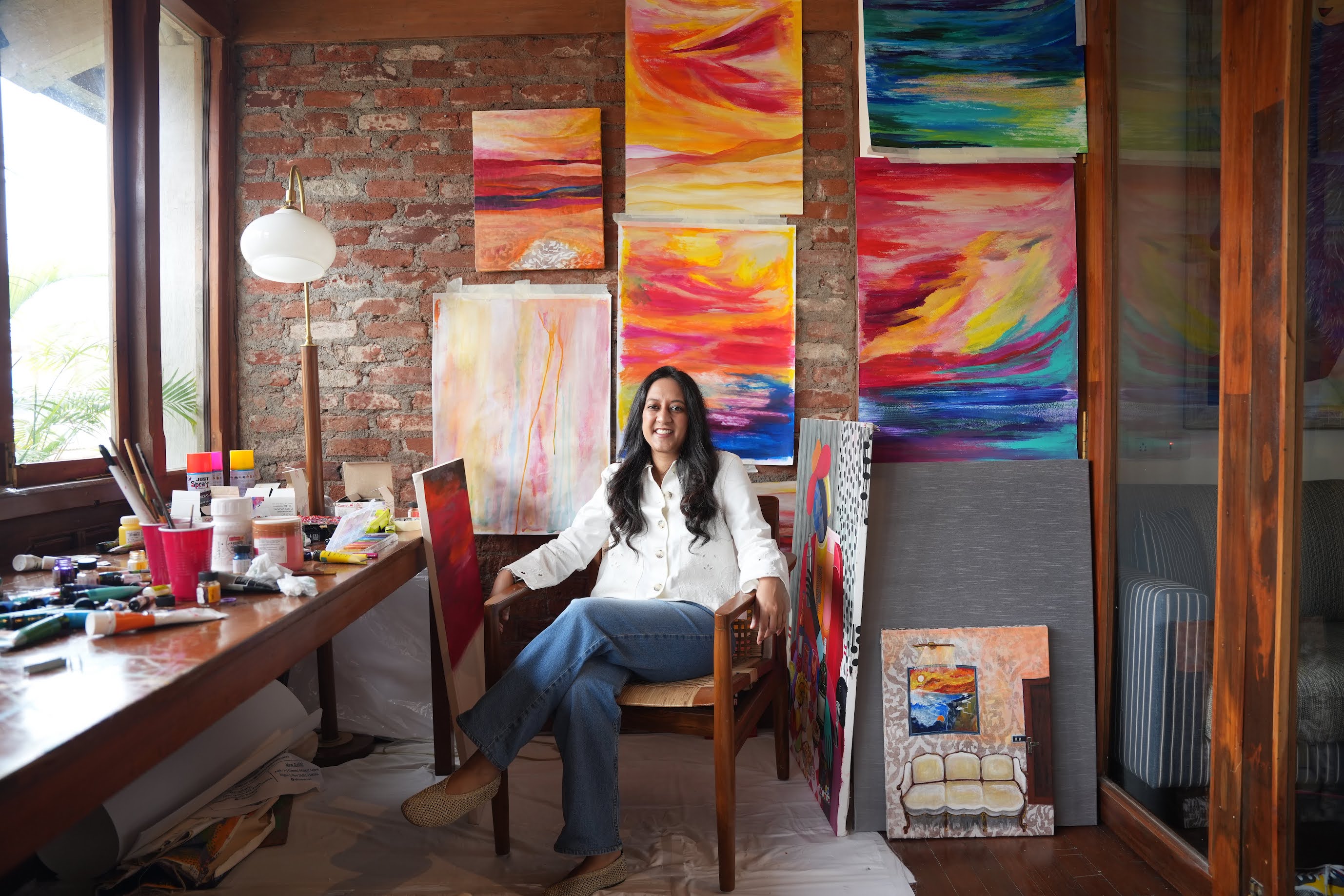
Parnika Mittal is an MA Painting graduate of Central Saint Martins, UK, who has also held a residency with British sculptor and draftsman Antony Gormley
Besides this were single-day encounters with craftspeople and specialists: embroidery and craft with Monica Shah in Lower Parel, jewellery, gems and settings with Karan Kothari on Altamount Road, and carpet weaving with Tissage Rugs in Jaipur. These were not apprenticeships, but points of contact. The question was what a contemporary painter might take from a loom, a stone-setting bench or an embroidery practice and bring back into her own material language.
For Parnika, whose work is concerned with belonging and memory, Phulkari has been a key reference. She has approached it as part of memory, lineage and transmission between women. “I haven’t had the chance to learn from women who practise it directly, but I’ve researched it thoroughly and seen various exhibitions and clothing passed down through generations,” she says. “What has stayed with me is that Phulkari isn’t just an embroidery technique. It’s knowledge that has travelled through generations, often through relationships between women.”
Also read: Subodh Gupta interview: ‘Even the most ordinary objects can carry extraordinary human histories’
In this residency, Parnika has been drawn to Phulkari — untwisted silk worked in darning stitch from the reverse of handwoven khaddar — while continuing to work with cyanotype across mirror, linen and canvas. Both artists are also working on locally sourced khadi and other materials found in India.
For Parnika, the workshops have been a way to rethink labour. “The value of these encounters has been less about learning a technique and more about understanding the thought, patience and lived knowledge behind it,” she says. “Spending time with craftspeople has made me look at making differently: at repetition, labour, gesture and the passing down of knowledge.”
Mary’s response has been similar, though from a different starting point. Her own practice, she says, is usually “very spontaneous and intuitive and willy-nilly”. Watching artisans work made her newly aware of method, discipline and sustained effort. “What I’ve taken most from observing these artisans and craftsmen is such an admiration for the painstaking labour and effort embedded in their work,” she says. “It’s a level of physical dedication that is massively foreign to my usual way of making, and I felt so inspired to bring more of that approach into my own work.”
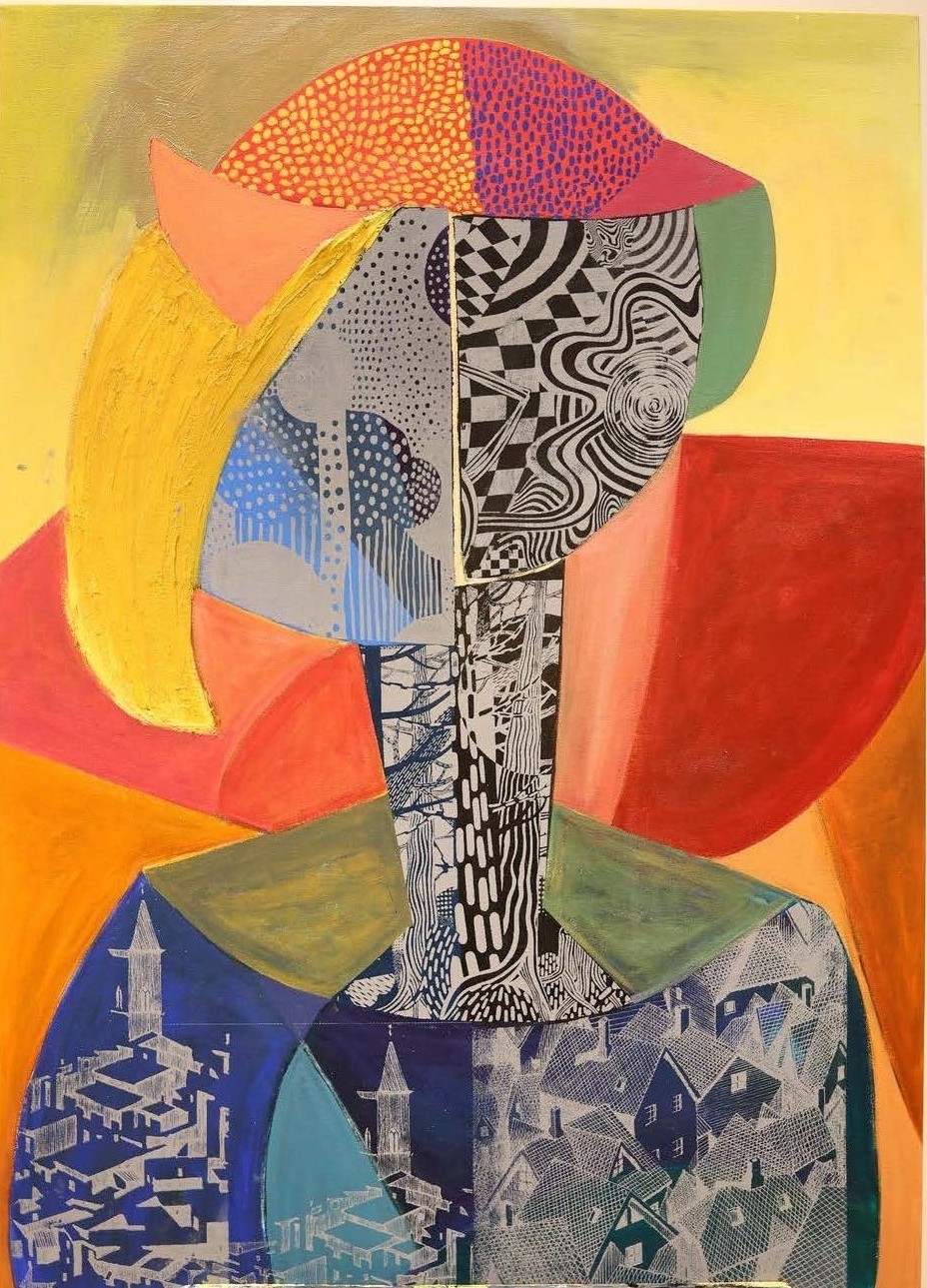
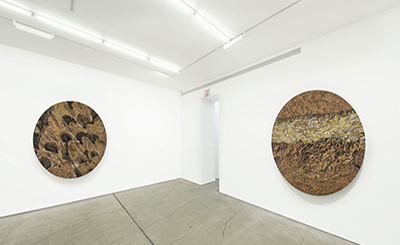
Parnika Mittal, Torn Passage
Each mentor takes a subject in their area of specialisation, with a one-hour online session per artist and an assessment at the end. The mentors are Ghadah AlHarthi, Cultural Advisor at Central Saint Martins and Professor at University of the Arts London; Sadaf Padder, a US-based curator and Visiting Critic on Columbia University’s MFA programme; and Divya Pande, Senior Sales Director at Victoria Miro in London and Venice.
For Parnika, the point of assessment is not to judge the final work too narrowly. “Assessment looks at the process as much as the outcome,” she says. “It’s important not to focus only on the final result, but on experimentation and different uses of material, because the work is inevitably still changing and evolving.”
Mary describes the mentoring as a kind of pause inside an otherwise overwhelming experience. “You can only meet a work where it stands in the present moment,” she says. “For meaningful evolution to happen, you first have to pause and ground yourself, and the mentors gave me that necessary stillness.”
For Meze, these relationships are among the most valuable parts of the residency. The craftspeople, she says, will remain in the artists’ minds as inspiration and as a heritage influence. The mentors, however, may become long-term professional connections. “The artists got to show their work to people of that calibre, which is something thousands of artists never get to do in their whole careers,” she says.
Meze hopes Bhatia’s documentary will help audiences outside India, especially in the US, understand what this kind of exchange can look like. “FAACII wants to build a real bridge between India and the West,” she says, “and we want a US audience to see what an opportunity like this looks like, and how beautiful India is.”
For Mary, the proof of the exchange lies in the feeling left behind by each encounter. “Whenever I’ve learned something from someone, I feel an immediate sense of admiration, and that creates a genuine bond,” she says. “Every single encounter left me feeling enriched by their vast knowledge, through our conversations and my own simple observations.” For a first residency, that may be the most honest measure. As Meze says, “I’m very proud of what we’ve built, and I think the residency will keep inspiring people for years to come.”
More from Arts
Comments
*Comments will be moderated