








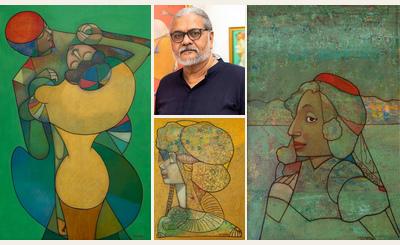
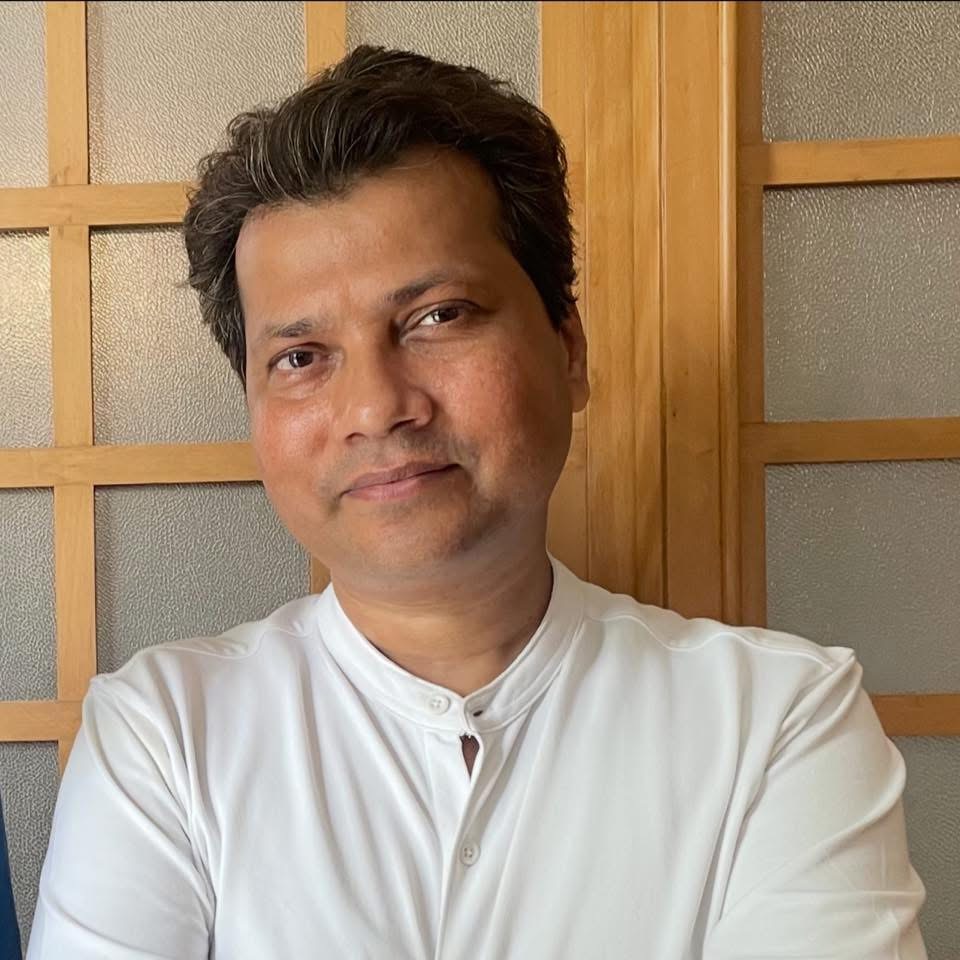
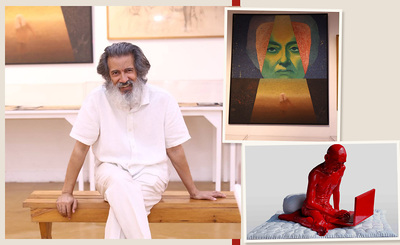
Delhi-based artist Neeraj Goswami’s new show, Walk Unto Self, owes its genesis to a small circle, about a foot across. Inside it, Goswami placed a solitary figure. He kept returning to the painting, building its textures, but the figure remained alone. “This small work reflects the whole journey of an artist’s life,” he writes in the exhibition note. “It’s a circle.” He has kept the painting in his own collection. “This is not for sale,” he told The Magazine. “I want to keep and preserve it so that I remember that everything started from this.”
Curated by Debeshi and running through November 30 at Bikaner House, the exhibition brings together about 20 canvases, from miniatures to large works. Some are from Goswami’s own collection. “They were very close to me,” he says. “They give me inspiration for doing future works.” The gallery text follows the journey from the physical body and the material world to the mind, senses and intellect, and then further inward, into memory and the subconscious. For Goswami, the paintings trace a movement from form to formlessness.
“You travel outside, physically, and through introspection you become aware of your mind, your subconscious,” he says. “After experiencing the world, eventually you have to come back to yourself.” At this point in his life, he says, he can recall his experiences and become a witness to them. “It’s a journey which takes me back to self-realisation.” The paintings do not begin with a fixed plan. “It’s not conscious. It’s very spontaneous,” he says. “It can begin with a play, sometimes with some textures, some play with colours on the canvas. Gradually there is deep contemplation. I get involved with the space and I become one with the space.”
Sometimes the first thing to appear is not a figure but a colour or a shape. “A golden light or golden form or golden boat comes. Sometimes a deep red or blue. It emerges out of nothingness and then takes form on the canvas. It’s a very mysterious process.” That process can bring difficult images to the surface. Goswami recalls encountering dark images and negative thoughts from the subconscious. “Sometimes there are emotional disturbances,” he says. “But gradually, through meditation and the creative process, you transcend that state. Your own state transforms, and that is reflected on the canvas.”
His work has undergone several phases. In his early career, the paintings were abstract and expressionistic, with bold lines and dark, tormented images. “There was a lot of paint, suffering, loneliness. That was my state, so I manifested that.” Later, he became preoccupied with more theatrical and surreal imagery. The human figure remained his main subject, which he studied “anatomically, psychologically and spiritually.” The exhibition text describes the same progression in his practice: at college, Goswami worked through academic disciplines such as sketching, anatomy, outdoor studies and landscape. He painted what he saw, but then wanted to reach beyond it. The mind, he writes, began drawing on memories, pain, suffering and melancholy to create imaginative forms. “This state cannot be explained in words, but can be revealed through forms on canvas.”
His distinctive angular figures began in anatomy classes at the College of Art, Delhi. In the first years of his training, he and his fellow students learnt to study the body in planes, following the fall of light and shade. “I learnt to create a three-dimensional form on a two-dimensional paper by creating angular shapes,” he says. What began as an exercise became his own way of combining realism with abstraction. In a statement on the gallery wall, he writes that the human form in his paintings is abstracted to reveal “the presence of the formless within the rhythmic structure”.
Across the exhibition, the titles encompass different registers of experience. There is Family (2025), Theatre – The World Within Me (2025), and the 2026 paintings Play, Pageant and Vacation by Seaside. In Reverie – In Love (2026), affection takes shape through two closely joined figures. Angel and the Muse (2025) and Unmanifest – Manifest(2026) bring the human figure into a more explicitly spiritual register.
The wall text for Unmanifest – Manifest describes “the Infinite taking form as Love and Compassion”. Its figures and shapes are drawn towards a central angel, creating what the text calls a visual melody and a sense of joyful abandon. Goswami’s own words elsewhere in the gallery make the connection between feeling and abstraction clear: “Painting for me is like merging into Love. I become Love, and Love flows on to the canvas, creating rhythms, visual melodies and songs of the unmanifest.”
The label for Theatre – The World Within Me offers another key to the exhibition. It describes the artist becoming a witness to existence and discovering that the world is not simply outside him, but also manifests within as activity, vibration and imagination. That idea is visible in the painting’s crowded field of figures: the outer world seems to gather inside the canvas.
A large work that brings these ideas together is The Boat That Sings – Deha Nauka (2026), a 78-by-132-inch acrylic on canvas. Goswami sees the body as a boat carrying the soul through life. The figures aboard it include children who stand for the five senses; strings and shifting shapes give the boat a musical rhythm. “The whole boat is in a melodious, rhythmic form,” he says. “The shapes are floating and moving, and they create a sort of music and melody.” The soul, he explains, experiences “the vibrations of the world within the body”.
The boat also suggests the passage through life, with its births, deaths and accumulated experiences. Goswami connects this to bhav-sagar, the sea of life that one must cross. “You go through life with all the experiences and happenings,” he says. “If you are a seeker, searching for the truth within you, ultimately you can realise that truth.” A related work, The Living Boat (2026), is painted on wood and measures 38 by 96 inches. In Maestro (2026), a seated musician plays a large stringed instrument, bringing another kind of melody into the exhibition.
Another work, Vintage Cruise, turns the passage of a life into a golden car carrying abstracted human figures. An emblem on the car bears the dates 1964–2026, marking Goswami’s own journey. The figures hold the emotions and phases he has travelled through. “I can recall all my experiences in life and enrich myself with those experiences.”
The question of what remains beneath those experiences runs through his account of the self. A person first knows the body, he says; later the mind and intellect develop. But introspection can lead to the sense that the mind is not the end of one’s existence. “If you stop the process of thinking, you experience something which is there within you.” The body, in this understanding, is a “beautiful machine”, animated by something beyond its visible form.
A gallery text puts it simply: “You are not the body, but you are in the body.” Another statement describes the journey from “I am this”, meaning the physical form, to “I am That”, or Tat Tvam Asi. In the interview, Goswami gives his own explanation: “You cannot ever experience it with the mind or thinking. You can experience it when you become that.” He describes the state as “nothingness” filled with joy. “It is difficult to explain in words, but very easy to manifest on the canvas.”
Goswami’s search for that something began in sorrow. His father died in an accident in Varanasi when Goswami was in Class 10 and waiting for his board examinations. The family did not see his father’s body before it was cremated. They learnt of the accident later and, after searching, managed to find photographs through the police. “Everything was going on slowly, and suddenly this thing happened,” he says. “I became depressed and disinterested. I lost interest in life and the world.” His father had been proud of his son’s creative talent. “He was very fond of me because I was a painter. He used to feel proud: ‘My son is a creative person.’”
With its sole breadwinner gone, the family was devastated, barely managing to make ends meet: Goswami had two younger brothers and began earning through illustration work, drawing on the realistic skills he had developed as a young artist. “I had to start earning from that time,” he says. “I started doing illustrations because I had this great skill.” His mother also worked, and he helped support the family. The loss brought questions he could not put aside: “What is life? What is this? Who am I?” He describes that period as one of darkness, made harder by financial strain. “I was alone with myself. Inside, there was darkness, blackness, many things which cannot be described.”
After joining the College of Art, he found his way to an ashram in Jamshedpur, where he began practising meditation. He describes the practice as an ancient technique, passed down by rishis, centred on meditating on the “unstruck sound”. He says it helped quieten his mind and breath. “It’s a very scientific method to pacify your mind and your breath.” Over time, painting and meditation became closely linked. “Meditation emerged in my painting. Both things combined, and I found this direction.” He credits them with helping him through the period that followed his father’s death. “I went through the dark place and found liberation.”
Goswami remains connected to the ashram and volunteers at meditation camps in India and abroad. He wants to share what he has learnt with people, particularly young people dealing with an unsettled mind, personal difficulties and the constant distractions of digital life. In December, he says, he plans to lead a two-day workshop in Jamshedpur.
Born in Patna in 1964, Goswami moved to Delhi as a child and completed his BFA and MFA at the College of Art, New Delhi. In 1988, he received the Bharat Bhavan Award at the Second Biennale of Contemporary Indian Art and a research grant fellowship from the Lalit Kala Akademi. He has held more than 20 solo exhibitions in India and abroad, including ten at Galerie Ganesha in New Delhi through the 1990s. His exhibitions have also taken him to Paris, New York and Singapore. In 2004, he was Artist in Focus at the Harmony Show in Mumbai.
He has also worked as a sculptor and muralist. In 1999, he was commissioned to paint a portrait of President K. R. Narayanan for the Rajya Sabha. His work is held by the National Gallery of Modern Art in New Delhi and by corporate and private collections in India and abroad, including of Apollo, Hero Honda, Ranbaxy, Max India, Adidas, Somdatt and Reliance. Arun Ghose’s 2013 book on the artist, Liquid Distillation of Animated Consciousness, traces the relationship between his paintings and his spiritual journey.
Goswami has also made sculptures, murals and portraits, but the canvas is where he finds it easiest to become still. Sculpture involves physical labour and movement; a canvas needs only an easel and a place to sit. “It’s very easy to meditate on the canvas,” he says. “Your body becomes still, your mind becomes still, and you can go deep within you.” Paper and board offer the same possibility: a two-dimensional space in which to settle into the work.
More from Arts
Comments
*Comments will be moderated