








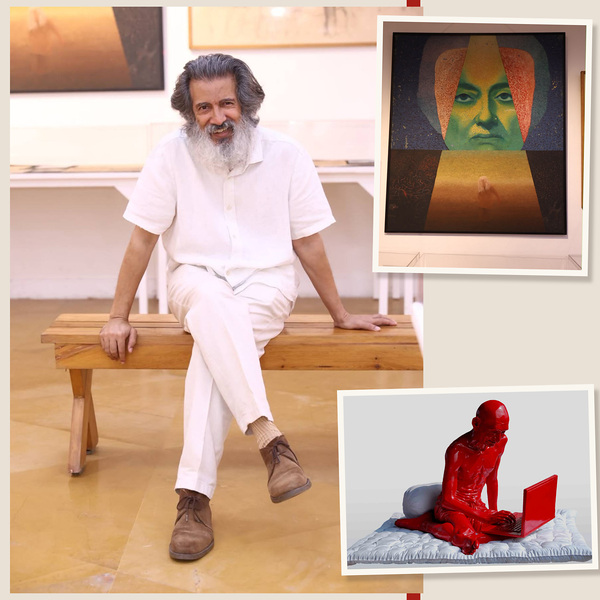
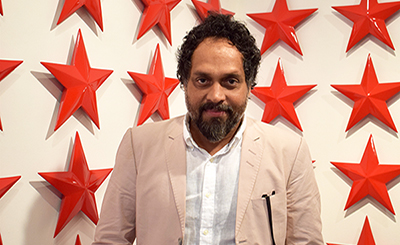
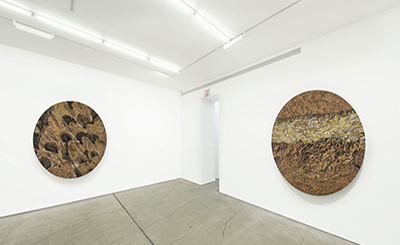
(from left) Neville Tuli, Famous Mrs. G, a mixed-media/oil painting by Vivan Sundaram (1974), and Mahatma Gandhiji Debanjan Roy | India Shining I (Gandhi And The Laptop), painted fiberglass with mattress and bolster, 2007. Photos: TRIS
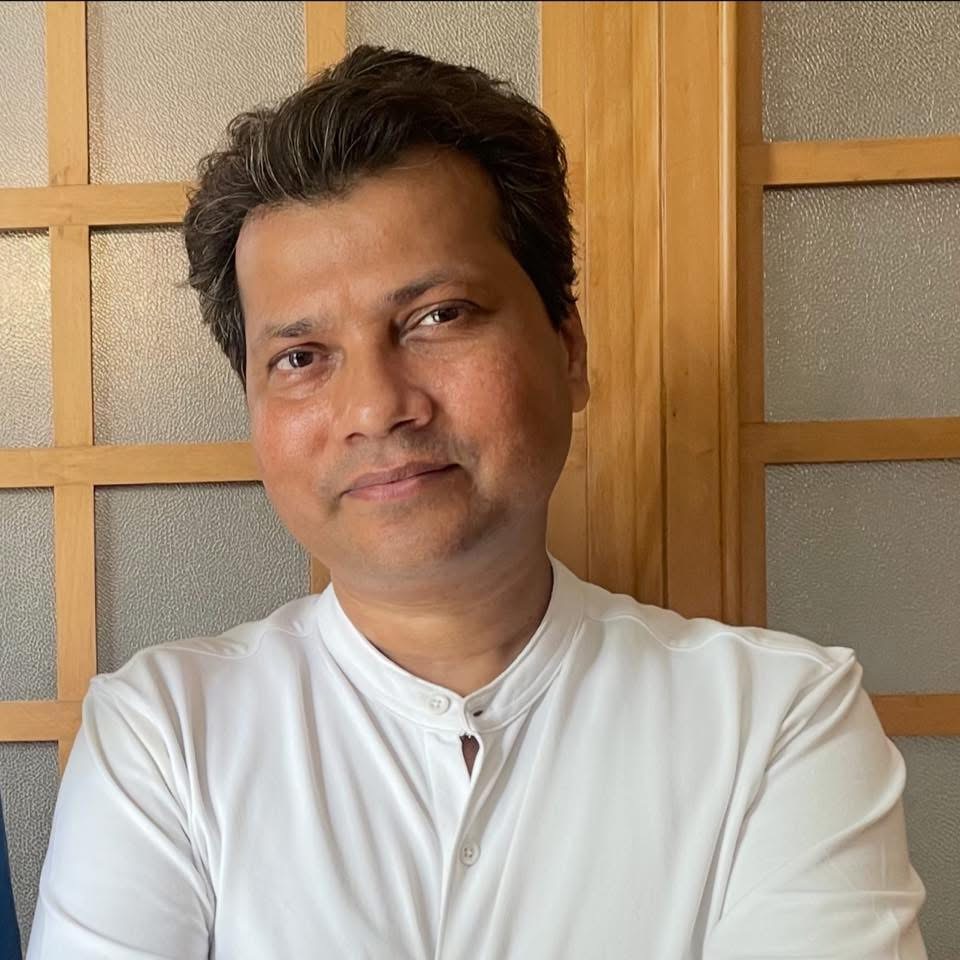
At ‘SWARAJ: Revisualising India’s Political History’, Neville Tuli uses art, photographs, books, posters, film material and everyday objects to look again at the making of modern India. In conversation, the curator and archivist speaks about Gandhi and self-rule, our inability to read images, the loss of memory in the age of AI, what Indian education has got wrong, and why Saraswati and Lakshmi must sometimes share the same sofa
Neville Tuli would rather you looked first and read later. Walk through SWARAJ: Revisualising India’s Political History, the new exhibition at the Visual Arts Gallery, India Habitat Centre, that he has curated, and there are fewer explanatory captions than one might expect from a show covering such an enormous span of Indian history. This is deliberate. “Exhibitions like this open up the mind that the visual has great knowledge. That’s why I don’t put captions, by and large,” he says. The problem, he feels, is that most of us have never been taught how to look. “People are visually illiterate. They see something but they don’t know how to read it. It’s like giving them a Chinese newspaper. They have no concept of line, form, colour, composition, texture. None of these things. No one’s nurtured that.”
That belief gives SWARAJ its shape. The exhibition, on view from August 12 to 16, does not tell India’s political history through leaders and dates alone. Paintings, photographs, prints, books, film publicity art, memorabilia and visual, textual and audio archives move from early European encounters with India and the Bengal Renaissance through 1857, the rise of Bharat Mata and the Tiranga, Gandhi and the freedom struggle, and into the political life of independent India. The artists and photographers range from Abanindranath and Gaganendranath Tagore, Nandalal Bose and Ramkinkar Baij to Chittaprosad, M.F. Husain, Vivan Sundaram, Sudhir Patwardhan, Felice Beato, Henri Cartier-Bresson and Raghu Rai. A mass-produced object can lie next to a work of fine art without apology.
This refusal to separate things into tidy cultural compartments goes back a long way with Tuli. Educated in economics and developmental theory at the London School of Economics and St Catherine’s College, Oxford, he returned to India in the early 1990s. In 1997 came The Flamed Mosaic: Indian Contemporary Painting, a nearly 500-page study of modern Indian painting. Later, through Osian’s, he juggled art, books, archives, popular culture and cinema; Osian’s took over the Cinefan festival in 2004, extending an interest in cinema that has remained central to his work.
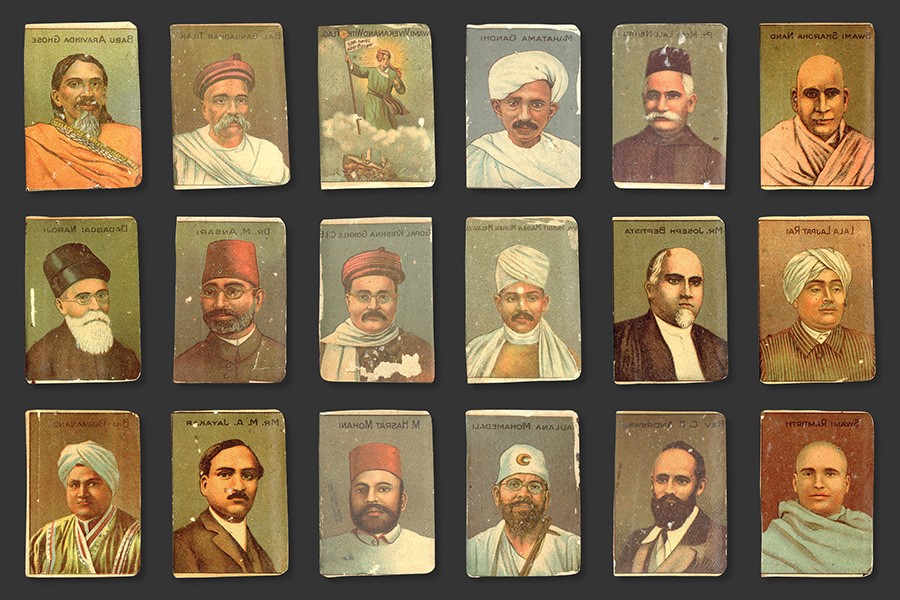
Match-box tin covers with mis-printed names of Swadeshi leaders, ca.1921
So when Tuli calls what he is doing now “a 30-year journey”, it is less a flourish than a description of a long-running preoccupation. “Before we were ahead of the curve. People used to say, why, what’s the point?” he recalls. His complaint was then, and remains now, that education had placed the written word above almost every other way of knowing. “We imagine that all the source of knowledge was in the text. Undermining the visual, undermining the audio. And most important, undermining the context in which the three of them must be placed.”
Also read: Subodh Gupta interview: ‘Even the most ordinary objects can carry extraordinary human histories’
For him, learning works when “text, visual, audio, context” operate together, reinforcing one another. Without that, he says, “our mind is so narrow. It’s so tunnelled.” The Tuli Research Centre for India Studies, or T.R.I.S., is the latest institutional form of that idea. It began presenting its material publicly with Self-Discovery via Rediscovering India at the India International Centre in March 2024. A few months later, The World’s Greatest Mela — Respecting India’s Cinematic Heritage filled the India Habitat Centre with film posters, stills, publicity material, memorabilia and other objects drawn from a research base built over three decades and reported at the time as encompassing more than 400,000 objects across fine and popular arts, crafts and cinema.
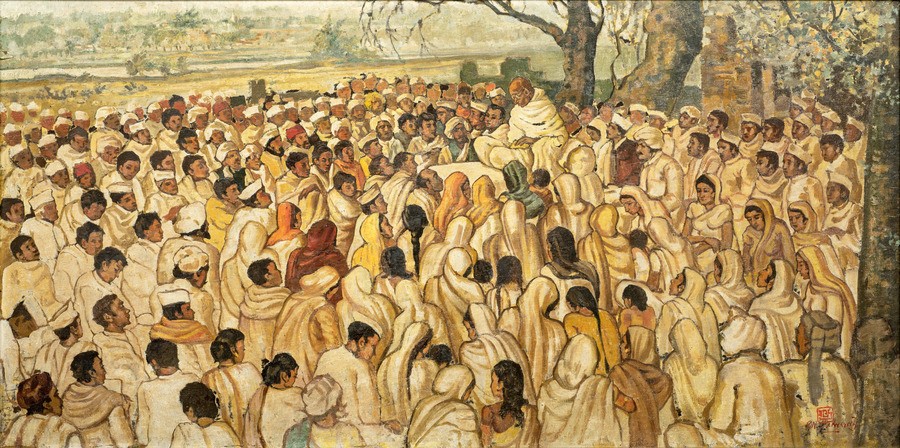
Ramendranath Chakravorty, Gandhiji at Dandi, Oil on canvas, c.1932
The online T.R.I.S. platform followed in April 2025. It is organised around 16 research categories, and its current site says the platform uses more than 150,000 visual and textual objects; its first public version opened with more than 100,000. Access is free. The categories themselves tell you something about Tuli’s appetite: cinema, modern and contemporary art, photography, architecture, politics, spirituality, social history and, most recently, the relationship between animals, humans and nature occupy the same intellectual structure.
What he wants to restore above all is pleasure. “The joy has gone out of the whole educational learning process,” he says. “Now, how do you bring back joy? You can only bring back joy with first love. Genuine love. Genuine empathy. No judgments on right and wrong.” His description of India follows the same argument. “She’s absorbed it like this eternal sponge. She takes everything in her stride, slowly imbibes it, resolves it, understands it, makes it part of herself and moves on.”
The irony is that we now spend much of the day looking at images. Tuli acknowledges that the mobile phone and Instagram have made people take the image more seriously. But looking, in his view, is not the same as reading. “They’re still not seeing it as a great source of knowledge to work with the text. It’s a complement to the text. It’s not an equal. That has to change.”
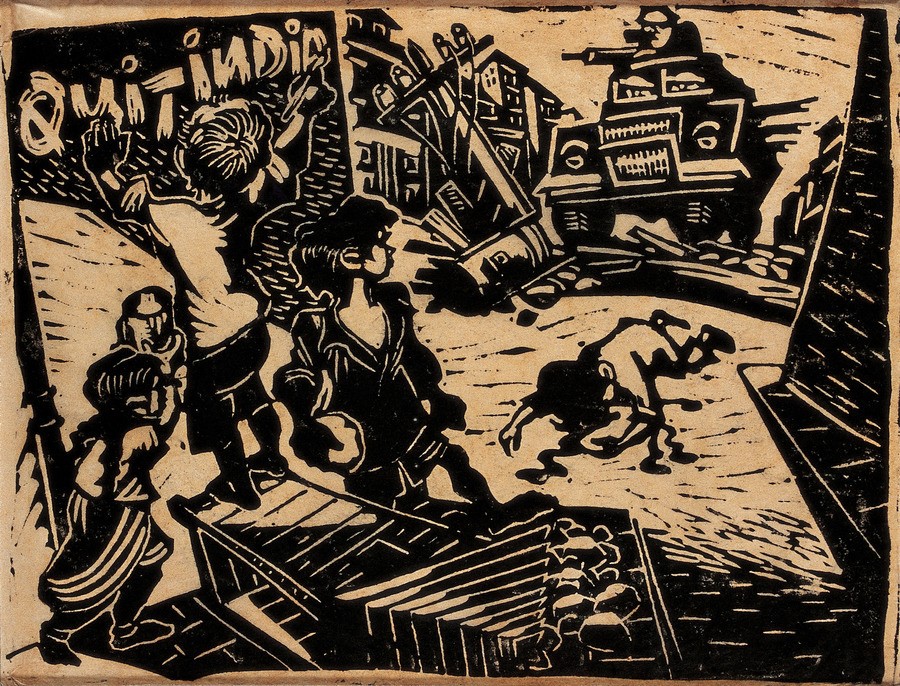
Chittaprosad, Quit India, Linocut on paper, c.1942
Cinema is perhaps his clearest example. Tuli has been arguing that a film can be read not simply as cinema but as evidence: of clothes, architecture, family structures, class, gender, language, aspiration, music and the changing city. The World’s Greatest Mela was followed by masterclasses on “Cinema as a Critical Educational Resource”; the same idea remains the first core research category at T.R.I.S.
In January this year, the centre put Mughal-e-Azam and Sholay together to look at the visual and material legacies of two landmarks of Bombay cinema. In May, All Living Souls widened the frame again, introducing the 16th research category, the “Animal-Human-Nature Continuum”. Exhibitions are held alongside conversations, lectures, online material and short pieces released through its social channels; the archive is meant to circulate rather than simply gather dust in storage.
With SWARAJ, though, the questions become explicitly political. The title itself carries the burden of more than a century of argument. Looking at a wall that moves from Dayanand Saraswati and Dadabhai Naoroji to Gandhi and Nehru, Tuli points out that there was never one fixed definition of self-rule. “Their concept of Swaraj is also not my concept,” he says.
Gandhi comes closest, but not simply because of his politics. “Gandhi comes closer because of his genuine focus on introspection of the personal journey. There’s no point of a collective journey moving in a certain direction if your personal journey lags so far behind.” That, for Tuli, is what remains difficult and necessary about Gandhi. “The essence of Gandhi’s vision is that focus on introspection.”
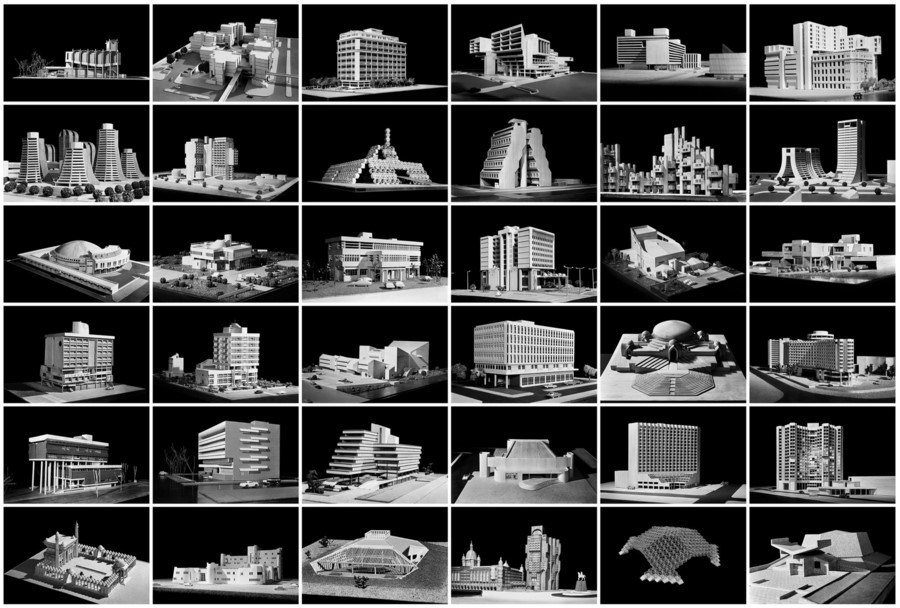
Madan Mahatta Archives, Models, I, Pigment prints, set of 36 photographs
He thinks we are losing precisely that ability. “Introspection is going out of the door. Everyone is getting offended by the smallest things. The skin has become so fragile. The mind has become so superficial.” Then he comes to memory: “Memory is dying. How does your imagination grow if you don’t have a memory? You can’t take it from AI or from Google or from other sources.”
The digital archive Tuli is building might seem to be at odds with that warning, but his objection is not to technology itself. It is to outsourcing the work of the mind to it. “Let technology be the best version of itself. The human mind will always be one level more because there is a soul,” he says. What he wants from human beings is something beyond the accumulation of information. “I cannot be satisfied anymore with information. I cannot be satisfied anymore with just knowledge. Now, I need a deep emotional-spiritual connect. I need an experience.”
He even accepts that “one day the digital and the biological will fuse”, calling it part of evolution. The real danger, he argues, is allowing our own capacities to weaken. His answer, once again, is almost stubbornly simple: “If the joy is not there, you need to bring joy. At every moment of your life, you need to bring joy. And especially in the learning process.”
That leads him to a larger criticism of Indian education. Engineering, medicine, science and IT have been treated as the disciplines that develop a country, he says, while “the arts, humanities, social sciences are the intangible forces without which all of that becomes empty”. India has acquired the hardware, in his telling, without paying enough attention to what should fill it.
He is not arguing that everything inherited from the past should be preserved simply because it is old. “There are many things to disrespect. There are many things that need change. Everything is in constant evolution.” What matters is developing “the inner wisdom to know what is authentic that needs to be preserved”, while keeping the intellectual base wide enough to question everything. “The moment you narrow your base, you die.”
Tuli pushes this argument into more contentious territory when he speaks about secularism. He believes India’s developmental framework failed to understand the deep presence of faith, meditation and prayer in everyday Indian life, and that Indian secularism could never simply be a copy of the Western separation of religion and politics. His idea of prayer is deliberately broad: “You don’t have to pray to a God. You can pray to your child. You can pray to your friend. You can pray to your animals. Love.”
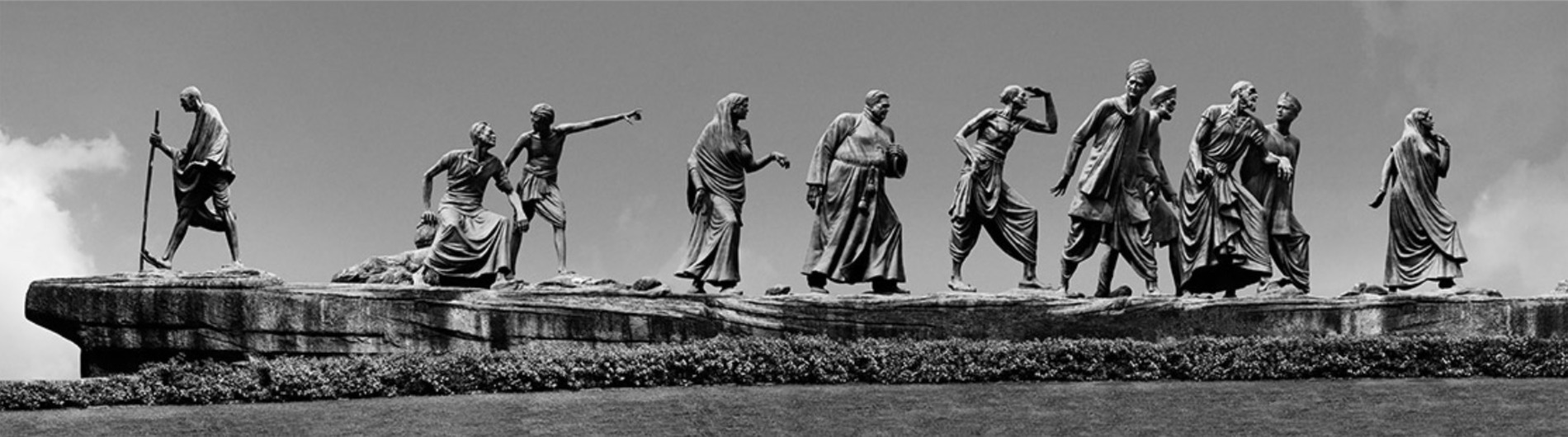
Gigi Scaria, Who Deviated First?, Inkjet print on archival paper, 2010
SWARAJ does not try to resolve these arguments. Asked about the changing representations of Bharat Mata and the flag — images that have again become central to public debate — Tuli gives perhaps the simplest statement of his curatorial position: “Everything needs to be re-examined. Everything.” “The Indian mind now needs to go back to its introspection,” he says. “It needs to get back the joy of introspection.”
The same re-examination applies to art itself. Tuli spent much of his earlier career helping build a market for Indian art. Now his language is increasingly about knowledge, history, education and access. He does not, however, pretend that money can be wished away. Financial value, he says, is “one important phase” in the life of art. What must follow is “the sensibility. The knowledge. The understanding of the history. The understanding of the framework. How art builds a civilisation. Not just as a commodity.”
“I gave 25 years building that framework,” he says. “It was always a duality. Building the knowledge base, building the market. Because you can’t have one without the other.” And then he sums up that uneasy but necessary relationship with an image that is both playful and precise: “Saraswati and Lakshmi have to sit on the same sofa, have a dialogue, and then go their separate ways.”
That sentence could almost serve as a key to SWARAJ. The exhibition keeps putting things beside each other that we are accustomed to separating: fine art and popular print, political icon and everyday object, Gandhi and contemporary India, memory and argument, the written record and the image. Tuli is less interested in telling the viewer what conclusion to draw than in getting those things onto the same sofa. The conversation, after that, is ours.
More from Arts

Comments
*Comments will be moderated