








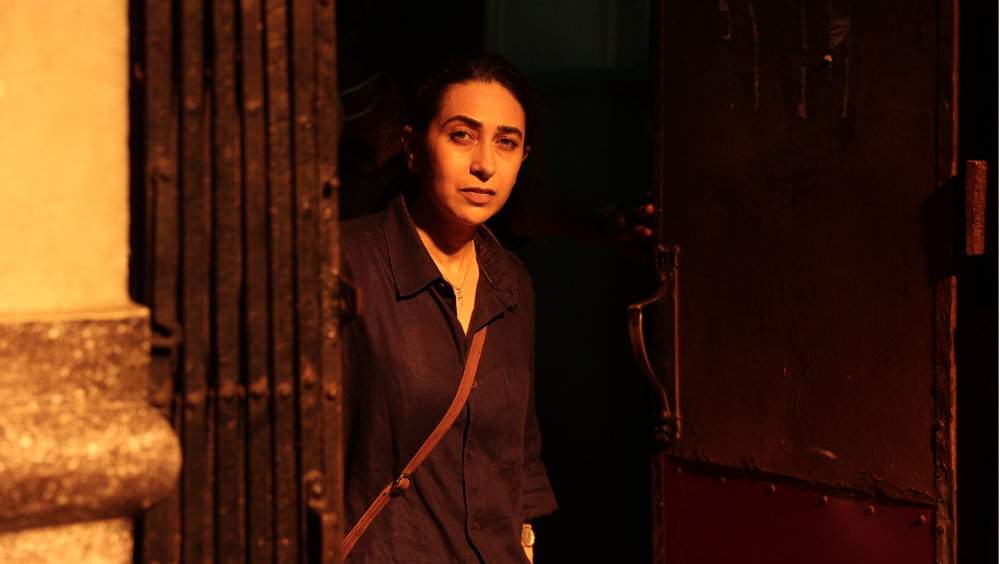

Abhinay Deo’s thriller works better as a portrait of a wounded woman and a morally decaying city than as a murder mystery, but Karisma Kapoor’s Rita Brown makes it gripping, graceful and worth watching
Whodunits are tricky things. They open like flowers, petal by petal. Pull too fast and the mystery falls apart. Move too slowly and the viewer grows restless. Abhinay Deo’s neo-noir psychological thriller Brown, currently streaming on Zee5, understands this tension fairly well. The series is not just interested in the establishing who the killer is but also in the city in which a series of murders takes place: its shame, silences, old houses, buried scandals, and people who know how to look respectable while brushing their depredations and moral degradations under the carpet.
Set in Kolkata, the series uses the city’s myriad scenic vistas to its advantage. There are the trademark yellow taxis, autos, narrow streets, old havelis, police stations, bars, traces of Chinatown, and the tired grace of a port city carrying too much history. This was once the capital the British built for themselves, and that colonial past is still evident in the architecture, the clubs, the Anglo-Indian homes and the city’s social habits.
Directed by Deo and adapted from Abheek Barua’s novel City of Death, Brown follows Rita Brown (Karisma Kapoor), a disgraced Kolkata cop and recovering alcoholic, who is drawn into the murder investigation of a young woman. Led by Rita, with her deputy (Surya Sharma) in tow, the case slowly opens up a world of old money, family secrets, sexual violence, hypocrisy and buried shame.
The dead girl’s wealthy family carries the right mix of grief and calculation: the father (Abhinay Deo), the brother (Paresh Pahuja), and the mother (Meghna Malik), all seem to be protecting something more than family honour. Jisshu Sengupta, as the victim’s psychiatrist, brings a certain unease to the story but he is also the weakest link. The boyfriend, a scientist with a dodgy past, keeps growing more doubtful by the episode. Other cast members, including, Soni Razdan, Helen Khan, Ajinkya Deo and Shaan, are all good, but the show belongs, almost completely, to Karisma.
Rita Brown could so easily have become a bundle of familiar traits: alcoholic cop, angry woman, lonely survivor, officer with a disturbed past. We have seen that person many times on streaming shows. But Karisma shines in the role of the Anglo-Indian; her identity gives the story another layer, allowing Deo to draw on her world and lend it some detailing that further enriches the series. Even if the show does not explore it as deeply as one would have liked, the presence of that culture gives Rita a slight apartness. She belongs to Kolkata, but she also seems to stand at a small distance from it, watching it with the eyes of someone who knows both its charm and its cruelty.
The writing credits are shared by Diggy Sisodia, Mayukh Ghosh and Sunayana Kumari; Sisodia’s earlier association with Kohrra naturally raises expectations. What makes Brown more than a routine murder mystery is the world it slowly uncovers. We get a peek into a conservative culture and its private debauchery. A mother, shamed after her child witnesses her extra-marital affair, takes her own life. A girl is forced into marriage. Families seem normal until their dysfunction, inherent violence and mistreatment of women are revealed. It’s then that the old havelis become symbols of a two-faced respectability, where everything ugly is hidden behind the doors.
The themes are disturbing, but not exactly shocking. Reality, as we all know, has often been darker than fiction. We have heard and seen worse in the news, in families, in small towns, in big cities. So the strength of Brown is not that it shows something entirely new; it is in how it presents this world: patiently, moodily, and with a sense of pain under the surface, and a fair understanding of the world it portrays, shining a light on its moorings.
Cinematically strong and engaging in parts, though the murderer track becomes one of its duller stretches. The better material lies elsewhere: in Kolkata’s old and modern faces, in its underbelly, in its grief, in the complicated lives of its women, and above all in Karisma’s Rita Brown; the actor had made her OTT comeback in a leading role after a 14-year hiatus (she made her debut OTT with the dramedy series Mentalhood in 2020).
Kapoor looks ravishing; the shirts, the cigarettes, the tired eyes, the fit, agile body, the stillness, all of it gives Rita a force of its own. She is intense, graceful and refreshingly powerful. Helen Khan and Soni Razdan (as Brown’s grandmother and mother) bring warmth and wit through their banter, and Surya Sharma feels convincing, which says something about Abhinay Deo’s direction as well. Even when the plot is familiar, its people seem different.
The family, in Brown, is not always a place of love. Sometimes it is a place where crime festers and brings women to an edge, leaving them with little choice but to see themselves slowly succumbing to the chokehold of trauma. This is where the show feels sharp. It knows that violence sometimes begins with a man in the house who knows he will never be questioned. Sometimes it begins with a woman being told to keep quiet for the sake of the family name. Brown is very interested in that old Indian habit of hiding rot behind respectability.
As a murder mystery, Brown is gripping but not extraordinary. It keeps you watching. It has pace. It has mood. It has enough turns to pull you into the next episode. Abhinay Deo knows how to build tension. The cinematography is strong, and the show is visually rich without becoming too glossy. The city has its good, bad and ugly sides, and the show wants to catch all of them.
Even when the writing becomes familiar, the actors inhabit their rooms well. Still, Brown could have been better. It could have made the murder mystery less predictable. But whatever the show lacks, Karisma Kapoor gives it a centre. This is a powerful role for her after a long time, and she does it justice. Hindi cinema has often struggled to imagine second lives for its actresses. It either freezes them in their youth, pushes them into mother roles, or asks them to return as a version of what they once were. Brown gives Karisma the chance to play someone older, harder, funny, angry, and capable.
That is why the show stays with you; in the unravelling of the case, we also see the unravelling of Rita’s own wreckage; like the city in the face of growing gruesome crime, she trying not to collapse. Brown is a better character study than a crime thriller. The real question is not only who killed the young woman. It is how people keep living after shame, grief and guilt have entered their bloodstream. On that question, Karisma Kapoor gives the show its most honest answer. She makes Rita Brown difficult, watchful and alive. That is enough to make Brown worth watching.
More from Culture








Comments
*Comments will be moderated