








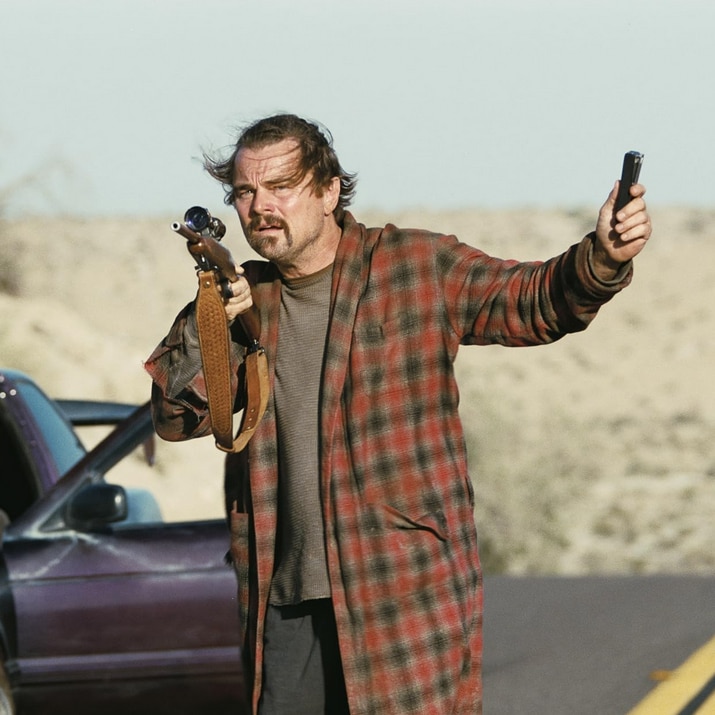

In his tenth feature, Paul Thomas Anderson stages a full-on recalibration of his longstanding obsessions — revolution and fatherhood, spectacle and intimacy, paranoia and inheritance — spooling them into a furious, awkwardly joyous action-epic that both extends and complicates his filmography
Paul Thomas Anderson has never made the same film twice, but he’s always made the same inquiry across his oeuvre: how do people live with their appetites once the world no longer needs them? His latest, One Battle After Another, which released in theatres worldwide on September 26, pushes that question to its outer limit. Set in a bruised, contemporary America of broken rebellions and burnt-out idealists, it has a little bit of every mode he’s ever worked in: the sprawl of Magnolia, the menace of There Will Be Blood, the warped tenderness of Phantom Thread, and the absurdist entropy of Inherent Vice, his adaptation of Thomas Pynchon’s novel of the same name.
One Battle After Another, which had its world premiere in Los Angeles on September 8 and was theatrically released in India on September 26, has been critically acclaimed, and has come to be considered as Anderson’s highest-grossing film. From its opening movement — a dense tangle of surveillance footage, protest chants, and a single father’s fractured voiceover — it’s clear this is not a return to the intimacy of Licorice Pizza. This is Anderson thinking on a national scale, but with the psychological precision of a chamber piece..
If Boogie Nights was his coming-of-age story for a lost America and The Master his indictment of cult fanaticism and lies in the name of religion, One Battle After Another is his elegy for conviction itself. The characters aren’t really chasing power, fame, or love anymore; they’re chasing some way to make the past answer for itself. Anderson, now decades into his directorial life, seems to have grown allergic to nostalgia. Every frame of this film feels like it’s arguing with his own legacy, stripping away the sentimentality often projected onto his earlier, more exuberant work. This is a film of doubt, made by a filmmaker who once trafficked in certainty.
If there is a secret engine of the film, it is this: the past will not stay buried, and no matter how far one flees into isolation, the future keeps careening into view. And this is the key: Anderson has made a film about flight, but also about return; an ex-revolutionary called Bob Ferguson (the terrific Leonardo DiCaprio) seeks refuge off-grid with his daughter, only to have everything old and new collide when the nemesis he thought he’d left behind resurfaces.
What Anderson offers here, at 55 and with nine features already behind him, is a daring synthesis of his earlier style: a blockbuster scale meets the interiority of character, a father-daughter story with geopolitics, an action-thriller with the weird tonal shifts we expect from him but calibrated this time for a wider horizon. Many critics already mourn the director’s earlier time of period pieces, suggesting this is his first “modern” setting.
For decades Anderson has drawn characters who run from something, or toward something: fathers and sons, screenplays that loop around regrets, systems of belief, failed masculinity. Think of There Will Be Blood (2007): the oil baron Daniel Plainview hunts the land and then himself. Or The Master (2012): Freddie Quell swallowed by belief, by mentor, by myth. (In Magnolia (1999) and Boogie Nights (1997), ensemble flows of people seeking meaning and connection amid collapse. Anderson’s syntax is fluent in regret, in longing, in violent stillness.
With One Battle After Another, those impulses remain, but the mode changes: he casts his hero not merely as a man haunted by past ideology, but as a father whose ideology was his escape, whose daughter demands presence not protest. It’s as if Anderson asked: what happens when the radical becomes the parent? When protest becomes patrol? And when the battle you thought was over was only the opening salvo? The answer: one battle after another.
The film qualifies as a “populist” Anderson, or so some argue. But that is also a bit misleading. It’s not simply Anderson redirecting toward mainstream; it’s Anderson deepening his core by widening the lens. Instead of a closed character study, we get a network-of-forces: authoritarian military privatised in suburban guise, children of former radicals now navigating banal adult realities, the interface between activism and daily life.
Bob Ferguson’s relationship with his daughter Willa (Chase Infiniti) is the emotional axis of the film, and it works precisely because it’s messy. Bob’s past is potent — he was a radical, he abandoned something — and Willa’s present refuses to simply inherit that past. Their dynamic reveals Anderson’s continuing fascination with intergenerational conflict but in fresh guise. Earlier, in Punch-Drunk Love (2002), a lonely man learns connection; here, a man must relearn responsibility.
.jpg)
The twist: Anderson doesn’t treat Bob’s radical past as nobility. He treats it as part of what he must escape and surpass. Willa’s agency stands as both her father’s redemption and indictment. This interplay takes us beyond the simpler models of Anderson’s earlier family work (say in Magnolia) into territory where personal reckoning meets cultural reckoning. In that sense, the film is maybe the most “personal” Anderson has made (even if loosely based on another novel by Pynchon, Vineland). Some critics argue it reflects Anderson’s own fatherhood and the mid-career shift in his lens.
It is telling that Anderson stages large‐set pieces — stasis broken by force, vehicles sliding down embankments, helicopter raids in a school gymnasium. He does not abandon his internal concerns for the larger-than-life; he escalates them. The father-daughter becomes a microcosm of culture war, of revolt versus discipline, of freedom and surveillance.
If one had to map the arc of Anderson’s formal experiments: early years (Hard Eight, Boogie Nights) embraced ensemble and movement; mid-career (Punch-Drunk Love, There Will Be Blood) honed silence and violence; later (Inherent Vice, Phantom Thread) explored genre hybridity. With One Battle After Another, he combines all of those: car-chases and extended takes, humour and dread, absurdity and urgency.
That the film is shot in VistaVision and IMAX at blockbuster budget levels for Anderson matters. But this isn’t laissez-faire style glam: the camera remains anchored in character even when the terrain expands. The collaboration with composer Jonny Greenwood remains central. Greenwood’s score for the film — piano, ondes Martenot, percussion — carries the haunting urgency that marked There Will Be Blood and The Master. The formal vocabulary is consistent, yet here Anderson uses it to power grand-scale narrative rather than enclose a single psyche.
In Phantom Thread (2017), Anderson turned inward, to obsession and fetish. In One Battle After Another, he turns outward; while keeping the membranes thin so we feel the internal in the external. That’s the alchemy of the piece. The old Anderson of personal myth collides with the new Anderson of networked power.
The politics of One Battle After Another are layered: Bob’s past, the colonel’s resurrection, immigrant detention centres, covert raids, the rebellion of youth. Critics note the film’s relevance: “a modern America disturbingly similar to the authoritarian one it depicts.” A set piece involving the school gym and kids is no mere ornament, it is the theatre of the war. The film doesn’t deliver a politico-pamphlet but embeds feeling, humour, and rage in the kinetic architecture of the story.
Yet Anderson does not sacrifice nuance. Bob is not heroically pure. He is flawed, arguably complicit in his own retreat. Willa is not a passive victim. The colonel (the amazingly unbelievable Sean Penn) is caricatured, yes, but his absurdity serves to highlight the danger of ideological rigidity turning monstrous. This mingling of satire and sincerity is quintessential Anderson but now deployed at scale. Where Inherent Vice (2014) took us through stoner noir and paranoia, Anderson in One Battle After Another gives us full-throttle genre, but it’s rooted in the internal logic of his prior work. And though some critics protested it lacked clarity, the slippage is intentional.
One Battle After Another is Anderson’s biggest budget, first wide release in his career. Critics spotlight the domestic opening as career-best. But trade reports also note the film may struggle to break even. The paradox: a deeply personal auteur film shot in blockbuster scale that risks being misunderstood or undervalued. This only shows Anderson’s long trajectory: he has often been celebrated but not always rewarded by mainstream institutions.
What makes One Battle After Another scintillate is not only its action-choreography, though the car-chases and stunts are visceral. It matters because Anderson has refused to compromise and managed to extend his reach. He presents a father-daughter story and a national allegory, a history and future of activism. At a time when are fatigued by cynical binary politics, it’s rare to see an established auteur engage with our moment without falling into didacticism. For enthusiasts of Anderson’s earlier work — his long takes, weird humour, internal collapse — this film is a confirmation that he has not abandoned his vision, he has recalibrated it. For newcomers, it’s the Anderson film you might start with: grand, edgy, timely, and, above of all, stitched with the DNA of his entire career.
At the end of the film, watching Bob and Willa go about their daily business we know that the battle may pause, but it hasn’t ended. Anderson resists closure because in his universe, redemption isn’t a destination, it’s a series of choices. One Battle After Another is Anderson at his most self-aware, his most dialectical, and his most politically present.
More from Culture







Comments
*Comments will be moderated