








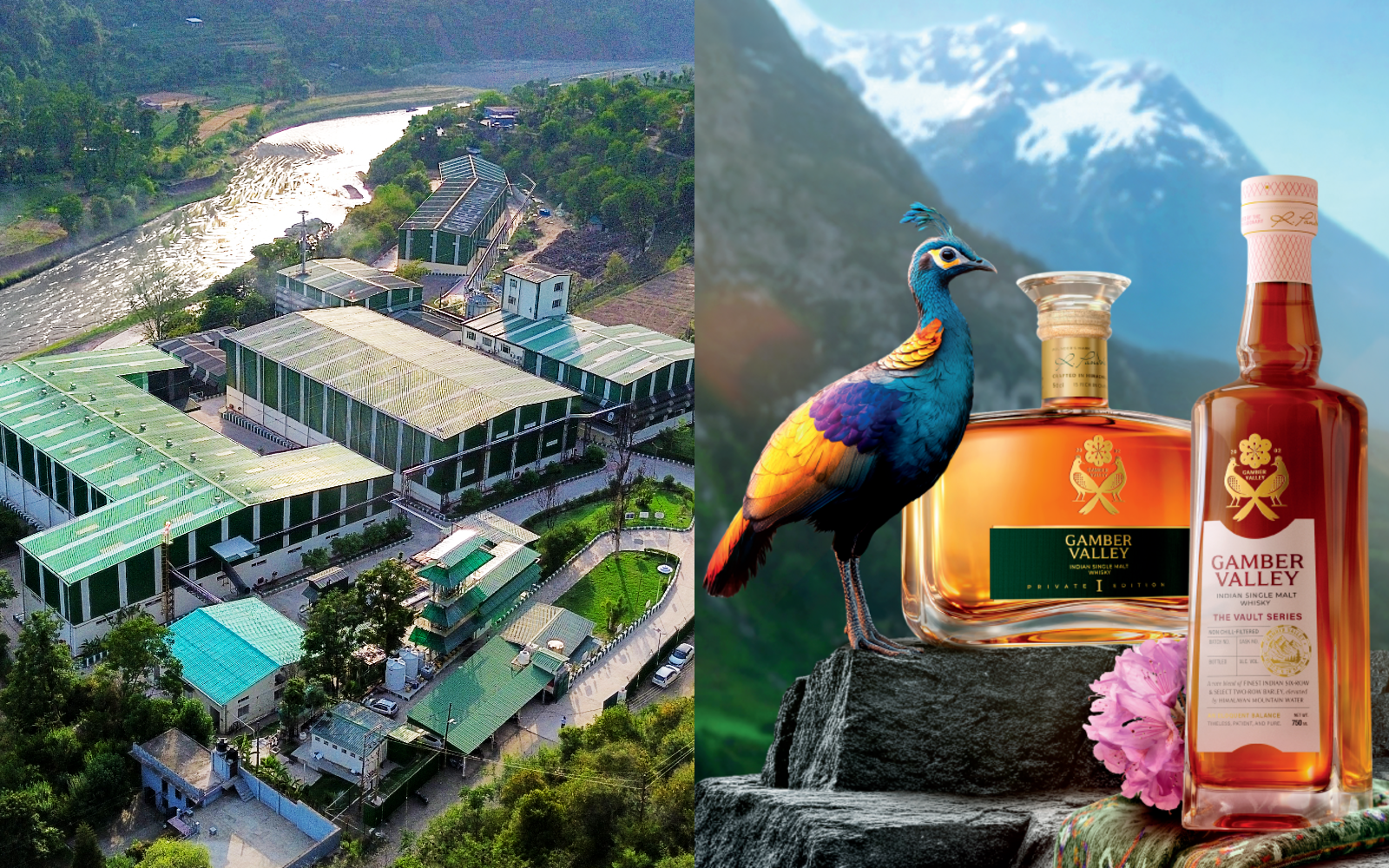
Gamber Valley, the latest entrant on the Indian single malt scene, starts its journey with Private Edition 1, with honey, oak and spice, and the softer Vault Series, with vanilla and a hint of chocolate. (left) the riverside distillery in Solan, Himachal Pradesh. Photos: Alcobrew
A weekend in Solan in Himachal Pradesh, with an unveiling at Orillia Kasauli, takes us inside Alcobrew’s new Indian single malt and the choices behind its flavour. Made and matured at the riverside distillery, Gamber Valley opens with two Indian single malts: Private Edition 1, with honey, oak and spice, and the softer Vault Series, with vanilla and a hint of chocolate.
For many decades, Scotch was the bottle many Indian drinkers wanted on their shelves. We made and drank plenty of whisky ourselves, mostly blends, but an Indian single malt had a harder time being taken seriously. Amrut helped change that when it launched its single malt in Glasgow in 2004, bringing it to the Indian market in 2010.
Paul John, Rampur and, later, Indri gave drinkers more homegrown names to choose from. There is now a growing willingness to try an unfamiliar Indian whisky, to ask where it comes from and what gives it its flavour. Gamber Valley, made by Alcobrew Distilleries India Ltd. in Solan, Himachal Pradesh, is among the newer arrivals hoping to turn that curiosity into a following.
Truth be told, single malt whiskey is an expensive business to enter. For it lies in casks for years before it can be sold, and reaching customers across India means negotiating different state rules and paying substantial fees. Those costs help explain why a bottle made here can still require some thought before buying.
I wanted to understand what went into Gamber Valley beyond its handsome packaging, and a weekend visit to its distillery offered the chance. Leaving Delhi early on a crisp Saturday, morning, I headed towards Solan for a visit that would include an unveiling at Orillia Kasauli, where I was staying the night.
First, though, came the familiar pleasures of the road: paratha and chai at Amrik Sukhdev in Murthal, a stop I regarded as mandatory, followed by lunch at the pretty Haveli Dharampur on the Chandigarh-Shimla highway. By the time we reached Solan, I had eaten well and was ready for the distillery visit.
The high-tech distillery is at Kandla in Solan district and began operating in 2022. Gamber Valley is distilled, matured and bottled at the facility. Alcobrew already has established brands, including White & Blue and Golfer’s Shot; this is its first Indian single malt. The company brings experience and distribution to the venture, though persuading someone to spend several thousand rupees on an unfamiliar malt presents a different challenge from selling a familiar everyday whisky.
Paul John, Rampur and, later, Indri gave drinkers more homegrown names to choose from. There is now a growing willingness to try an unfamiliar Indian whisky, to ask where it comes from and what gives it its flavour. Gamber Valley, made by Alcobrew Distilleries India Ltd. in Solan, Himachal Pradesh, is among the newer arrivals hoping to turn that curiosity into a following.
Truth be told, single malt whiskey is an expensive business to enter. For it lies in casks for years before it can be sold, and reaching customers across India means negotiating different state rules and paying substantial fees. Those costs help explain why a bottle made here can still require some thought before buying.
I wanted to understand what went into Gamber Valley beyond its handsome packaging, and a weekend visit to its distillery offered the chance. Leaving Delhi early on a crisp Saturday, morning, I headed towards Solan for a visit that would include an unveiling at Orillia Kasauli, where I was staying the night.
First, though, came the familiar pleasures of the road: paratha and chai at Amrik Sukhdev in Murthal, a stop I regarded as mandatory, followed by lunch at the pretty Haveli Dharampur on the Chandigarh-Shimla highway. By the time we reached Solan, I had eaten well and was ready for the distillery visit.
The high-tech distillery is at Kandla in Solan district and began operating in 2022. Gamber Valley is distilled, matured and bottled at the facility. Alcobrew already has established brands, including White & Blue and Golfer’s Shot; this is its first Indian single malt. The company brings experience and distribution to the venture, though persuading someone to spend several thousand rupees on an unfamiliar malt presents a different challenge from selling a familiar everyday whisky.
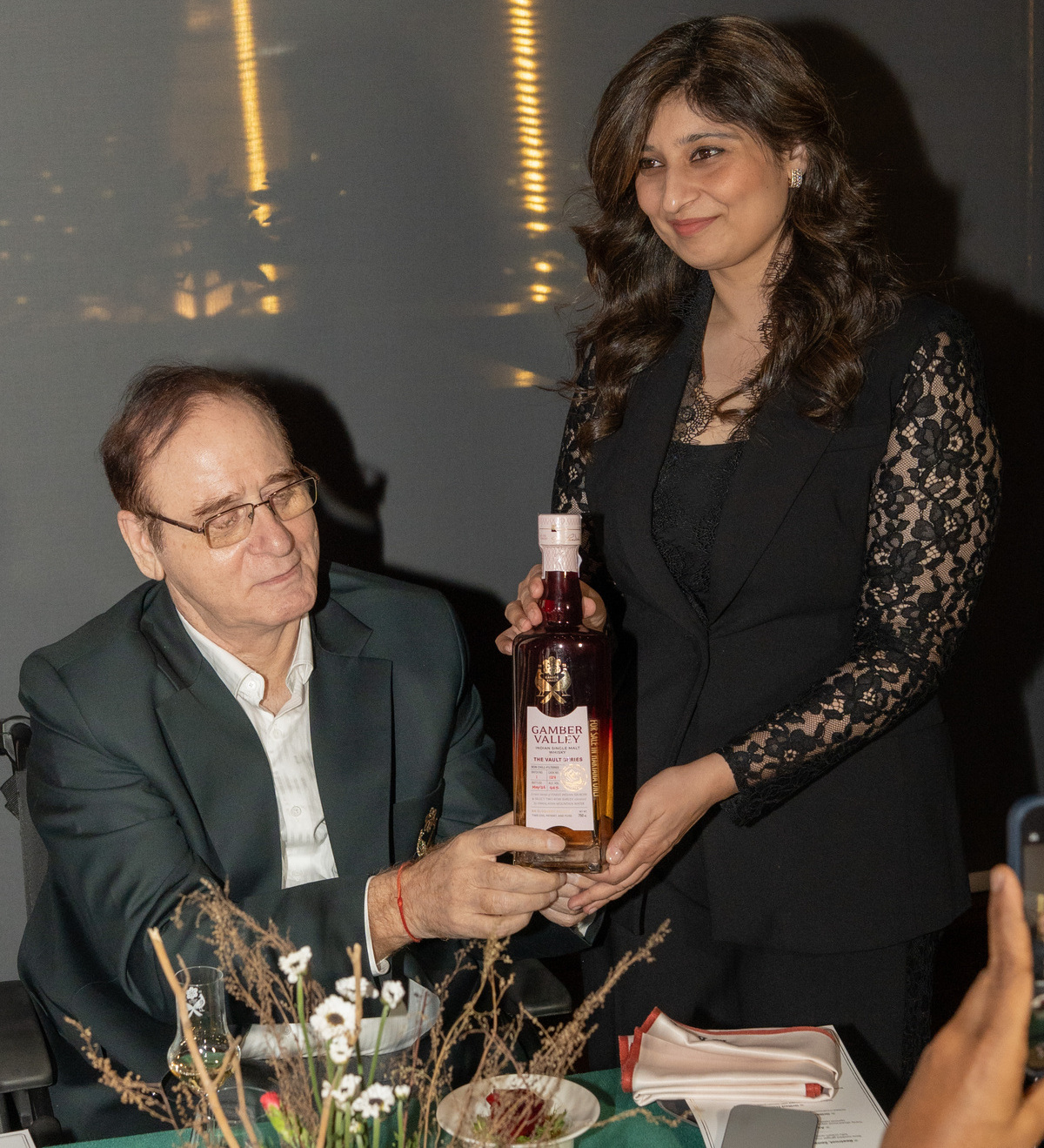
Romesh Pandita, Alcobrew’s founder, Chairman and Managing Director, and Vanessa Pandita, Director of Strategy & Business Development.
The Gambhar River, also spelt Gamber, runs beside the distillery. About 68 km long, it winds through the hills of Himachal Pradesh, passing through Solan district before feeding the Gobind Sagar reservoir in the Satluj basin. Its surrounding valley gives Gamber Valley whisky its name, and Alcobrew distils and matures the spirit here on the riverbank, in the Shivalik foothills. The company says the region’s soft, mineral-balanced water helps fermentation and contributes to the spirit’s character.
On the distillery floor, Assistant Manager Sahil Thakur took me through the journey from malt to new-make spirit. The process starts with malted barley, which is cleaned and milled into grist. It is then mixed with hot water in the mash tun, where the process draws out the fermentable sugars to create wort. Once cooled, the wort moves into one of nine fermentation tanks, where yeast converts those sugars into alcohol. The resulting wash is then distilled twice. The first distillation produces low wines; the second, in the spirit still, is where the different fractions are separated and the desired middle cut, known as the heart, is collected.
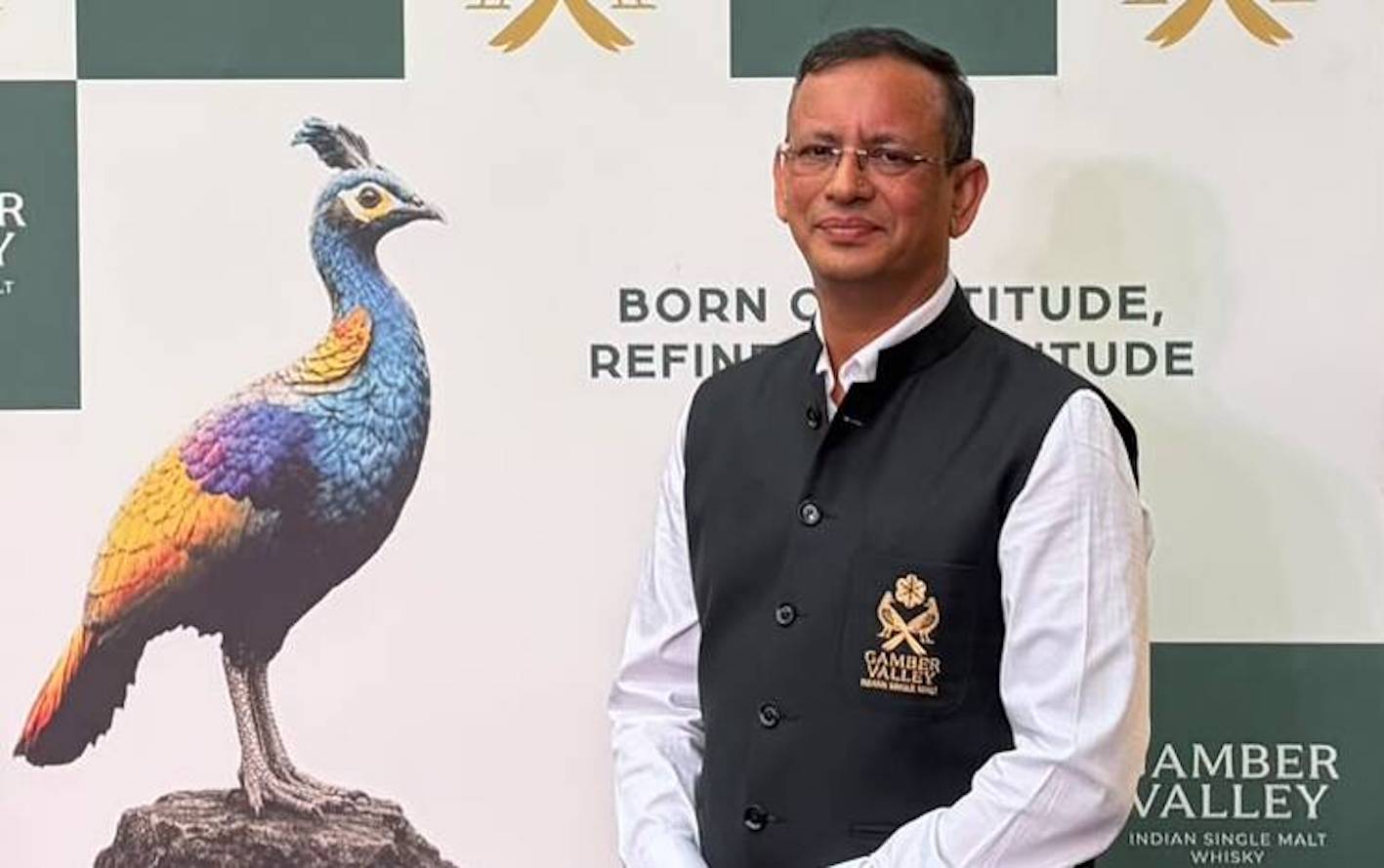
Gamber Valley's Chief Operating Officer Ashutosh Rajput.
Much of the early process is monitored through SCADA, the plant’s supervisory control and data acquisition system, which lets the team track key parameters during milling, mashing and fermentation. Distillation, however, remains manual/operator-led. It is a process where experience matters: the spirit is closely observed and assessed as it emerges from the still, with senior members of the team also involved in evaluating the new-make spirit from individual batches.
There is a practical economy to the process, too. Spent grain finds a second life as cattle feed, while pot ale, the liquid left after the first distillation, goes to the effluent treatment plant. A finished bottle gives little sense of how much has had to be checked and handled along the way. Then comes the longest stage of all: maturation.
The new-make spirit begins its extended relationship with wood, spending years in casks as the character of the whisky develops. At Solan, the changing mountain climate becomes part of that process. Seasonal variations in temperature and humidity influence the interaction between spirit and wood, while evaporation gradually reduces the volume in the cask — the losses that the industry calls the “angel’s share.”
For the team, maturation is ultimately a matter of patience and judgement. The question is not simply how long the spirit has spent in wood, but when it has developed the balance, character and depth its makers are looking for. A mountain setting may provide an evocative backdrop, but the real story is told slowly, inside the cask, one season at a time.
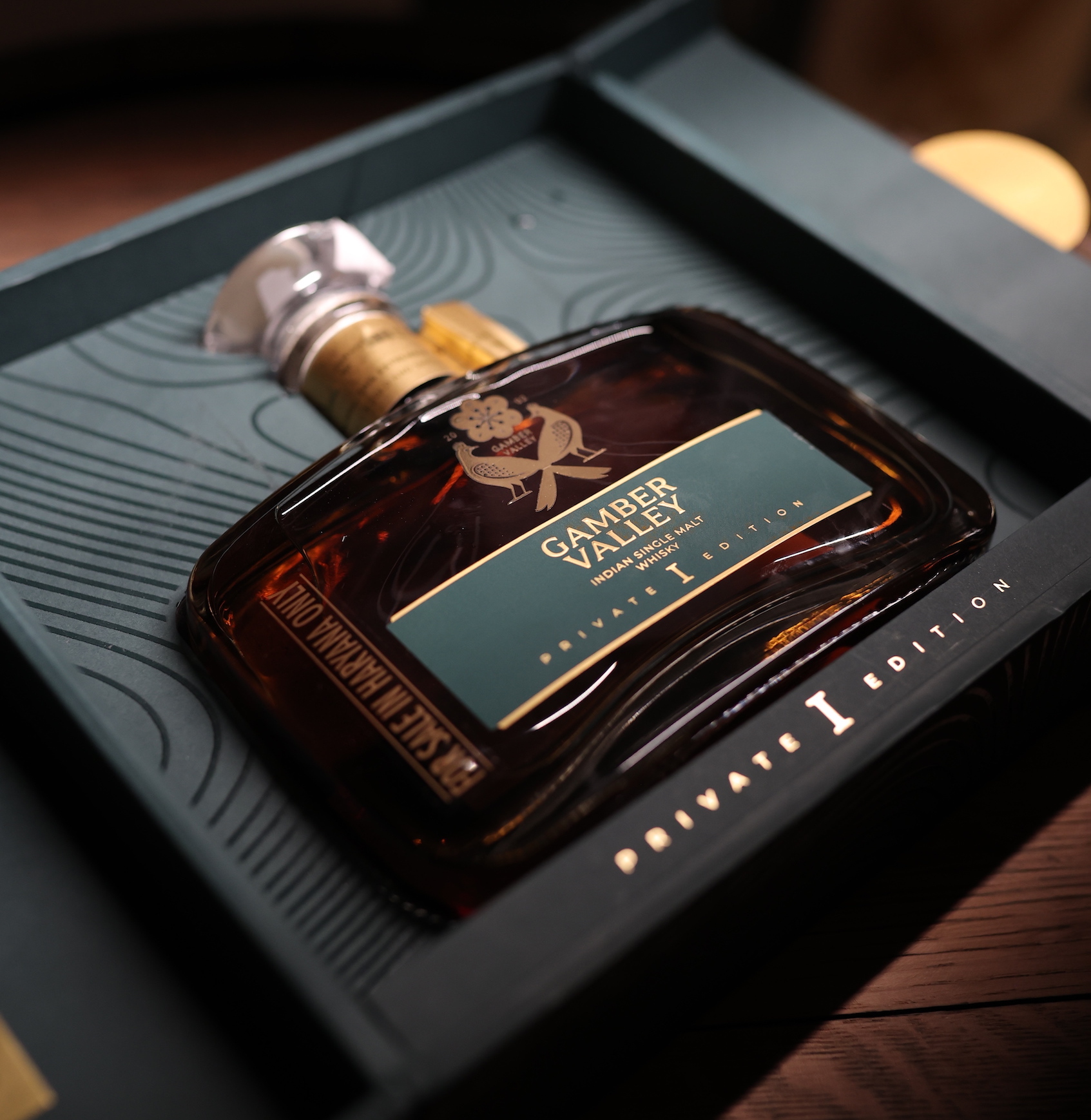
Private Edition 1 is an invitation-only release drawn from four selected virgin-oak casks, with individually numbered bottles.
Our overnight base was Orillia Kasauli, in village Kadhog, near Kanda. Its stone building and surrounding pines made a welcome change from the highway. Outside, wicker chairs stood on the lawns; red cushions brightened the seating beneath a wooden gazebo. This was also where the tasting session of Gamber Valley’s virgin-oak Private Edition 1 and The Vault Series happened . Chief Operating Officer Ashutosh Rajput, Vanessa Pandita, Alcobrew’s Director of Strategy & Business Development, and Category Manager Rishabh Bhatia were generous hosts, happy to let questions lead into longer conversations.
At the tasting session, I spoke to Ashutosh about everything from the wood used for maturation to the rather less romantic business of excise costs. The tour had given me more specific questions to ask, including why the company had chosen Solan.There was a family connection. Vanessa studied economics and management at the University of St Andrews in Scotland.
At the tasting session, I spoke to Ashutosh about everything from the wood used for maturation to the rather less romantic business of excise costs. The tour had given me more specific questions to ask, including why the company had chosen Solan.There was a family connection. Vanessa studied economics and management at the University of St Andrews in Scotland.
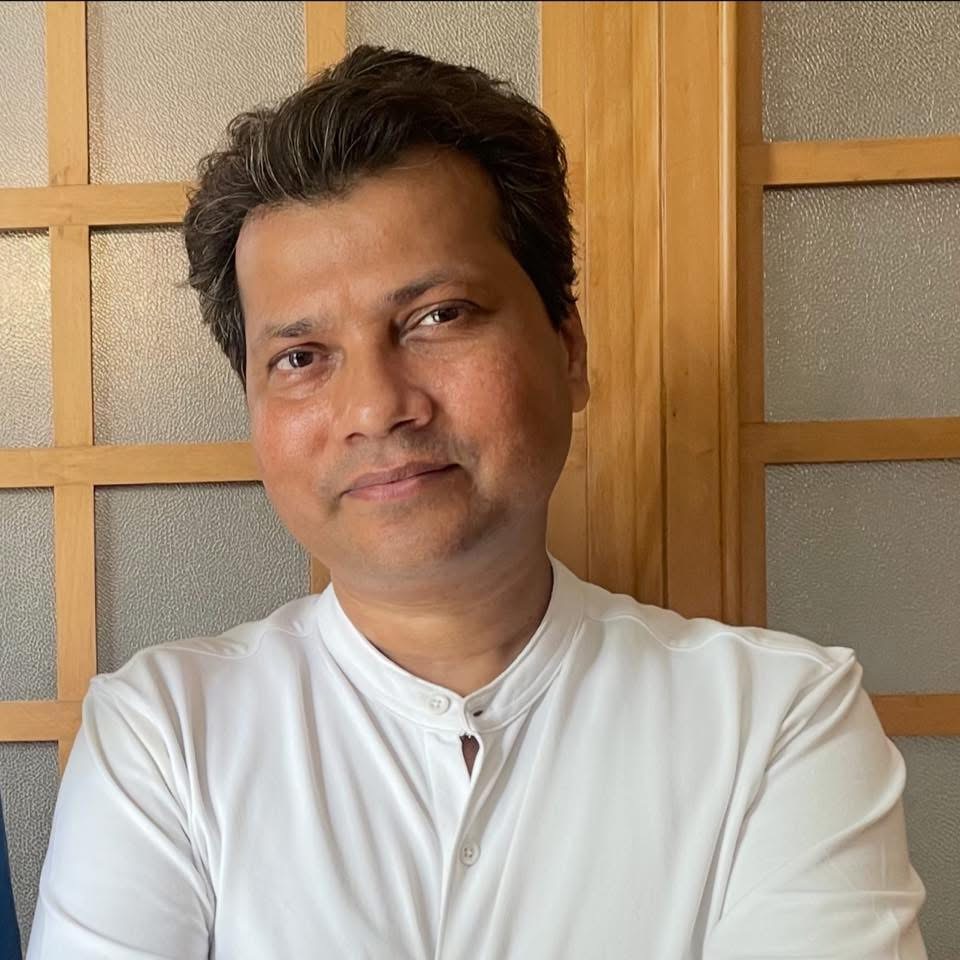
Her father, Romesh Pandita, Alcobrew’s founder, Chairman and Managing Director, visited Scottish distilleries while travelling there to see his daughter. Those encounters helped set him thinking about an Indian single malt. Ashutosh also spoke of Romesh’s Kashmiri background and his attraction to Himachal as the place to build the distillery. The choice had a personal pull as well as a business rationale.
Also read: At JW Marriott Aerocity’s K3, The Caspian Table brings a taste of Baku and Tbilisi to Delhi
Ashutosh recalled research the company had done years earlier in which consumers did not associate Scotch with Scotland. “Scotch is seen as something imported, something good,” he said. He also felt that drinkers did not always understand what age statements told them about a whisky.
I also asked him about the frequent comparison between the time whisky spends ageing in India and in Scotland. He was reluctant to turn faster maturation into the brand’s principal argument. His preference was for people to taste the whisky, ideally without being led by a label. In a blind tasting alongside some 12- or 15-year-old whiskies, he suggested, drinkers might not find much difference. Longer ageing in Indian conditions, he pointed out, can bring greater intensity and substantial evaporation losses.
Tasting the two whiskies brought us back to the choice of casks. Private Edition 1 is an invitation-only release drawn from four selected virgin-oak casks, with individually numbered bottles. Virgin oak has held no previous spirit. The Vault Series, the other opening expression, uses selected ex-bourbon casks. That difference in the wood’s history is the good starting point for understanding the two whiskies.
Ashutosh recalled research the company had done years earlier in which consumers did not associate Scotch with Scotland. “Scotch is seen as something imported, something good,” he said. He also felt that drinkers did not always understand what age statements told them about a whisky.
I also asked him about the frequent comparison between the time whisky spends ageing in India and in Scotland. He was reluctant to turn faster maturation into the brand’s principal argument. His preference was for people to taste the whisky, ideally without being led by a label. In a blind tasting alongside some 12- or 15-year-old whiskies, he suggested, drinkers might not find much difference. Longer ageing in Indian conditions, he pointed out, can bring greater intensity and substantial evaporation losses.
Tasting the two whiskies brought us back to the choice of casks. Private Edition 1 is an invitation-only release drawn from four selected virgin-oak casks, with individually numbered bottles. Virgin oak has held no previous spirit. The Vault Series, the other opening expression, uses selected ex-bourbon casks. That difference in the wood’s history is the good starting point for understanding the two whiskies.
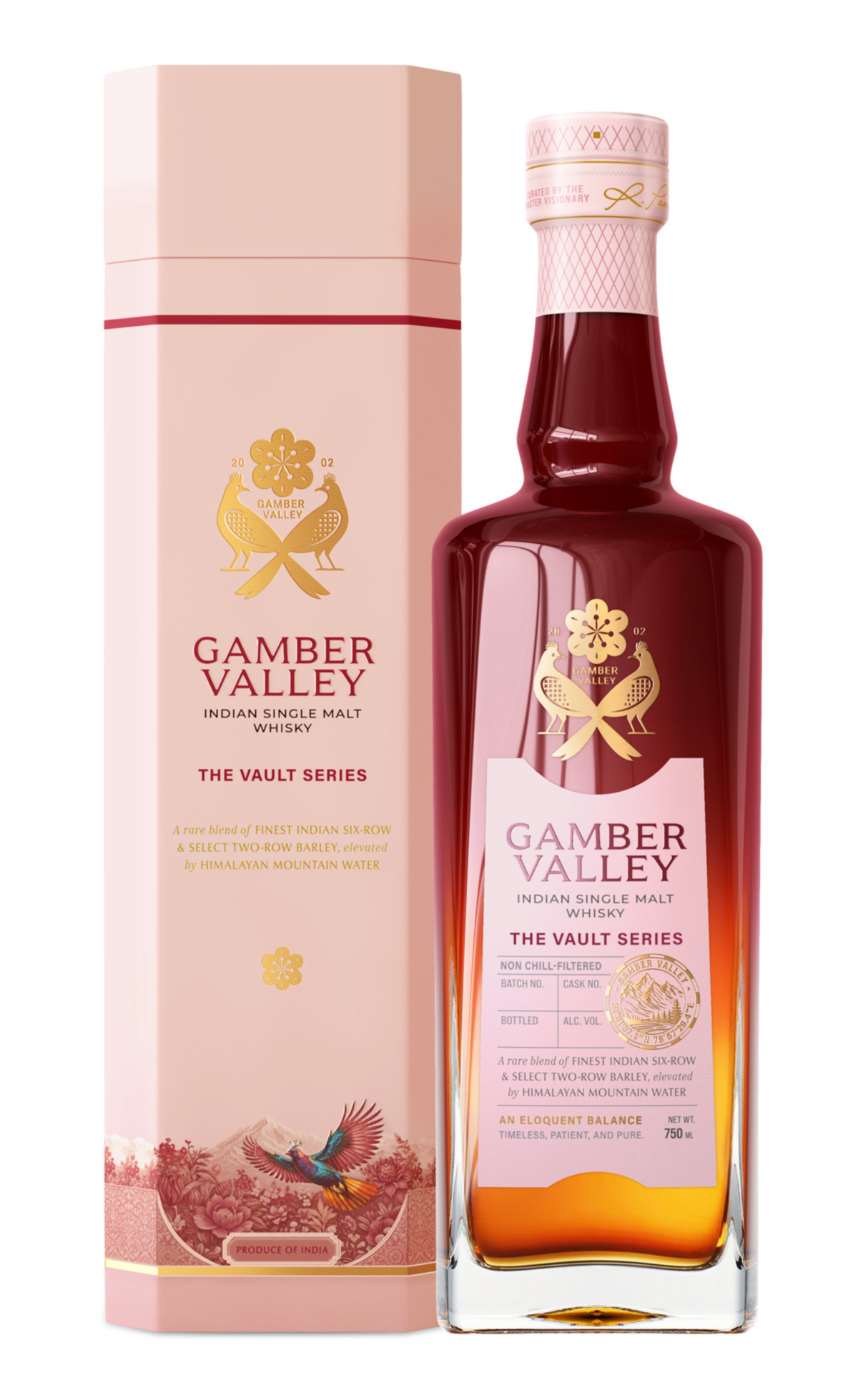
The Vault Series is gentler in its profile, with vanilla and honey, delicate malt, then sweetness touched by spice and light chocolate.
The virgin-oak expression has the more assertive character. Its tasting profile runs through honey and vanilla, with caramel and light dried fruit on the nose; malt sweetness is followed by a hint of spice and oak on the palate. What pleased me most was the finish, which I remarked on to Ashutosh: smooth, warm and lingering. It was a whisky you could enjoy neat, with the option of a few drops of water. The Vault Series is gentler in its profile, with vanilla and honey, delicate malt, then sweetness touched by spice and light chocolate.
Both are bottled at 46 per cent alcohol by volume (ABV). Private Edition 1, the virgin-oak expression, comes in a 500 ml bottle, with prices ranging between Rs 13,000 and Rs 16,000. The Vault Series is 750 ml, priced at Rs 7,000 to Rs 10,000. The different bottle sizes are worth noticing when comparing prices: the private release is substantially more expensive for the amount of whisky you receive.
Ashutosh said the liquid had helped determine its presentation. On tasting the virgin-oak whisky, he had felt that “this is something which is very special, which is very unique”. The packaging needed to reflect that conviction. He described a process of trying and refining ideas with the leadership and marketing teams, drawing on their accumulated experience. “It’s been a team effort,” he said.
The logo design makes its regional references quite specific. Two Himalayan monals, the state bird, face each other in the brand mark, with a pink rhododendron, or buransh, at its centre. Patterns inspired by Himachali weaving are worked into the elusive, rarely-sighted birds of the higher mountains, whose males have striking, iridescent plumage, bringing the region’s craftsmanship into the design. Its place on the label ties the whisky to the region. The private release’s forest-green presentation box and decanter-style bottle give it a formal presence. An accompanying note, titled The Ritual and signed by Romesh, asks the drinker to uncork it slowly. I was more interested in what followed the uncorking, though the references to Himachal now made sense to me.
Ashutosh also spoke about two forthcoming expressions: Pravaah and Tapah. While the former is a nod to the flow of life and the latter to the heat and smoke of a peated whisky. The team had been thinking about how an Indian single malt ought to introduce itself. Why reach automatically for names that sound Scottish? they wondered. When I raised the possibility of overseas drinkers finding Indian names difficult to pronounce, his answer was succinct: “We buy Yamazaki.” Yamazaki, of course, is the House of Suntory’s flagship Japanese single malt. It comes from Japan’s first and oldest malt whisky distillery, founded in 1923 in Yamazaki, near Kyoto. Ashutosh’s point was fair: drinkers are quite capable of learning the name of something they want.
Both are bottled at 46 per cent alcohol by volume (ABV). Private Edition 1, the virgin-oak expression, comes in a 500 ml bottle, with prices ranging between Rs 13,000 and Rs 16,000. The Vault Series is 750 ml, priced at Rs 7,000 to Rs 10,000. The different bottle sizes are worth noticing when comparing prices: the private release is substantially more expensive for the amount of whisky you receive.
Ashutosh said the liquid had helped determine its presentation. On tasting the virgin-oak whisky, he had felt that “this is something which is very special, which is very unique”. The packaging needed to reflect that conviction. He described a process of trying and refining ideas with the leadership and marketing teams, drawing on their accumulated experience. “It’s been a team effort,” he said.
The logo design makes its regional references quite specific. Two Himalayan monals, the state bird, face each other in the brand mark, with a pink rhododendron, or buransh, at its centre. Patterns inspired by Himachali weaving are worked into the elusive, rarely-sighted birds of the higher mountains, whose males have striking, iridescent plumage, bringing the region’s craftsmanship into the design. Its place on the label ties the whisky to the region. The private release’s forest-green presentation box and decanter-style bottle give it a formal presence. An accompanying note, titled The Ritual and signed by Romesh, asks the drinker to uncork it slowly. I was more interested in what followed the uncorking, though the references to Himachal now made sense to me.
Ashutosh also spoke about two forthcoming expressions: Pravaah and Tapah. While the former is a nod to the flow of life and the latter to the heat and smoke of a peated whisky. The team had been thinking about how an Indian single malt ought to introduce itself. Why reach automatically for names that sound Scottish? they wondered. When I raised the possibility of overseas drinkers finding Indian names difficult to pronounce, his answer was succinct: “We buy Yamazaki.” Yamazaki, of course, is the House of Suntory’s flagship Japanese single malt. It comes from Japan’s first and oldest malt whisky distillery, founded in 1923 in Yamazaki, near Kyoto. Ashutosh’s point was fair: drinkers are quite capable of learning the name of something they want.
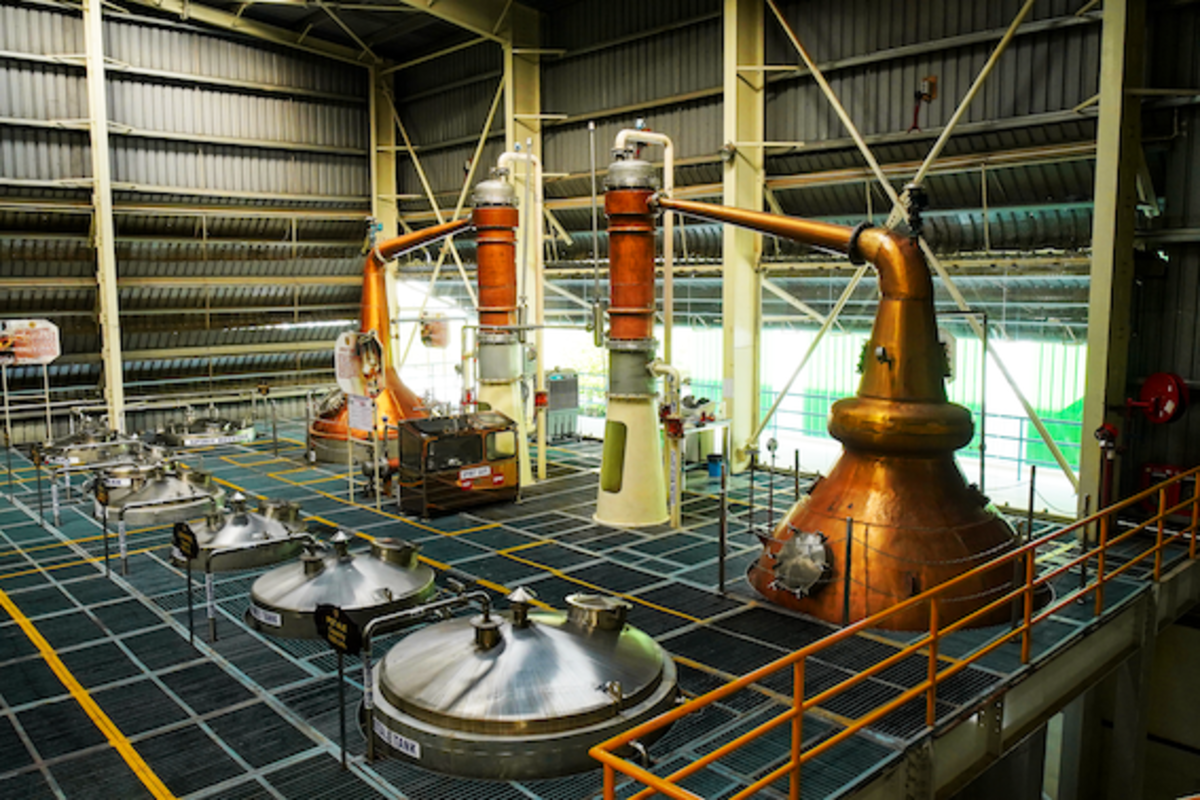
The first distillation produces low wines; the second, in the spirit still, is where the different fractions are separated and the desired middle cut, known as the heart, is collected.
He was generous towards other Indian producers. Amrut, he said, deserved particular respect for taking Indian single malt to the world when the idea had little recognition. He admired Indri’s confidence in its Indian identity and its connection to the place where it is made. The award-winning single malts Paul John and Godawan came into the discussion, too, along with GianChand. Paul John is made by John Distilleries in tropical Goa; Godawan is Diageo India’s whisky from Alwar, Rajasthan. GianChand comes from DeVANS Modern Breweries in Jammu. He saw a category still finding its way, with producers pursuing different approaches. “Everyone is learning, everyone is experimenting,” he said.
I liked that willingness to acknowledge the people who had made the market possible. It also led to a useful distinction. A company can study another brand’s positioning and learn from its marketing; flavour, Ashutosh said, is much harder to understand and control. His starting point was the whisky his own distillery produces and where it might find an audience.
There is room for more drinkers, in his view. He described Indian single malt as a relatively small segment with considerable scope to grow, helped by rising spending power and greater willingness to experiment. He also thought some consolidation might follow as the category matured. Some of the people I spoke to during the visit had little previous experience of whisky. Their interest made me question how much of the category’s supposed exclusivity comes from the way it is talked about. A newcomer should be able to say what they enjoy without first acquiring a specialist vocabulary.
I also raised the assumption that women are not whisky drinkers. It seemed to me that the useful ambition was to make the tasting welcoming. There is little to be gained by replacing the old masculine image of whisky with another set of instructions about what women should like. People can make up their own minds once they are given the chance to taste.
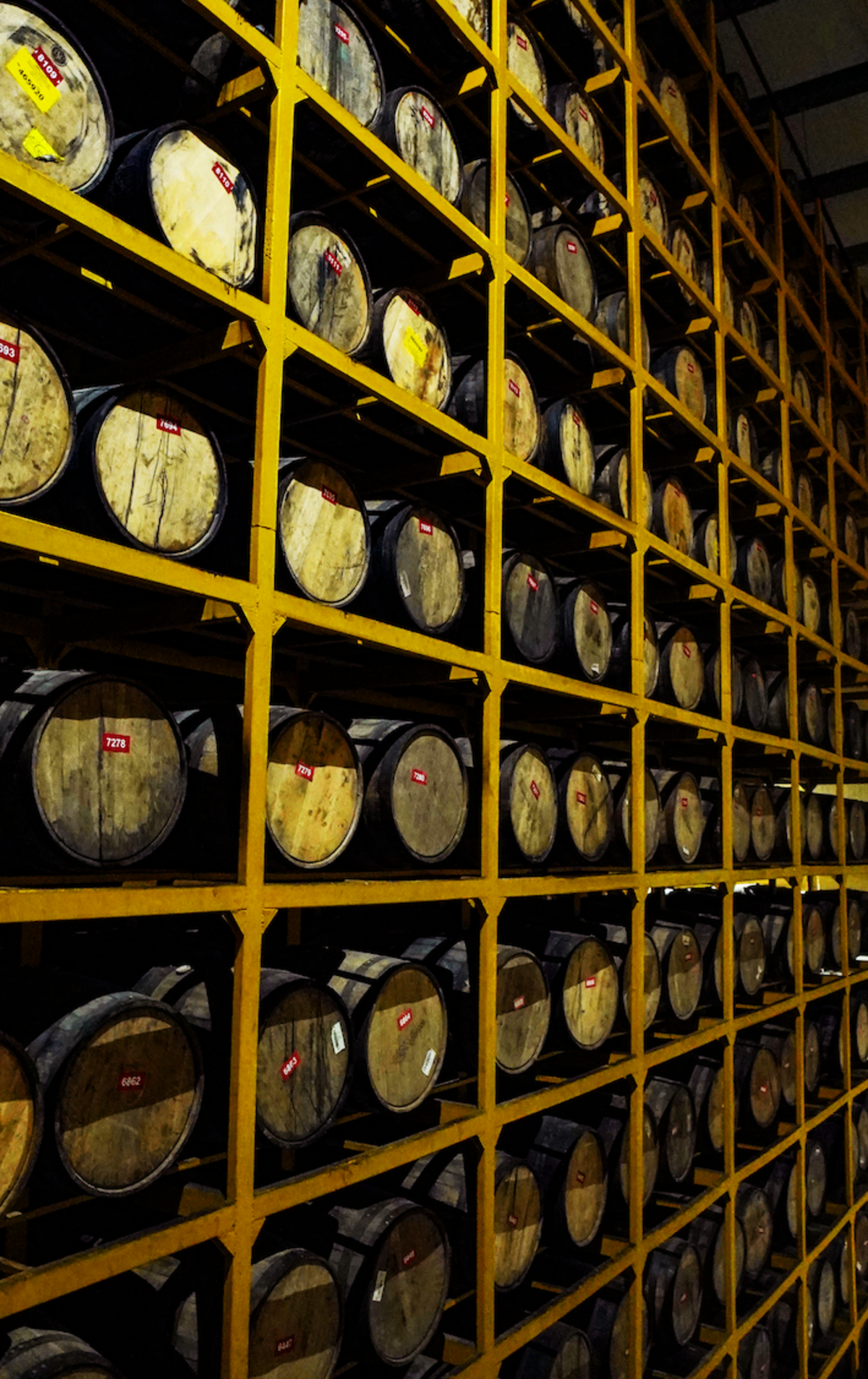
The casks kept at Gamber Valley's distillery in Solan.
Gamber Valley plans to go beyond the obvious metropolitan markets. He mentioned Chandigarh and Lucknow, as well as Jaipur and Bhubaneswar, as places where he sees potential for premium Indian spirits. The June launch announcement had named Haryana, Uttar Pradesh and Chandigarh as the initial markets, with expansion planned to Rajasthan, Odisha, Maharashtra, Karnataka and Delhi NCT for upcoming expressions. Reaching these drinkers will require patient distribution work. For someone persuaded to try it, the next question is whether they can find a bottle close to home.
That brought us to excise. “There is a high annual fixed cost of doing business for a brand,” Ashutosh said. For a young label selling limited quantities, he argued, that burden can be difficult to absorb. He would like smaller, higher-priced products to receive some breathing room while they establish themselves. The immediate revenue for excise departments, he acknowledged, will continue to come from mass-volume brands. His question was how the system might also allow a future premium category to develop. Once those brands reached sufficient scale, he felt, they would be better placed to meet the usual requirements.
Also read: ‘We want Coffee Island Beyond to become part of your routine’: Vita Nova Group CEO Amitabh Negi
He was equally frank about awards. International recognition can help reassure a producer that its work stands up alongside established whiskies. But Ashutosh felt the sheer proliferation of medals had weakened their usefulness as a message to consumers. “We are very picky about which awards we want to get associated with,” he said. Hearing that at a whisky unveiling was refreshing. A medal may prompt a first purchase, but enjoying the whisky is what makes someone buy it again.
Overseas distribution remains part of the plan. Ashutosh spoke about identifying key markets and the credibility that comes with being stocked by respected retailers abroad. For an unfamiliar Indian whisky, that could reassure buyers about its quality and consistency. It seemed to interest him more than another medal on the label.
For Alcobrew, the next two or three years will be all about focusing on establishing Gamber Valley and building on it. It has simultaneously been working with more familiar Indian flavours in its One More Next vodka range, too. Its latest release, Twisty Minty Jamun, pairs the tart, earthy taste of jamun with a mint finish. It has launched in Uttar Pradesh and Haryana, where the company already sells its cranberry variant, with Punjab and Chandigarh planned next. Ashutosh also mentioned work in flavoured and coloured spirits, but his commitment to the malt was clear: “For us, this is the brand for the future of the company.”
For anyone used to heading straight for the Scotch, the Indian whisky shelf now deserves a little bit of thinking. Gamber Valley has to earn its following, especially at these prices, but single malt enthusiasts would love having another contender to consider. Romesh Pandita is 72 and has spent more than four decades in the spirits business. He wasn’t at the distillery when I visited, though his wager on Solan was there in the whisky maturing on the distillery site. His larger ambition for Gamber Valley is to build a luxury Indian single malt with a recognisable Himachali identity. But he is poised it to find scores of drinkers far beyond those hills. John Denver wanted the country roads to take him home. Pandita wants the whisky to head the other way and take a little of home with it.
The writer travelled as a guest of Alcobrew Distilleries India Ltd.
More from Culture



Comments
*Comments will be moderated