








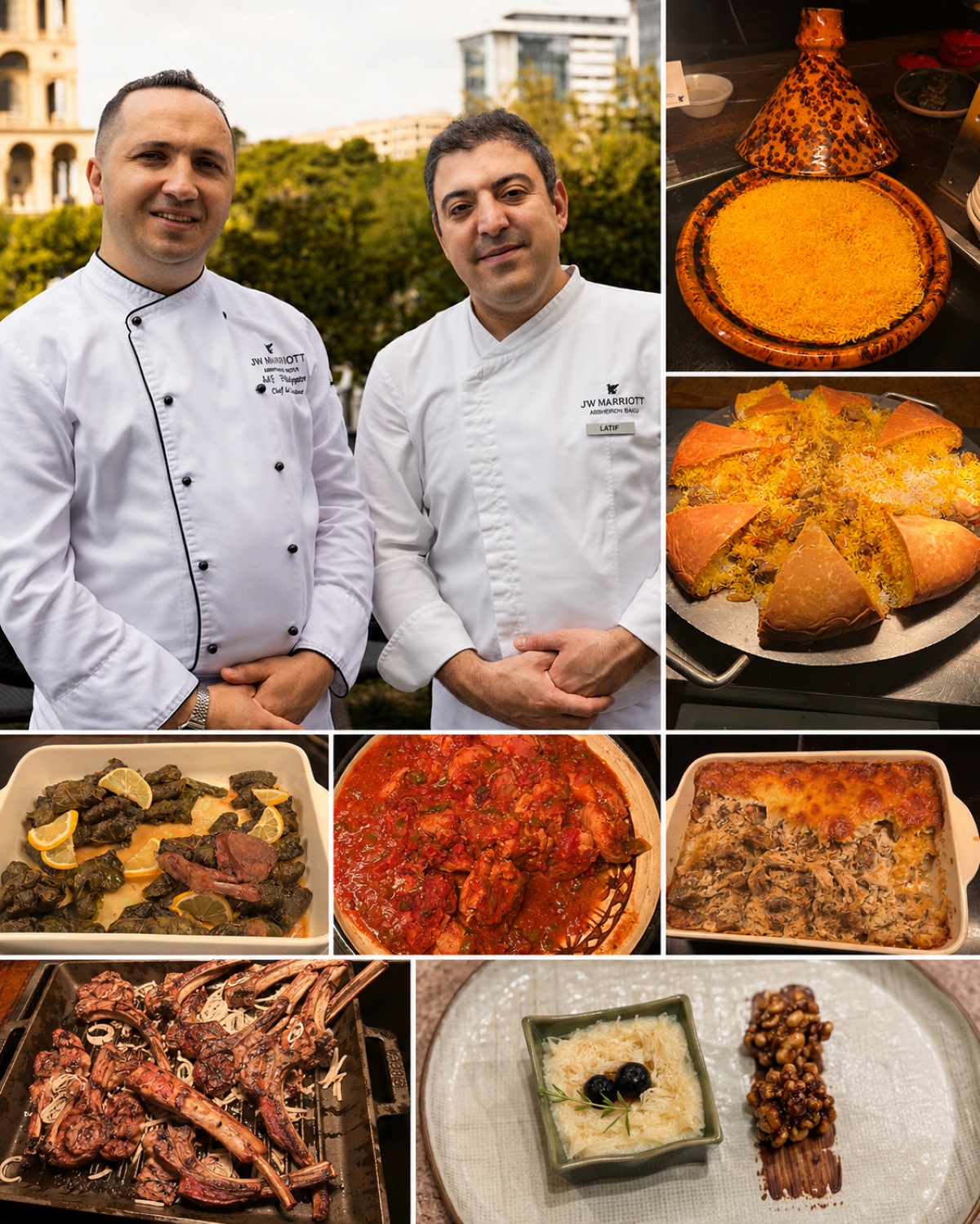
(clockwise from left); Chef Asif Hidayetov and Chef Latif Meybullayev; saffron rice; Shah Plov, the crown jewel of Azerbaijani cuisine; saffron rice, slow-cooked meat (lamb), roasted chestnuts, and sweet dried fruit, with crispy, golden bread crust (gazmag) made from lavash; Mushroom with chicken, baked mushroom topped with chicken and melted Suluguni cheese; Gozinaki, caramelised walnuts bound into honey, and Sutlac, Azerbaijan-style rice pudding; lamb kebab; Yarpaq Dolma, vine leaves stuffed with seasoned minced lamb and rice; and Chakhokhbili, Georgian Chicken Stew prepared with tomatoes, onion, herb and traditional spices.
For five days, JW Marriott New Delhi Aerocity’s K3 turns its attention to Georgia and Azerbaijan, with visiting chefs Asif Hidayetov and Latif Meybullayev bringing breads, grills, stews, saffron rice, herbs and the generous food of the Caucasus to the table
At The Caspian Table at K3 — New Delhi’s Food Theatre, JW Marriott New Delhi Aerocity’s all-day restaurant, the draw for me — a foodie given to relishing all sorts of authentic cuisines from around the world — was simply the sight of the food: a pot of chicken simmering in a thick red sauce, saffron rice glowing yellow under a crisp lavash crust, lamb coming hot from the grill, vine leaves packed with meat and rice, a bowl of yoghurt soup flecked with herbs. The names (at least some of it) may not all be familiar in Delhi, but the food has an ease about it. You look at it and know roughly where you want to begin.
Running from August 19 to 23, the five-day showcase brings together the food of Georgia and Azerbaijan, with visiting chefs Asif Hidayetov and Latif Meybullayev from JW Marriott Absheron Baku leading the menu. K3 is a natural setting for it. The restaurant is known for the live kitchens and a regular spread (comprising Indian, pan-Asian and Mediterranean cuisines), chefs at the counters, breads coming out hot, grills going, diners wandering back for “just one more thing”. For these few days, that familiar K3 energy has been given a Caucasian turn.
I was witness to how Chefs Hidayetov and Meybullayev, guided by Chef Anuraag Narsingani, Director of Culinary at JW Marriott New Delhi Aerocity, used that theatre well, bringing in the breads, grilled meats, herbs, slow-cooked dishes and wonderfully unfamiliar sweets of their part of the world, from pakhlava and shekerbura to gata and churchkhela. The menu changes through the run, which is a smart decision. It gives the chefs more room to show the range of these cuisines rather than reducing them to five or six recognisable dishes repeated every evening.
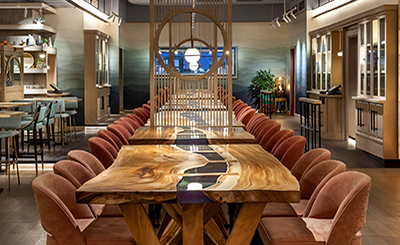
For The Caspian Table, Marriott has added a little atmosphere without going overboard. Near the entrance are carpets, pottery, copper-toned pieces, candles and visual references to Georgia and Azerbaijan. Georgian music plays in the background. Baku and Tbilisi appear in photographs and design details. It is enough to tell you that something different is happening without making the room look like a film set. The food does the rest. Chakhokhbili, the Georgian chicken stew, was one of the dishes I went back to. Chicken is cooked with tomatoes, onions, herbs and seasoning until the sauce becomes thick, bright and deeply savoury. It is the sort of dish that feels familiar even when you have never eaten it before.
Shah Plov, or Shah Pilaf, was hard to walk past without stopping. The rice comes enclosed in a crisp shell of lavash, giving the whole thing the look of a golden crown. Cut through it and you get saffron rice, lamb, roasted chestnuts and dried fruit. It has richness, sweetness and crunch in the same mouthful. Of everything on the spread, it has enough flavour to justify the appearance. The rice itself deserves a mention. Saffron rice, served separately too, was fragrant without being weighed down by too much spice. That restraint runs through a lot of the food here. Delhi diners are used to kebabs, rice, breads and stews, so the basic vocabulary may feel close to home, but the seasoning often takes a gentler route.
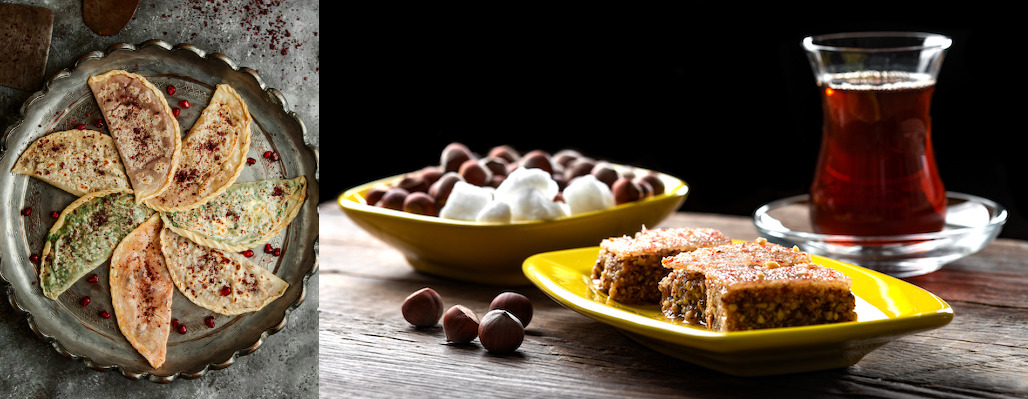
Qutab, a traditional dish in Azerbaijani cuisine, made from thinly rolled dough that is filled with a variety of ingredients and cooked briefly on a convex griddle called a saj; Pakhlava, a layered pastry dessert made of filo pastry, filled with chopped nuts, and sweetened with either syrup or honey; it's the Armenian and Central Asian version of baklava, a poor version of which is now available in the Indian market.
Dovga is a good example. The Azerbaijani yoghurt soup, made with rice and herbs, is light, sour and soothing. It works particularly well in a meal where lamb, cheese, bread and grilled fhood are never far away. At the other end of the soup spectrum is kharcho, a Georgian lamb soup with rice, herbs and spices. It is fuller, warmer and more robust, two bowls that tell you quite a lot about the range of the region. The starters carry the same mix of freshness and substance. The menu includes chicken satsivi salad, with walnut sauce, garlic, saffron and herbs; mimosa salad, layered with tuna, potato, carrot, egg and cheese; eggplant rolls filled with walnuts and herbs; and red bean pkhali, where beans meet walnuts and Georgian seasoning.
Walnuts appear often, and that is one of the small things that begins to distinguish the food after you have been eating for a while. They bring richness without making everything creamy or heavy. Herbs are equally important. They are not there merely as garnish; they keep turning up inside fillings, soups, stews and salads. I liked the Yarpaq Dolma, listed on the menu as Yarpaq Sarmasi, vine leaves wrapped around a filling of seasoned meat and rice. It is a compact little dish, but it carries a lot of flavour. There is something satisfying about the contrast between the slightly sharp vine leaf and the soft, savoury filling inside.
The lamb kebab is more direct. Meat, grill, smoke. No elaborate explanation required. Delhi knows kebabs well, which makes this an interesting point of comparison. What I enjoyed was that the meat was not buried under seasoning. You still tasted lamb first. Another dish that quietly disappeared from my plate faster than expected was mushroom with chicken: baked mushrooms with chicken and melted Suluguni cheese. It is rich, certainly, but also hard to resist. The cheese gives it a salty, stretchy finish, while the mushrooms keep it earthy. Alongside it, potatoes with mushrooms, sautéed with herbs and spices, offered a simpler vegetarian counterpoint.
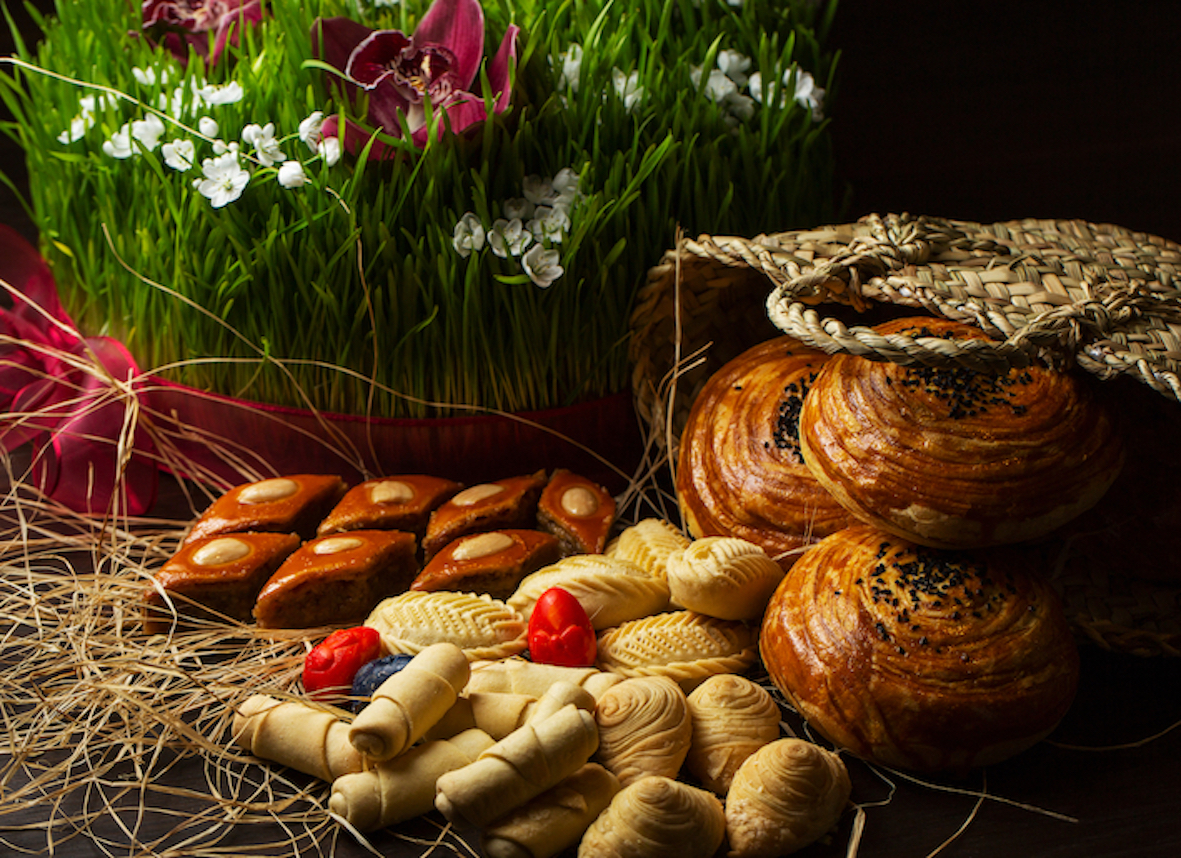
Novruz sweets. During Novruz in Azerbaijan, the most famous treats include diamond-shaped Pakhlava, half-moon Shekerbura, multi-layered Gogal, almond-filled Badambura, and rolled Mutaki.
There was also a Georgian spiced roasted chicken, one of the chef’s signature preparations. This was less saucy than the chakhokhbili and more about the roast itself: browned edges, juicy meat and spice that stayed in the background rather than taking over. Other dishes rotate through the festival: qutab, khinkali, piti, baked fish, Caspian Sea fish with herbs, Saj mixed grill, khachapuri, lavash, shashlik and lyulya kebabs. That changing menu is one of the reasons the five-day format works. You could come on two different evenings and not necessarily eat the same meal twice.
The live stations are especially suited to food like this. Bread should be hot. Kebabs should not sit around. A khachapuri is at its best when the dough, cheese and heat still feel fresh. K3’s format lets much of this happen close to the diner rather than somewhere behind a closed kitchen door.
Also read: ‘We want Coffee Island Beyond to become part of your routine’: Vita Nova Group CEO Amitabh Negi
The drinks have been thought through, too. The special menu relies on ingredients that make sense with the food: pomegranate, saffron, citrus, mint, basil, pear and cardamom. Cocktail names include Caspian Pearl, Persian Tide, Sour of Baku, Caspian Garden and Silk Road Spritz, while the non-alcoholic side has drinks such as Caspian Rose Fizz, Baku Citrus Breeze, Azerbaijan Sunset and Caspian Mint Sharbat. All these flavours are sensible companions to the meal.
Dessert moves away from the usual hotel buffet comfort zone as well. Depending on the day, there may be pakhlava, shekerbura, gata, churchkhela, gozinaki or sütlaç. Nuts, honey, pastry and fruit appear in different combinations, and the sweets feel connected to the rest of the meal rather than tacked on at the end.
What I liked most about The Caspian Table was that it did not try too hard to make the food exotic. Georgia and Azerbaijan are not cuisines most Delhi diners encounter every week, but the chefs let the food speak in a language that is surprisingly easy to understand: bread, rice, lamb, chicken, yoghurt, herbs, nuts, fruit, fire. There are familiar echoes everywhere, but the details are different enough to keep you curious.
And perhaps that is the best reason to go. With the menu changing every day, one evening might be about chakhokhbili, saffron rice and lamb from the grill; another could take you towards khinkali, khachapuri, piti or fish. Five days is not enough to understand two cuisines, but it is certainly enough to make you want to know them better.
(The Caspian Table is on at K3, JW Marriott New Delhi Aerocity, from August 19 to 23, 2026. Dinner begins at 7 pm; Sunday brunch runs from 12.30 pm to 3.30 pm)
More from Culture

Comments
*Comments will be moderated