








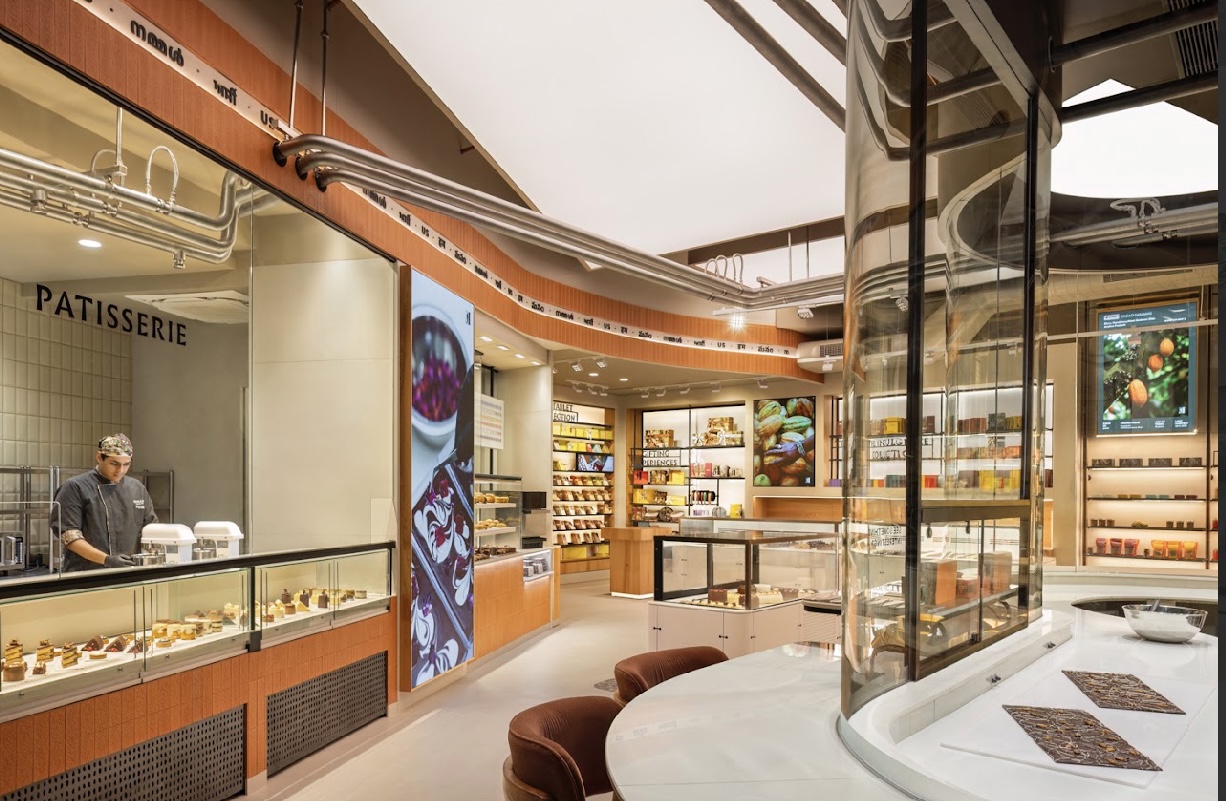
Manam Chocolates’ newly opened experiential outpost at Eldeco Centre in New Delhi. Photos: Manam Chocolates
At the newly opened experiential outpost in New Delhi’s Eldeco Centre, the Hyderabad-based craft chocolate house fuses origin, artistry, and innovation, transforming cacao into an immersive, multi-sensory experience that proves Indian chocolate is ready for its next chapter
At Delhi’s Eldeco Centre, the first thing that hits you is the unmistakable aroma of pure cacao, circulating through tanks, slipping into pastries, infusing drinks, and anchoring an entire space designed to prove that chocolate in India is ready for a new story. This is Manam Chocolates, the Hyderabad-born craft chocolate house founded by Chaitanya Muppala in 2023. Within just a year, its Hyderabad “Karkhana” earned a spot on TIME magazine’s list of the World’s Greatest Places 2024. Now, with the launch of its expansive 3,200 sq. ft. experiential retail centre in Delhi, Manam is making an audacious statement: chocolate in India can, and should, be more than a purple-wrapped bar.
“We want people to get the impression that chocolate is not limited to what we have always seen,” says Ruby Islam, Head Chef at Manam. “It actually has expressions far beyond something pre-packed in purple covers, the likes of Dairy Milk and Galaxy. When you walk in here, you find different pockets of experience. We’ve got melting tanks cooling chocolate through pipelines and depositing it into the kitchens — pastry, beverage bar, and the chocolatery itself. There’s an array of bonbons, truffles, bars, a snacking collection, a gifting collection, and even a tablet section. It’s to help people realise that chocolate, whether for gifting or self-indulgence, is not limited to candy. It has so many different forms, textures, and ingredients.”
.jpg)
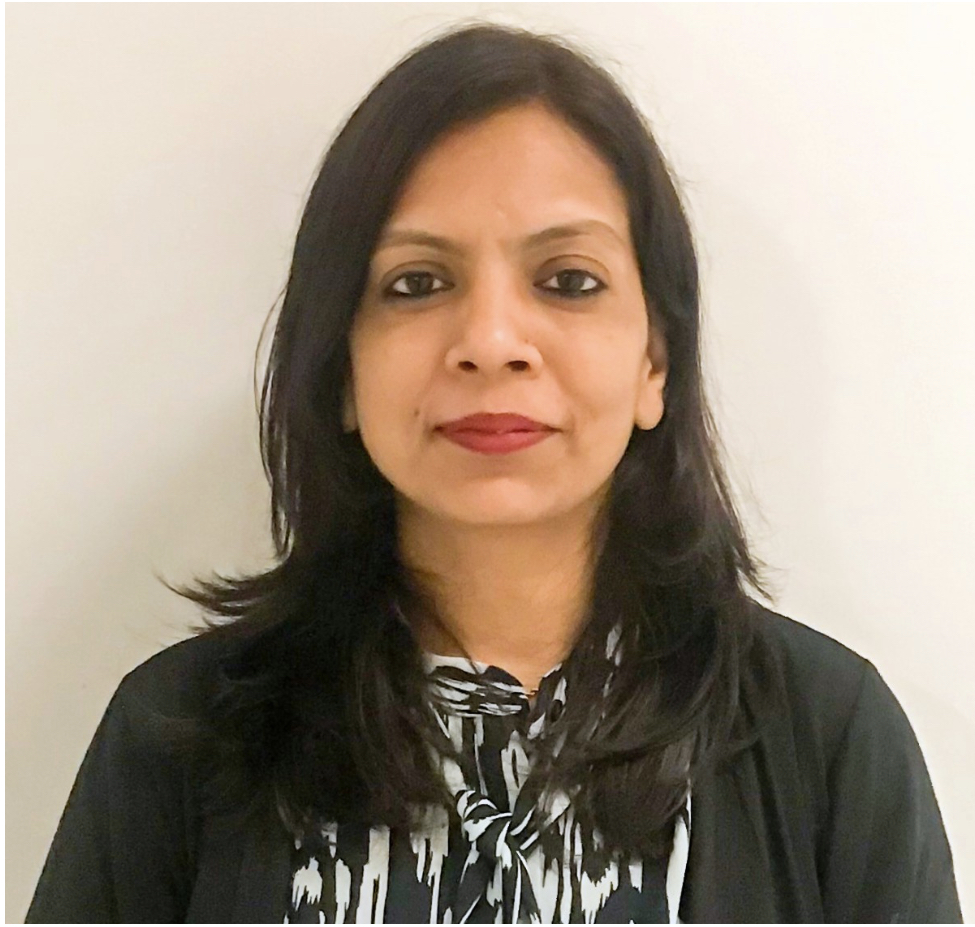
Chaitanya Muppala, founder of Manam Chocolates.
That variety is rooted in ingredients that are as local as they are nostalgic. “We try to work with everything in-house and influenced by the authenticity of our land,” Islam explains. “So I use coconut flakes, peanuts, peppers — ingredients from the farm — in recipes that echo our past but also prove that chocolate doesn’t have to be limited to sweet. It can be clever, nuanced, and flavour-forward: Guntur chilli with raspberries, curry leaves with white chocolate, lavender and Earl Grey, chamomile tea. These are the kinds of expressions we have here.”
Manam’s Delhi space takes you on a guided journey. Visitors move from design elements to tasting trays that show what a dry bean looks like, what roasted beans contain, how cacao butter and powder are formed, and how formulation works. “We express chocolate in the form of origin, type, and percentage,” Islam explains. “That’s how we build formulation, because it represents flavour. And flavour, for us, is a composition of texture, feel, taste, and aroma.”
How does Delhi compare with Hyderabad? “We were so encouraged with the response there that we created an entirely new pastry menu here,” she says. “It’s much larger than what we offer at the Karkhana. We have live baking — croissants laminated and baked in view, a new line of craft cookies fresh from the oven, savoury croissant pot pies, and a new viennoiserie menu. A dark chocolate cookie with pistachio filling served warm in front of you gives a sense of ownership and involvement. People thought dark chocolate starts with a bean and ends as a bar. But the same dark chocolate, if tempered right, can be created into endless products. Our bakery is new, our pastry menu is new, and most importantly, our beverage bar is an entirely new entity.”
Why a beverage bar in Delhi? Islam is clear: “Chocolate started off as a drink. We realised that with our five hot and five cold varieties, people were intrigued to try different flavours—Mexican, vanilla, sea salt. We wanted to extend the versatility of chocolate as a fruit. It’s not just a tablet; it belongs in snacking, indulgence, pantry—and beverages. So we built a menu of hot, cold, ice shakes, vegan options. Chocolate can be drinkable, repeatable, refreshing, not too heavy on the gut. And we wanted to show our country and the world that this is possible. Even vegan hot chocolate, in pure form, is rare to find. We wanted to expand that. All the varieties created for Delhi will eventually go back to Hyderabad.”
.jpg)
Ruby Islam, Head Chef at Manam Chocolates
Still, she’s cautious about early trends. “We need more time in Delhi to see what people are inclined towards. But we know the country wants experts to lead them into something new. On e-commerce, customers tell us: we don’t want sugar-laden Galaxy or Twix; give us craft chocolate options. That’s encouraging.”
The Delhi outlet, she notes, also caters to the city’s sweet-tooth culture. “NCR loves sweets—desserts before or after dinner, coffee, gelato. So our menu reflects that. The space is family-friendly: something for children, mothers, grandparents. The pastry section has cakes finished live, and the menu covers every expression of chocolate—nutty, fruity, in a glass, as a tart. Sitting in a café, ordering, and watching everything made in front of you is a level up. That’s what we wanted.”
On celebratory cakes: “We’ve done an extensive cake menu because Delhiites love cakes. We’re launching a brochure for it, setting up delivery formats with quick WhatsApp orders. People want conscious eating with good ingredients. As dark chocolate makers, I believe it should taste great and also positively affect your body. We’re already getting queries for customised and vegan cakes. Customers want details—kind of sponge, filling, elegant finish. For us, it’s always about the product.”
Islam admits the hardest part is logistics. “As a chef, I need to make sure the product is made right—with the right ingredients, training, methodology. But equally, it has to reach the customer in the right form and temperature. India is tropical: mornings at 34°C, afternoons at 45°C, then a rainstorm that brings it down to 28°C with high humidity. Chocolate is very temperamental. Pure chocolate is sensitive to temperature and humidity—it can condense, lose shelf life. That’s my biggest challenge.”
.jpg)
Even in-store, education is crucial. “I tell people: if you’re carrying chocolate home, keep it in AC, don’t let it touch the sun. These small things make a difference.”
And recognition? Islam takes it as fuel. “When we received TIME’s accolade, it only created a platform for us to be more responsible and set the bar higher. For me, it’s not just a compliment—it’s encouragement. Yes, our country is ready for the next step. And it’s my responsibility to put something better on the plate every time. As my team says, the top of one mountain is the bottom of the next.”
Since August 2023, Manam has built over 400 SKUs across categories. “Our tablets alone have 40 varieties, snacking has about 36 — clusters, barks, different flavours. Everyone has their preferences. Some want pure chocolate, others fruit notes, others nostalgic flavours. Chocolate is not for one target audience; it’s for everyone. That’s what makes people come back — to try more, to expect new experiences.”
.jpg)
With Muppala’s vision and Islam’s creativity, Manam’s Delhi outpost is more than a café or retail store. It is a theatre of chocolate: where beans become bars, drinks, pastries, and cakes; where local ingredients meet global techniques; where education sits beside indulgence.
And as Delhiites file in — from wide-eyed children to seasoned gourmands — the message is clear. Chocolate in India has finally broken free of its purple wrapper.
More from Culture


Comments
*Comments will be moderated