








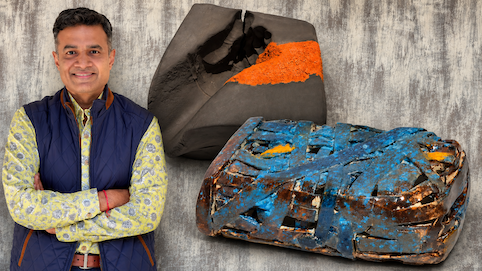
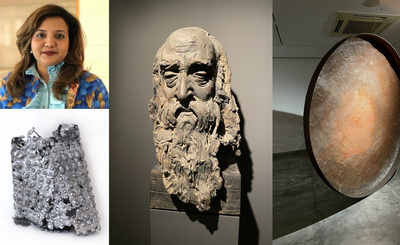
(Clockwise from left) Rahul Kumar, Traces of Presence, terracotta clay and brick dust, 2026, and The Shape of Absence, glazed stoneware
At Exhibit 320 in New Delhi, the ceramist brings together more than 70 works whose handprints, fractured blocks and elusive scripts give physical form to a difficult question: what survives a human life when those who understood its traces are gone?
A squat block of charcoal-grey clay lies on a white plinth at Exhibit 320 in New Delhi. From a distance, its most conspicuous feature is a crack. Come closer, and the hollow in its centre begins to resemble a clenched hand: four fingers drawn in, a thumb lying to one side. A fissure runs through the impression and out towards the edge. In another block, a coarse patch of orange spills over the lip of a depression. Nearby, a brown piece has split so widely that you can see the granular surface inside. The blocks share a rough geometry, but no two have opened in quite the same way. It is the difference between those breaks that draws you in.
These are among more than 70 recent works in Marking Time: What Remains, Passes, and Returns, Rahul Kumar’s third solo exhibition at Exhibit 320, in Lado Sarai. On view through November 30, 2026, the show takes up a question that might sound impossibly large for a roomful of clay objects: what remains of us once we are gone? Its most persuasive answers are quite small. A hand withdraws but leaves its shape behind. A line remains on a slab even when the words are hard to read. The work makes room for the less reassuring possibility that something may survive without ever again being understood as its maker intended.
In the group marked Traces of Presence 2, the plinths are staggered at different heights. Some pieces confront you with an upright face; others ask you to look down. This strikes you because a block that appears almost intact at eye level can turn out to have a deep cleft running across its top. One of the black forms opens into a narrow gap with a thin ridge still standing inside it. There is a similar play of concealment on a wooden shelf where five smaller, dark forms lie in a row. Their depressions are less deeper, and one carries a thin orange band near its base. Seen together, they make you pay attention to the different ways a surface can yield.
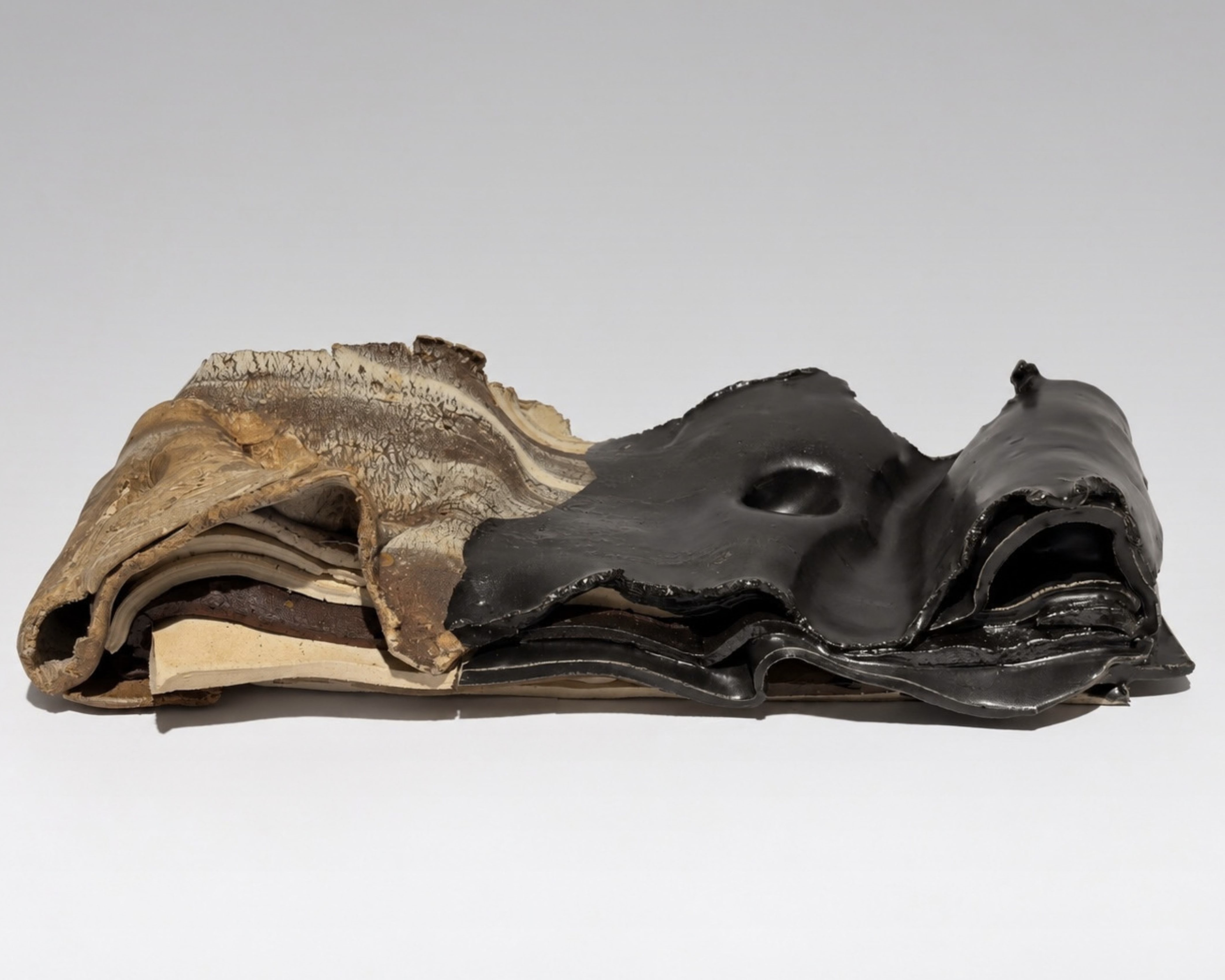
Bound Earth, glazed stoneware and earthenware clay
“Clay remembers differently,” Kumar writes in his statement on the gallery wall. He means this in a literal sense. A finger pushes into wet clay and displaces it; the mark is part of the object from then on. Firing may preserve it, but it can also introduce a fracture that cuts right through it. Kumar deliberately works with conditions that make such outcomes more likely. He fires solid blocks, which can burst if they retain moisture. He brings different clay bodies together even though they may shrink at different rates, opening a crack where they meet. He also puts molten metal in contact with ceramic, risking a sudden temperature change that can shatter the clay. The question in the studio is how much of that uncertainty a work can withstand and what it becomes in the process.
Also read: Subodh Gupta interview: ‘Even the most ordinary objects can carry extraordinary human histories’
There is a good example in Calendar Bound by Fire. Twelve rectangular plates are mounted in two rows, with short bars, square studs and rounded protrusions arranged on their surfaces. The count suggests a calendar before you have worked out how the piece was made. Look along the rows, though, and the regularity of the layout gives way to smaller variations. On one plate the marks lean diagonally; on another they cluster into a compact grid. In the work, pieces of fired clay meet cast iron. The combination brings together materials at different stages of their encounter with heat: the ceramic has already hardened by the time the metal is fluid enough to be cast. What looks from across the room like a tidy system for counting turns out, up close, to be full of awkward little differences.
Kumar came to these experiments by way of the vessel. He began with a traditional potter, trained at Delhi Blue Pottery in the 1990s, and went on to study with Dipalee and P.R. Daroz. A Fulbright scholarship took him to the University of Dallas, where he earned a master’s degree in art with a concentration in ceramics in 2008. He later spent time in the Welsh studio of the British ceramist Walter Keeler, observing his approach to salt firing. Fragments were already central to Kumar’s 2023 exhibition at Exhibit 320, the untold resides somewhere, assembling fragments. That helps explain how comfortably he moves here between the familiar shape of a pot and forms whose purpose is much harder to place.
_2026_MARKING TIME_Rahul Kumar.jpg)
Relics, earthenware clay, 3X3X5 inches (set of 9), 2026
In Still Life, a row of upright slabs shares a narrow white shelf with two small vessel-like forms, one black, the other off-white. The slabs could be pages propped open for reading. One is dotted with small impressions; another bears broad, incised marks. A thin rust-coloured line crosses a pale slab and changes direction partway down. Elsewhere, three cream-coloured sheets hang one above the other. The glaze catches the light on raised, handwriting-like marks, so that parts of a line become visible and then recede as the angle changes. There is something familiar in the urge to lean in and decipher them. You might do the same with an old letter, recognising the movement of someone’s hand before you can make out a sentence.
Roobina Karode, whose curatorial guidance helped shape the show, traces its beginnings to Kumar’s reading of the Bhagavad Gita, the Vedas, the Upanishads, the Buddhist Tripitakas, the Talmud, the Bible and the Quran. These texts have very different accounts of what a life is and what may follow death. What drew Kumar to read across them was the possibility that death could be understood in relation to continuity or return. The show takes its two movements, Atmanand Brahman, from Sanskrit philosophical vocabulary. As Karode explains in her curatorial note, the terms give the exhibition a way to move from the scale of a single life towards larger questions of collective memory, ritual and history. The ceramics need very little of that explanation to make an impression, but it helps account for the distance the exhibition travels from the mark of one hand to the systems by which whole societies remember.
_2026_MARKING TIME_Rahul Kumar.jpg) The Fourth Dimension, stoneware and terracotta clay, 2026
There is welcome playfulness in that journey. On a long black table, dozens of small forms stand in loose ranks: a yellow arch with stubby legs, a red-brown body with long yellow horns, little towers, tripods and shapes that might be stools or creatures. From one end the arrangement looks like a gathering. Walk along the side and figures that seemed to belong together separate, while others line up unexpectedly. A row of dark wall-mounted forms plays a related game with fewer colours. Each begins with a block, but above it Kumar puts a loop, a fork, a ladder-like construction or a row of beads. It is tempting to read them as an alphabet. The longer you look, the more they seem to change between signs and objects.
The exhibition is less convincing when every object is asked to carry the same thought about impermanence. Some of the smaller forms are simply funny or peculiar, and the show is richer for letting them be so. There are also folded and perforated sheets of ceramic whose edges curl like cloth, although the material has long since hardened. In one stack, glossy black layers meet cream and ochre sheets; the openings make it possible to see into the layers beneath. The framed close-ups elsewhere perform a different trick with scale. A ragged edge seen in isolation looks like a ridgeline; a fissure can fill the frame. They return you to the sculptures with a better sense of how much their surfaces contain.
Back at the grey block, the hand is still there if you look from above. From the side, it disappears and the split is almost all you can see. The sculpture gives both views equal weight. It has kept enough of a gesture for a stranger to recognise it, and the crack has changed it enough that nobody could quite put the hand back.
More from Arts
Comments
*Comments will be moderated