








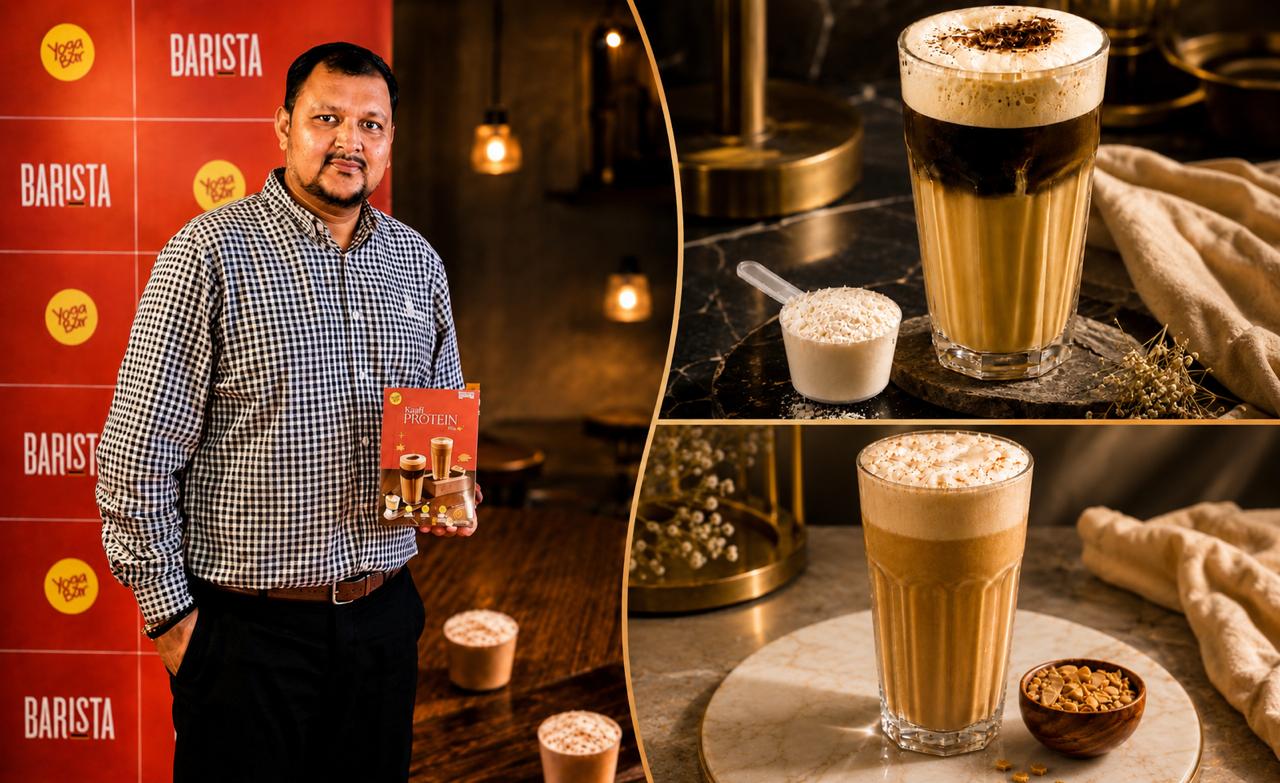
Rajat Agrawal, CEO of Barista Coffee (left), Iced Caramel Whey-chino (top) and Mocha Pro-Muscle Shake.
With two new protein-loaded drinks, Barista Coffee is trying to catch a shift already under way in Indian cafés: coffee is no longer an occasional indulgence, and protein is no longer confined to the gym. CEO Rajat Agrawal talks about the Yoga Bar partnership, changing menus, smaller-city consumers, competition and why a chain of Barista’s size cannot chase every passing trend
There was a time when ordering coffee was uncomplicated. Espresso if you meant business, cappuccino if you wanted to linger, cold coffee if it was too hot outside. The modern café menu has other ideas. Matcha has arrived, Vietnamese coffee has travelled well, Spanish lattes are having their moment, and now protein has found its way into the cup.
Barista Coffee’s latest move is built around two drinks with names that leave little doubt about what they are selling: Iced Caramel Whey-chino and Mocha Pro-Muscle Shake. Launched with Yoga Bar under the campaign Kaafi Protein Hai, the range also includes a Chicken Tikka Sandwich, while customers can add Yoga Bar whey protein to any drink on the menu. The products were rolled out nationally on August 11.
For Rajat Agrawal, CEO of Barista Coffee, this is less an abrupt encounter between the coffee shop and the protein shaker than the next step in something the company has been working towards for a while. Barista has sold Yoga Bar’s protein bars and biscuits for nearly two years.
About a year ago, it also began integrating protein into its breads and sandwiches; Agrawal says the breads used for these carry 18 grams of protein. Once food had gone that way, beverages were the obvious next place to look. The two companies then spent six or seven months on research and development before arriving at the current range.
“We are the beverage guys,” Agrawal says, summing up the logic of the partnership. “We can do a beverage creation, but we are not the ingredient guys.” That distinction matters when the ingredient in question is whey protein.
Consumers, he believes, pay much closer attention to where their protein comes from than they once did. For Barista, Yoga Bar — now part of ITC — offered both a known product and the reassurance of established sourcing. “Whey protein is something you would always want to consume [as] a branded product,” he says. The partnership, in other words, is as much about trust as formulation.
The number Barista settled on is 24 grams of protein per drink. Agrawal says its trials suggested that pushing the amount higher made the beverage too heavy. The intention was to find a level substantial enough to matter without turning a coffee into something that feels like a meal in a glass. “We wanted to have the right balance,” he says.
He also points to a wider concern about everyday protein intake, particularly among vegetarians, many of whom, he argues, do not consume as much protein as they need. Rather than ask customers to completely alter their habits, Barista is betting that adding protein to something they are already drinking may prove easier.
Also read: ‘We want Coffee Island Beyond to become part of your routine’: Vita Nova Group CEO Amitabh Negi
That “already drinking” part may be the more interesting story. Coffee in urban India has moved well beyond being a weekend treat, and Agrawal thinks younger consumers have accelerated that change. “Gone are the days when it was a lifestyle product. It is a necessity today,” he says, pointing to consumers who may have coffee three or four times through the day.
A café, meanwhile, sells more than the coffee in the cup. People meet there, work there, pass time there and, increasingly, expect the menu to move as quickly as the rest of their lives. “Coffee is any which way a by-product in our store,” Agrawal says. “It is more about experiences, it is about people coming along, having their good times at the café, working cafés and all that is becoming a big thing.”
Barista has been quietly widening that experience. Vietnamese coffee and Spanish latte have entered the menu. Matcha has been added as a category. Milkshakes came earlier; tamarind has also been tried. A fresh-fruit smoothie is being prepared for launch. Protein is the newest addition, not the only one.
Yet Agrawal is wary of confusing novelty with innovation. A four-store company, he says, can change a recipe overnight and see what happens. A chain with hundreds of outlets cannot. “I need to take a decision of 500 stores,” he says. Every new product has to survive R&D, operational questions and the rather less glamorous test of whether it can work consistently not at five cafés but across the network. That, he argues, makes Barista slower to jump but also more deliberate once it does.
The protein push is not meant only for Delhi, Mumbai or Bengaluru either. Agrawal points to Punjab, one of Barista’s strongest markets, as evidence that the appetite for fitness-led products is hardly confined to the big metros. The state’s gym culture and familiarity with protein, he says, have made early response encouraging. More interestingly, the buyers are not only young customers. Older consumers, too, are trying the drinks.
He expects protein beverages to become a sizeable part of Barista’s portfolio over the next two or three years rather than disappear after a seasonal campaign. That confidence comes at a crowded moment for Indian coffee. New domestic chains are multiplying, international names continue to expand, and old players are remaking themselves. Agrawal does not sound particularly anxious about it.
“In a large sense we have already done that,” he says when asked whether Barista needs to reinvent itself for the new market. He argues that Barista’s menu already reflects the changes shaping the category and that its larger problem is of a different kind: scale.
According to Agrawal, the chain is closing in on 550 stores across its markets, including 95 in Sri Lanka and a recently opened outlet in the Maldives. Barista’s official company note describes a network of more than 500 cafés across over 160 cities. Agrawal also says the company is opening roughly 60 to 70 stores a year and has built an especially deep Tier-I and Tier-II presence, with close to 200 stores across Punjab, Himachal Pradesh and Jammu & Kashmir.
Also read: At JW Marriott Aerocity’s K3, The Caspian Table brings a taste of Baku and Tbilisi to Delhi
His argument is that expansion by itself is not much of an achievement if it depends indefinitely on outside capital. He contrasts Barista with younger, venture-funded café companies and says the real test is whether scale eventually creates a viable business. He describes Barista as self-sustainable and says it is profitable, a claim he sees as central to the company’s position in an increasingly competitive market.
Competition, he concedes, is useful. It “keeps us on the toes” and forces established chains to keep doing better work. But he is reluctant to compare a network of Barista’s size with a new entrant operating a handful of stores.
One way the company has kept its menu moving is through collaborations. The Yoga Bar deal is part of a pattern rather than a one-off. Over the past two years, Barista has worked on a pistachio-led line in association with the US Embassy and American Pistachios, followed by an American cranberry initiative. Last year came a partnership linked to Turkish hazelnuts and the Turkish Embassy.
Agrawal likes these collaborations because they introduce new ingredients without requiring Barista to pretend it knows every part of the supply chain. But there is a condition: the partner has to be established. “The idea is to have trusted partners,” he says. Barista, he adds, is not interested in alliances with brands still “trying to figure out” what they are. A collaborator must already have consumer acceptance and bring something useful to both sides.
That perhaps explains the protein coffee experiment better than the language of wellness does. The café business has always sold habits. What has changed is the habit itself. The customer who once came in for a sugary cold coffee may now check protein, ask for less sugar, order matcha on Wednesday and a Spanish latte on Friday. Health and indulgence are no longer sitting at opposite ends of the menu. Barista’s wager is that they may even fit into the same glass. And if Agrawal is right, the Whey-chino may not look particularly unusual for very long.
More from Culture



Comments
*Comments will be moderated