








At the fourth edition held at Mahalaxmi Racecourse, Indian modernists and international galleries shared the fair with live mural commissions by KNMA and Saffronart Foundation, and presentations by Gallery Veda, Pristine Contemporary and Blueprint12, among others
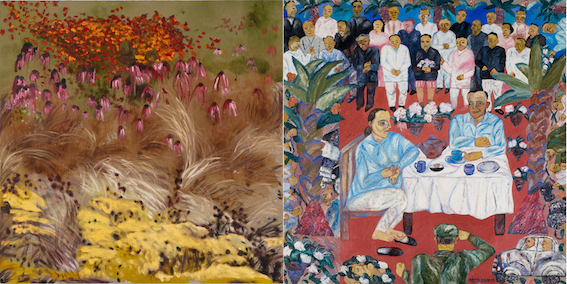
In Subodh Gupta’s Flower Seller (2026), shown by Nature Morte at Art Mumbai 2026, yellow blooms fill the foreground, pink flowers hang their heads farther back, and red and orange gather at the top of the canvas. The pale grasses bend across the middle, breaking up the bands of colour and giving the garden a sense of movement. It takes a moment to notice that the person named in the title is missing. Once you do, the flowers begin to suggest the work that will take them from the garden to the market: cutting the stems, sorting them and tying them into bunches.
A few months earlier, Mumbai had seen the sweep of Gupta’s practice in A Fistful of Sky, curated by Clare Lilley at the Nita Mukesh Ambani Cultural Centre. At Art Mumbai, his painting brought the artist’s interest in ordinary labour into a different territory. Gupta is widely recognised for his use of kitchen vessels. But in the painting, the clue to the work people do with their hands was in a title that sent you back into a canvas full of flowers.
The fair’s fourth edition, held from November 12 to 15, 2026, at Mahalaxmi Racecourse, brought together 94 exhibitors, 21 from outside India. Its size made for some unlikely neighbours. A Picasso still life was part of the same fair as a camouflage jacket covered in button flowers and a marriage-chamber image being made on a wall. Perrotin, Richard Saltoun Gallery, Night Gallery, Rizq Art Gallery and Niru Ratnam were among the international galleries making their Indian art fair debuts. Birla Opus Paints presented the edition, with 360 ONE as legacy partner. Since its debut in 2023, Art Mumbai has grown into a fair where established collectors, first-time buyers and people who just want to look at art can spend a day under the same roof. What they each come away remembering is a more interesting measure of its scale.
A wall with a history
The four walls taken up by the Kiran Nadar Museum of Art and Saffronart Foundation offered an answer of their own. Voices from the Earth: Women, Nature, Power, curated by Preeti Bahadur Ramaswami, KNMA’s senior curator and head of Indian Classical, Folk and Tribal Arts, followed the work of women across Madhubani, Rajwar, Bhil, Baiga, Gond, Jogi, Bengal Patachitra and Warli traditions. Many of these practices took shape on domestic or ritual walls. As the work travelled onto paper and canvas, it could reach collectors and institutions, and the names of individual artists could travel with it. Something also changed in the encounter. A drawing on paper can be hung anywhere. A painting made for a marriage chamber comes with a room, a purpose and people who know what the image is there to do.
Rajiv Menon, Maya Seas Offerings
KNMA’s collection includes Ganga Devi’s Sita in a Grove (1987–88), an ink drawing on paper. For one of the fair’s four site-specific commissions, Prerna Jha and Swati Kashyap took a different drawing by Ganga Devi as their point of departure. They revisited Naina Jogin, a protective female figure traditionally painted in Mithila marriage chambers, on an interior wall. On an exterior wall they worked with another part of Ganga Devi’s imagery, a lattice of nagas, or serpents. The two commissions made it possible to consider what the artists kept, what they adapted and how an image changed with the wall it occupied.
Across the hangar, Rajwar practitioners made a clay relief inspired by the house Sona Bai Rajwar transformed in Sarguja, Chhattisgarh. Geometric patterns, jalis and narrative forms recalled a home in which the wall itself was part of the work. The other exterior commission involved Warli Suhvasinis, women who traditionally paint the walls of their homes, working with Mayank and Mayur Vayeda. Clay, mud, husk and rice paste belong to the environments in which these practices developed. To see work being made during the fair was to see how much knowledge sits in the preparation of a surface and in gestures that can look deceptively simple once the work is finished.
The exhibition gave that knowledge names. Baua Devi, Anmana Devi and Pushpa Kumari appeared alongside Ganga Devi in the Mithila section. Sundari Bai Rajwar carried the Rajwar account beyond Sona Bai’s example. Lado Bai, Jodhaiya Bai Baiga, Durga Bai Vyam and Roshini Vyam brought Bhil, Baiga and Gond work into view. The Bengal Patachitra artists Suwarna Chitrakar and Tagar Chitrakar and the Jogi artist Teju Ben Jogi extended a conversation whose details kept changing with place and practice. The range mattered because the word vernacular can make very different kinds of work sound as though they share a single history.
The figure, from Panicker to Pristine
In Hangar A, Chennai’s Gallery Veda, founded by Preeti Garg, brought a work on paper that K. C. S. Panicker (1911-1977), the abstract painter from Malabar who interpreted the country's age-old metaphysical and spiritual knowledge, breaking out of the mould of Western influence in the 1960s, made in 1953. Its subject is a figure, handled with earthy colour and loose strokes. The few passages where light catches the body do much of the work. It is worth lingering over how little Panicker needs to say about the face or the setting for the figure to have a presence. A fair can make a famous name feel like something you already know. An early work like this is a chance to catch the painter making decisions before they became part of the story we tell about him.
In Hangar A, Chennai’s Gallery Veda, founded by Preeti Garg, brought a work on paper that K. C. S. Panicker (1911-1977), the abstract painter from Malabar who interpreted the country's age-old metaphysical and spiritual knowledge, breaking out of the mould of Western influence in the 1960s, made in 1953. Its subject is a figure, handled with earthy colour and loose strokes. The few passages where light catches the body do much of the work. It is worth lingering over how little Panicker needs to say about the face or the setting for the figure to have a presence. A fair can make a famous name feel like something you already know. An early work like this is a chance to catch the painter making decisions before they became part of the story we tell about him.
The Estate of Vivan Sundaram, Marxism in the Expanded Field, Geeta's Bookshelf, Photoink
Pristine Contemporary had a different reason to put several approaches to painting in the same booth. Founded in New Delhi in 2024 by Arjun Butani and Arjun Sawhney, the gallery works out of a converted timber mill in Kotla. Its Mumbai selection included Saskia Pintelon, Rabia Akhtar, Rifat Ara Mim, Nature Shankar, Kumari Nahappan, Conor Mccreedy and Varad Bang. Painting, sculpture and works on paper shared the booth, with room for figuration, contemporary miniature and a more concentrated use of colour. Bang had also been part of Pristine’s Delhi exhibition A Slow Sip of Solitude, which brought academically trained figurative painters together around private moments and ordinary interiors. The other six artists gave fairgoers six reasons to keep looking beyond it.
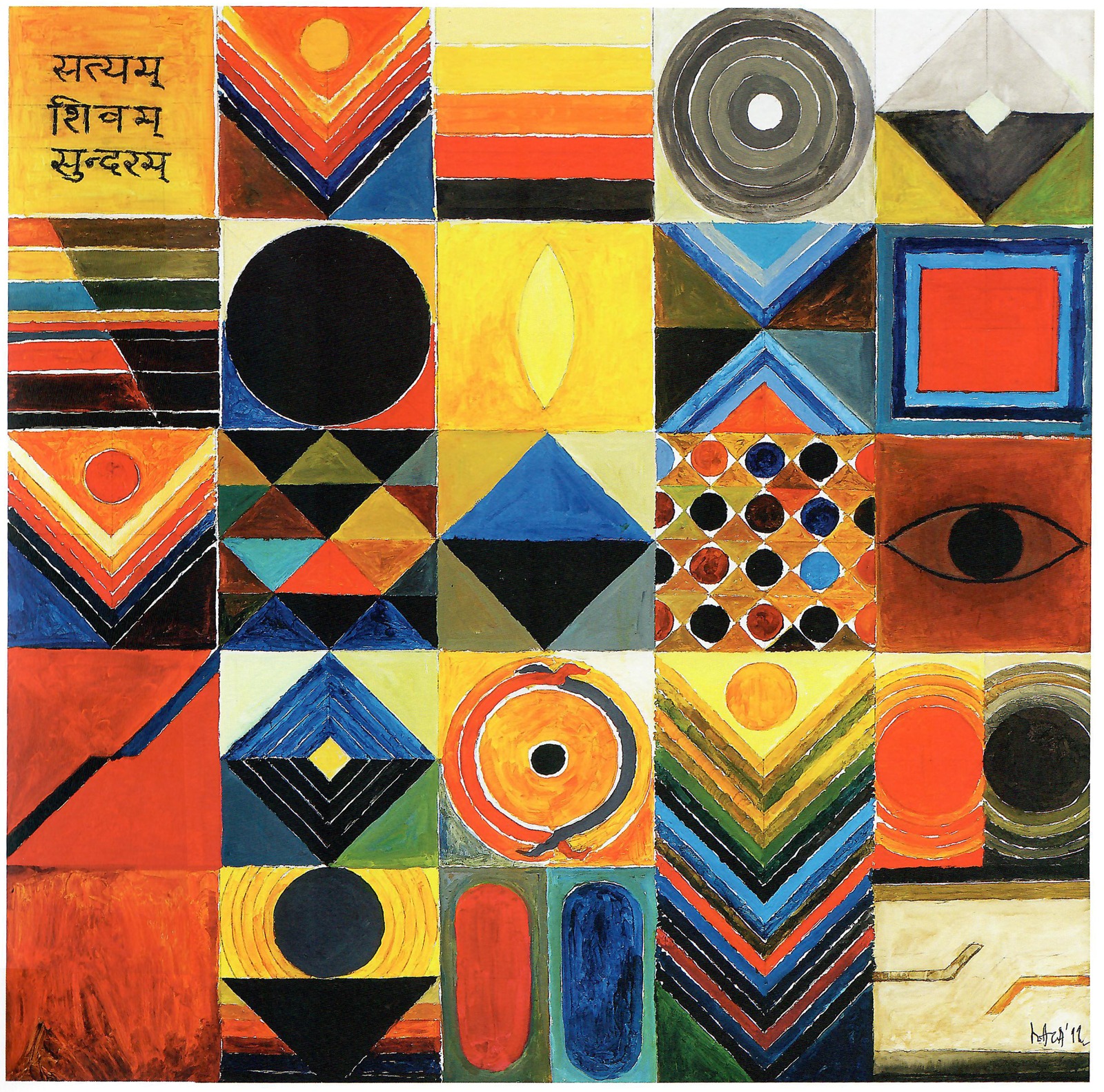
Elsewhere in Hangar A were several ways of making a figure present. In M. F. Husain’s Young Head (1964), at Kumar Gallery, a face comes forward from an earthy, rubbed surface. The raised paint catches the light in small patches. Kumar Gallery’s presentation looked back to its 1963 exhibition Fourteen Leading Abstractionists, with Akbar Padamsee’s Abstract Cityscape and an early S. H. Raza giving that history some breadth. Great Banyan Art showed F. N. Souza’s Untitled (Reclining Nude) (1962), in which the heavy outline of the body holds against a loud yellow field. At AINA Gallery, Raza’s Ekatra (2011) had the compressed variety of a painter sorting through his own repertoire. An eye, a black circle, stacked chevrons, squares and a phrase in Devanagari all have a place in the grid.
Divya Mehra, Sculpture Park
DAG put two very different kinds of invention within reach of each other. In Jogen Chowdhury’s Tulip (1984), the dark flowers almost look too heavy for their stem. Fine orange lines keep the blooms from sinking into the brown of the paper. Across Madhvi Parekh’s Playing with Serpent (1981), a yellow creature hangs in the air while human figures, birds and smaller beings go about their business. The little figures inside or against the larger ones are easy to miss. They turn an already lively picture into a world with its own rules.
What a surface gives away
Blueprint12 called its eleven-artist presentation Unknowing. Kaimurai’s Bhuta Sthala series made a good case for the title. In one work, a dark ring sits on khadi. Move closer and the edge breaks into fine rays of natural indigo. Follow those rays outwards and the weave of the cloth comes into view. The ring is clear enough to register from across the booth. Everything worth noticing about how it was made takes longer to see.
Indu Antony used a screenprinted photograph, brass, pen marks and her own hair in The witnessing hand. Mansha Chhatwal worked book pages into beeswax and damar resin in Soft pulped words. Youdhisthir Maharjan cut and wrapped reclaimed pages, turning something designed to be read into something you have to examine for the traces of its former use. In Kingsley Gunatillake’s War text, a used book accommodates gold leaf and copper figures. Shoneize Akhtar’s The Reader, Bandstand Lovers and Nothing to wear offered recognisable situations amid all these alterations and erasures. Arshi Irshad Ahmadzai, JK, Meghana Gavireddygari, Mojahid Musa and Zoya Chaudhary completed a presentation in which a piece of cloth, a page or a strand of hair could carry as much weight as an image.
 Bharti Kher, My Inside Out I, Perrotin
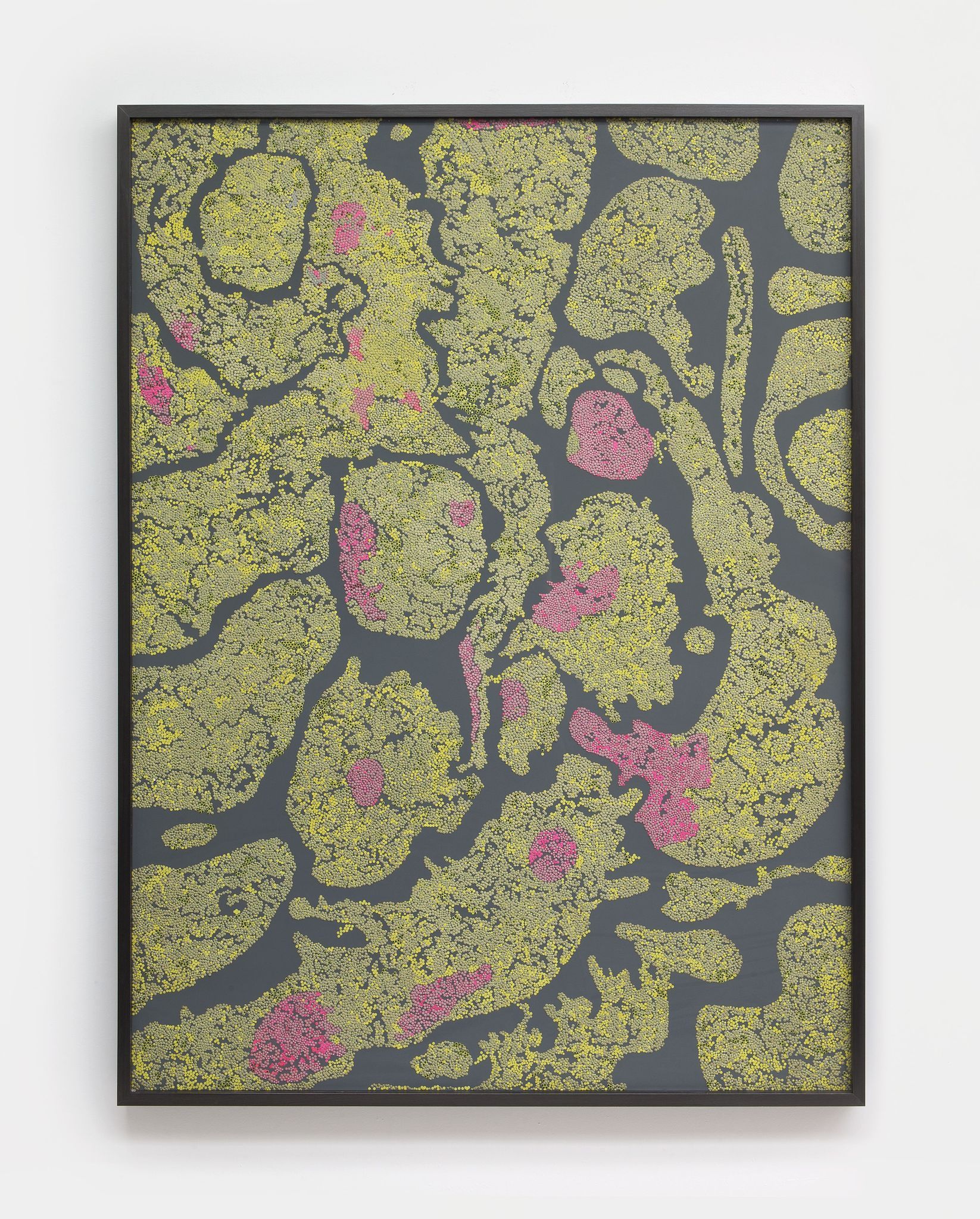
A change of distance was also the point of Bharti Kher’s My Inside Out I (2013), brought by Perrotin. Fields of yellow-green and pockets of pink stand out against a dark ground. From across the room they could be colonies of cells or patches of growth on stone. Up close, they are individual bindis. Each still has the scale of something worn on the skin, even as the eye gives itself over to the larger pattern. The work lets you keep both impressions at once.
Ai Weiwei used similarly familiar units to different effect. At Galleria Continua, buttons made bright flowers on a cat-motif camouflage jacket. It is hard to imagine a garment less able to disappear into its surroundings. At Nature Morte, the pastel bricks in his Still Life (After Giorgio Morandi) made a group of vessels easier to recognise from farther away. Ben Brown Fine Arts brought another still life, Picasso’s Compotier et verres (1943). The lines that describe the fruit bowl and glasses are thick enough to become objects in their own right. Some do the work of two outlines. Your eye keeps trying to finish the job Picasso has left it.
On the plane, at the bookshelf and out in the open
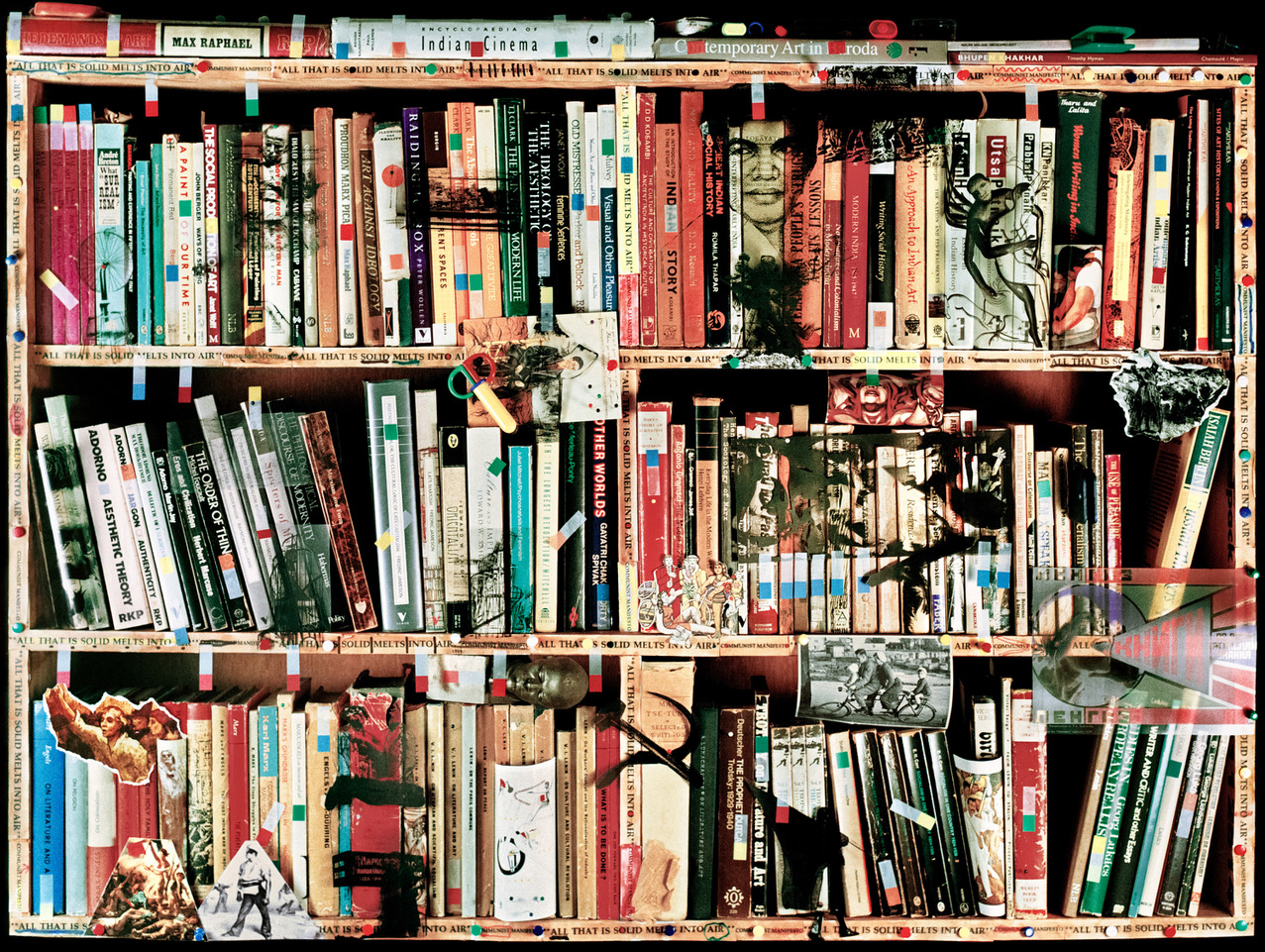
Sudhir Patwardhan put the act of looking into the picture itself. In Sketcher on a Flight (2005), at Vadehra Art Gallery, a passenger has made just enough room for a red sketchbook. Everyone around him has found a different place to rest their eyes. In Atul Dodiya’s Householder (2026), at Chemould Prescott Road, a green bird is one of the few things you can be quite sure of in a landscape where a building seems to hang in the air. At PHOTOINK, Vivan Sundaram’s Marxism in the Expanded Field (Geeta’s Bookshelf) (2000) described the intellectual life of the critic and curator Geeta Kapur through the books she lived with. Coloured tape, photographs and scraps of print interrupt the order of the shelves. Anyone who has tried to make sense of a person through their books will recognise the temptation to start reading the spines.
There were quieter works that could easily have been missed in a quick circuit of the fair. At Gallerie Splash, Zarina Hashmi’s Cage (1970) used slivers of bare paper between black, wood-grained uprights to suggest the space inside an enclosure. At Experimenter, the folded-looking ridges of Ayesha Sultana’s dark Untitled (2026) picked up light a little at a time. Rana Begum’s No 1523 Painting (2025), at Jhaveri Contemporary, made the visible cloth count as much as its planes of red, maroon and grey. Sundaram Tagore Gallery showed Miya Ando’s Kangetsu, A Moon that appears on a Cold Winter Night (2024), in which a small blue moon nearly disappears into a larger blue field. Anish Kapoor, at Lisson, made looking a more conspicuous affair. One of the two purple-and-gold discs in Purple and Wild Cherry Mix to Pagan and Lime Gold Mix (2017) gives you back the room with a figure turned upside down.
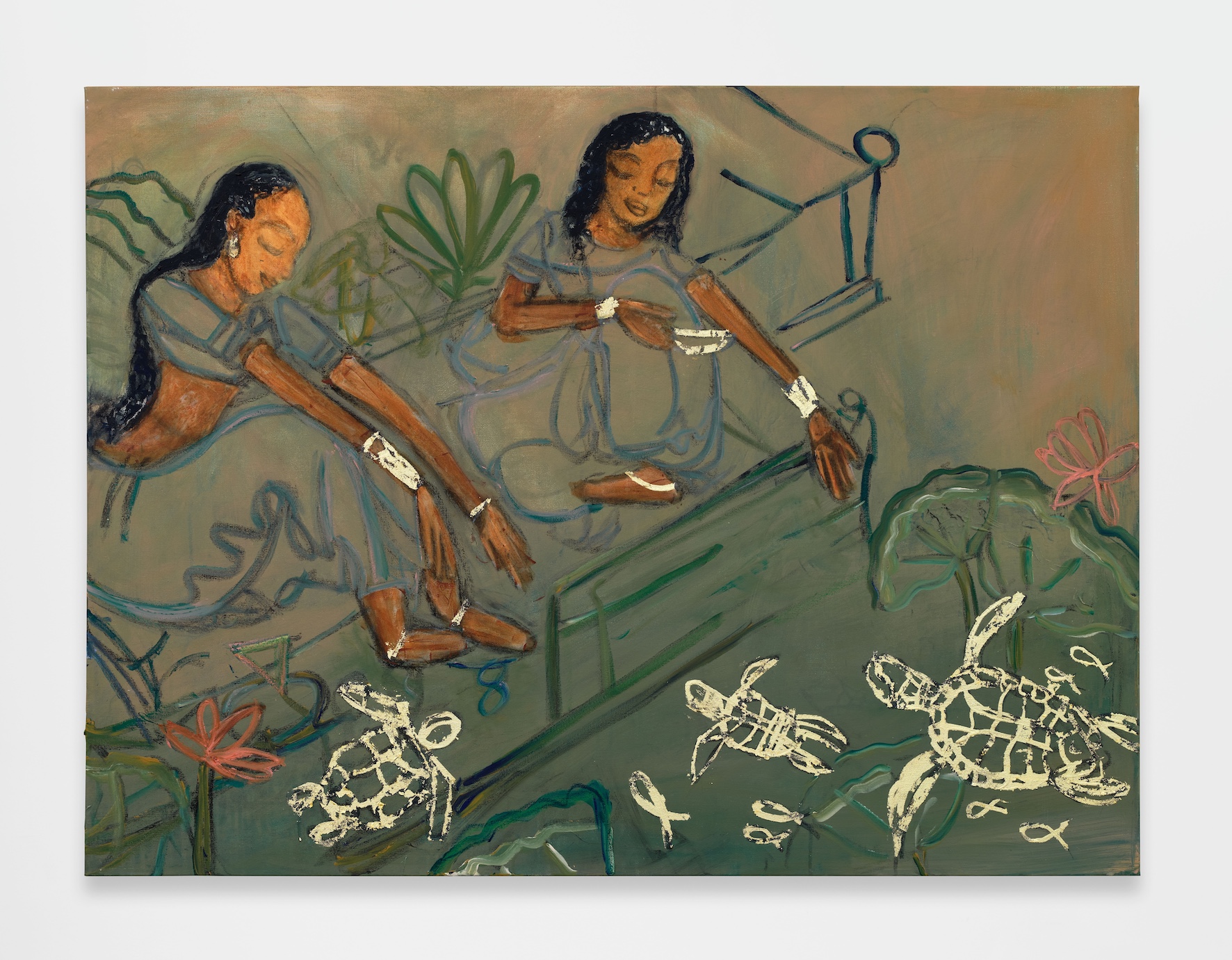
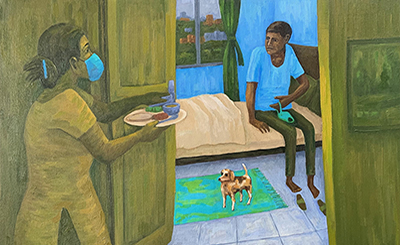
At Aicon Contemporary, the oil-painted velvet of Maithili Chaturvedi’s Amra let a face and a few glints of jewellery emerge gradually. Anant Art’s Untitled by Vikrant Bhise pressed profiles and limbs into a tight red-brown space. At Gallery Maskara, the orange strokes along a dark tree in T. Venkanna’s Untitled flickered over a reclining skeletal figure. The stitched face in Gurjeet Singh’s Hum Hor Nahi Hai 1, shown by Chemould CoLab, looked straight back with button eyes and a crooked green nose. At Rajiv Menon Contemporary, Maya Seas’s Offerings placed two women at the water’s edge. The pale turtles and fish below their hands catch the eye in much the same way as the jewellery on their wrists.
S H Raza, Ekatra, AINA Gallery
The fair gave photography more room this year. Chennai Photo Biennale and WWF-India presented In Dialogue with Nature, while Derry Moore’s black-and-white photographs looked towards India’s princely cities and Richard Bartholomew’s portraits brought the faces of modern Indian art into view. The Dabriwala Foundation for the Arts, Dot Line Space Art Foundation and The Cycle added to the institutional presence. KNMA’s Learning Space used repetition as a way into drawing and printmaking, with student workshops, artist-led sessions and multisensory activities developed with Access For ALL.
The 14-panel Speaker Series and the programme around it widened the conversation further. Ranjit Hoskote moderated a discussion between Javed Akhtar and Baaraan Ijlal on poetry and painting, and joined Vishal Dar for a discussion on public art. Lydia Yee, Manuel Rabaté and Minal Vazirani considered the growth of art institutions across Asia and the Middle East. Indu Antony took part in Women to Watch, and a panel led by Asad Laljee looked at how immersive technologies are changing the encounter with art. Art Mumbai’s Cultural ambassador Karan Johar’s The Fame Game took up celebrity and fandom. Around the guided walks and talks came Madboy/Mink’s mix of electro, cabaret and film-score influences, Harini Nilakantan’s meeting of Bharatanatyam and street dance, and a Sunday performance by the Indian Navy Band.
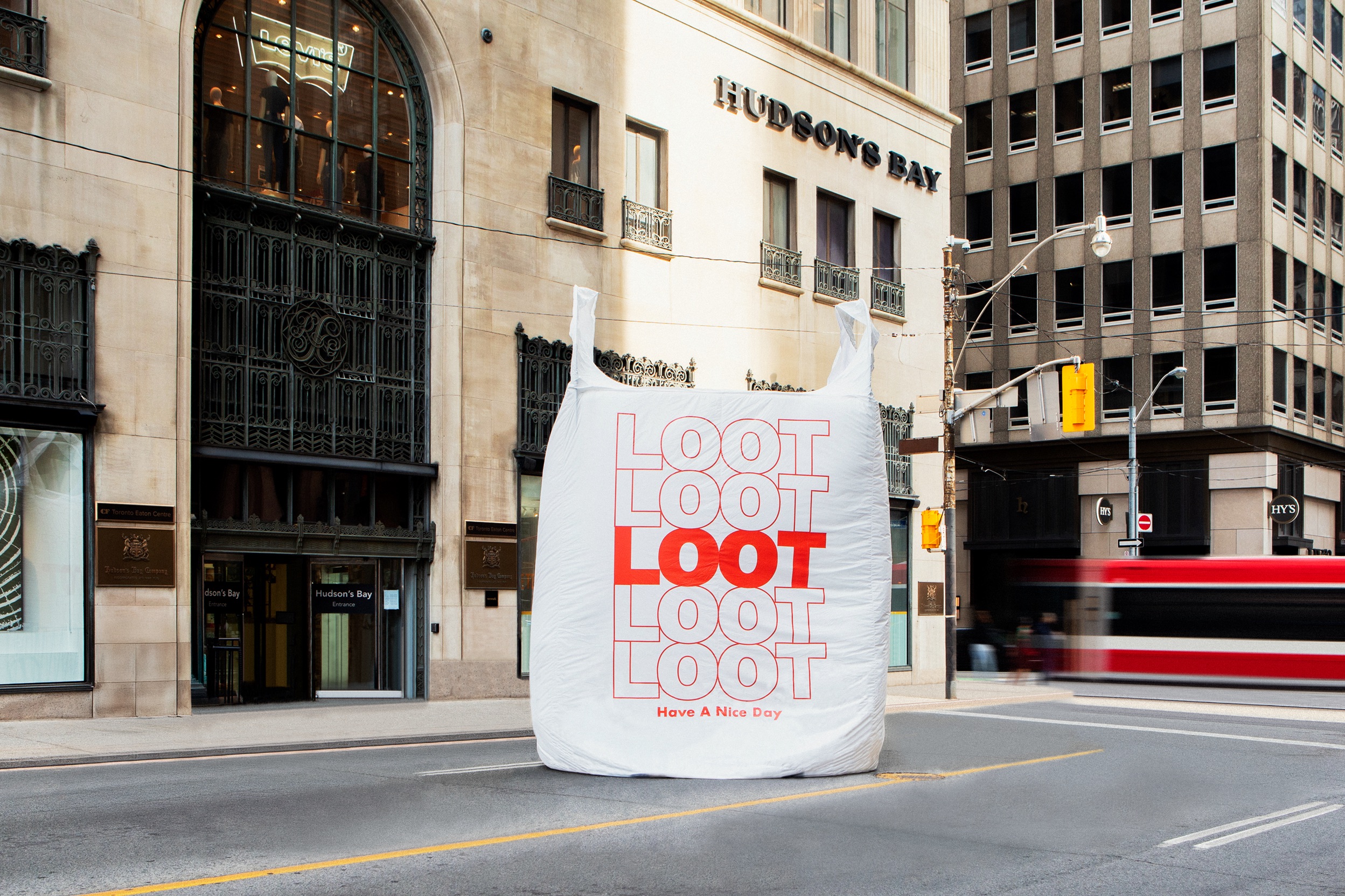
Outside the booths, the 13-work Sculpture Park, themed Material and Memory, brought together Satish Gujral’s bronze Nandi, Jonathan Trayte’s candy-bright Babba Su, and work by Sakshi Gupta and Sumakshi Singh, among others. Night Gallery showed Divya Mehra’s A Practical Guide. In the photograph made outside Hudson’s Bay in Toronto, the giant takeout bag stands in the road, LOOT printed over and over where you might expect to read THANK YOU. At the bottom, it still wishes you a nice day.
It was a good work to encounter at a fair. For four days, people had been deciding what they wanted to take home, and a large part of the pleasure of being there was seeing what someone else had chosen to bring. Mehra’s bag made the word acquisition sound a little less innocent. It also made me think again about the clay relief at KNMA, and about Sona Bai Rajwar working on the walls of the house she lived in. You could take a photograph of the relief, remember a bit of its pattern, or follow the artist’s work elsewhere. The wall itself had already done something rarer at an art fair. It had given you a reason to think about where a work belongs.
More from Arts
.png)

Comments
*Comments will be moderated