








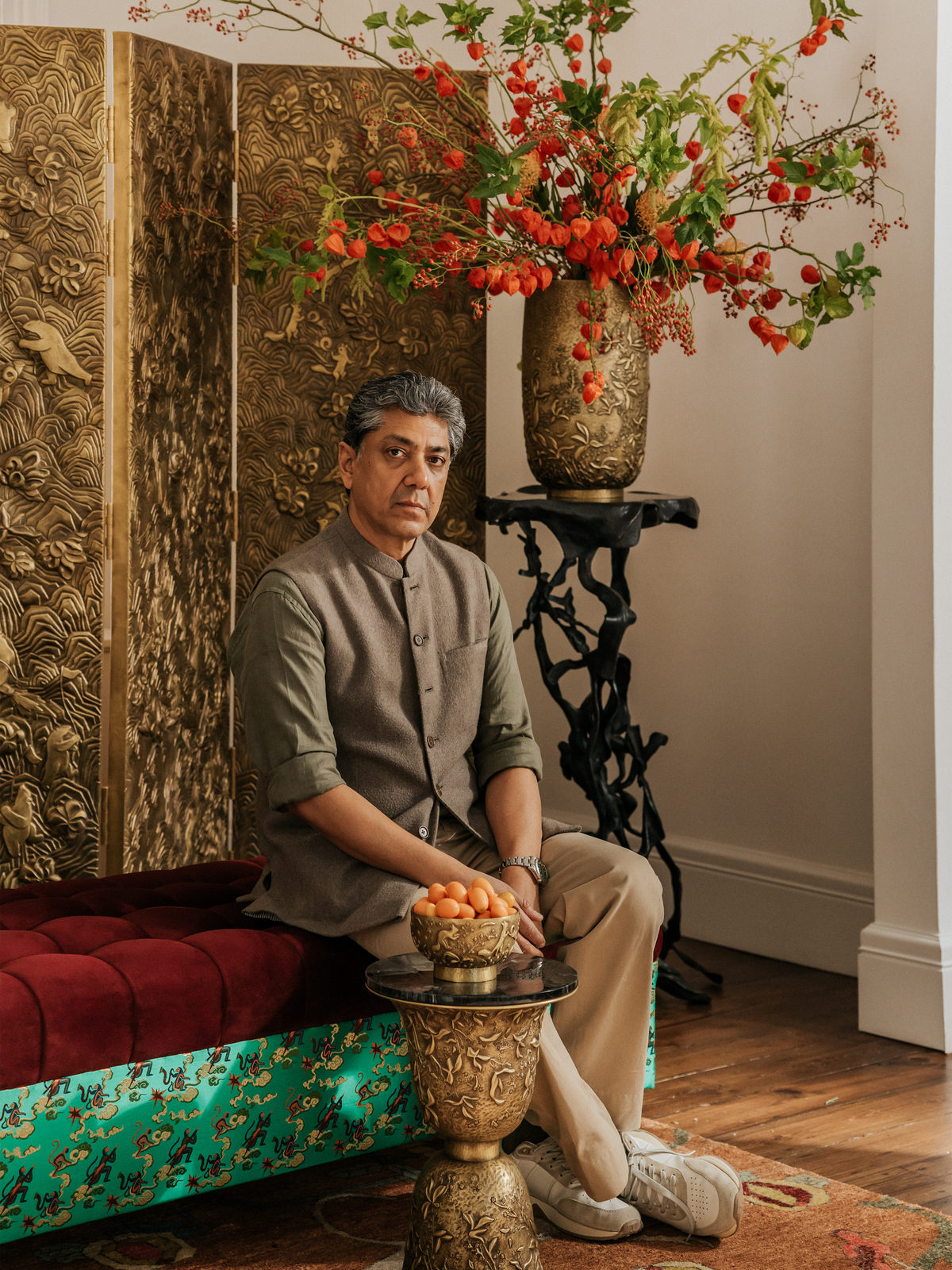
In Wings and Tales, his new collection, the Delhi-based designer-artist takes the animal world of the Ramayana into furniture, brocades and tableware. In this interview, he talks about taking the collection to London, his penchant for baithak, and why he designs for his own curiosity
Monkeys ride stylised rockets across the green brocade of Delhi-based designer Vikram Goyal’s Makara ottoman, beneath a maroon velvet seat. Sculpted brass feet, finished in patinated gold, give the piece its animal presence. Named after Makara, a mythical aquatic creature with crocodilian features, the ottoman is one of several high-end collectible furniture pieces that were part of Wings and Tales, Goyal’s exhibition at 7 Grafton Street, a Georgian townhouse in London’s Mayfair, which was held from October 13 to 16. Next to the ottoman, Vikram Seth’s The Golden Gate and Amitav Ghosh’s Sea of Poppies are stacked beneath a brass bowl on a side table decorated with animals in relief.
Coinciding with Frieze and PAD London, the exhibition occupied two rooms arranged as a baithak, the traditional space in Indian homes where people gather, talk and entertain guests, and where conversations can stretch well into the night. Brass screens (room dividers), brocade-covered seats, tables and vessels filled the spaces, with flowers by Blooming Haus, food and drink from Gymkhana, and bespoke candles, spices and fruit adding to the atmosphere. Madhuvana, the honey forest of the Ramayana, provided the imaginative setting. Conversations featuring writers Sam Dalrymple and Gurnaik Johal brought the rooms to life. Goyal wanted visitors to sit, talk and spend time together, rather than just walk around admiring objects.
Also read: Jenjum Gadi interview: ‘My village in Arunachal is my identity, Delhi made me who I’m today’
The idea for Wings and Tales, Goyal tells The Punch Magazine, began with a painting he came across in Garden and Cosmos: The Royal Paintings of Jodhpur, the 2008 publication by Debra Diamond, Catherine Glynn and Karni Singh Jasol that accompanied an exhibition at the Smithsonian’s Arthur M. Sackler Gallery in Washington, DC. Among the paintings from the royal collection of Marwar-Jodhpur, Goyal was drawn to a scene of Vanaras enjoying themselves. They were eating, gathering and celebrating, apparently delighted by one another’s company. This moment of camaraderie stayed with him. He began imagining a collection that might capture something of that spirit.
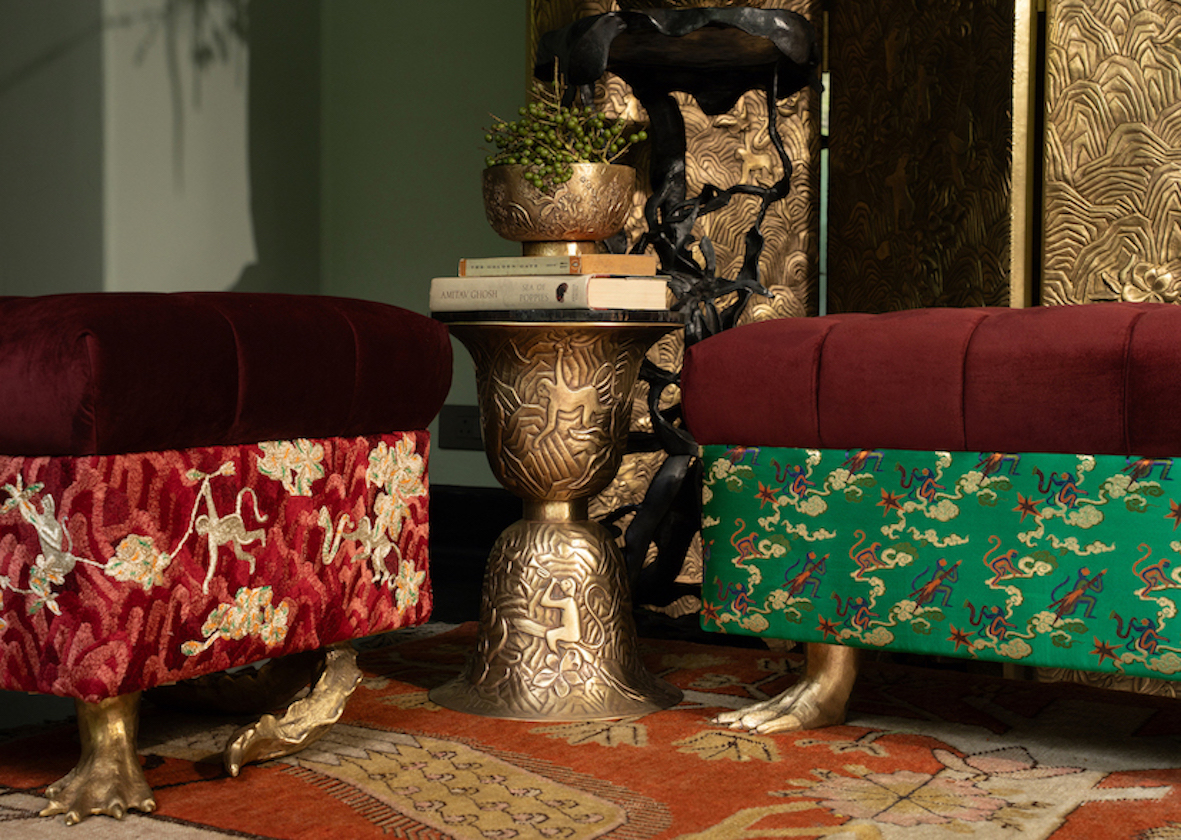
Vana Maitri Screen & Side table, Whispers of Madhuvana Bowl, Bagh Pedestal, Makara Ottoman, Vishrama Makara Stool
The inspiration came from the Sundara Kanda of Valmiki’s Ramayana. After Hanuman discovers Sita in Lanka, the returning Vanaras enter Madhuvana, a grove belonging to Sugriva, and celebrate with such enthusiasm that things soon get out of hand. They feast on honey, sing, dance and quarrel, damaging the grove in the process. Goyal was drawn to the sheer exuberance of the episode. Working with his team, he developed an original miniature painting populated by animals, plants and fanciful incidents that would eventually appear across the collection.
In London, the ottoman stood before the folding brass Vana Maitri screen, with pale-green seating arranged nearby. The townhouse’s white fireplace and plasterwork offered a contrast to the elaborate objects. Tall vases held branches with orange lantern-like pods and red berries. The brass caught the changing light, revealing a monkey here, a bird or a branch there. It was an inviting arrangement, with plenty to examine without the formality of a conventional gallery display.
Also read: Subodh Gupta interview: ‘Even the most ordinary objects can carry extraordinary human histories’
Goyal sees Wings and Tales as an extension of The Soul Garden, his installation at Design Miami Paris in 2025, inspired by the animal characters of the Panchatantra. With the new collection, he wanted “to continue exploring the relationship between nature, craft and spirituality”. “The animals are the characters,” he says. In Indian mythology and literature, they can be loyal, mischievous, brave or foolish, and often behave in ways that are strikingly human. Goyal draws on these associations while allowing himself considerable freedom to invent.
In Vana Maitri, or Friends of the Forest, monkeys and bears gather along a green bank above swirling blue water. There are pink rocks, dense trees and birds overhead. Some creatures carry bows or flags; others hold musical instruments. Fish, turtles and Makara populate the water, while tiny riders cross the sky on rockets. The rockets are particularly amusing, an unexpected intrusion into a world inspired by an ancient epic. The painting is full of small incidents, allowing the viewer to move from one scene to another without following a fixed narrative.
Showcased ahead of Diwali, the exhibition also drew attention to the animal protagonists of the Ramayana, whose roles extend well beyond the decorative. The Vanaras help Rama build the bridge to Lanka, while Jatayu, the vulture who tries to rescue Sita from Ravana, represents extraordinary courage and loyalty. Goyal is interested in these qualities, but his interpretation is playful rather than reverential. A creature may carry a weapon in one part of the composition and appear to be enjoying a celebration in another.
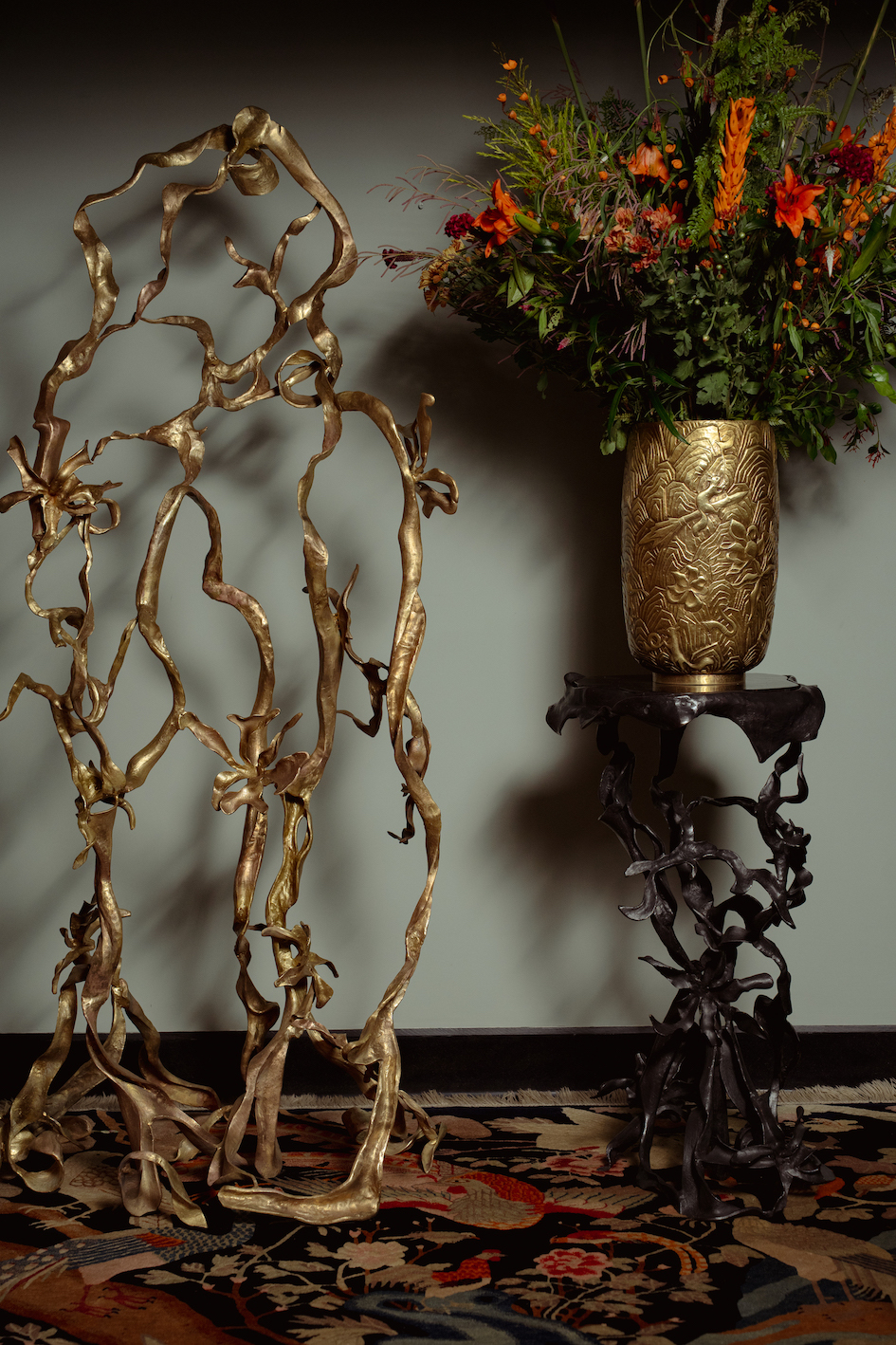
Bagh Screen & Pedestal, Vana Maitri Vase
The Vana Maitri screen gave this imagined world its most expansive expression. Approximately nine feet across and six and a half feet high, it translated the intimate details of a painted narrative into a large sculptural object. Monkeys emerged from densely worked foliage, their curved tails, raised arms and instruments visible against the patterned brass. From different angles, figures appeared and disappeared as the light shifted across the folding panels. The pleasure lay as much in the individual details as in the scale of the work.
Goyal also brought pieces from Bagh, his garden-inspired collection that had featured in his presentation with Nilufar at PAD London in October 2025. That series included tables, mirrors and a ceiling light shaped around the forms of vines, leaves and flowers. The collection showcases Goyal’s longstanding interest in Mughal-era gardens. He takes the organic, branching forms found in gardens and translate them into metal, lending them a sense of permanence. For Wings and Tales, a Bagh screen that captures the geometry and flowing growth patterns of those gardens, foyer table, small pedestal and mirror became part of the forest setting. Irregular ribbons of brass rose and twisted into stems and foliage, their open forms allowing glimpses of the townhouse walls beyond. The pieces had been conceived for another collection, but they belonged comfortably among the creatures of Madhuvana.
The seating was among the exhibition’s most playful elements. The Makara ottomans and Vishrama Makara stools combined rich brocades and velvet with brass legs modelled on animal forms. One ochre piece carried orange patterns along its sides, while another paired burgundy velvet with red fabric woven with pale monkeys and flowers. Beneath the upholstery, claws and animal feet projected towards the floor. These were practical objects, although their unusual appearance invited a closer look before anyone settled down on them.
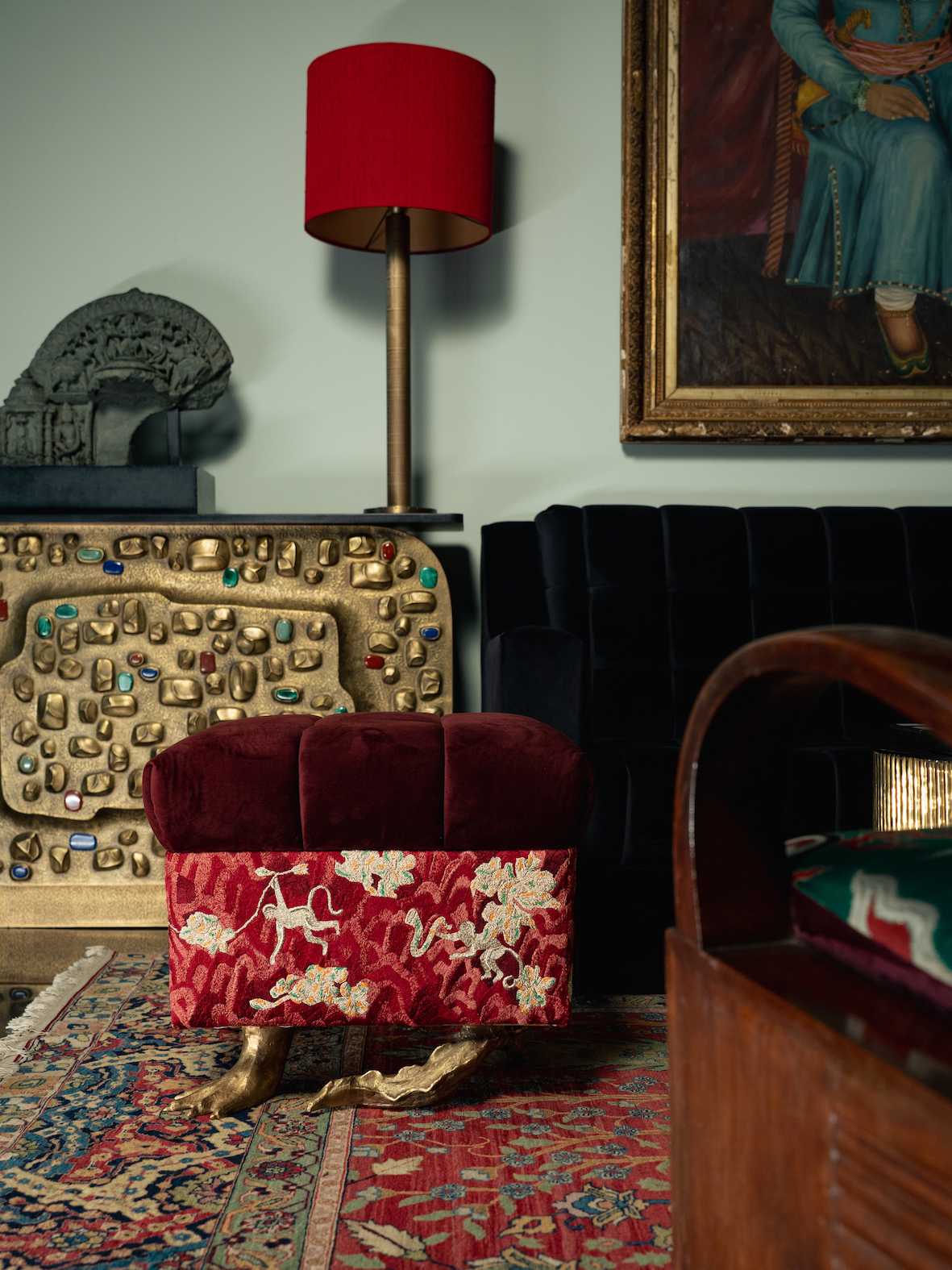
Vishrama Makara Stool
Colour gave the collection much of its character. Saturated greens, reds and ochres appeared alongside patinated brass, while tufted velvet provided broad surfaces of colour against the tiny repeating figures in the brocades. Monkeys, rockets and musical instruments were woven into patterns that looked abstract from a distance but became recognisable up close.
For the brocades, Goyal worked with weavers in Banaras, providing drawings that the craftspeople translated into fabric. It was not a straightforward process. The weavers had to determine how much detail the loom could accommodate and how individual figures would align with the patterns. “We learned from them,” he says, acknowledging the role their judgement played in the finished designs.
The repoussé screens were also handcrafted in Varanasi. The technique involves hammering sheets of metal from the reverse to raise figures and patterns on the surface. It is painstaking work, particularly when the imagery includes small animals, foliage and narrative scenes. Goyal’s studio has worked extensively with repoussé, using it for both sculptural furniture and large decorative pieces. The finished screens appear almost like paintings in relief, although every detail depends on the careful handling of metal.
The workshop also uses pietra dura, the inlay of cut stones, and hollowed joinery, in which hammered brass sheets are welded into hollow structures. These techniques allow the studio to create substantial sculptural forms without relying on solid metal. But Wings and Tales also brought experiments with upholstery, mother-of-pearl marquetry and hand-knotted rugs. Made entirely from recycled sari silk, the rugs depicted imagined realms of land, sea and air, with mounds, waves and clouds inhabited by fantastical creatures.
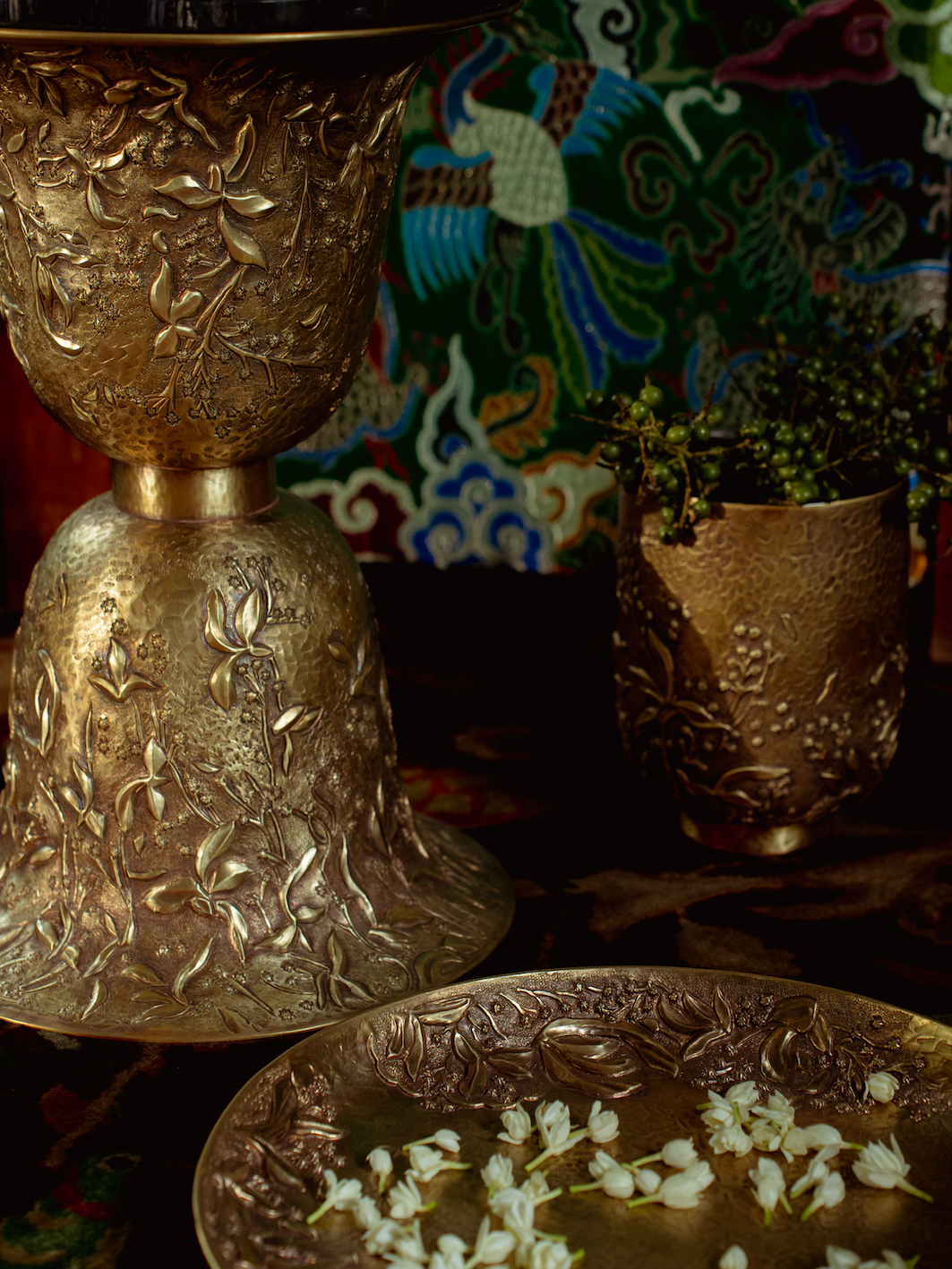 Whispers of Madhuvana Side table, Ice bucket and Thali
“I’m not using nature by itself, in the figurative or physical way,” Goyal says when I ask about his relationship with the natural world. He is interested in how human beings coexist with other forms of life, how we depend on them and what we might learn from them. These concerns, he says, occupy both his conscious and subconscious thinking. The wish to create a place where people could gather also came from his response to a natural world in upheaval. For him, the baithak offered an opportunity for conversation and reflection, with everyone meeting on “equal footing”.
Goyal’s route into design was hardly conventional. After studying engineering and economics, he worked in finance in the US and Hong Kong before returning to India in 2000 and co-founding Kama Ayurveda. Over the following two decades, he developed a design practice around traditional Indian crafts, particularly metalwork. His furniture frequently resembles sculpture, with tables taking the form of tangled branches, screens carrying landscapes and objects borrowing the shapes of animals and plants.
For the London exhibition, his references extended beyond Indian mythology to Ottoman miniature painting, Chinese embroidery and porcelain. He wanted these different artistic traditions to coexist in a domestic setting. In his exhibition statement, he questions what he sees as a growing uniformity in contemporary design, particularly interiors that leave little room for storytelling or personal expression.
Does he imagine a particular buyer when he begins? “I never think commercially,” he says. He asks what would have “relevance to me”, what would “make sense to me”. He wants to “create things which have not been done before”. His work may circulate through international galleries and design fairs, but he says curiosity remains his starting point.
He makes a distinction between the studio and Viya, his lifestyle brand. The studio produces elaborate, labour-intensive pieces that can take months to complete, while Viya offers home décor, apparel and gifts intended for a larger audience. Its products are simpler and more accessible in price, allowing him to work with different materials and reach people who may not be looking for collectible furniture.
Goyal is encouraged by the growing number of independent design studios in India, but when asked what young designers need most, he turns to the importance of travelling. He believes they should see what is being made elsewhere, visit exhibitions and encounter different cultures to develop their understanding of design. His own career, which has taken him through different countries and professions before finding its expression in Indian craftsmanship, helps explain that conviction.
Back in the Mayfair townhouse, the monkeys on rockets, curling brass branches and patterned brocades offered a glimpse of where that curiosity had taken him. What began with a scene of Vanaras celebrating in an ancient epic had become a room filled with creatures, stories and unexpected inventions. For all its elaborate craftsmanship, Wings and Tales was designed around a rather simple pleasure: sitting with other people, enjoying their company and discovering something new in the things around you.
More from Arts



Comments
*Comments will be moderated